
If you send USDT without enough TRON Energy, the network can burn available TRX to cover the Energy shortfall, provided the transaction’s fee limit allows it. If available resources or the fee limit cannot cover execution, the transfer fails: the USDT transfer does not complete, but an on-chain failed attempt can still consume resources and burn TRX.
- Send USDT without enough TRON Energy: available TRX can cover the shortfall, within the transaction’s fee limit.
- TRON can charge resources for failed execution even though the USDT transfer does not complete.
- Check the confirmed transaction result before retrying; a wallet warning is not an on-chain failure.
- Nbtrx provides Telegram business operations tools; verify USDT payment outcomes on-chain before updating customer operations.
Why this matters
Not enough Energy does not automatically mean the transfer will fail. Your available Energy, spendable TRX, and transaction fee limit determine whether execution has enough resources. A wallet warning alone does not establish the final outcome.
For a 2026 payment workflow, separate payment submission from payment confirmation. Nbtrx provides Telegram business operations tools; a Telegram message or customer operations update is not proof that a blockchain transfer succeeded. Keep the transaction ID with the payment record and verify the result before marking the obligation paid.
If execution has already started, read the related explanation of running out of TRON Energy mid-transaction.
What happens if you send USDT without enough energy?
A TRON-based USDT transfer calls a smart contract. That execution uses Energy, while the transaction also uses Bandwidth. When available Energy does not cover execution, TRX can fund the shortfall through the network’s resource-charging mechanism.
The outcome depends on where the process stops:
| Situation | What happens to the transfer | What to check next |
|---|---|---|
| Energy is insufficient, but spendable TRX and the fee limit cover execution | The transfer can succeed, with TRX burned for the uncovered Energy | Confirm success and inspect resource usage |
| Execution exhausts permitted resources | The transaction fails and its contract changes are reverted | Inspect the failure result and resource charges |
| The wallet blocks submission during its checks | No transfer has been broadcast through that attempt | Correct the warning before signing again |
| The transaction is submitted but not yet confirmed | The final outcome is not established | Track the transaction ID rather than immediately resending |
A failed transfer and an unsubmitted transfer are different events. An unsubmitted attempt does not execute on-chain. An included transaction that fails during execution can still incur resource charges.
Use this sequence to establish what actually happened:
- Find the transaction ID. Copy it from the sending wallet or payment system rather than relying on a notification.
- Check the final result. Distinguish confirmed success, confirmed failure, and an unresolved submission.
- Inspect the token transfer. Verify the token contract, destination address, and amount against your intended payment.
- Review resource usage. Check Energy consumption, Bandwidth usage, and any TRX charged.
- Decide whether to retry. Retry only after you establish that the original payment did not complete.
If TRX covers the Energy shortfall
A wallet does not need enough preallocated Energy for every successful USDT transfer. Available TRX can cover uncovered execution, subject to the transaction’s fee limit and the network’s rules.
The benefit is straightforward: the transfer can complete without arranging additional Energy first. The drawback is equally concrete: your TRX balance decreases, and the amount depends on the resources charged to that transaction.
Best for an immediate transfer: using available TRX is an option when you accept the wallet’s current estimate and understand the fee limit. Check the estimate before signing rather than assuming your USDT balance can pay for execution.
USDT and TRX serve different roles here. Holding enough USDT to cover the payment does not establish that your wallet has the resources needed to send it.
If the transaction fails during execution
When execution fails because permitted resources are exhausted, the intended USDT transfer does not complete. Contract state changes from that failed execution are reverted, but the network does not treat the attempt as if no work occurred.
That distinction explains a common balance mismatch: your USDT remains untransferred while your TRX balance is lower. Check the transaction’s recorded result and resource charges before attributing the difference to a missing token payment.
Do not repeat an unchanged transaction after a resource failure. First correct the resource shortfall or the restrictive fee limit, then obtain a fresh estimate. Repeating the same conditions exposes another attempt to the same problem.
Also read the actual error. Not every failed USDT transfer is an Energy problem; a smart-contract rejection requires a different correction from resource exhaustion.
If the wallet refuses to submit
A wallet can stop you before broadcasting when its checks identify insufficient resources or another problem. In that situation, there is no on-chain execution from that unsubmitted attempt.
The advantage is that you can correct the issue before execution consumes resources. The limitation is that the wallet’s message is a preliminary assessment, not a confirmed blockchain receipt.
Check whether the wallet produced a transaction ID and whether that transaction appears on-chain. If the submission status is unclear, investigate it before creating another payment. An interface error does not, by itself, prove that broadcasting failed.
For your 2026 operating procedure, record the distinction explicitly: blocked before submission, submitted awaiting confirmation, confirmed failed, or confirmed successful. Those states require different actions.
Why the outcome varies
The USDT amount alone does not determine whether execution succeeds. Check these factors before treating an Energy warning as a simple balance problem:
- Available Energy: inspect the sending address’s current resources, including delegated Energy, rather than a previous balance.
- Spendable TRX: TRX committed to staking is not the same as a spendable balance available for resource charges.
- Transaction fee limit: a low limit can restrict execution even when the account holds additional TRX.
- Contract execution: the transfer’s actual execution determines its Energy consumption; do not assume every recipient produces an identical requirement.
- Bandwidth coverage: Energy does not replace Bandwidth, so check both resource categories.
- Other transactions: activity from the same address can change resources and balances between your estimate and submission.
For planning, use a current estimate for the actual transfer rather than a remembered allowance. The guide to calculating how much TRON Energy you need explains the preparation step separately from failure diagnosis.
How do you fix the problem before retrying?
Fix the cause shown in the transaction result, not just the wording of the wallet notification. Your next action should address the specific constraint: resources, fee limit, or a different execution error.
Confirm the outcome
Match the transaction ID to the sending address, intended recipient, token, and amount. If the original transaction succeeded, stop: another transfer creates another payment rather than repairing the first one.
If the result remains unresolved, continue tracking it. Do not use a recipient’s delayed acknowledgment as proof of failure, especially when the destination belongs to a custodial service with its own crediting process.
Restore resource coverage
You can obtain additional available Energy or maintain enough spendable TRX to cover uncovered execution. If you use delegated Energy, verify that it has reached the address that will actually sign and send the transfer.
Best for a resource-prepared transfer: confirm the sending address’s Energy before submission. The benefit is resource readiness; the drawback is that arranging Energy introduces another step, and delivery to the wrong address does not help the sender.
Never share a seed phrase or private key to receive delegated resources. Resource preparation does not require handing another party control of the wallet.
Review the fee limit
The fee limit constrains what a smart-contract transaction permits for execution. Raising it does not create Energy or add spendable TRX to your account.
Review the wallet’s estimate and the transaction’s limit together. A higher limit is not a promise of success, and it does not resolve a non-resource contract error.
Re-estimate and submit deliberately
Check resources again immediately before signing. Use the intended destination and token contract, because an estimate for a different transaction is not a substitute for the actual payment check.
After submission, save the new transaction ID separately from the failed attempt. Your payment record should show which attempt succeeded, not merely that somebody pressed send again.
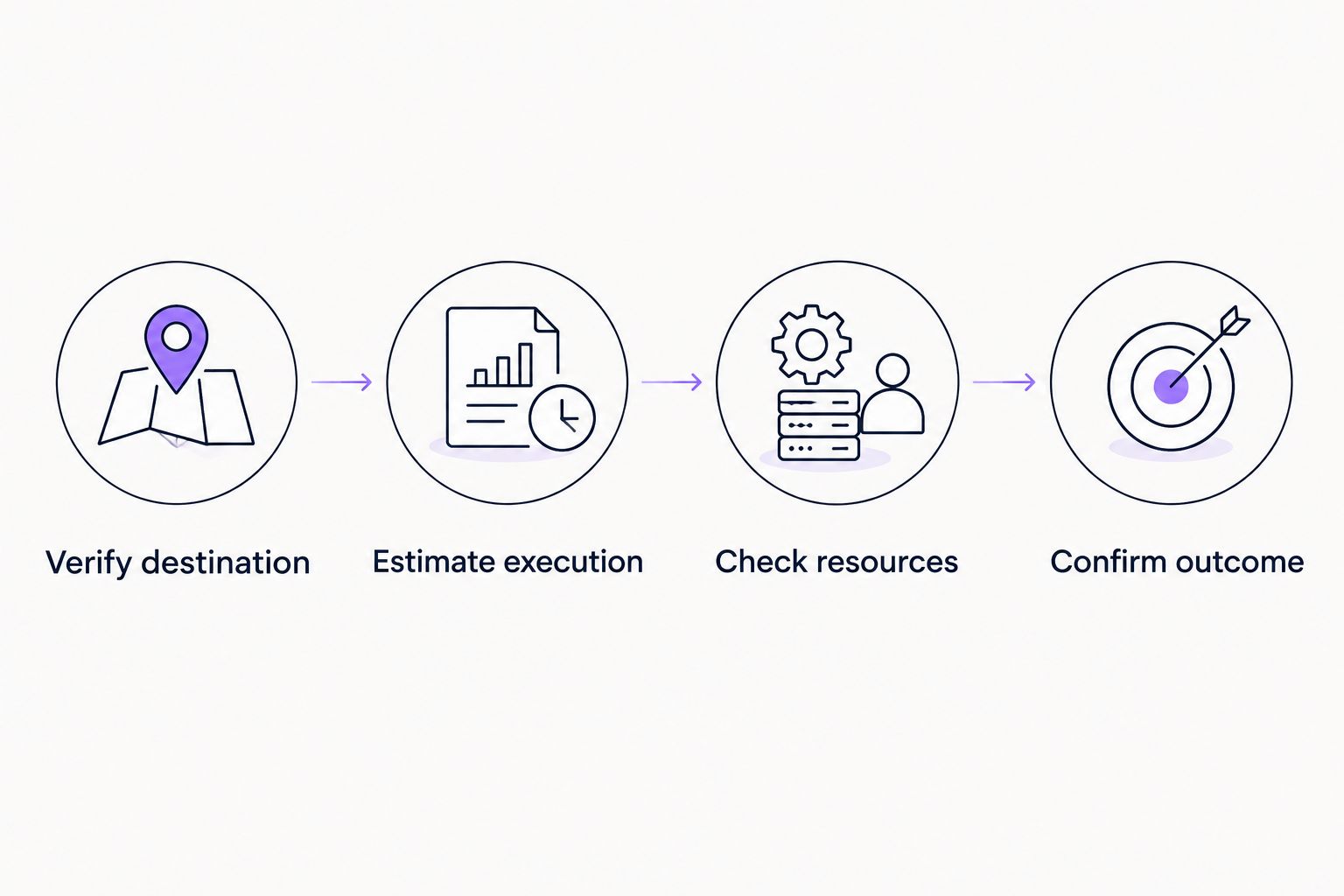
A practical pre-send check for 2026
Use a short sequence that separates the payment instruction from the resources needed to execute it. Apply the same checks whether you send manually or through a business workflow.
- Verify destination: match the recipient address and the intended TRON network.
- Estimate execution: obtain the wallet’s current estimate for the intended USDT transfer.
- Check resources: inspect Energy, Bandwidth, spendable TRX, and the fee limit.
- Confirm outcome: verify the final transaction result after submission.
The sequence matters. Resource readiness does not correct an incorrect destination, and a correct destination does not guarantee sufficient execution resources.
Will you lose your USDT if Energy runs out?
An execution failure does not complete the intended USDT transfer. The failed transaction’s state changes are reverted, while resource charges can still apply.
Check the final result rather than assuming every balance change represents transferred USDT. Also distinguish a failed transaction from a successful payment sent to an incorrect address; the latter is a destination problem, not an Energy failure.
Does adding TRX automatically restart a failed transfer?
Adding TRX does not restart a confirmed failed transaction. After correcting the cause, you must submit a new transaction if you still intend to make the payment.
The new submission receives its own transaction ID. Keep both records so customer operations can distinguish the unsuccessful attempt from the completed payment.
Can you avoid burning TRX by getting Energy first?
Enough available Energy can cover the Energy portion of execution without burning TRX for that portion. Bandwidth and any other applicable transaction requirements remain separate.
Confirm the resources on the sending address before you sign. A provider’s delivery notification is not a substitute for checking the address’s actual resource balance.
FAQ
Can I send USDT without enough TRON Energy in 2026?
You can send USDT without enough TRON Energy if available TRX covers the uncovered execution and the transaction’s fee limit permits it. Otherwise, the wallet can block submission or the transaction can fail during execution.
Does a failed USDT transfer still use TRX?
A failed on-chain USDT transfer can still burn TRX for resources consumed during execution. A wallet attempt that never broadcasts does not execute on-chain.
Can my USDT balance pay for missing Energy?
Your USDT balance does not directly cover TRON Energy charges. The network uses available Energy and, when required, burns spendable TRX for uncovered execution.
Is enough TRX a guarantee that my USDT transfer succeeds?
Enough TRX does not guarantee success. The fee limit can restrict execution, and errors unrelated to resources can also prevent the transfer.
Should I resend USDT when my wallet shows an error?
Check the original transaction’s final result before resending USDT. A wallet error does not by itself establish that the transaction was never broadcast or that payment failed.
Does delegated Energy need to reach the sending wallet?
Delegated Energy must be available to the address executing the transfer. Resources assigned to a different address do not cover the intended sender’s execution.
What should a business record after a failed USDT payment?
Record the transaction ID, final result, intended recipient, amount, and resource charges. Keep any replacement transaction separate so the payment record identifies the successful attempt.
One last thing
Energy preparation and payment confirmation are separate controls. Even a fully prepared wallet still needs a verified destination and a confirmed transaction result.
For your 2026 payment checklist, make the final step “confirm outcome,” not “send.” That distinction prevents an attempted payment from becoming a completed-payment record before the blockchain result supports it.