
Yes—paying for TRON Energy with a different cryptocurrency is possible when the rental provider explicitly accepts that asset on the network you use. The payment transaction has its own network requirements, and successful payment does not prove that Energy has reached your receiving wallet. Confirm the payment asset, payment network, and Energy recipient before sending funds.
- TRON Energy rental supports alternative cryptocurrency payments only when the provider explicitly accepts the asset and network.
- To rent TRON Energy paying in different cryptocurrency, verify payment instructions before transferring funds.
- USDT payment and TRON Energy delivery are separate events; check both records.
- Rented Energy does not replace every network resource needed for a TRON transaction.
Why this matters
A rental payment and a resource allocation solve different problems. The payment settles your order; the allocation gives the specified TRON address access to Energy for smart-contract execution.
Confusing those events creates an operational mistake: sending the intended token transfer before the wallet has the resources it needs. Start with how TRON Energy rental works, then check the provider's current payment instructions.
For a 2026 rental order, treat accepted assets as checkout-specific information. A cryptocurrency mentioned in a guide is not permission to send it to an unrelated deposit address.
Can TRON Energy be rented while paying in a different cryptocurrency?
Yes, provided the rental service accepts your chosen cryptocurrency and can associate the payment with your order. TRON does not require a commercial rental provider to collect customer payments exclusively in TRX. The provider's payment process determines what you can use.
That does not change how TRON accounts for resources. Paying an invoice with another cryptocurrency does not make that cryptocurrency the native asset used by the TRON protocol for transaction charges.
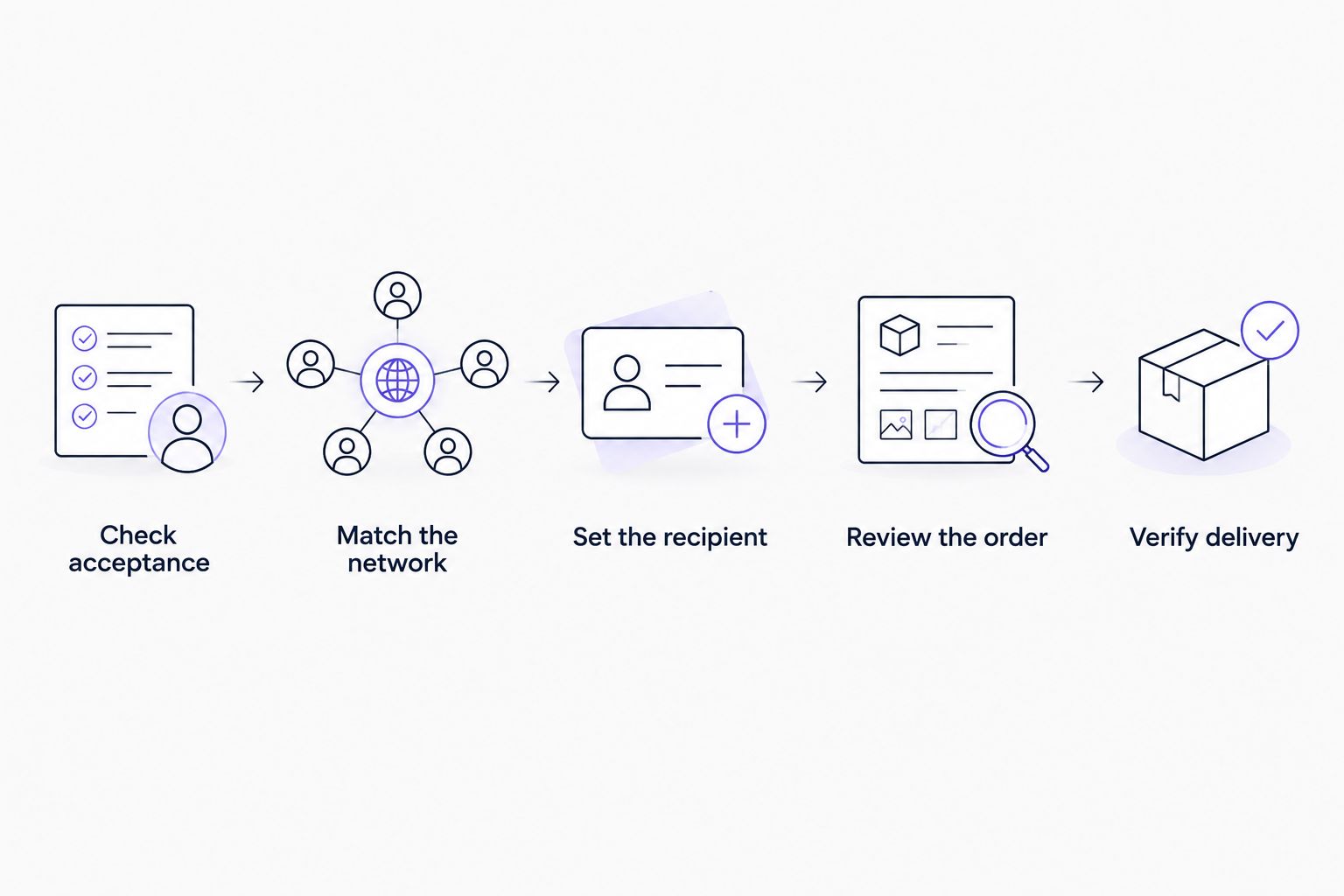
Follow this sequence before paying:
- Check acceptance. Find an explicit payment option for the asset you hold. Do not infer acceptance from a logo, article, or support-channel discussion.
- Match the network. Confirm the blockchain named in the payment instructions, not just the token ticker.
- Set the recipient. Enter the TRON address that needs Energy. Do not assume it is automatically the wallet funding the purchase.
- Review the order. Check the requested resources, rental period, payment instructions, and delivery conditions.
- Verify delivery. Inspect the recipient's resources before submitting the transaction that needs Energy.
The accepted payment asset and the Energy recipient are separate order details. Keep both in your records so a payment question does not become a wallet-identification problem.
Direct cryptocurrency payment versus conversion first
There are distinct ways to fund a rental when your wallet does not hold the provider's preferred payment asset. Neither route is universally better. Choose according to explicit acceptance, the transfers required, and your ability to reconcile the order.
| Payment route | Best for | Practical advantage | Limitation |
|---|---|---|---|
| Pay directly with an accepted cryptocurrency | Buyers whose existing asset and network match checkout | Avoids a separate conversion step | Works only for the provider's supported payment route |
| Convert into an accepted payment asset first | Buyers whose current asset is unsupported | Aligns the payment with the provider's instructions | Adds a conversion step and its own transaction requirements |
| Use a separate payment wallet | Teams separating treasury payments from operating wallets | Keeps funding separate from the Energy recipient | Requires explicit recipient support and accurate order records |
Use direct payment when the exact asset-network pair is accepted. Conversion is a fallback, not proof that the original cryptocurrency was supported.
For a 2026 comparison, examine the complete workflow rather than the token name alone. An accepted asset is useful only if you can send it through the specified network and connect that payment to the correct order.
Direct payment: best for an exact checkout match
Direct payment is the simplest route when the provider's instructions match the cryptocurrency and network you already use. You avoid arranging a separate exchange solely to fund the rental.
The limitation is strict compatibility. A provider accepting a token on one network has not necessarily agreed to accept the same ticker on another network. Follow the stated route exactly.
Conversion first: best for unsupported holdings
Convert first when the provider does not accept your existing asset but you still want to use that rental service. Review the conversion and withdrawal requirements separately from the rental order.
This route adds dependencies. A completed conversion does not mean the rental has been funded, and a withdrawal request does not mean the provider has credited the payment. Wait for each required step to complete.
Separate payment wallet: best for treasury separation
A separate payment wallet fits an operation where treasury funds the order and another TRON wallet performs the contract transaction. Confirm that the provider lets you specify the Energy recipient independently.
The drawback is reconciliation. Your records must connect the funding transaction, rental order, and recipient address. Without that connection, support staff cannot reliably distinguish a delivery issue from an incorrect recipient entry.
Can you pay with USDT instead of TRX?
Yes, if the rental provider explicitly accepts USDT on the network you intend to use. USDT acceptance is a payment-policy question, not a universal feature of TRON Energy rental. Check the invoice or checkout before transferring tokens.
USDT exists on multiple blockchains. The ticker alone does not identify the correct payment route. The destination address and network instructions must belong to the same supported payment method.
There is also a funding dependency to check. Sending USDT on TRON invokes a smart contract and uses Energy; the transaction also uses Bandwidth. If you are buying Energy because your payment wallet lacks resources, inspect how you will fund that initial payment before starting.
Do not assume the purchase will retrospectively cover the transaction used to pay for it. The payment wallet must satisfy its own transaction requirements when it sends the payment.
Can you pay from another blockchain?
Yes, if the rental provider offers an explicit payment method on that blockchain. A payment elsewhere and resource delivery on TRON can be separate parts of the provider's order process.
That arrangement does not mean Energy moves between blockchains. The provider receives the accepted payment and arranges resources for the specified TRON address. Payment acceptance remains a commercial service condition.
For cross-chain funding in 2026, distinguish a supported payment route from a transfer you devised yourself. Sending funds through a bridge or exchange does not create an accepted payment method unless the resulting transfer matches the provider's instructions.
Keep the payment transaction reference and the TRON recipient together. If delivery needs investigation, those records identify what was paid and which address should receive resources.
Why alternative cryptocurrency payment workflows vary
The main differences concern payment recognition, resource delivery, and wallet readiness. Check these factors against the current order rather than assuming another provider works the same way:
- Accepted asset. The provider must explicitly support the cryptocurrency you want to spend.
- Accepted network. The supported blockchain matters independently of the asset's ticker.
- Payment recognition. Check how the provider associates an incoming transfer with your order and when it treats payment as complete.
- Recipient selection. Establish whether the funding wallet and Energy recipient can be different addresses.
- Resource requirements. Match the requested Energy to the intended contract interaction; do not treat a token name as a resource estimate.
- Delivery and rental terms. Check when resources should arrive, how long access lasts, and what process applies if delivery fails.
Do not choose a payment route solely because you already hold the cryptocurrency. Choose a route you can verify from payment through resource delivery.
How do you confirm the rental worked?
Confirm the recipient's resources, not just the outgoing payment. A successful payment transaction shows that a transfer occurred; it does not independently establish that the rental provider delivered the ordered Energy.
Use separate checks for separate events:
- Payment record: Does the transaction show the intended asset, network, and destination?
- Order record: Does the rental order identify the correct TRON recipient and requested resources?
- Resource record: Does the recipient show the expected resource allocation or delegation?
- Transaction readiness: Does the wallet have the resources required for the intended contract interaction?
A provider dashboard is useful for order tracking, but the recipient's on-chain resource information is the relevant delivery check. Resource availability can change as transactions consume it, so inspect the wallet near execution rather than relying on an earlier screenshot.
For an operational checklist in 2026, define completion as verified resources at the intended address. Do not define it merely as funds leaving the payment wallet.
What should a business record before approving payment?
Record the accepted asset and network, payment destination, Energy recipient, order reference, and delivery conditions. Keep the payment transaction reference with those details after submission.
This is especially useful when different people authorize funding and execute token transfers. The person releasing payment needs evidence that the instructions are valid; the person operating the TRON wallet needs evidence that resources arrived.
For teams using Nbtrx for Telegram business operations, keep rental payment approval separate from member operations and customer operations. A message saying an order is paid should not substitute for a resource check.
Build that distinction into your 2026 workflow. Payment approval authorizes spending; resource verification authorizes the next blockchain transaction. Neither status should silently stand in for the other.
FAQ
Can I rent TRON Energy using cryptocurrency other than TRX?
Yes, when the rental provider explicitly accepts that cryptocurrency on your chosen network. Confirm the payment instructions and TRON recipient before transferring funds.
Can I pay for TRON Energy rental with USDT?
Yes, if the provider offers USDT as an accepted payment method on the network you use. USDT acceptance on one blockchain does not establish acceptance on another.
Does paying with another cryptocurrency remove every TRON transaction fee?
No, paying the rental invoice with another cryptocurrency does not remove every TRON resource requirement. Check both Energy and Bandwidth before submitting the intended transaction.
Can I pay from one wallet and send Energy to another?
Yes, if the rental service supports a separately specified TRON recipient. Verify that recipient in the order rather than assuming resources follow the payment wallet.
Does a confirmed crypto payment mean my rented Energy has arrived?
No, a confirmed payment does not independently prove Energy delivery. Check the intended TRON address for the expected resource allocation before using it.
Do I need to stake TRX myself to use rented Energy?
No, receiving delegated resources does not require you to stake your own TRX first. You still need to check the rental conditions and the recipient's resources before execution.
What happens if I send payment on the wrong network?
A wrong-network transfer does not satisfy payment instructions that specify a different network. Contact the provider with the transaction reference; do not assume the payment will be credited or recovered.
One last thing
Check the payment wallet before checking the rental recipient. When you fund a rental with a TRON token transfer, that payment itself needs resources. A workflow intended to solve an Energy shortage can stall at its first transaction if you overlook the funding wallet.
Then check the recipient again before execution. The useful endpoint is not a paid invoice; it is a wallet ready for the specific contract interaction you intend to submit.