You need the energy estimated for your exact USDT transfer on TRON, not a fixed allowance copied from another transaction. In 2026, the dependable method is to simulate the transfer with the actual sender, recipient, token contract, and amount before submitting it. Energy covers contract execution; bandwidth and any TRX burned for uncovered resources are separate considerations.
- For how much TRON energy for USDT transfer, use an estimate for the exact transaction—not a universal allowance.
- TRON energy and bandwidth are separate resources; covering contract execution does not cover every transaction resource.
- USDT recipient state and TRON’s dynamic energy model can change the execution requirement.
- Check usable energy on the sending address before signing, then inspect the confirmed transaction receipt.
How much TRON energy do you need for a USDT transfer?
The energy you need is the current execution estimate for the specific USDT transfer you intend to send. A previous transfer gives you a reference, not a guaranteed requirement for the next recipient.
Use this sequence before you fund a transfer or compare TRON energy rental services for USDT transfers:
- Identify the transfer. Confirm that you are sending USDT on TRON, rather than USDT on another network.
- Build the transaction. Enter the actual sender, recipient, and amount in your wallet or transaction system.
- Estimate execution. Use the wallet’s simulation or a TRON node’s supported energy-estimation method.
- Check usable resources. Compare the estimate with the energy currently available to the sending address.
- Review the fallback. Check bandwidth, spendable TRX, and the transaction’s fee limit before signing.
Do not treat the USDT amount as an energy calculator. Contract execution depends on what the transfer does to blockchain state, not simply on the monetary size of the payment.
Why this matters
An energy estimate answers a resource question. A wallet’s projected transaction charge answers a different question: what the transfer is expected to consume from your resources and balance.
For your 2026 transfer workflow, keep those questions separate. You need enough execution resources, a suitable transaction limit, and a clear understanding of what happens if existing resources do not cover execution.
That distinction matters when someone offers an energy package. A package size describes what you receive; it does not establish what your particular transfer requires.
Which transfer conditions change the energy requirement?
Two transfers of the same token can follow different contract-execution paths. The recipient’s token balance state is one reason their energy requirements can differ.
| Transfer condition | What to check | Benefit of checking | Limitation |
|---|---|---|---|
| Recipient already holds USDT | Simulate using the actual recipient address | Captures the relevant existing balance state | Another recipient’s receipt is not a substitute |
| Recipient has no USDT balance | Estimate the actual transfer rather than copying a prior allowance | Accounts for the relevant storage update | An active TRON address does not establish its USDT balance |
| Repeated transfers | Refresh estimates and inspect receipts | Shows how your actual workflow consumes resources | Past execution does not fix future requirements |
| Transfer through another contract | Estimate the complete contract interaction | Includes execution beyond a direct token transfer | A direct-transfer estimate does not describe the full operation |
These are transaction conditions, not guaranteed energy tiers. Do not assign a permanent energy allowance to a recipient category without checking the transaction.
Recipient already holds USDT
A recipient with an existing USDT balance presents a different storage condition from a recipient whose balance is zero. Estimate against the recipient you will actually pay.
An old payment record is useful for reconciliation. It is not proof that the next payment will consume the same energy, even when you send from the same wallet.
Recipient has no USDT balance
Do not confuse an address appearing on TRON with that address holding USDT. Native-account activity and token-contract balances describe different things.
For a 2026 payment checklist, record the intended recipient rather than selecting an energy allowance from an address label such as new or established. The transaction simulation is the relevant check.
Transfer uses another contract
A direct USDT transfer and an interaction involving another contract are not interchangeable. Additional contract calls can change the execution involved.
If your transaction routes through a payment contract or another application, estimate that complete interaction. Do not size it using a receipt for a simple wallet-to-wallet transfer.
Why USDT transfer energy varies
The useful drivers are the ones attached to the transaction and the blockchain state it encounters:
- Recipient balance state. Updating an existing token balance and changing a zero balance involve different storage conditions.
- Execution path. A direct token transfer differs from an operation that calls additional contracts.
- Dynamic energy adjustments. TRON’s dynamic energy model applies energy adjustments to affected contracts, so historical usage is not a permanent allowance.
- State at execution. A simulation evaluates state when it runs; the submitted transaction executes against the state available when processed.
Your available energy is a separate variable. It changes how much of the execution your resources cover, not what the contract needs to execute.
Keep that distinction in payment records. A transfer consuming energy and a transfer burning TRX to cover missing energy can perform the same token operation while producing different balance effects for the sender.
How do you estimate energy before sending USDT?
Build first, estimate second, sign last. Estimating a generic transfer before you know the recipient leaves out information the contract will use.
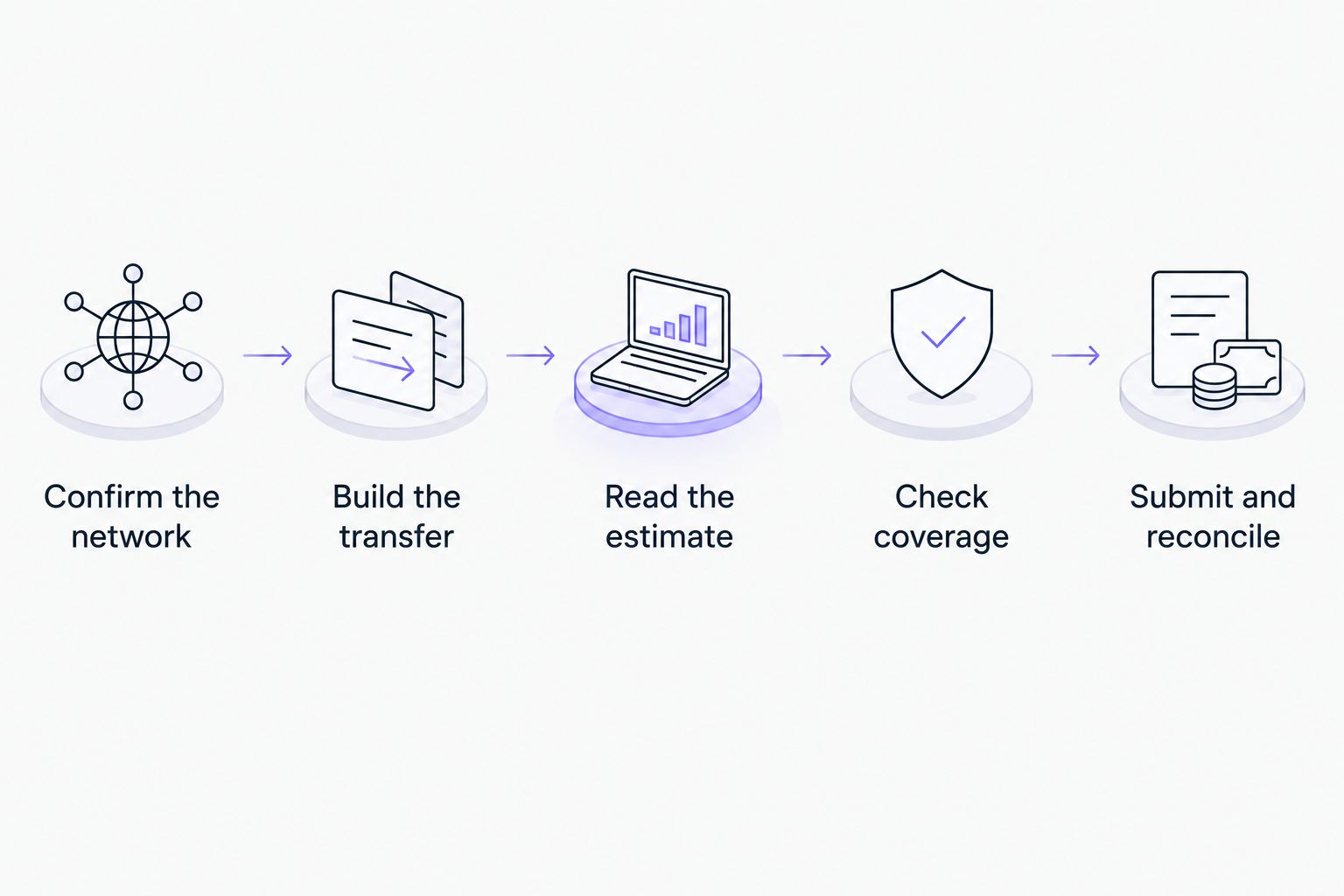
Confirm the network
Check that the withdrawal or transfer network is TRON and that the destination accepts USDT on that network. The token name alone does not identify the blockchain.
If you are withdrawing from an exchange, distinguish the exchange’s withdrawal process from a transaction sent directly by your wallet. The exchange controls its sending infrastructure; your personal wallet’s energy balance does not fund its outgoing transaction.
Build the transfer
Use the actual sending account, recipient, and token amount. Confirm the token contract rather than relying only on a displayed ticker.
For an integration, construct the same contract call that you intend to submit. A simulation of a different call cannot establish the requirement for your payment.
Read the estimate
Look for the energy estimate, not just a projected charge displayed in TRX. A supported TRON energy-estimation endpoint can return an execution requirement; wallet interfaces present this information differently.
If your interface exposes only a transaction charge, do not reverse-engineer an energy allowance without understanding what that charge includes. Use an interface or integration that exposes the required resource information.
Check coverage
Compare estimated energy with usable energy on the sending address. Then check bandwidth and spendable TRX separately.
Resources associated with a different account do not establish that your sending account can use them. Verify the address receiving any delegated resources before relying on them.
Submit and reconcile
After confirmation, inspect the transaction receipt for execution status and resource consumption. Keep the transaction identifier with your payment record.
A broadcast response is not the same as confirmed execution. Close the payment only after checking the blockchain result and the intended token movement.
How should you cover the estimated energy?
Choose a resource method after estimating the transfer. Choosing a package first reverses the decision and leaves you checking whether the transaction fits what you bought.
| Method | Best for | Advantage | Limitation |
|---|---|---|---|
| Energy from staking | Senders choosing an ongoing resource allocation | Provides resources through TRON’s staking system | Requires committing TRX and managing resource allocation |
| Delegated energy | Senders receiving resources from another account | Makes delegated resources usable by the receiving account | You must verify the receiving address and usable allocation |
| TRX burn for uncovered energy | Senders using the protocol’s balance-funded fallback | Covers missing energy when balance and transaction limits permit | Consumes spendable TRX and remains subject to execution limits |
These methods cover resources; they do not change the recipient or token amount. None replaces checking bandwidth, transaction limits, and the final receipt.
For repeated transfers in 2026, compare the operational burden as well as the resource method. Staking requires resource management; delegated energy requires allocation checks; balance-funded execution requires monitoring spendable TRX.
Best for occasional senders: choose the method you can verify before signing. A method you cannot confirm on the sending address is not a dependable part of the payment workflow.
Is energy the same as the transaction fee?
No. Energy measures contract execution, while a transaction’s balance impact depends on resource coverage and applicable network charges.
TRON also uses bandwidth for transaction data. Having enough energy does not prove that every resource requirement is already covered.
The fee limit is another separate control. It limits the energy-related spending permitted for contract execution; it is not a statement of how much energy the transaction needs.
Raising that limit does not create energy. It also does not correct an invalid recipient, an incorrect token contract, or a contract call that fails for another reason.
Can a USDT transfer fail when you hold enough USDT?
Yes. Holding the token amount does not establish that the sender can cover execution or that the contract call will succeed.
Check the transaction status before repeating a payment. A failed contract transaction can still consume resources, so repeated submissions are not a substitute for diagnosis.
Read the failure result, confirm the sender’s resources and limits, and rebuild the intended transaction if necessary. Do not assume every failure means you should acquire more energy.
What should a business record for each transfer?
Separate payment instructions from execution evidence. A customer message saying a transfer was submitted is not the same record as a successful blockchain receipt.
Use a payment record containing:
- The network and token contract used.
- The sending and receiving addresses.
- The intended token amount.
- The preflight energy estimate and resource check.
- The transaction identifier and confirmed execution status.
- The observed token movement and resource consumption.
Keep this process distinct from customer operations. If you use Nbtrx for Telegram business operations, the blockchain receipt remains the evidence for the transfer; an operations message does not replace it.
The practical rule is simple: estimate the payment, verify the resources, then reconcile the receipt. Apply that rule to each transaction rather than promising that a single allowance covers every customer payment.
FAQ
How much TRON energy do I need to transfer USDT?
You need the energy estimated for your exact USDT transfer. Simulate the actual sender, recipient, token contract, and amount, then compare the result with usable energy on the sending address.
Does sending more USDT always require more energy?
No. USDT transfer energy depends on contract execution and blockchain state, not simply on the amount sent. Estimate the actual transaction instead of multiplying an allowance by the payment amount.
Does a recipient with no USDT balance need a separate estimate?
Yes. The recipient’s token balance state affects the contract’s storage operation. Estimate using the actual recipient rather than reusing another address’s result.
Can I send USDT without holding energy?
TRON can burn TRX to cover uncovered execution energy when the sending account has sufficient spendable balance and the transaction limits permit it. Bandwidth and other transaction requirements still need checking.
Does holding USDT give my wallet energy?
No. A USDT balance is a token balance, not an energy allocation. Check the sending account’s usable resources separately.
Can I reuse the energy estimate from my last transfer?
Use the previous estimate as a reference, not a guarantee. Recipient state, execution path, and dynamic energy adjustments can change the requirement.
Does a failed USDT transfer consume resources?
A failed contract transaction can consume resources. Inspect the confirmed result and failure reason before submitting another transfer.
One last thing
Energy sizing and payment confirmation are different jobs. A correct estimate helps prepare a transaction; only the confirmed execution result establishes what happened on-chain.
For your 2026 workflow, make the final checkpoint a receipt review—not a successful broadcast message. That catches the gap between sending a transaction and completing a payment.