
Businesses can get invoices for TRON energy rental purchases when the rental provider offers business invoicing; blockchain payment alone does not generate a supplier invoice. Confirm the issuing entity, required billing details, and document format before you pay. An invoice documents the supplier's charge, while payment and resource-delivery records establish different parts of the purchase.
- Invoices for TRON energy rental purchases depend on the supplier's invoicing policy, not the payment network.
- TRON transaction records document on-chain activity; they do not replace supplier-issued billing documents.
- Confirm the legal supplier, business billing details, and invoice process before authorizing a rental.
- Keep the invoice, payment reference, and resource-delivery evidence together for reconciliation.
Why this matters
Your finance team needs to identify what the business purchased, who supplied it, and how the payment relates to the service. A wallet transaction does not answer every question. Neither does a rental confirmation that omits the supplier's identity.
For your 2026 purchasing process, treat billing documentation as an approval requirement rather than an after-payment request. The TRON energy guide for crypto accounting firms provides related reading for teams organizing these records.
Confirm the invoice process before payment, not during reconciliation. This separates a usable purchasing workflow from a collection of unrelated screenshots.
Can businesses get invoices for TRON energy rental purchases?
Yes, provided the supplier issues them. The decisive question is whether the contracting business can receive an invoice from an identifiable supplier with the billing information its finance team requires. Do not infer that capability from a checkout page, payment address, or transaction confirmation.
Ask the provider for a redacted sample before approving the purchase. Check whether it identifies the supplier, accepts your company's billing details, describes the rental, and provides a reference you can match to the order.
Different documents support different checks:
| Document | Best for | What it supports | Main limitation |
|---|---|---|---|
| Supplier-issued invoice | Recording the supplier's charge | Supplier identity, buyer details, service description, and billing reference | Does not independently prove payment or delivery |
| Payment receipt | Confirming acknowledged payment | The supplier's acknowledgment that payment was received | Does not necessarily contain the information required on an invoice |
| Blockchain transaction record | Checking on-chain payment | Addresses, asset movement, transaction status, and transaction reference | Does not by itself establish the legal supplier or business purpose |
| Rental order confirmation | Matching the requested service | Order details and the intended receiving address | Does not independently prove that resources were delivered |
| Resource-delivery evidence | Checking fulfillment | Resource delegation or other relevant on-chain delivery activity | Does not replace the commercial billing record |
Use these records together. An invoice without a payment reference leaves reconciliation work. A payment reference without supplier documentation leaves a different gap.
What should you ask before paying?
Ask a direct operational question: can the provider issue an invoice to your legal business name for this rental, and how will you receive it?
Then request the details that determine whether your team can use the document:
- The legal name of the invoicing entity.
- The supplier information shown on the invoice.
- The buyer details the provider can include.
- The service description and order reference.
- The process for receiving and correcting the invoice.
- Any jurisdiction-specific billing information your accountant requires.
A positive answer to “Do you provide receipts?” is not enough. Ask specifically about invoices and inspect the proposed format.
Individual invoices and consolidated statements
For an individual purchase, ask whether the provider issues an invoice tied to that specific rental order. The advantage is a direct match between the purchase and its supporting records. The limitation is administrative work when your business makes repeated rentals.
For recurring purchases, ask whether the provider offers consolidated billing documents with an itemized order schedule. Consolidation simplifies document handling only when your team can trace each listed rental to its payment and fulfillment evidence.
Do not assume either format is offered. Choose the documentation structure your finance team can reconcile, then confirm the supplier supports it.
For a 2026 expense file, keep the original document and any corrected version together. A corrected invoice should not silently replace the history of what your team received and approved.
Why invoice availability and usefulness vary
Invoice handling is a supplier process. The TRON network records blockchain activity; it does not determine the supplier's commercial paperwork or your company's accounting requirements.
These factors explain what you need to check:
- Supplier identity: Establish which legal entity sells the rental and issues the document. A service name alone does not resolve that question.
- Billing workflow: Confirm whether you request the invoice before checkout, enter details during checkout, or contact the provider afterward.
- Buyer information: Check whether the document can identify the purchasing business rather than only a username or wallet address.
- Purchase structure: Determine whether the document covers an individual rental or a group of orders, and how those orders are identified.
- Payment routing: If an employee, treasury wallet, or intermediary pays, preserve the connection between the payer and the business purchase.
- Applicable requirements: Have your accountant confirm the document requirements for the relevant entities and jurisdiction. An ordinary invoice is not automatically a compliant tax invoice.
For supplier reviews in 2026, evaluate these factors separately from delivery speed. A provider's ability to deliver resources does not establish its ability to produce acceptable billing documents.
How do you build an invoice-ready rental workflow?
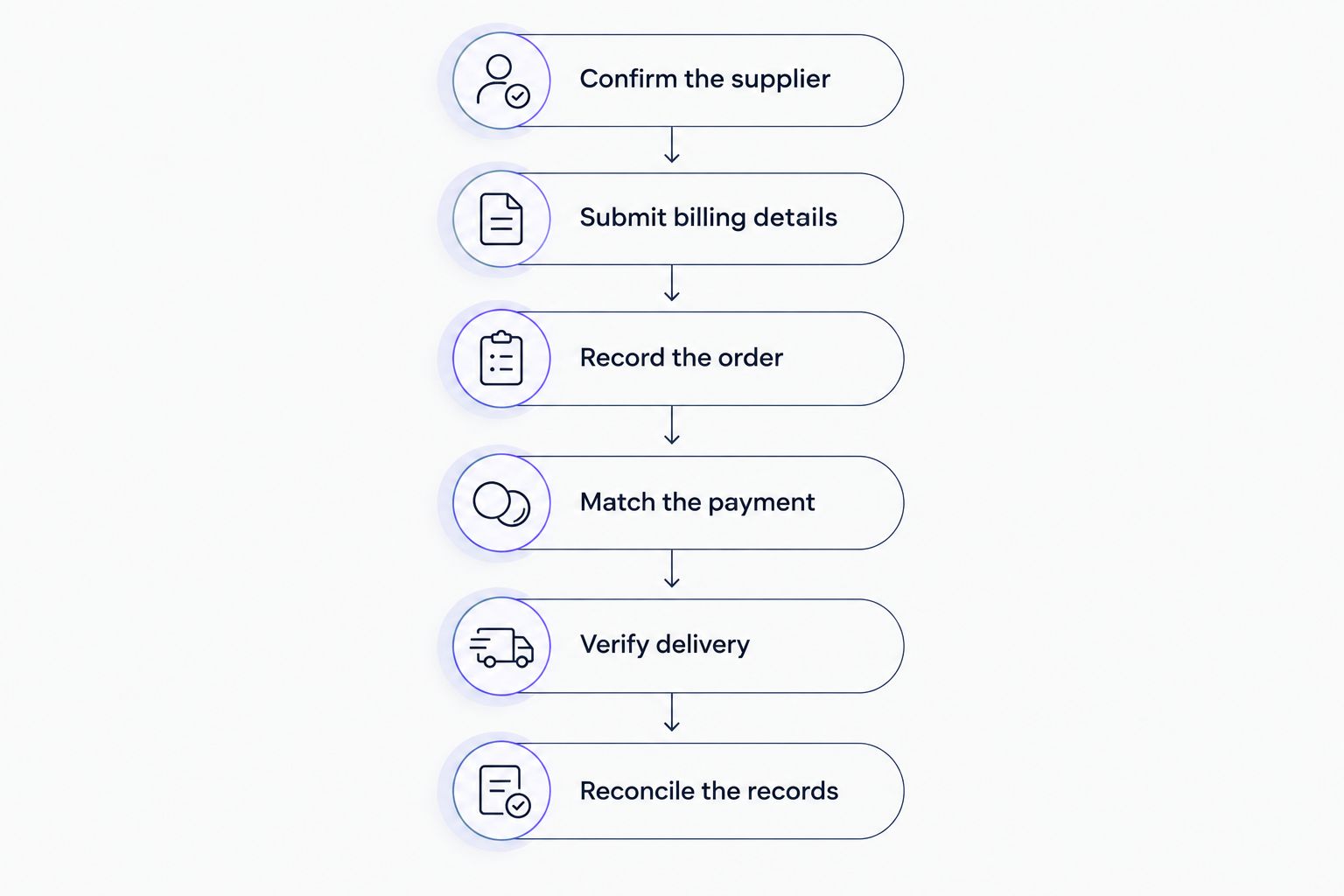
Use a documented sequence that connects approval, purchase, payment, and delivery. Assign an owner to each step so that missing records do not become an unresolved handoff between operations and finance.
1. Confirm the supplier
Identify the entity taking responsibility for the rental. Compare that identity with the proposed invoice issuer and ask the provider to explain any difference.
Do not treat a wallet address as a substitute for supplier identification. The address helps trace blockchain activity; the commercial record identifies the counterparty.
2. Submit billing details
Provide the legal business name and the billing information your finance team requires through an appropriate business channel. Ask the supplier to confirm the details before issuing the document.
Avoid adding unrelated personal information to the request. Supply what the invoicing process requires, and keep sensitive information out of public support conversations.
3. Record the order
Save the order reference, requested rental details, intended receiving address, and approval record. Describe the business purpose in language a reviewer can understand without reconstructing a chat history.
The paying wallet and receiving wallet serve different roles. Record both when they differ rather than assuming the payment transaction identifies the resource recipient.
4. Match the payment
Save the payment transaction reference and identify the order it settles. If the supplier provides a receipt, retain it alongside the on-chain evidence rather than choosing one record and discarding the other.
Check the actual transaction details. A copied reference is useful only when it points to the payment associated with your purchase.
5. Verify delivery
Confirm that the relevant resource-delivery activity matches the intended receiving address and rental order. Payment confirmation and fulfillment confirmation are separate checks.
Use the guide to verifying a TRON energy rental transaction on-chain for related verification steps. Keep the resulting evidence with the commercial documents.
6. Reconcile the records
Match the invoice to the order, payment, and delivery evidence. Resolve discrepancies before marking the purchase complete in your internal workflow.
For your 2026 reconciliation checklist, make the final status explicit: complete, awaiting invoice, awaiting correction, or awaiting delivery evidence. A payment marked successful does not resolve every documentation requirement.
What should you check on the invoice?
Check the document against your company's requirements before filing it as complete. The following is a purchasing checklist, not a universal statement of legal invoice requirements.
- Supplier information: Does the document identify the entity you contracted with?
- Buyer information: Does it identify the correct business rather than an employee or chat account?
- Document reference: Can your team distinguish this invoice from other purchases?
- Issue and service dates: Can a reviewer identify when the document was issued and what service period it concerns?
- Service description: Does it describe the rental clearly enough to match the order?
- Billing currency and totals: Can finance interpret the document without guessing what unit it uses?
- Order linkage: Does the reference connect to the payment and delivery records you retained?
- Required tax information: Has your accountant confirmed what applies to this transaction?
An invoice can be readable but still fail your internal approval rules. Address the specific defect with the supplier instead of assuming the blockchain record fills it.
Is a TRON transaction hash enough for accounting?
A TRON transaction hash is not a supplier invoice. It points to a blockchain transaction, which helps establish on-chain activity but does not independently explain the full business arrangement.
Your accountant determines which supporting records are appropriate for the transaction. Keep the hash with the invoice, order, and business-purpose record so the evidence answers complementary questions.
Can the paying wallet differ from the receiving wallet?
A different paying wallet does not remove the need to identify the purchasing business. Record who authorized the payment, which order it settled, and which address was intended to receive the rented resources.
Ask the provider whether its documentation can preserve that distinction. Do not assume the invoice must name the owner of whichever wallet sent the funds.
Does an invoice prove the rental is tax-deductible?
An invoice alone does not establish tax deductibility. Tax treatment depends on the relevant rules and the circumstances of the business transaction.
For 2026 reporting, give your accountant the complete record rather than only the invoice. Do not treat a supplier's billing description as a tax determination.
What if the provider cannot issue an invoice?
If your purchasing policy requires an invoice, do not approve a supplier that cannot provide one. That is an internal control decision, separate from whether the rental itself functions.
If payment has already occurred, ask the supplier for the documentation it can provide and preserve the original correspondence. Record the missing invoice as an exception for finance to assess; do not relabel a screenshot or transaction record as a supplier-issued document.
For teams using Nbtrx's Telegram business operations tools, keep the invoice-request owner and unresolved billing status clear in the customer operations workflow. That organizational role does not establish a rental provider's invoice policy or replace its documents.
FAQ
Can my company get invoices for TRON energy rental purchases?
Your company can get invoices for TRON energy rental purchases when the provider offers business invoicing. Confirm the issuing entity, required buyer details, and delivery process before payment.
Does paying in cryptocurrency automatically create an invoice?
Paying in cryptocurrency does not automatically create a supplier invoice. Keep the blockchain payment record and request the commercial document separately.
What business details should I give the rental provider?
Give the provider the legal business name and the billing information your finance team requires. Confirm any jurisdiction-specific requirements with your accountant before submitting the request.
Can I request an invoice after the rental is complete?
Whether you can obtain an invoice afterward depends on the provider's process. Confirm that process before purchasing rather than relying on a later request.
Is a payment receipt the same as an invoice?
A payment receipt is not necessarily an invoice. A receipt acknowledges payment, while an invoice records the supplier's charge; check the actual document rather than its filename.
Can my business use a consolidated invoice for several rentals?
Ask whether the supplier offers consolidated invoices and whether your finance team accepts the format. Retain an itemized schedule that connects each rental to its order, payment, and delivery evidence.
Does an invoice confirm that rented energy was delivered?
An invoice does not independently confirm resource delivery. Verify fulfillment separately and retain the relevant evidence with the invoice and payment record.
One last thing
A complete invoice file still needs a business-purpose explanation. Add a short internal note stating why the rental was purchased and which approved workflow it supported.
That note connects the technical transaction to the commercial decision. Keep it factual, attach it to the order, and leave tax classification to your accountant.