
To verify a TRON energy rental transaction on-chain in 2026, confirm the resource-delegation transaction, check that it assigns ENERGY to your exact receiving address, and inspect that account’s current resources. A confirmed payment alone does not prove delivery, and a successful delegation does not prove that your later smart-contract transaction succeeded.
- To verify tron energy rental transaction on-chain, check TRON delegation records, the receiving address, and current account resources.
- A payment transaction proves payment, not Energy delivery.
- DelegateResourceContract identifies resource delegation; verify ENERGY and the exact receiver.
- Check the later smart-contract receipt separately to confirm execution and Energy consumption.
Why this matters
Payment, resource delivery, and contract execution are separate checks. A provider’s order status describes its own workflow. The blockchain records what actually happened to the accounts involved.
Start with how TRON energy rental works if you need the distinction between paying for a rental and receiving delegated resources. Then verify the delivery transaction rather than stopping at the payment receipt.
In 2026, your verification record should connect the order, the receiving wallet, the delegation, and the intended contract call. Keep those records separate so a payment dispute does not become a search through unrelated wallet activity.
How do you verify a TRON energy rental transaction on-chain?
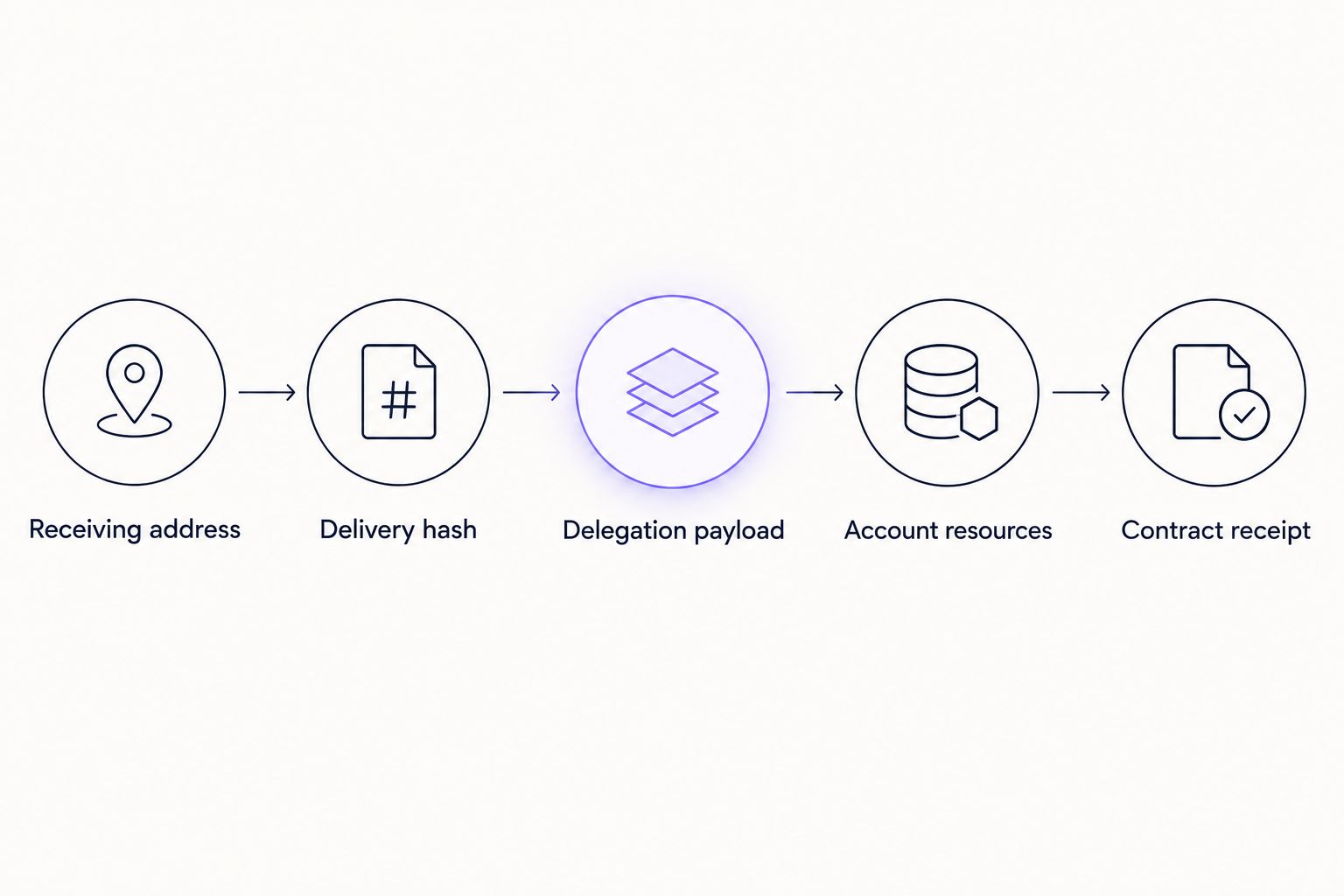
Use the following sequence for a rental delivered through TRON resource delegation. If a service uses another delivery arrangement, establish its mechanism before treating this checklist as proof of fulfillment.
1. Identify the receiving address
Copy the address that was supposed to receive Energy from your original order. Compare it against the wallet that will execute the smart-contract transaction—not merely the wallet that paid for the rental.
Those addresses can differ. A treasury wallet can pay while an operating wallet receives the resources, so matching the delegation against the payer creates the wrong acceptance test.
TRON tools display addresses in Base58Check or hexadecimal form. Normalize the representation before comparing them, and compare the complete address rather than its opening and closing characters.
2. Separate the payment hash from the delivery hash
Open the transaction identifier supplied by the provider in TRONSCAN, or retrieve it through a TRON node interface. Inspect its contract type and participating addresses.
A normal TRX payment appears as a transfer, not as an Energy delegation. A token payment likewise does not establish that resources reached the intended wallet.
Ask for the delegation transaction identifier when the receipt only identifies payment. Keep both identifiers in your records; they answer different questions and need not involve the same sending address.
3. Inspect the delegation payload
For Stake 2.0 resource delegation, inspect the transaction’s DelegateResourceContract payload. The important fields identify the resource owner, receiver, resource type, and delegated stake amount.
owner_address: The account delegating the resources.receiver_address: The account receiving the resources.resource: The resource must resolve to ENERGY, not BANDWIDTH.balance: The amount of staked TRX underlying the delegation, expressed in SUN.
The delegated stake amount is not the delivered Energy-unit count. TRON uses 1,000,000 SUN per 1 TRX; neither denomination is an Energy unit. Compare the correct field against the correct obligation rather than reading a stake balance as an Energy quantity.
A provider can use a separate resource-supplying account. An unfamiliar owner address is not, by itself, proof of failure; the receiver, resource type, successful execution, and connection to the order remain the essential checks.
4. Confirm inclusion and successful execution
Check that the delegation transaction appears in a block and has a successful execution result. A submitted transaction identifier or broadcast acknowledgment does not establish successful delivery.
For an API workflow, gettransactionbyid exposes the transaction and its contract payload. gettransactioninfobyid provides execution information, including the block reference and result information where applicable.
Use confirmed-state data when your acceptance rule requires finality. A confirmed-state interface and an unconfirmed view answer different questions; record which one your verification process uses.
5. Check the receiving account’s resources
Inspect the receiving wallet’s current Energy limit and Energy used. In TRON’s account-resource response, these appear as EnergyLimit and EnergyUsed; remaining capacity depends on both, not the limit alone.
For Stake 2.0 delegations, inspect the relationship between the resource owner and receiver through getdelegatedresourcev2. Its frozen_balance_for_energy describes delegated stake backing Energy, not a direct count of remaining Energy units.
Capture a resource snapshot before and after delivery when you control the workflow. Without the earlier snapshot, an account with existing stake or other delegations makes attribution harder: the current total does not identify which order supplied every unit.
6. Verify the intended contract call separately
After you use the wallet, inspect the smart-contract transaction’s execution result and resource receipt. Check Energy consumption, including energy_usage_total, and any fee fields relevant to that transaction.
A successful rental does not guarantee a successful contract call. Contract logic, permissions, available resources, and transaction settings still determine execution.
Preserve the delivery evidence before spending the resources. A later screenshot showing little available Energy cannot distinguish failed delivery from successful delivery followed by consumption.
Which verification method should you use?
TRONSCAN is best for a manual inspection; a TRON node interface is best for repeatable checks. Neither method replaces the need to match the correct wallet and transaction type.
| Method | Best for | Advantage | Limitation |
|---|---|---|---|
| TRONSCAN | Reviewing an individual rental | Presents transaction and account information for manual inspection | Screenshots alone do not preserve every underlying field |
| TRON node interface | Repeatable operational checks | Returns structured transaction and resource data | Requires address normalization, response handling, and explicit confirmation rules |
For manual review, save the transaction identifier and relevant field values alongside screenshots. For an automated workflow, retain the raw responses and the rules used to accept or reject delivery.
In a 2026 verification workflow, avoid accepting a transaction solely because an explorer displays a success label. Success applies to the action in that transaction; a successful payment remains a payment.
Why the Energy balance you see varies
The receiver’s current resources are a live account state, not a permanent receipt for a particular order. These factors explain why a later balance does not necessarily match an earlier delivery view:
- Existing resources: The wallet can already have Energy from its own stake or other delegations.
- Resource consumption: Smart-contract calls consume available Energy after delivery.
- Recovery: Consumed Energy recovers over a 24-hour period, so used-resource figures change with time.
- Delegation changes: Additional delegations or undelegations change the resources assigned to the account.
- Observation timing: A historical transaction and a current account snapshot describe different moments.
- Network allocation: Energy entitlement depends on the network’s resource-allocation rules, not a permanent conversion from delegated TRX.
Use the delegation record to establish the action and the resource snapshot to establish current capacity. Neither record, alone, answers both questions.
Do not calculate a guaranteed Energy quantity from delegated stake using a fixed conversion. Read the account-resource state and retain the observation time when the usable quantity matters to your order.
What does a successful delegation actually prove?
A successful delegation proves that the recorded resource-delegation action executed for the named receiver. It does not independently prove every commercial term of a rental agreement.
| Evidence | What it establishes | What it does not establish |
|---|---|---|
| Confirmed payment | The recorded payment occurred | Delivery to the intended wallet |
| Successful ENERGY delegation | Resources were delegated to the recorded receiver | Satisfaction of every rental term |
| Current account-resource response | Resource state at the observation time | The wallet’s complete historical state |
| Successful contract receipt | The contract call executed successfully | Which commercial order supplied its resources |
Check any lock fields separately from the commercial rental duration. A protocol restriction on undelegation is not automatically the same as the provider’s promised service period.
For a duration dispute, preserve the original terms and inspect the relevant delegation history. A current balance cannot reconstruct an entire rental period, and a delivery transaction does not promise that resources will remain assigned indefinitely.
Can you verify delivery without the provider’s transaction hash?
You can investigate delivery using the receiving address, its delegation relationships, and relevant account history. A provider-supplied delivery hash makes attribution simpler, but the hash is not the underlying proof—the chain record is.
Start with the intended receiver and the expected delivery window. Identify incoming resource delegations, inspect their owners, and match the candidate transactions against the order record.
If several rentals overlap, do not assign the first visible delegation to your order without supporting evidence. Ask the provider to identify its supplying address and delivery transaction, then verify those details independently.
Does a successful rental mean your transfer used no TRX?
A successful rental does not establish that the later transaction consumed no TRX. TRON accounts for Energy and Bandwidth separately, and the contract transaction’s receipt records the resources and fees associated with execution.
Inspect the actual receipt rather than inferring the outcome from the rental status. Check Energy usage, Energy fees, network usage, and network fees where those fields are present.
Keep the claim narrow: confirmed Energy delivery establishes resource delivery. Only the later transaction record establishes what that transaction consumed and whether it succeeded.
Keep the order workflow separate from chain verification
Nbtrx provides Telegram business operations tools; a Telegram message is not on-chain proof of resource delivery. Keep customer operations records alongside independently checked transaction evidence, rather than treating an order notification as the final acceptance signal.
Your 2026 verification record should contain:
- The original order reference and intended receiving address.
- The payment transaction identifier, when applicable.
- The delegation transaction identifier and resource owner.
- The confirmed execution result and block reference.
- The account-resource snapshot and observation time.
- The later contract transaction identifier, if execution is part of the review.
Store public chain data without collecting wallet secrets. Looking up a transaction or public account does not require a seed phrase, private key, or a transfer of wallet control.
Reject requests for wallet secrets as part of verification. Public inspection and wallet authorization are different operations; reading chain records does not require signing a transaction.
FAQ
How do I know whether my TRON energy rental was actually delivered?
Confirm a successful ENERGY delegation to your intended receiving address, then inspect that account’s resource state. Keep the delivery transaction separate from the payment transaction.
Is a successful payment transaction enough to verify an Energy rental?
A successful payment transaction is not enough to verify Energy delivery. It establishes payment, while delivery requires evidence of the resource assignment to the intended wallet.
Which TRON transaction type should I look for?
For Stake 2.0 resource delegation, look for DelegateResourceContract with the resource set to ENERGY. Check the receiver and execution result, not just the transaction label.
Does the delegated balance show how many Energy units I received?
The delegated balance represents staked TRX denominated in SUN, not Energy units. Inspect the receiving account’s resource information to assess its Energy capacity.
Why is my available Energy lower after a successful rental?
Available Energy can be lower because the account consumed resources or its delegation state changed. Compare transaction history and time-stamped resource snapshots before concluding that delivery failed.
Do I need to connect my wallet to verify a rental?
You do not need to connect your wallet to inspect public TRON transactions and account resources. Do not provide a seed phrase or private key for verification.
Can the payment wallet and Energy receiving wallet be different?
The payment wallet and Energy receiving wallet can be different. Verify delivery against the receiving address specified in the order, not automatically against the payer.
Does successful Energy delivery prove my smart-contract transaction succeeded?
Successful Energy delivery does not prove that a later smart-contract transaction succeeded. Inspect that transaction’s execution result and resource receipt separately.
One last thing
Capture the resource snapshot before the first contract call. Once the wallet consumes Energy, a current balance becomes weaker evidence of what was available immediately after delivery.
For your 2026 operating procedure, make acceptance a recorded event: verify the delegation, save the resource state, then release the contract call. That sequence preserves the distinction between delivery and consumption without relying on a provider’s status message.