
There is no single minimum amount of TRON energy to rent across all rental services; the minimum order depends on the provider’s terms. A provider’s smallest order is not necessarily enough energy for your transaction. Before ordering in 2026, compare the accepted order size with your wallet’s available energy, the transaction’s estimated requirement, and the rental duration.
- The minimum amount of TRON energy to rent depends on the provider, not a universal rental threshold.
- TRON smart-contract energy requirements and a provider’s minimum order are separate checks.
- Choose an order that covers your estimated energy shortfall within the rental period.
- Confirm delegated energy in the receiving wallet before submitting the intended transaction.
Is there a minimum amount of TRON energy you can rent?
A rental service sets its minimum order; your intended transaction determines how much energy you need. Those quantities answer different questions. The first determines whether the service accepts your order, while the second determines whether the resources cover the operation you plan to submit.
For the underlying delegation process, read how TRON energy rental works. Understanding that process helps you separate an order confirmation from energy actually reaching the intended wallet.
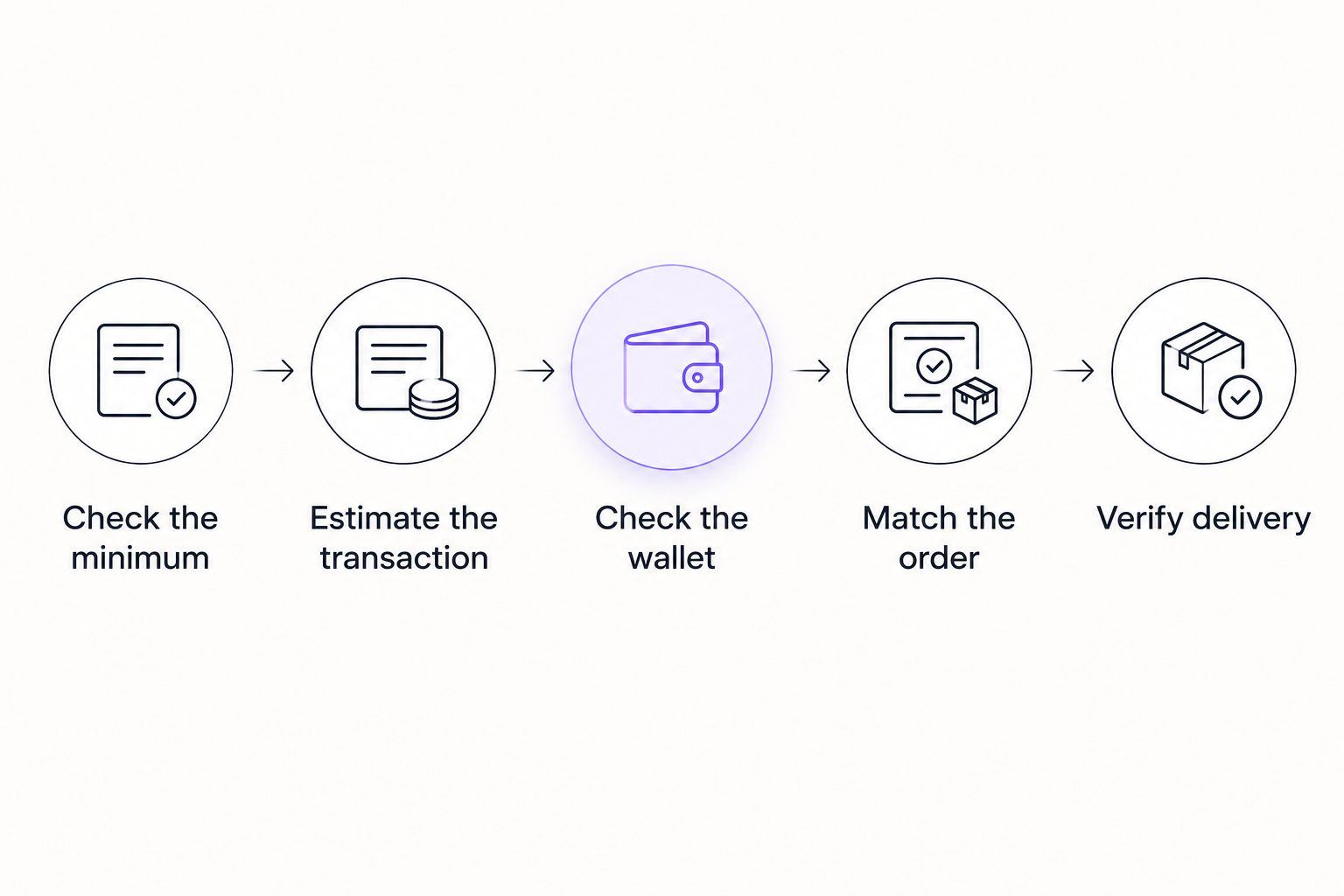
Use this sequence before choosing an amount:
- Check the minimum. Read the provider’s current order terms for the selected rental duration.
- Estimate the transaction. Use your wallet’s estimate or a suitable transaction simulation for the exact contract call.
- Check the wallet. Confirm the energy already available to the address that will submit the transaction.
- Calculate the shortfall. Subtract usable existing energy from the estimated requirement.
- Match the order. Select an accepted amount that covers the shortfall and remains usable when you need it.
If the provider’s minimum exceeds your shortfall, the smallest accepted order still leaves excess capacity. If the minimum falls below your shortfall, ordering the minimum alone does not solve the resource requirement.
Why this matters
A small minimum order sounds useful, but it does not establish whether a rental fits your transaction. Duration, delivery, and the receiving address matter too. An accepted order sent to the wrong wallet does not supply the wallet that needs to execute the contract.
For a 2026 comparison, record the amount and duration together rather than keeping an isolated minimum-order figure. Treat the provider’s order terms as commercial terms, not as a network-wide statement about what every transaction requires.
The practical objective is straightforward: cover the resource shortfall for the intended transaction without ordering capacity you have no planned use for. Start with the transaction, then choose the order.
Minimum order, required energy, and available energy
These terms belong in separate fields in your transaction checklist. Combining them into a single figure makes it harder to identify whether a problem comes from the rental order or the transaction estimate.
| Measure | What it tells you | What it does not establish |
|---|---|---|
| Minimum order | The smallest order the selected provider accepts | Whether that order covers your transaction |
| Estimated requirement | The expected energy use of the intended contract call | Whether a provider accepts that exact amount |
| Available energy | The energy currently usable by the sending wallet | Whether it will remain sufficient after other activity |
| Rental duration | The period covered by the rental arrangement | Whether your transaction will execute successfully |
| Delivery confirmation | Whether the expected delegation has reached the address | Whether the contract call itself is valid |
Recheck the wallet before submission if other transactions have occurred since your estimate. An earlier balance is not the same as the balance available at execution.
Also keep energy separate from bandwidth. TRON uses distinct resource categories, and renting energy does not by itself establish that every other transaction requirement is covered.
Which order approach fits your transaction?
Choose an approach based on your workload, not just the smallest amount shown on an order form. The table compares order-selection methods, not named providers or verified service features.
| Approach | Best for | Advantage | Limitation |
|---|---|---|---|
| Smallest accepted order | A shortfall already covered by the provider’s minimum | Keeps the order decision simple | Leaves excess capacity when the minimum exceeds your need |
| Shortfall-based order | A specific, estimated contract call | Connects the order to the wallet’s actual requirement | Depends on a current estimate and an accepted order increment |
| Planned workload order | A defined sequence of contract calls | Accounts for the intended workload rather than an isolated action | Requires a schedule and estimates for the included calls |
Use a shortfall-based order for an isolated transaction when the service accepts the required amount. That recommendation follows the resource requirement rather than assuming that every wallet needs the same package.
For a planned workload, list the contract calls you intend to submit during the rental period. Do not use the token transfer amount as a substitute for estimating the calls themselves. Sending more tokens does not, by itself, provide a reliable energy estimate.
How to find the smallest suitable order
Check the minimum
Read the actual order form and terms. Look for the accepted energy quantity, any quantity increments, the rental duration, and the address that receives the delegation. A headline describing a small order is not a complete rental specification.
For your 2026 record, save the terms you accepted with the transaction details. This keeps the minimum, duration, and receiving address tied to the same order rather than scattered across messages.
Estimate the transaction
Estimate the operation you will actually submit, including its contract and recipient. A previous successful transaction is useful context, but it is not a substitute for checking the current call. Contract execution and current state determine resource use.
Avoid treating a generic token-transfer example as an exact requirement for every transfer. Your decision should use the transaction estimate available at the time you prepare the order.
Check the wallet
Inspect the sending address’s available energy. Then account for any other planned contract calls that will use the same resources before your intended transaction. A wallet shared by several operations needs a coordinated resource check.
For customer operations, record who controls submission and who confirms delegation. That division prevents a rental confirmation from being mistaken for permission to send immediately.
Match the order
Compare the shortfall with the provider’s accepted quantities and duration. If the required quantity is not accepted exactly, identify the smallest accepted order that covers it. Do not round down merely to reach a smaller order.
Read how long rented TRON energy lasts before matching the rental window to your submission schedule. Quantity and timing belong in the same decision.
Verify delivery
Check the receiving wallet’s resources before submitting the contract call. An order receipt confirms an order; the wallet’s resource state confirms what is available to use. Keep those checks separate.
The final check belongs immediately before execution, especially when the wallet handles other activity. Reconcile the delivered resources with the planned transaction instead of relying only on the amount entered during checkout.
Why the amount you need to rent varies
The provider’s minimum and your required rental amount can differ for several reasons. Check these factors individually rather than looking for a universal order size.
- Provider order rules. The service’s accepted minimum and quantity increments define what you can order.
- Existing wallet resources. Energy already available to the sending address reduces the shortfall you need to cover.
- Contract execution. The specific contract call determines the energy requirement; a rental minimum does not determine it.
- Current contract state. The execution path depends on the state encountered when the transaction runs.
- Other wallet activity. Contract calls submitted before your intended transaction consume resources from the same available pool.
- Rental timing. The resources must remain usable when you submit the intended call, not just when you place the order.
For a 2026 operating checklist, give each factor its own field. A single note saying that energy was purchased does not show the amount delivered, the receiving wallet, or whether the intended operation has been covered.
Can I rent only enough energy for my shortfall?
You can target the shortfall if the provider accepts that quantity and the rental terms fit your timing. Otherwise, choose an accepted order that covers the requirement. An exact shortfall calculation does not override the provider’s minimum or quantity increments.
The benefit is a direct connection between the order and the intended operation. The limitation is estimate accuracy: changes in wallet activity or the contract call require another resource check before submission.
Is the smallest rental enough for a USDT transfer?
The smallest rental is enough only when it covers the estimated energy shortfall for that transfer. A provider’s minimum is not a promise that every USDT contract call will fit within it.
Use the exact sending wallet and intended recipient when preparing the transaction estimate. Also confirm other transaction requirements, including bandwidth and any applicable TRX requirements, rather than treating an energy rental as complete transaction coverage.
Should I choose a provider only by minimum order size?
No. Choose an order that fits the required amount, duration, receiving address, and delivery process. A lower minimum does not compensate for terms that do not fit your workflow.
Nbtrx provides Telegram business operations tools. For teams coordinating a rental through a Telegram-based partner workflow, record the requested amount, receiving address, confirmation, and submission owner; do not treat that coordination process as evidence of a provider’s rental terms or guaranteed business results.
FAQ
What is the minimum amount of TRON energy to rent in 2026?
The minimum amount of TRON energy to rent depends on the provider’s current order terms. Check the accepted quantity and rental duration, then compare them with your transaction’s estimated energy shortfall.
Is there a network-wide minimum rental order?
There is no universal commercial rental minimum across providers. TRON resource requirements and a rental service’s minimum order are separate matters.
Can I rent less energy if my wallet already has some?
Existing usable energy reduces the shortfall you need to cover. The provider’s minimum and accepted quantity increments still determine the smallest order you can place.
Does every USDT transfer need the same rental amount?
Do not assume every USDT transfer needs the same rental amount. Estimate the intended contract call and subtract the sending wallet’s usable energy before selecting an order.
Does renting energy cover bandwidth too?
Renting energy does not automatically establish that bandwidth is covered. Energy and bandwidth are separate TRON resources, so check the wallet’s requirements for both.
Should I send immediately after receiving an order confirmation?
Verify the receiving wallet’s available resources before sending. An order confirmation alone does not establish that the intended delegation has reached the correct address.
Does ordering more energy guarantee my transaction will succeed?
Ordering more energy does not guarantee transaction success. Contract conditions, transaction settings, and other execution requirements still apply.
One last thing
The smallest accepted order is a checkout threshold, not a transaction recommendation. Keep that distinction in your 2026 workflow. Ask whether the order covers the exact operation, reaches the correct wallet, and remains usable at submission.
Before approving a rental, write a short handoff containing the receiving address, estimated shortfall, selected quantity, rental duration, and verification owner. That record gives the person submitting the transaction something concrete to check. It also separates a completed purchase from a transaction that is ready to execute.