
Renting TRON energy is safe only when you verify the seller, confirm resource delegation to your address, and keep control of your wallet. Energy delivery does not require your seed phrase, private key, token spending approval, or account-owner permissions; prepayment still exposes you to seller non-delivery, and rented energy does not eliminate every transaction resource requirement.
- Is renting TRON energy safe? TRON resource delegation does not require handing over wallet control; the seller still needs verification.
- Reject any rental request for your seed phrase, private key, token approval, or account-owner permissions.
- Verify delegated energy on-chain before submitting the transaction that needs it.
- Treat payment, energy delivery, and your intended transfer as separate checks.
Is renting TRON energy safe?
The resource-delegation mechanism does not give the energy provider control of your tokens. The risk comes from the surrounding transaction: who receives your payment, what your wallet signs, whether resources arrive, and whether those resources cover your intended contract call.
TRON's resource-model and resource-delegation documentation distinguish delegated resources from account permissions. Receiving energy is not the same action as authorizing another party to move assets. A seller that merges those actions into one unexplained approval creates an avoidable security risk.
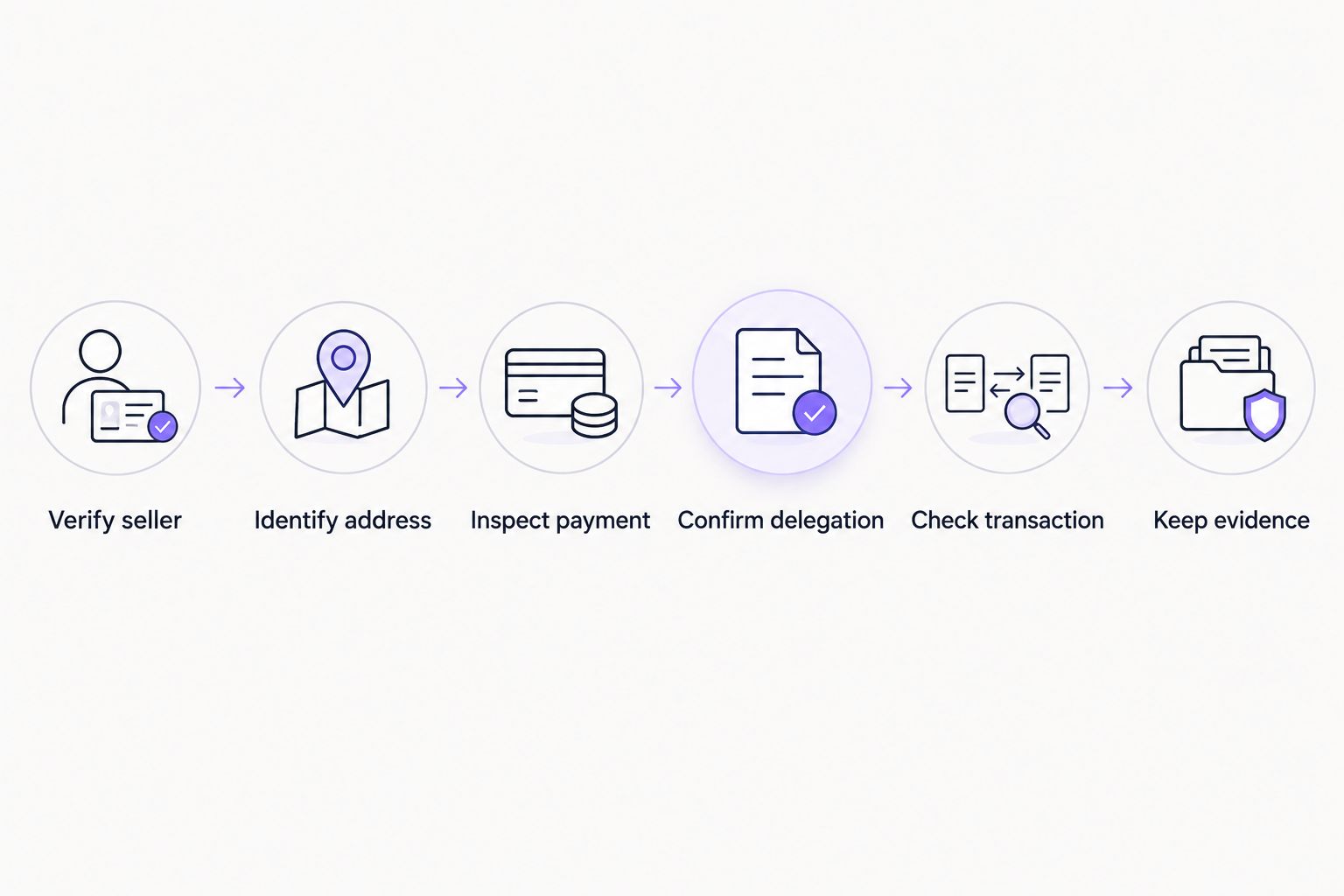
Use these 6 checks before renting energy in 2026:
- Verify the seller. Check the exact website, account identity, order instructions, and payment destination. Use the guide to customer trust and reviews to structure your comparison, not as a substitute for checking a seller yourself.
- Identify the receiving address. Confirm the TRON address that will execute the intended contract transaction. Delegating resources to another address does not fund the account you actually use.
- Inspect the payment. Read the destination, asset, amount, and transaction type in your wallet. Signing a payment is different from changing account permissions or approving token spending.
- Confirm delegation. Check your address's resource information through an independently opened TRON explorer or wallet resource view. Do not rely only on a seller's success message.
- Check the intended transaction. Review the recipient, token contract, transaction simulation or resource estimate, and wallet fee settings. Energy does not validate the destination.
- Keep evidence. Save the order details, payment transaction, delegation evidence, and any support correspondence. These records help distinguish delivery problems from transaction-execution problems.
A failed check is a reason to stop. Do not compensate for uncertainty by sending another payment or signing a transaction you cannot explain.
Why this matters
Energy rental involves separate relationships: you pay a provider, the provider delegates resources, and you execute a transaction. Success at one stage does not prove success at the others. A confirmed payment proves that funds moved; it does not prove that energy reached the correct address.
The distinction matters for TRC-20 transfers and other smart-contract interactions. Energy supports contract execution, while bandwidth is a separate TRON resource. Renting energy does not remove the need to review other resource requirements or maintain suitable wallet settings.
For your 2026 operating checklist, separate custody safety, delivery reliability, and transaction correctness. A provider can deliver the promised resources while you still send tokens to the wrong recipient. Conversely, a carefully reviewed transfer can fail if the account lacks the resources needed to execute it.
Rental, staking, or paying transaction fees directly?
You do not need to rent energy simply because a seller recommends it. Choose the resource approach that fits your activity and how much operational work you want to manage.
| Approach | Best for | Main benefit | Main limitation | Safety check |
|---|---|---|---|---|
| Rent delegated energy | Users who need resources without staking their own TRX | Separates resource access from owning the underlying stake | Adds seller, payment, and delivery risk | Confirm delegation to your address |
| Stake your own TRX for energy | Users prepared to manage their own resource allocation | Avoids a rental seller for those resources | Requires committed TRX and management of staking rules | Review current staking and withdrawal conditions |
| Use TRX to cover insufficient resources | Users prioritizing a direct transaction workflow | Avoids a separate rental order | Consumes TRX when available resources are insufficient | Review the wallet's transaction estimate and fee limit |
Renting is an operational choice, not a security upgrade. It introduces a provider relationship that staking your own resources or paying network fees directly does not require.
Staking also has trade-offs. You must understand resource allocation and the network's withdrawal process rather than assuming staked assets remain immediately spendable. Direct fee payment is simpler to coordinate, but it still requires enough TRX and careful transaction review.
None of these approaches protects you from a malicious token contract, a compromised wallet, or an incorrect recipient address. Resource management and asset security remain separate tasks.
Why rental safety varies
A useful 2026 review examines the actual workflow rather than the provider's headline promise. These factors change your exposure:
- Seller identity. A copied name or familiar-looking chat account does not establish who controls the payment address. Verify the destination through the provider channel you independently selected.
- Payment structure. Prepayment puts funds at risk before delivery. Read the order conditions and understand what evidence the seller requires for a delivery dispute.
- Signing requests. A normal payment has a different purpose from a token allowance or account-permission update. Inspect the action, not just the wallet's confirmation button.
- Delivery address. Resources must reach the account executing the transaction. Copying an exchange deposit address or another wallet address can make the rental useless for your intended action.
- Resource sufficiency. Delivered energy is not proof that every contract call will fit within it. Check the intended transaction rather than relying on an unrelated earlier transfer.
- Delegation conditions. Understand when resources become usable and when the provider can reclaim them under the applicable delegation conditions. Do not infer a service duration from a generic confirmation message.
Keep these factors separate when comparing sellers. A provider with clear payment instructions can still have unclear delivery terms; a fast delivery claim says nothing about wallet permissions.
What should an energy rental never require?
Receiving delegated energy does not require your recovery phrase or private key. Those credentials control the wallet. Anyone requesting them is asking for access far beyond resource delivery.
Your public receiving address is different. It identifies the account that needs resources, but sharing it also makes that address's public blockchain activity easier to associate with you. Use the address necessary for the transaction and avoid sending unrelated customer or account information.
Treat these requests as stop signals:
- A recovery phrase entered into a website, form, support chat, or bot.
- A private key sent to an operator for wallet verification.
- A token spending approval presented as a requirement to receive energy.
- An account-owner or active-permission change that you did not deliberately initiate.
- An unexplained contract interaction described only as activation or synchronization.
A provider can require payment for its service. That does not justify unrelated permissions. If the wallet cannot show what an action does, reject it until you can independently identify the transaction.
How do I verify that rented energy actually arrived?
Start with the receiving account, not the order page. Open your wallet's resource view or independently access a TRON explorer, then check the account's energy information and the relevant delegation records.
Keep 2 transaction records separate: your payment to the provider and the provider's resource-delegation transaction. A payment transaction hash is not delivery evidence. The delegation record should identify the intended receiving address and the resource being delegated.
Review the account's currently available energy as well. Resources can be consumed by activity, so a historical delegation alone does not establish what remains available when you submit your transaction.
For a 2026 rental order, your verification record should answer:
- Did the payment reach the intended destination?
- Does the delegation evidence identify your receiving address?
- Does the account currently show usable energy?
- Does your intended transaction have an acceptable resource estimate?
- Do the delivery conditions match what you ordered?
A screenshot from the seller is supporting material, not independent confirmation. Check the account state yourself before using the resources.
Can renting energy drain my wallet?
Delegating energy to your address does not, by itself, authorize the provider to transfer your tokens. Wallet-draining risk comes from exposing credentials, granting dangerous permissions, approving malicious spending, or signing another harmful transaction.
That distinction does not make every rental website safe. A fraudulent service can wrap a harmful signature request inside an otherwise familiar payment flow. Read every wallet prompt, including prompts that appear after an order says it is complete.
If you already signed something suspicious, stop using the rental flow and identify the transaction on-chain. Review token allowances and account permissions separately; they are different forms of authorization. Rejecting future prompts does not reverse an authorization already recorded on-chain.
If a seed phrase or private key was exposed, removing a token allowance does not restore exclusive control of that wallet. Follow your wallet provider's documented recovery guidance and use a securely created wallet for future activity.
How should a business handle energy rentals?
A business needs a repeatable approval process, not a shared chat containing wallet credentials. Separate the person requesting resources from the person approving payments, and record which account needs the energy before authorizing the order.
Use 1 designated receiving address per order as an explicit operating rule. This is a recordkeeping recommendation, not a TRON protocol limit. It makes it easier to match a payment, a delegation, and the transaction that consumed the resources.
Your 2026 procedure should record the requester, receiving address, payment evidence, delivery evidence, and intended transaction. Keep private keys and recovery phrases outside support conversations and order records.
Nbtrx is best for teams seeking Telegram business operations tools, not a substitute for verifying TRON resource delegation. Customer operations and wallet authorization need separate controls regardless of which communication tools your team uses.
FAQ
Is renting TRON energy safe for a beginner?
Renting TRON energy is safe only when you verify the seller, inspect every signature request, and confirm delegation independently. Beginners should stop if a provider asks for a recovery phrase, private key, token approval, or account-permission change.
Does an energy provider need access to my wallet?
An energy provider does not need your private key or recovery phrase to delegate resources to your address. A public receiving address identifies the account, while a separate payment can be required under the provider's order terms.
Can I rent energy without connecting my wallet to a website?
TRON resource delegation does not inherently require connecting the receiving wallet to a website. A provider's ordering interface can impose its own workflow, so distinguish that interface requirement from the blockchain's delegation mechanism.
Does rented energy cover every TRON transaction requirement?
Rented energy does not cover every TRON transaction requirement. Bandwidth is separate, and insufficient resources can require TRX; review the specific transaction before signing.
Is a successful rental payment proof that energy arrived?
A successful rental payment is not proof that energy arrived. Verify the receiving account's resources and the relevant delegation evidence independently.
Is staking my own TRX safer than renting energy?
Staking your own TRX removes the rental seller's delivery risk, but it introduces staking and resource-management responsibilities. It does not protect against compromised keys, malicious contracts, or incorrect transfer destinations.
What should I do if the provider asks me to approve USDT?
Reject a USDT spending approval presented as necessary to receive delegated energy. Token spending authorization and resource delegation are separate actions; investigate the request before continuing.
One last thing
A genuine delivery can still precede a fraudulent request. Receiving energy does not make a later refund form, verification prompt, or support message trustworthy. Evaluate each new action on its own.
Before you submit the intended transfer, compare the recipient address in your wallet with the destination you independently verified. Energy makes contract execution possible; it does not make the recipient correct.