
Best overall for a one-off USDT transfer in 2026: a TRON energy rental service that shows the recipient wallet, delegated energy, duration, and payment before you confirm. Best for repeat transfers: staking TRX for your own Energy. Best fallback when neither is ready: holding enough TRX in the sending wallet to cover network resource use.
- The best TRON energy rental services for USDT transfers show delegation details before you pay; no named provider is verified here.
- Rent Energy for an occasional transfer; consider staking TRX when you send USDT repeatedly.
- Check the receiving wallet and available Energy before sending; a successful rental payment is not a confirmed delegation.
- Keep TRX available as a fallback when the sending wallet lacks sufficient resources.
Why this matters
A TRON USDT transfer uses network resources. If the sending wallet lacks enough Energy, the network can consume TRX to cover the resource requirement. Renting Energy can change how you obtain that resource, but it does not remove the need to check the wallet, the delegation, and the transfer itself.
For a team using Nbtrx for Telegram business operations, keep member operations separate from payment approval. A message saying Energy was rented is not proof that the sending wallet received it. Check the wallet before you authorize a USDT transfer.
The best rental choice is the one whose delegation you can verify on the sending wallet before the transfer. That rule matters more than a provider's headline claim. This 2026 guide ranks practical ways to obtain Energy and identifies where rental ends and other TRON resource options begin; it does not assign an unsupported winner among named vendors.
What makes the best TRON energy rental service?
Use these criteria before choosing a rental service for a TRON USDT transfer:
- Recipient control: You can identify the exact TRON address receiving delegated Energy before confirming payment.
- Visible resource terms: The service shows the Energy amount and delegation duration. You can compare those terms with the transfer you intend to make.
- Verifiable delivery: You can inspect the sending wallet's resources after delegation. A payment receipt alone does not establish that Energy arrived.
- Clear timing: You know when the delegation begins and ends. A duration that ends before the transfer is submitted does not help.
- Limited permissions: You do not need to share a seed phrase or private key. A service requesting either fails this check.
- Usable support path: You can find the transaction or order record needed to investigate a failed or delayed delegation.
A provider that hides the destination address, amount, or duration fails the basic comparison, regardless of how convenient its order screen looks. In 2026, apply the same checks to a website, wallet interface, or Telegram bot. The channel is not proof of delivery.
TRON energy options at a glance
| Option | Best for | Standout feature | Key limitation |
|---|---|---|---|
| Direct, verifiable Energy rental | An occasional USDT transfer | Delegation can be checked against the sending address | Terms and delivery depend on the provider |
| Repeat rental through an established workflow | Teams with recurring transfer procedures | The same verification steps can be built into each run | A repeatable workflow does not make a provider trustworthy |
| Stake TRX for Energy | Senders who expect to keep using the same wallet | Energy comes from the wallet's own staked resources | Requires holding and staking TRX; it is not rental |
| Use TRX to cover resources | A transfer when rental or staking is not set up | No separate delegation step | Resource use consumes TRX |
The first two rows describe service-selection routes, not endorsements of specific companies. The final two are network alternatives. They belong in the comparison because they can be the better operational decision for a USDT sender, even though neither is an energy rental service.
1. Direct, verifiable Energy rental: best for an occasional transfer
A rental provider delegates Energy to a specified TRON address for a stated period. For one transfer, choose a service only when you can review that address and the delegation terms before paying. Afterward, check the resources on the actual sending wallet rather than assuming an order confirmation completes the job.
This is the default rental route for an occasional sender in 2026. It avoids treating a recurring subscription or bot workflow as necessary for a single transaction. It also gives you a clear stop point: if the delegation is not visible on the intended wallet, do not submit the USDT transfer on the assumption that it will appear later.
Direct rental pros:
- Keeps the decision tied to a specific sending address and transfer.
- Gives you a delegation event to verify before sending.
- Does not require you to stake TRX for ongoing use.
Direct rental cons:
- Provider terms and delivery must be checked for each order.
- A rental can expire before a delayed transfer is submitted.
- A correct payment to the provider does not correct a mistyped receiving address.
Best for: An occasional USDT sender who can pause between renting and transferring to verify delivery. Verdict: Buy only after the provider displays the address, Energy amount, and duration, and the wallet shows the resource.
2. Repeat rental workflow: best for teams with recurring transfers
Repeated USDT transfers call for a procedure, not blind trust in a familiar interface. A team can use the same checks each time: confirm the sending address, inspect its current resources, request delegation if needed, verify arrival, then submit the transfer. If a provider supports the workflow you need, assess its terms on each run.
This option suits customer operations where more than one person handles a request. Nbtrx may sit alongside those Telegram business operations, but a Telegram conversation must not replace wallet-level confirmation. Keep the payment decision with the person authorized to use the sending wallet.
Repeat rental pros:
- Makes the resource check a defined part of each transfer.
- Helps separate a delegation request from confirmation that it arrived.
- Gives staff a consistent point at which to stop if details do not match.
Repeat rental cons:
- Repetition can encourage approval without checking a changed address or duration.
- A provider's workflow cannot guarantee a USDT transfer will succeed.
- The team still needs an approved process for wallet access and transfer authorization.
Best for: Teams that send USDT repeatedly and can enforce a wallet check for every transfer. Verdict: Hold until the provider's current delegation terms and the team's approval steps are documented.
3. Stake TRX for Energy: best for repeat use of one wallet
Staking TRX is a TRON network option for obtaining resources without placing a rental order for every transfer. It is not an energy rental service. It belongs on this list because a sender who repeatedly uses the same wallet should compare it with renting rather than assume every transfer needs a new provider.
Staked resources still need monitoring. TRON Energy used by a transaction restores over a 24-hour period, so the wallet's available amount changes with use and recovery. Check what is available when you plan to send, not what was available after an earlier transfer.
TRX staking pros:
- Removes the separate rental-order step for a wallet with sufficient available Energy.
- Lets you inspect resources on the wallet before each transfer.
- Fits a repeat-use decision rather than a one-off purchase.
TRX staking cons:
- Requires holding and staking TRX.
- Available Energy can be insufficient after other transactions use it.
- It does not eliminate the need to check resource requirements before sending.
Best for: A repeat sender who controls the wallet and wants to manage its resources directly. Verdict: Buy as a resource strategy if the wallet's available Energy meets your actual transfer needs; skip it as a substitute for checking each transaction.
4. Cover resources with TRX: best fallback when Energy is unavailable
A sending wallet can use TRX to cover resource consumption when it lacks sufficient Energy. This is neither rental nor staking. It is the fallback to consider when a transfer cannot wait for a delegation, provided the wallet has enough TRX for the transaction's resource use.
Do not confuse the unit of the asset with a transfer fee. One TRX equals 1,000,000 SUN, the network's smaller unit. That conversion does not tell you what a particular USDT transfer will consume; inspect the wallet's transaction information instead of relying on a fixed figure from an article.
TRX fallback pros:
- Does not require a separate rental provider.
- Avoids waiting for a delegation to reach the sending wallet.
- Gives you a route when a planned rental has not arrived.
TRX fallback cons:
- Resource use consumes TRX.
- An insufficient TRX balance can still prevent the intended transfer.
- It does not solve an incorrect network, address, or transaction approval.
Best for: A sender who needs to proceed without a verified delegation and has checked the wallet's TRX balance. Verdict: Hold until the wallet shows the resources needed to submit the transaction.
Verify Energy before sending USDT
In 2026, treat rental and transfer as two separate events. The first establishes whether the sending wallet received a resource. The second moves USDT. A confirmation for one is not confirmation for the other.
- Check network. Confirm that the asset, sending wallet, and destination are for the intended TRON transfer. Do not use an address copied from an unrelated conversation without checking it.
- Inspect resources. Look at the sending wallet's available Energy and TRX before ordering anything. Another recent transaction may have changed the available Energy.
- Confirm delegation. If you rent, compare the delegated address with the wallet that will send USDT. Check the amount and duration, then verify that the resource appears on that wallet.
- Send transfer. Review the destination and transaction in the wallet. Submit only after the resource check, and then inspect the transfer result separately.
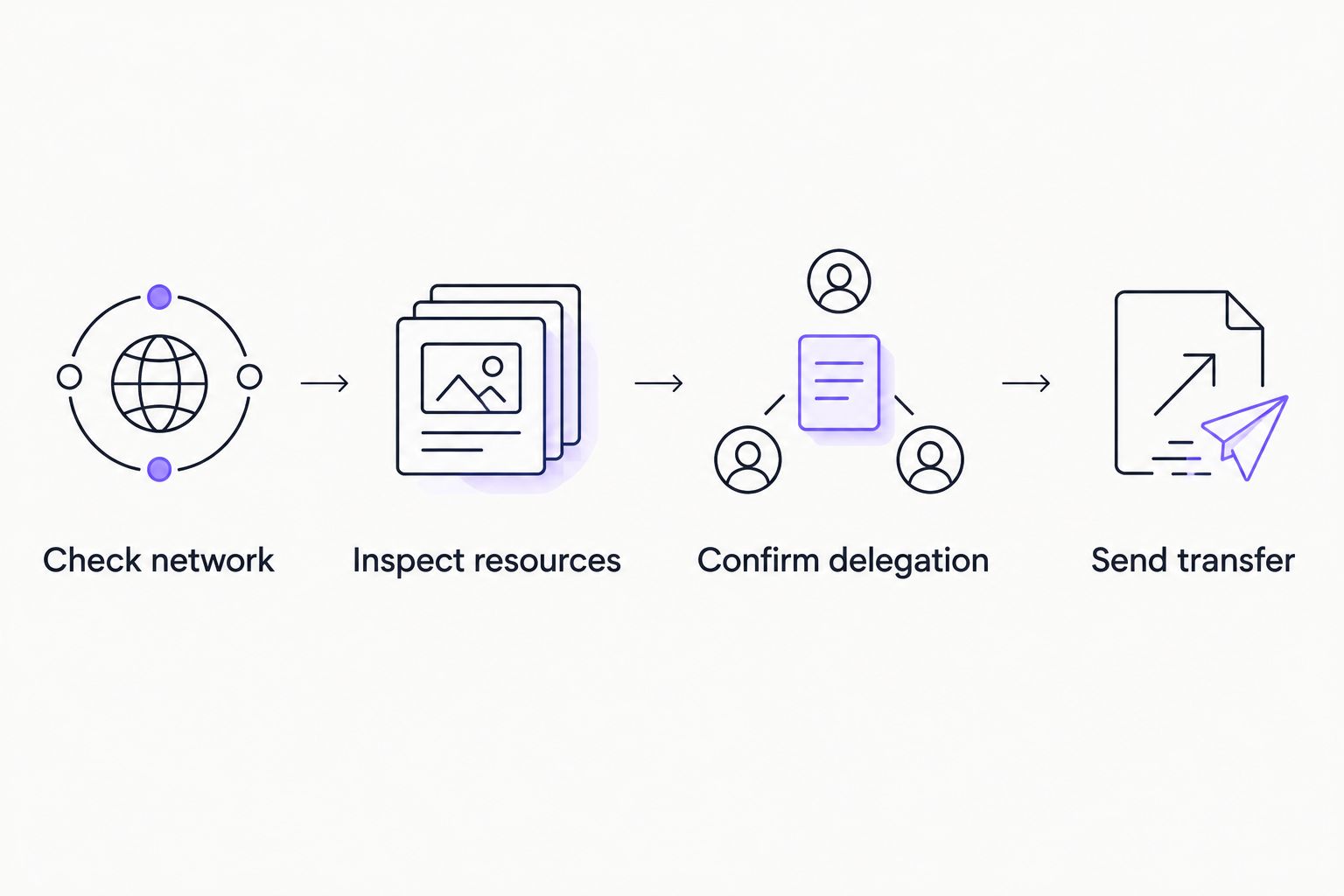
This sequence works whether you rent once, follow a repeat rental procedure, or use staked Energy. Skip the delegation step only when you are not renting; never skip the resource and destination checks. For Nbtrx users handling partner workflow in Telegram, record the wallet decision in the appropriate payment process rather than treating a chat message as transaction evidence.
How these options are ranked
The ranking puts verifiable, direct rental first for the searcher's stated task: finding Energy for a USDT transfer. Repeat rental comes next because it adds an operational process without removing the need to confirm each delegation. Staking and TRX resource payment follow as alternatives, not as vendors disguised as rental services.
No named rental provider receives a top rank here. A defensible provider comparison requires its current terms, destination controls, and proof of delegation; none are established by the supplied product information. Use the criteria above to compare providers you are considering in 2026, and reject any that require your private key or seed phrase.
Which TRON energy option should you choose?
Choose direct, verifiable rental for an occasional USDT transfer. If you send repeatedly from the same wallet, compare ongoing rental with staking TRX and checking the wallet's available Energy before each send. Keep TRX resource payment as a fallback, not as evidence that an unverified rental succeeded.
For a business using Nbtrx in customer operations, make the handoff explicit: the person managing a Telegram request can identify the intended payment, but the wallet operator verifies resources and authorizes the transfer. No rental service guarantees a business outcome or excuses a wrong destination address.
FAQ
What are the best TRON energy rental services for USDT transfers in 2026?
The best choice is a service that discloses the delegated address, Energy amount, and duration, then lets you verify delivery on the sending wallet. No named provider can be ranked here without verified current terms and delivery evidence.
Do I need Energy to send USDT on TRON?
A TRON USDT transfer uses network resources, including Energy. If the sending wallet lacks sufficient Energy, TRX can be consumed to cover resource use.
Is renting Energy better than staking TRX?
Renting suits an occasional transfer; staking TRX is an alternative for a sender who expects to use the same wallet repeatedly. Check available resources before each transfer under either approach.
How do I know rented TRON Energy arrived?
Check the available resources on the exact wallet that will send USDT. A rental payment confirmation alone does not show that the intended wallet received a delegation.
Can a Telegram bot confirm my USDT transfer succeeded?
A bot message is not enough to establish the transfer result. Check the sending wallet and the transaction record independently, even when a bot helped arrange the Energy rental.
Should an energy rental service ask for my seed phrase?
No. Do not disclose a seed phrase or private key to obtain delegated Energy; reject a service that requests either.
What if my rented Energy expires before I send?
Check the sending wallet's available Energy again before submitting USDT. If the delegation is no longer available, reassess the wallet's resources instead of assuming the earlier rental still covers the transfer.
One last thing
Check the wallet, not the receipt. An energy rental order and a USDT transfer are different transactions with different outcomes. In 2026, that single distinction is the most useful check you can add before sending.