
The best TRON energy rental services earn trust through proof you can check on-chain, not through star ratings, so this 2026 ranking sorts provider models by how verifiable their trust signals are.
- TRON energy rental services ranked by trust and reviews: on-chain verifiable marketplaces rank first in 2026.
- Treat star ratings as weak evidence. Delegation transactions on TRON are the strongest proof a provider delivers.
- Anonymous resellers with no stated refund path rank last. Skip them for anything beyond a test order.
- Run a small test order before any volume purchase. It takes minutes and exposes most problems.
Best overall: a transparent marketplace with on-chain delegation proof. Best for exchanges and payment processors: an API-first provider. Best for small teams and one-off buyers: a Telegram bot provider. Best for predictable long-term volume: staking TRX and delegating energy yourself.
Why this matters
Energy rental means you pay a third party to delegate TRON energy to your address so smart contract calls, mostly USDT transfers, do not burn TRX. You send payment first and hope the delegation arrives. That order makes trust the main buying criterion.
A USDT (TRC-20) transfer typically needs about 65,000 energy when the recipient already holds USDT, and roughly double that when the recipient address has never held it. Without energy, the network burns TRX from your balance instead. Rental exists to cut that cost, and a bad provider erases the saving.
Review sites for this category are thin and easy to game. Anyone can post praise on a forum or Telegram channel. The delegation transaction is different: it sits on the TRON chain, timestamped, and nobody can edit it after the fact.
What makes a trustworthy TRON energy rental service
These six criteria drive the ranking below. Audit them before looking at the table.
- On-chain proof of delivery. The provider delegates energy from a visible address, and you can match each order to a delegation transaction.
- Stated failure path. A clear refund or re-delivery rule for orders that do not arrive. No stated rule means no rule.
- Named operator and support channel. A real contact point that answers during a test order, not only after you pay a large one.
- Independent reviews. Feedback on platforms the provider does not control, from buyers with a verifiable history.
- Predictable order flow. Same steps every time: address in, amount confirmed, delegation visible. Surprises are a warning sign.
- Low commitment to start. You can place a small order without a deposit or an account lock-in.
Provider models at a glance
The table groups providers by operating model, because the model predicts trust behavior better than any single brand name. No review scores appear here: none are verified, and an invented score is worse than none.
| Rank | Provider model | Best for | Standout trust signal | Key limitation |
|---|---|---|---|---|
| 1 | Transparent marketplace | High-volume senders | Delegation transactions match orders | Quality varies by seller listed |
| 2 | API-first provider | Exchanges, payment processors | Programmatic order and status checks | Needs engineering time |
| 3 | Telegram bot provider | Small teams, one-off buyers | Fast, low-friction ordering | Trust depends on operator identity |
| 4 | Self-staking and delegation | Predictable long-term usage | You control the whole chain of custody | Locked capital, manual management |
| 5 | Anonymous reseller | Small experiments only | None reliable | No accountability if an order fails |
1. Transparent marketplace: best TRON energy rental for high-volume senders
A marketplace lists multiple energy sellers and settles orders through a standard flow. Its strength is that every delegation is a public transaction, so you can audit sellers by their history instead of their marketing.
Marketplace pros:
- Delegation transactions let you verify each order on-chain.
- Several sellers on one platform give you a fallback when one fails.
- Repeat buyers can compare delivery behavior across orders.
Marketplace cons:
- Seller quality is uneven, so you still vet whom you buy from.
- Dispute handling depends on the platform's rules, which you must read first.
Marketplace pricing: check the current rates on the provider's site before ordering. Rates move with network conditions.
Best for: teams sending USDT in steady, high volume who want to audit before they commit.
Verdict: Buy. Start with a small order, verify the delegation, then scale.
2. API-first provider: best TRON energy rental for exchanges and payment processors
An API-first provider lets your system request energy and check order status automatically. For operations that move funds all day, this removes the manual step where mistakes happen. If integration is your priority, see the guide to TRON energy rental services with API access.
API provider pros:
- Automated ordering fits into existing payout and settlement flows.
- Status endpoints give you a machine-readable record of each order.
- Fewer manual steps means fewer address typos.
API provider cons:
- Integration costs engineering time before the first order.
- You still need monitoring, since an API response is not proof of delegation. Check the chain.
Best for: exchanges, payment processors and any operation that sends transfers programmatically.
Verdict: Buy if you have developer capacity. Hold if you send a few transfers a week.
3. Telegram bot provider: best TRON energy rental for small teams and one-off buyers
Telegram bot providers take orders in a chat: paste the address, confirm the amount, pay, receive the delegation. The flow is quick, and that speed is the appeal. It is also where trust matters most, because a bot hides the operator behind a handle.
Nbtrx builds Telegram business operations tools for member operations, partner workflow and customer operations, which is a different job from renting energy. The point for buyers is general: Telegram-native tooling is normal for TRON users, so judge any bot by the same criteria as every other model, not by how polished the chat looks.
Telegram bot pros:
- Low friction for a first order.
- No account or integration needed.
- Easy to run a small test purchase.
Telegram bot cons:
- Operator identity is often a username only.
- Chat history can be deleted, which weakens any dispute.
- Bots can be cloned. Verify you are in the real chat before sending funds.
Best for: small teams and individuals who send transfers occasionally and want a quick start.
Verdict: Buy for test orders and small volume once the delegation checks out. Hold for large orders until the operator has a track record.
4. Self-staking and delegation: best for predictable long-term volume
This is not rental. You stake TRX under TRON's Stake 2.0 model to obtain energy, and you manage it yourself. No third party touches your funds, so no trust problem arises with a seller. The cost is capital, locked up.
Energy regenerates over a 24-hour window, so heavy, steady usage works better than bursts. Unstaking carries a 14-day waiting period before TRX is withdrawable, which makes this a poor fit for uncertain demand.
Self-staking pros:
- Zero counterparty risk with a seller.
- Full control over delegation to your own addresses.
- Cost is predictable once the stake is in place.
Self-staking cons:
- Capital is locked and exposed to TRX price swings.
- You manage resources manually or build tooling for it.
- Slow to adjust when demand changes.
Best for: operations with steady, forecastable volume and spare treasury capital.
Verdict: Hold for most buyers. Buy only when your volume is stable enough to justify the lock-up.
5. Anonymous reseller: best only for tiny experiments
Anonymous resellers buy energy from other sellers and relist it with no named operator and no stated refund path. They sometimes show attractive offers, and that is the lure. When an order fails, there is nobody to ask.
Reseller pros:
- Quick to find and quick to start.
- Fine for a throwaway test with funds you can afford to lose.
Reseller cons:
- No accountability for failed or partial delivery.
- Reviews are easy to fabricate and hard to trace.
- Delegation may come from a chain of sellers you cannot inspect.
Best for: nothing beyond a minimal experiment.
Verdict: Skip for any real business use.
Explore Telegram business tools
Practical Telegram operations tools. No guaranteed business results.
How to verify a provider yourself
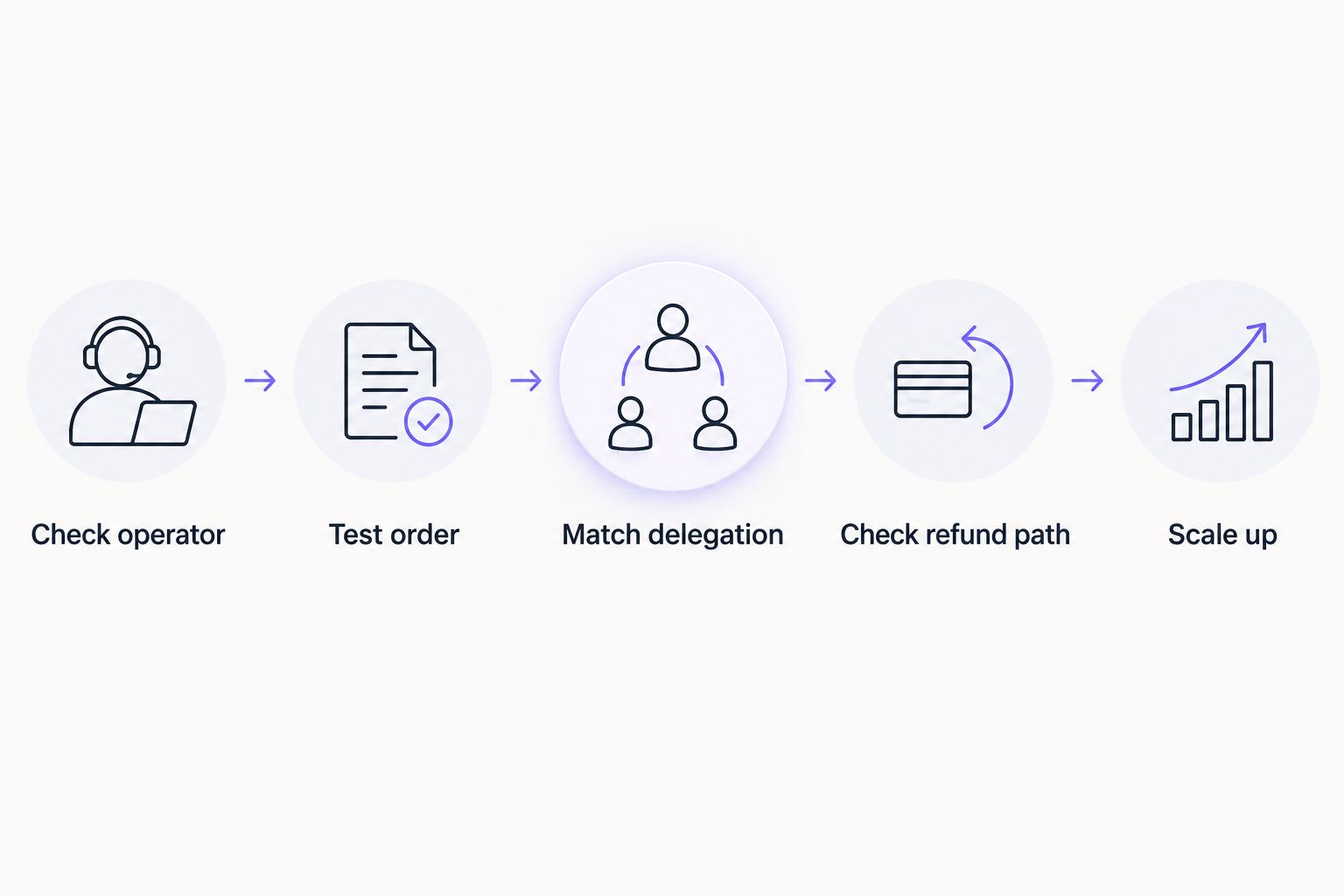
Reviews fail as evidence because they are cheap to produce. A test order is hard to fake. Run this sequence with any provider in 2026:
- Check the operator. Find a named contact and a support channel that answers before you pay.
- Place the smallest order the platform allows. Use a fresh address you control.
- Match the delegation. Open the TRON explorer and confirm the energy delegation to your address arrived in the amount ordered.
- Time the delivery. Note how long it took and whether it matched what the provider stated.
- Ask about failure. Message support with a hypothetical failed order and read the answer.
- Scale in steps. Raise order size gradually, not in one jump.
Providers that pass all six earn a place in your shortlist. Providers that avoid the test order, or push you to deposit a large amount first, drop out.
How we ranked
The ranking weights on-chain verifiability and a stated failure path above everything else, then operator identity, then independent reviews. Speed and cost matter, but they matter after trust. For those, compare delivery speed rankings and price rankings once you have a trusted shortlist.
Which TRON energy rental service should you choose in 2026?
Default to a transparent marketplace with on-chain delegation proof. It gives you an audit trail, seller choice and a standard flow. Move to an API-first provider when your volume or automation needs outgrow manual ordering. Use a Telegram bot provider for quick, small purchases, and self-staking only when volume is steady and capital is spare.
The pattern holds across all five models: the provider you can verify beats the provider with the best reviews. In 2026, the delegation transaction is your review.
FAQ
What is the most trustworthy type of TRON energy rental service?
A transparent marketplace with on-chain delegation proof is the most trustworthy model in 2026. You can match every order to a public transaction instead of relying on claims.
Can I trust reviews of TRON energy rental services?
Treat reviews as weak evidence. They are easy to fabricate, especially on channels the provider controls. Delegation transactions on the TRON chain are stronger proof.
How do I check that energy was actually delivered?
Open a TRON explorer and look up your receiving address. The delegation transaction should show the energy amount you ordered. If it is missing, the order did not deliver.
How much energy does a USDT transfer need on TRON?
A USDT TRC-20 transfer typically needs about 65,000 energy when the recipient already holds USDT. It can need roughly double that when the recipient has never held it.
Is renting energy safer than staking TRX myself?
Staking carries no seller risk, but it locks capital and unstaking takes 14 days. Renting needs no capital lock-up but adds counterparty risk, which a test order reduces.
Should I use a Telegram bot to buy TRON energy?
Yes for small orders, once a test order delivers. Verify you are in the real chat, since bots get cloned, and avoid large payments to an operator with no track record.
What red flags should I watch for in an energy rental provider?
Watch for no named operator, no stated refund path, pressure to deposit a large amount first, and refusal of a small test order. Any one is a reason to skip.
One last thing
Keep a simple log of every order: address, amount, time paid, time the delegation appeared and the transaction hash. After five orders you hold your own review dataset, and it is more reliable than anything a provider publishes about itself.