
Renting TRON energy is not inherently faster than delegating resources yourself; the faster route depends on whether usable resources and signing approvals are already in place. Rental removes the need to supply your own staked resources, but adds a provider fulfillment step, while self-delegation requires you to control the resources and authorize the delegation.
- Renting TRON energy vs delegating resources is a workflow comparison, not a different blockchain processing lane.
- Choose rental when you need externally supplied resources and have checked the provider’s fulfillment process.
- Choose self-delegation when your resources, signing permissions and receiving address are already prepared.
- Verify usable Energy at the transaction-sending address before submitting the smart-contract transaction.
Is renting TRON energy faster than delegating resources yourself?
Rental removes resource preparation, not blockchain confirmation. If you already control sufficient delegatable resources and can sign immediately, self-delegation avoids waiting for a supplier to act. If you have no resources prepared, rental lets a supplier handle that side of the workflow.
For your 2026 comparison, separate the time spent preparing resources from the time spent getting those resources assigned to the correct address. Combining them hides the actual source of delay.
| Route | Best for | Main advantage | Main limitation | Readiness checkpoint |
|---|---|---|---|---|
| Rent resources | An occasional transaction without personally supplied stake | You do not prepare the supplying stake yourself | Fulfillment depends on the provider’s process | Usable Energy appears at your sending address |
| Delegate your own resources | An operator with prepared resources and signing access | You control the delegation submission | You manage stake, permissions and resource allocation | Your delegation succeeds and resources are usable |
| Use resources already assigned | A wallet prepared before the transaction | No new rental or delegation step is needed | Existing resources must cover the intended contract call | Current available Energy meets the transaction requirement |
For the underlying sequence, see how TRON energy rental works. The key distinction is who supplies and assigns the resources, not a special transaction-processing mechanism available only to renters.
Why this matters
The wrong comparison starts with an unprepared personal wallet and a fully prepared rental supplier. That measures preparation as well as delivery.
A useful comparison starts from your actual operating position. An occasional sender and a treasury team with existing resource inventory face different work before either can submit a contract transaction.
Measure time to usable resources, not time to an order confirmation. A successful checkout, a bot response and an on-chain resource allocation are different events.
Renting resources: best for avoiding personal stake preparation
Rental is the relevant route when you want another party to supply the resources. Your operational task is to identify the correct receiving address, request the allocation and verify that the address has enough usable Energy.
The advantage is straightforward: you do not have to establish your own supplying stake for that request. The limitation is equally important: you depend on the supplier to fulfill it correctly.
Do not treat a provider’s order acknowledgment as permission to send. Check the on-chain result and the receiving account’s resource state.
For a 2026 rental workflow, establish the following before relying on delivery:
- Which address receives the resource allocation.
- What event starts fulfillment.
- How successful delivery is identified.
- What happens if an order is accepted but resources are not usable.
These are verification questions, not delivery promises. A label such as “instant” does not establish when your specific address will be ready.
Recommendation: choose rental when avoiding personal resource preparation matters more than controlling every fulfillment step. Do not choose it solely because the ordering interface looks faster.
Self-delegation: best for prepared resource operators
Self-delegation fits an operator who already controls sufficient resources and can authorize their assignment to another address. In that situation, there is no external supplier to wait for.
The advantage is control over submission and allocation. The limitation is the preparation you must maintain: available resources, correct permissions and a dependable signing process.
Distinguish delegation from staking. Delegation assigns eligible resources; it does not replace the work of obtaining the resources you intend to assign.
Also distinguish another-address delegation from using resources in the staking account itself. If the transaction-sending account already has sufficient usable Energy, adding a delegation step is unnecessary.
Your 2026 operating procedure should make those cases explicit. Otherwise, staff can spend time moving resources when the sending account is already ready.
Recommendation: choose self-delegation when resource inventory and signing access are already operational. Control is useful only when your team can act on it without waiting for unresolved approvals.
Why time to usable Energy varies
The elapsed time depends on the work between the request and verified readiness. Neither “rental” nor “self-delegation” describes all of that work.
- Resource preparation. Existing delegatable resources remove a preparation task. Starting without them adds work to the self-managed route.
- Approval path. A transaction waiting for authorized signatures is not ready for submission, regardless of who supplies the resources.
- Provider fulfillment. Rental adds the supplier’s order-processing and allocation steps before your address is ready.
- Address accuracy. Resources assigned to a different address do not prepare the account that will submit your contract transaction.
- Resource sufficiency. An allocation can arrive successfully without covering the contract execution you intend to perform.
- Verification method. An order status and an account resource check answer different questions. Use the resource check to establish readiness.
These factors explain why a universal delivery-time claim is a poor decision rule. Your fastest route is the one with the fewest unfinished prerequisites in your actual workflow.
How should you compare both workflows in 2026?
Compare the same sending account and intended contract call. Keep the transaction requirement consistent so you are measuring resource readiness rather than different workloads.
Use this sequence for either route:
- Check requirements. Identify the transaction-sending address and estimate the Energy required for the intended contract call. Check its existing resources before requesting more.
- Prepare allocation. For rental, complete the supplier’s required request process. For self-delegation, confirm that the supplying account has eligible resources and that authorized signers are ready.
- Submit allocation. Record when the supplier submits the delegation or when your team submits its own transaction. Keep that separate from the initial request time.
- Verify readiness. Confirm the allocation result and inspect usable Energy at the intended sending address. Do not stop at a submitted transaction identifier.
- Execute transaction. Submit the intended contract call only after checking readiness. Record its result separately from the resource-allocation result.
This creates two useful measurements: request-to-readiness and submission-to-readiness. The first captures operational waiting; the second isolates the period after allocation submission.
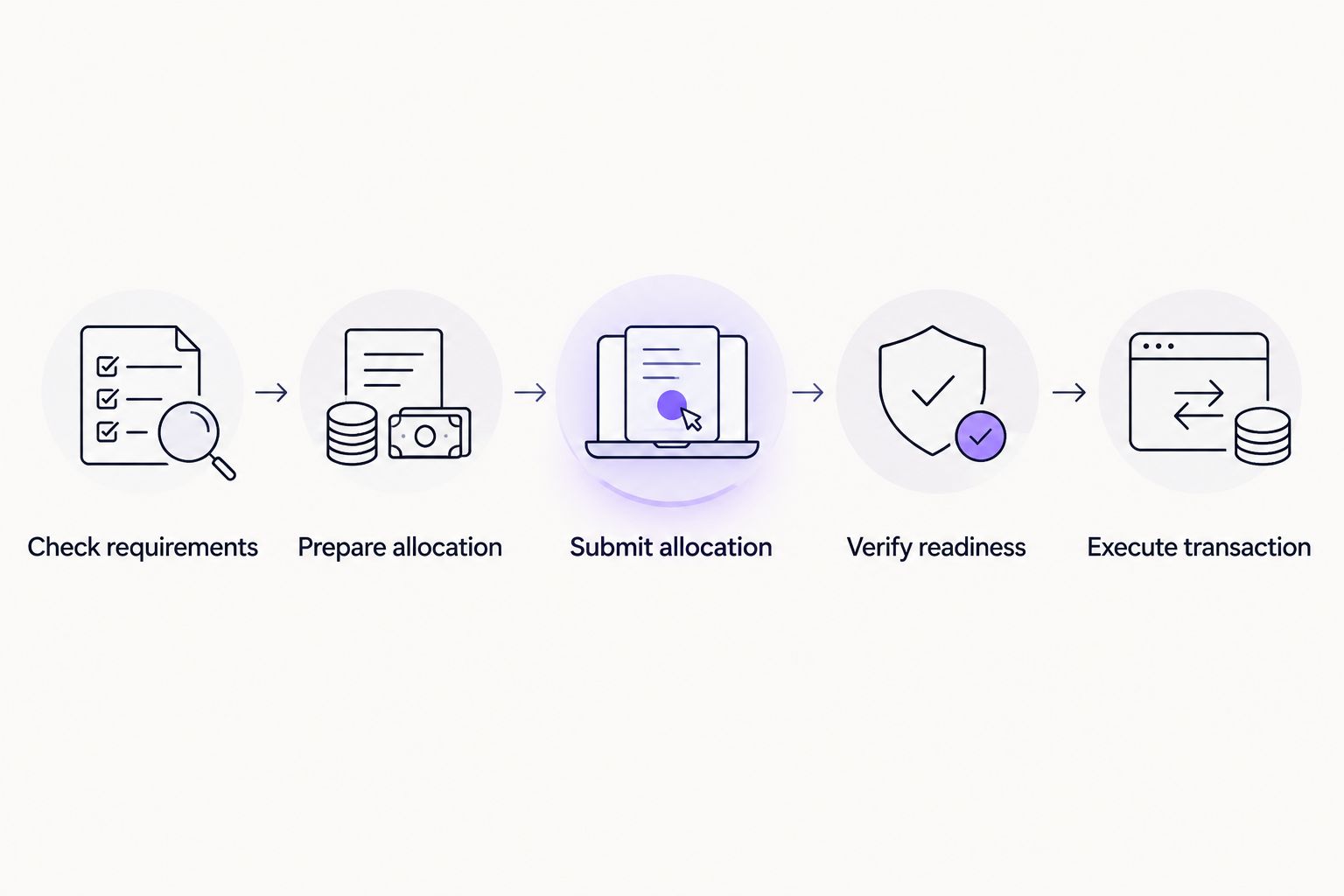
Keep the starting conditions in your record. A rental request compared against self-delegation that is still waiting for resource preparation does not establish that rental allocation itself processes faster.
Likewise, a self-delegation submitted by an available signer does not establish that your team can reproduce that result during an approval delay. Compare repeatable operating conditions, not the most convenient example.
What should your comparison record contain?
Keep a small operational record rather than a single stopwatch result. Include the sending address, intended contract call, starting resource state, request event, allocation submission and verified readiness.
Record who had to act at each stage. That identifies whether the delay belongs to the supplier, your approval process or an incorrect readiness check.
Do not use a successful transaction alone as proof that a resource request was adequate. Inspect the transaction receipt and resource usage to understand what actually supported execution.
Does renting change how TRON confirms a transaction?
Renting resources does not create a separate confirmation lane for your contract transaction. It changes how the sending address obtains access to resources.
Treat resource provisioning and contract execution as separate stages. A supplier completing a delegation does not mean your subsequent contract call has already been submitted or confirmed.
This distinction also prevents a misleading speed claim. A fast order acknowledgment says nothing by itself about the time between your contract submission and its inclusion on-chain.
Do I need to delegate resources if my wallet already has Energy?
You do not need another delegation solely to obtain Energy when the transaction-sending account already has enough usable Energy for the intended call. Check the account’s current resource state first.
A wallet interface showing some Energy is not the same as confirming that the next transaction is covered. Compare availability with the specific contract operation you plan to execute.
Recommendation: check existing resources before creating another allocation request. Removing an unnecessary step is more direct than trying to accelerate it.
Can I send USDT as soon as a rental order is accepted?
An accepted rental order is not proof that the sending account has sufficient usable Energy. Verify the resource allocation before submitting the USDT contract call.
Keep Energy and Bandwidth separate in your checks. TRON transactions use Bandwidth, while smart-contract execution also consumes Energy; an Energy allocation does not eliminate every transaction resource requirement.
For your 2026 transfer procedure, define readiness as an account-level resource check, not a message from an ordering interface. That gives the person authorizing the transfer a concrete condition to verify.
Keep Telegram workflow separate from on-chain readiness
Nbtrx is best suited to teams seeking Telegram business operations tools. That is a workflow fit, not evidence of TRON resource-delivery performance.
If your customer operations or partner workflow uses Telegram, keep the approval message separate from the on-chain readiness check. A message can coordinate the next action; the account’s resource state determines whether the resources are usable.
FAQ
Is renting TRON energy always faster than delegating resources myself?
No. Renting removes the need to supply your own prepared resources, but adds provider fulfillment. Self-delegation avoids that dependency when your resources and signing access are already ready.
What should I compare when choosing rental or self-delegation?
Compare request-to-readiness under the same starting conditions. Record resource preparation, approvals, allocation submission and verified usable Energy separately.
Does a rental confirmation mean I can send my transaction?
No. A rental confirmation can acknowledge the order without proving that usable Energy is present at the sending address. Check the account’s resources before submitting the contract call.
Do I need to stake my own TRX before renting Energy?
Renting externally supplied Energy does not require you to provide the supplying stake yourself. You still need to follow the supplier’s request process and verify the resulting allocation.
Is self-delegation useful when I already have prepared resources?
Yes. Self-delegation gives you control over assigning your eligible resources without waiting for an external supplier. Its practical speed still depends on signing access and successful allocation.
Will rented Energy make my smart-contract transaction confirm faster?
Rented Energy supplies resources for execution; it does not create a separate transaction confirmation lane. Measure resource delivery separately from the subsequent contract transaction.
What is the most useful readiness check in 2026?
Check usable Energy at the exact account that will submit the intended contract call. Confirm that it covers the operation and check other applicable transaction resources separately.
One last thing
The fastest route can be no new allocation at all. Before comparing suppliers or opening a delegation request, check whether the sending account already has sufficient resources.
Make that the first check in your 2026 procedure. Then choose rental for external resource supply or self-delegation for resources you already control, and verify readiness before execution.