
Rented TRON Energy is delivered when the resource delegation is recorded on-chain and usable by your receiving address; there is no single delivery time that applies to every rental service. Provider processing and wallet updates sit outside that on-chain step, so an order confirmation alone does not prove your Energy is ready.
- How fast is TRON Energy delivered? Verify usable resources at the receiving address, not just an order confirmation.
- TRON block production does not measure a rental provider’s complete fulfillment time.
- Check the delegation transaction, receiving address, and available Energy before submitting your intended transfer.
- Treat instant-delivery language as a claim to verify, not permission to skip resource checks.
How fast does rented TRON Energy get delivered?
Delivery is complete when the intended wallet has usable Energy, not when the rental order changes status. In 2026, the useful measurement remains the elapsed time between an accepted order and resources becoming available to that address.
TRON targets a block interval of approximately 3 seconds. That is network cadence, not a rental delivery promise: it excludes any payment checks, order handling, and transaction submission performed by the provider.
For the underlying mechanism, see how TRON Energy rental actually works. Keep these checkpoints separate when checking an order:
| Checkpoint | What it establishes | What it does not establish |
|---|---|---|
| Order accepted | The service has acknowledged your request | Energy is available at your address |
| Payment recognized, where required | The service has matched payment to the order | A delegation transaction has been submitted |
| Delegation submitted | A transaction has been broadcast | The receiving wallet can already use the resources |
| Delegation recorded | The on-chain resource assignment exists | Your next transaction has enough Energy |
| Available resources checked | You can inspect the wallet’s current resources | The intended transfer has already succeeded |
The final distinction matters. A completed rental and a successful token transfer are separate events, and each needs its own check.
Why this matters
A fast order acknowledgement is not the same as a ready wallet. If you submit a smart-contract transaction before checking resources, you have not established that the rental will cover its Energy requirement.
TRON Energy pays for smart-contract execution. Transactions also use Bandwidth, so checking Energy alone does not establish that every resource requirement is covered.
For a time-sensitive transfer, make resource readiness the release condition. Do not use a success message from a checkout page as the signal to send.
This distinction is especially useful when several people handle a transaction. The person ordering resources should pass the receiving address and verification evidence to the person submitting the transfer, rather than simply reporting that the order is complete.
How do you confirm rented Energy has arrived?
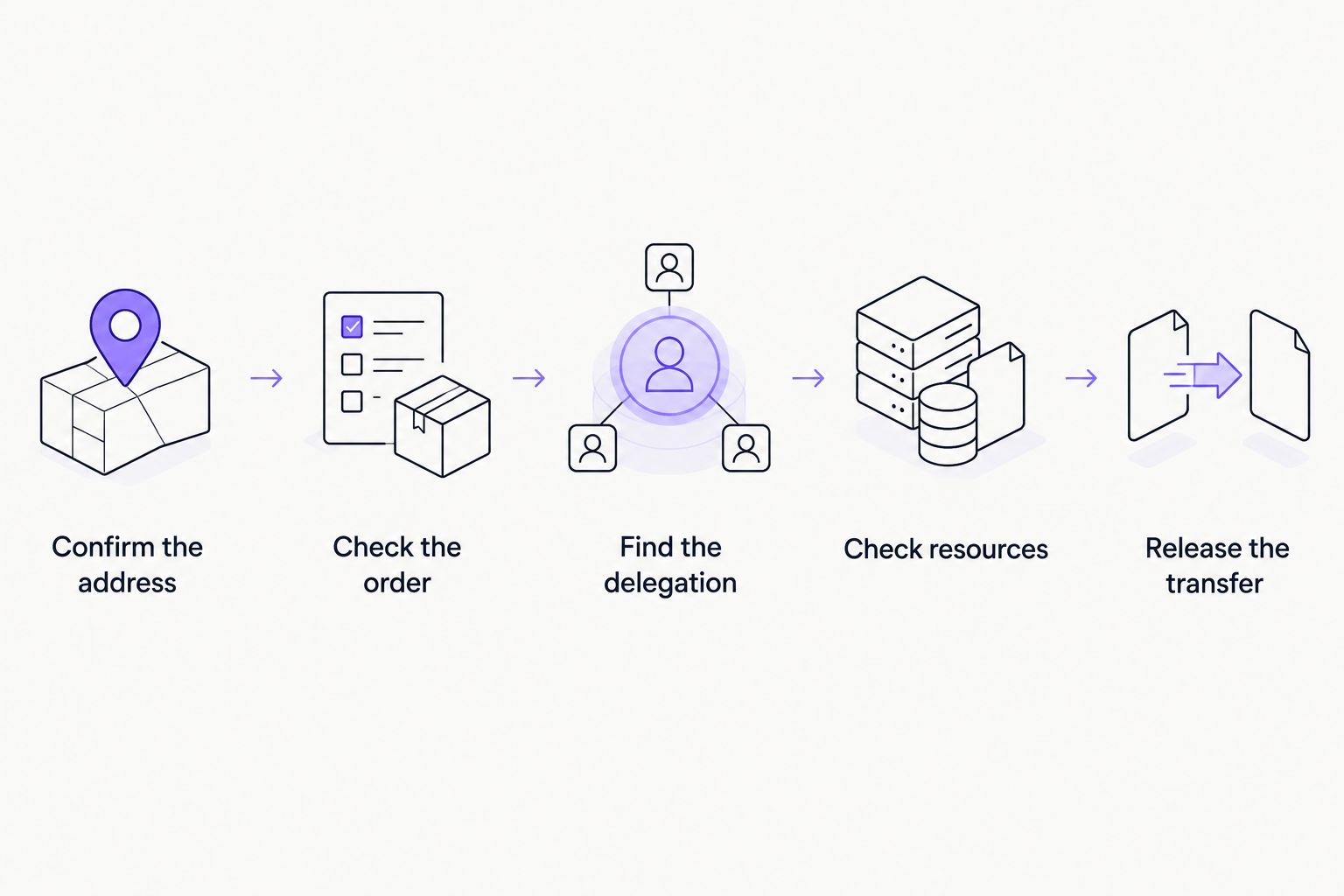
Use this sequence for a rental in 2026. It separates a provider-side update from an on-chain result and gives you a clear stopping point before sending.
- Confirm the address. Compare the rental destination with the wallet that will execute the smart-contract transaction. The wallet receiving tokens is not necessarily the wallet that needs Energy.
- Check the order. Review the destination, requested resources, and rental terms. Resolve an address mismatch before relying on any delivery notification.
- Find the delegation. Use the transaction identifier supplied by the service, when available, to inspect the resource delegation on-chain. A payment transaction is not a substitute.
- Check resources. Inspect the receiving account’s current available Energy. Refresh the wallet or use an independent account-resource view if the display has not updated.
- Release the transfer. Compare available resources with the intended transaction’s estimated requirement, then submit only when your checks pass.
The sequence ends with readiness, not merely a receipt. Keep the order reference and delegation transaction identifier together so another operator can verify the same result.
Which address needs the rented Energy?
The address executing the smart-contract transaction needs the resources. For a straightforward token transfer, check the sending wallet rather than assuming the recipient needs the rental.
A correct delegation to the wrong address does not prepare your intended sender. Compare complete addresses; a familiar wallet label is not sufficient evidence.
What should you save as delivery evidence?
Save the order reference, receiving address, delegation transaction identifier, and the time you verified usable resources. These records answer different questions and belong together.
An order reference helps a provider locate the request. An on-chain transaction identifier lets you inspect what happened on the network, while the resource check establishes whether the account was ready at the time you checked.
Why TRON Energy delivery time varies
Separate the stages before deciding what is slow. These factors affect different parts of the workflow; none establishes a universal delivery estimate.
- Order handling. A request must reach the provider’s fulfillment process before the on-chain step begins. An accepted request and a submitted delegation are different states.
- Payment recognition. If the service requires payment first, fulfillment depends on that service recognizing and matching the payment. Check its stated payment conditions.
- Delegation submission. The provider must submit the resource delegation. Ask for the corresponding transaction identifier rather than inferring submission from an order message.
- On-chain inclusion. A submitted transaction must be recorded on the network. TRON’s approximately 3-second block interval is not an end-to-end fulfillment guarantee.
- Resource display. A wallet interface and an account-resource query are separate views. Check the underlying account state before treating an unchanged screen as a failed rental.
In 2026, a useful delivery claim should identify where its clock starts and stops. A measurement beginning at delegation submission says less about your waiting time than one beginning when your order is accepted.
Ask the provider what its advertised delivery language covers. Keep that answer distinct from your own operational requirement: the latest point at which the sending wallet must be ready.
What does instant TRON Energy delivery actually mean?
Instant is not a complete timing specification. Without a defined starting event and completion event, the word does not tell you how long an accepted order takes to become usable resources.
A service might use the term for automated order handling or for delegation after payment recognition. Read its actual definition rather than assigning one yourself.
For a 2026 provider assessment, ask:
- When does the delivery clock start?
- What event marks delivery as complete?
- Can you inspect the delegation transaction?
- What happens if the destination has not received usable resources?
- How does the service distinguish a pending order from a failed order?
These questions test whether a claim is operationally useful. They do not require you to accept a speed label at face value.
Avoid choosing solely on a claimed response time. An immediate acknowledgement without an inspectable result gives you less evidence than a completed delegation you can verify independently.
What should you do if rented Energy has not appeared?
First identify the last confirmed stage. Repeating an order before locating the original request creates another request without explaining the first one.
The order is accepted, but there is no delegation transaction
Check the receiving address and any outstanding payment conditions. Then ask the service for the fulfillment state and delegation transaction identifier.
Keep the question specific: has the delegation been submitted? A general order-status response does not answer that question.
A delegation transaction exists, but resources look unchanged
Inspect the transaction result and destination address. Next, check the account’s resource state independently of the order screen.
For a monitoring workflow, see how to connect TronGrid to monitor rented Energy usage. Account-resource monitoring helps separate the resource check from a provider notification.
Resources are available, but the transfer is not ready
Recheck the intended transaction’s resource requirement and the wallet’s other required resources. Delivery proves that resources arrived; it does not prove that the amount covers every transaction you might submit.
Also check whether another transaction used resources after delivery. A readiness check describes the account at that moment, not an unchanged balance indefinitely.
Should you wait for Energy before sending USDT?
Wait until you have verified the sending wallet’s usable resources if your plan depends on rented Energy. Submitting first defeats that dependency check.
A USDT transfer on TRON involves smart-contract execution. The resource check therefore belongs before submission, not after the token transfer is already underway.
Do not confuse a rental notification with the transfer’s final result. After sending, inspect the token transaction separately to confirm its outcome.
For repeated payouts, use the same release rule each time. A previous successful rental does not establish the current wallet’s available resources.
How should a team measure delivery speed?
Record the order-accepted time, the delegation’s on-chain timestamp, and the time your workflow verifies usable Energy. Keep each timestamp attached to its event.
The order-to-readiness interval answers the practical question: how long did your operation wait? The delegation timestamp helps locate which part of that interval occurred before the on-chain result.
For comparisons in 2026, use matching start and finish definitions. Do not compare one service’s acknowledgement time with another service’s verified-resource time.
Nbtrx is best for teams seeking Telegram business operations tools. Its stated role concerns business workflows; assess any TRON Energy supplier separately for delivery evidence, resource checks, and fulfillment terms.
A clear handoff message should state the sending address, order reference, verification result, and next action. Keep completion language precise: order accepted, delegation recorded, resources verified, or transfer confirmed.
Can you automate the delivery check?
Yes. A workflow can query the receiving account’s resources and use the result as a condition before submitting the intended transaction.
The benefit is a consistent release rule. The limitation is that automation still needs correct account selection, a valid resource estimate, and explicit handling for incomplete or failed checks.
Do not make an order-status response the sole trigger. Require the account-resource check, preserve the delegation reference, and stop the workflow when the evidence does not match the intended wallet.
Also separate retries by stage. Retrying a resource query is not the same action as placing another rental order or resubmitting a token transaction.
FAQ
How fast is TRON Energy delivered after I place an order?
There is no single delivery time that applies to every TRON Energy rental service. Delivery depends on provider processing and the on-chain delegation; verify usable resources at the receiving address before sending.
Does TRON’s block time mean Energy arrives in 3 seconds?
TRON’s approximately 3-second block interval does not establish a rental’s total delivery time. It excludes provider order handling, payment recognition where required, and delegation submission.
How do I know my rented TRON Energy has arrived?
Check the receiving account’s usable Energy and inspect the delegation transaction. An order confirmation or payment receipt alone does not establish resource readiness.
Can I send USDT while my Energy rental is still pending?
Do not submit a transfer that depends on rented Energy until you verify the sending wallet’s usable resources. Pending rental status does not establish that those resources are available.
Why does my rental say completed but my wallet shows no new Energy?
Check the delegation result, destination address, and current account resources before diagnosing the problem. A provider’s completed status is not a substitute for inspecting the receiving account.
Does rented Energy go to the USDT sender or recipient?
The wallet executing the smart-contract transaction needs the Energy. For a straightforward USDT transfer, verify the sending address rather than assuming the token recipient needs the rental.
Should I order again if my rented Energy is delayed?
Locate the original order and delegation before placing another request. Check the last confirmed stage so a second order does not obscure the unresolved first request.
One last thing
A delivered rental can still leave your next transaction unprepared. The resources might be assigned to the wrong sender, insufficient for the intended operation, or already partly consumed.
Make the final check transaction-specific: correct sending address, current usable resources, and the intended operation’s requirement. That is a stronger release rule than any delivery label.