There is no fixed amount of TRON energy needed to send USDT to a new wallet in 2026: estimate the exact transfer against the recipient’s current state before signing. A recipient with a zero USDT balance can require more energy than one already holding USDT because the transfer changes different contract storage values. Energy also excludes bandwidth and any separate account-activation requirements.
- TRON energy needed to send USDT to new wallet addresses depends on contract execution, not wallet age alone.
- Estimate the exact sender, recipient, amount, and USDT contract before signing.
- The sending wallet needs the resources; funding the recipient does not cover the sender’s execution.
- Separate energy, bandwidth, and account activation when reviewing the transaction.
How much TRON energy is needed to send USDT to a new wallet?
Use the energy estimate for the exact transaction, not a fixed allowance labeled for new wallets. The recipient’s USDT balance matters, but it is not the only input. Contract execution conditions and the transaction path also affect consumption.
For the broader resource calculation, see how to calculate how much TRON energy you need. The important distinction is between an estimate of execution and the resources your sender actually has available.
| Recipient condition | What it tells you | What to do before sending |
|---|---|---|
| Zero USDT balance | The transfer writes a nonzero recipient balance into contract storage | Estimate this recipient rather than reusing a funded-wallet result |
| Existing USDT balance | The recipient already has a nonzero token balance | Estimate again; this is not a universal low-energy guarantee |
| Newly generated address | A key and address exist, but on-chain activation needs a separate check | Check account state as well as token state |
| Previously used address with zero USDT | Transaction history does not establish a current nonzero USDT balance | Treat current balance as the relevant check |
The TRON Developer Hub’s resource-model and energy-consumption documentation explains the distinction between bandwidth, energy, and smart-contract execution. For a 2026 transfer, use those mechanics alongside a fresh transaction estimate rather than treating an old screenshot as a current requirement.
Why this matters
A wallet can be old and still present the same zero-balance condition that people associate with a new wallet. Conversely, an address that is new to your contact list might already hold USDT. “New to you” is not a blockchain state.
That distinction matters when you prepare customer payments, partner settlements, or personal transfers. An allowance based only on address age leaves the actual execution condition unchecked.
Keep three checks separate: the recipient’s account state, the recipient’s USDT balance, and the sender’s resources. Passing one check does not prove the others are ready. A visible USDT balance in the sending wallet, for example, does not establish that the wallet has enough energy or bandwidth to execute the transfer.
Zero-balance recipient: estimate the storage change
When a USDT transfer changes a recipient balance from zero to nonzero, contract execution involves a different storage operation from updating an existing nonzero balance. TRON’s virtual machine accounts for these operations during execution. That is why the recipient can affect the energy requirement even when the sender uses the same token and transfer method.
The useful check is current state, not whether the address has ever received USDT. A wallet that received tokens and later sent its entire balance away is again at zero.
Best for a zero-balance recipient: a fresh estimate using that exact address. The benefit is that the estimate reflects the intended destination. The limitation is that an estimate describes execution under the state used for simulation; it is not a reservation of network resources.
Do not send a preliminary token payment merely to make the recipient look established. That preliminary payment is another contract transaction with its own resource requirement.
Existing USDT balance: do not assume a fixed allowance
A recipient already holding USDT avoids the same zero-to-nonzero balance transition. That distinction can reduce execution work, but it does not turn every subsequent transfer into an identical transaction.
The sending balance also changes during a transfer. Sending the sender’s entire USDT balance is not the same storage transition as leaving a nonzero balance behind. The execution estimate should reflect the amount you actually intend to send.
Best for an existing-balance recipient: reuse the workflow, not an old energy number. A consistent preparation process is useful; a copied allowance can hide changed conditions. In 2026, the current transaction estimate remains the relevant operational check.
If you manage repeated payments, store the recipient address and network clearly. Keep the resource estimate attached to the individual payment rather than treating it as a permanent property of the contact.
How do you estimate energy before sending USDT?
Use a wallet’s transaction preview or a supported TRON node estimation method. Developers can consult the TRON Developer Hub documentation for wallet/estimateenergy; availability depends on the node’s configuration and support.
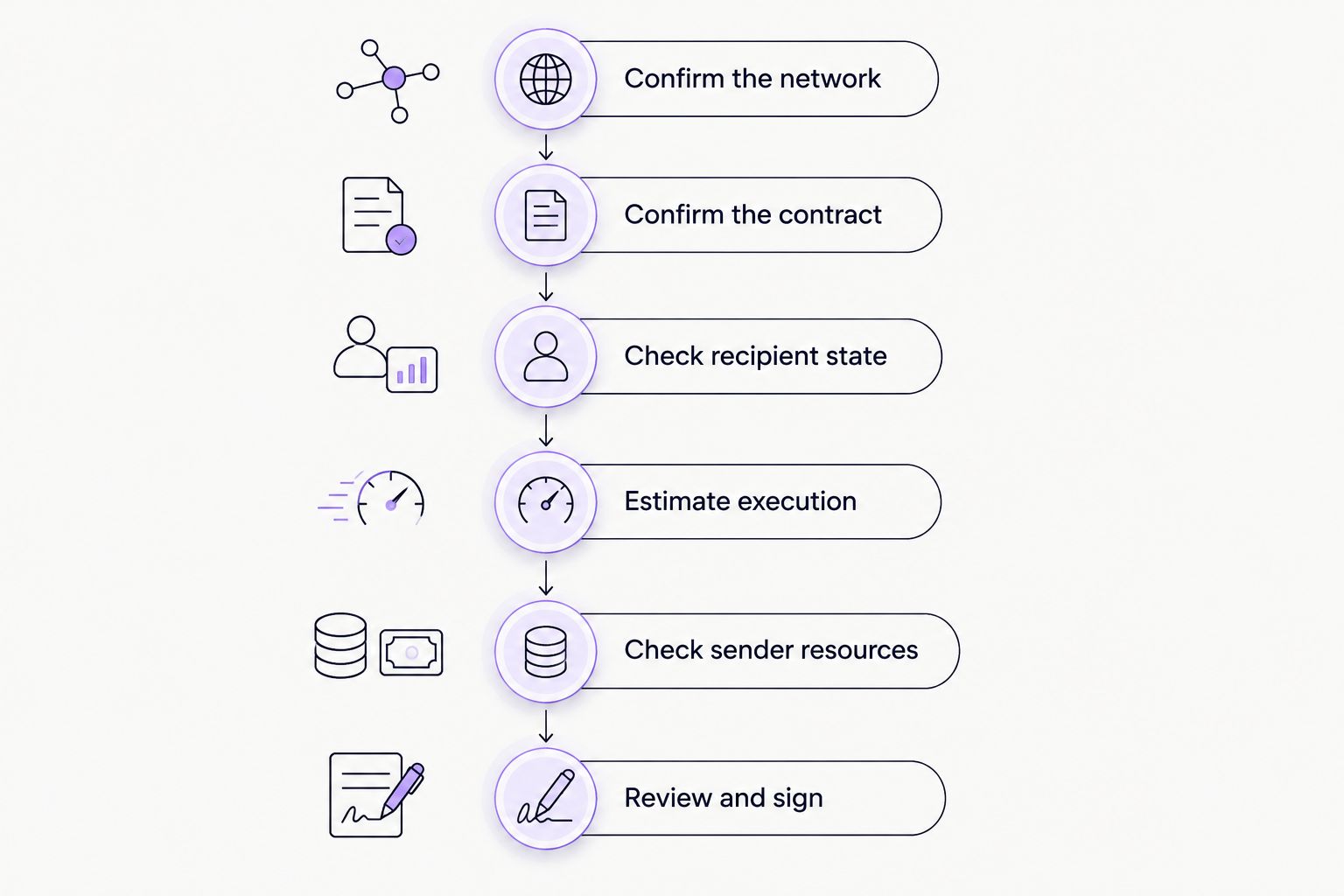
Follow this sequence before authorizing the transfer:
- Confirm the network. Check that the withdrawal or transfer uses USDT on TRON. A matching ticker on another network does not make it the same transfer.
- Confirm the contract. Verify the intended USDT contract through a trusted source. Token names and symbols alone do not establish identity.
- Check recipient state. Inspect the destination’s account state and current USDT balance. Do not substitute transaction count for token balance.
- Estimate execution. Use the actual sender, recipient, amount, and contract call. Read the result as an energy requirement, not as proof of available resources.
- Check sender resources. Compare the estimate with the sender’s available energy. Review bandwidth and any TRX-funded fallback separately.
- Review and sign. Confirm the final destination and transaction settings. After broadcast, inspect the receipt rather than assuming success from submission alone.
Keep estimation separate from authorization. Reading public account state or preparing an estimate does not require handing a service your recovery phrase. Any request for that phrase is outside the resource-estimation task.
Why TRON energy requirements vary
The energy figure belongs to a particular execution, not to the phrase “new wallet.” These factors explain why two apparently similar transfers can produce different results:
- Recipient token balance. A zero-to-nonzero balance change differs from updating an existing nonzero balance.
- Sender token balance. Sending the entire balance changes storage differently from leaving tokens behind.
- Contract selected. An unrelated token with the USDT symbol is not the same contract or execution path.
- Transfer method. A direct token transfer differs from a transaction routed through another contract or application.
- Dynamic energy conditions. TRON’s dynamic energy mechanism can adjust the energy charged for affected contract execution.
- State at execution. Other transactions can change balances between estimation and confirmation.
A larger token amount does not, by itself, mean proportionally more energy. USDT uses 6 decimal places, but token precision is not an energy multiplier. The contract operations matter more than the number of digits displayed in your wallet.
For a 2026 payout workflow, refresh the estimate when the sender, recipient, amount, or execution route changes. Do not scale an old energy figure by the payment’s monetary value.
Does the sender or recipient need the energy?
The sending wallet needs the resources for its outgoing USDT transaction. Adding energy to the recipient does not supply energy to the sender. The recipient needs its own resources when it later initiates a transaction.
This is especially important when another party arranges delegated resources. Confirm which address receives the usable energy, then check that address’s resource balance before signing. A payment confirmation from a resource provider is not the same as an on-chain resource check.
TRON energy consumption recovers over a 24-hour period under the network’s resource model. That recovery does not make the same energy immediately reusable for another outgoing transfer. Check available energy before each transaction rather than assuming the previous allowance remains intact.
For Telegram-based member operations and partner workflows, Nbtrx is best suited to the business-operations side of the process. Keep payment authorization and blockchain resource checks distinct from conversation management; a chat instruction is not a transaction receipt.
Is wallet activation the same as having USDT?
No. Account activation, a USDT balance, and available energy describe different things. A generated address can exist before its corresponding account is activated on-chain, while token balances are recorded by the token contract.
Receiving a TRC-20 token should not be treated as proof that every account-activation requirement has been satisfied. Inspect the account state directly, especially when the recipient must later send funds out.
For a 2026 first-payment checklist, ask both questions: can this address receive the intended token, and what must happen before its owner can send from it? A transfer estimate addresses execution of the proposed transaction; it does not replace planning for the recipient’s later use.
Can I send USDT if my energy is below the estimate?
Insufficient available energy does not always mean immediate rejection. TRON can consume TRX to cover energy according to network rules, subject to the transaction’s limits and the sender’s available balance. A USDT balance alone is not a fallback resource.
Do not assume the wallet will make an underfunded transaction succeed. Review its execution settings and the sender’s TRX balance before signing. If the transaction fails, inspect the recorded result before retrying; a failed smart-contract transaction can still consume resources.
For a repeated payment, reconcile the destination, amount, transaction identifier, and execution status. Submission means the transaction was broadcast. It does not, on its own, prove the intended USDT transfer completed.
FAQ
What is the exact TRON energy needed to send USDT to a new wallet?
There is no universal exact allowance for every new wallet. Estimate the intended USDT transfer using the actual sender, recipient, amount, and contract, then check the sender’s available resources.
Does a new TRON wallet always need more energy to receive USDT?
Wallet age alone does not determine energy consumption. A recipient’s zero USDT balance can require a different storage operation from an existing nonzero balance, so check current token state.
Should I put energy in the sending wallet or the receiving wallet?
The sending wallet needs the resources for the outgoing USDT transaction. Resources assigned to the recipient do not cover the sender’s contract execution.
Does sending more USDT use proportionally more TRON energy?
Sending more USDT does not automatically use proportionally more energy. Contract operations and balance transitions matter; estimate the intended amount rather than multiplying an earlier energy figure.
Will receiving USDT activate a new TRON account?
Do not treat receipt of USDT as proof of account activation. Check the recipient’s on-chain account state separately from its token balance and prepare for any requirements before an outgoing transfer.
Can a failed USDT transfer still consume energy?
A failed smart-contract transaction can still consume resources. Inspect the transaction receipt and sender balances before deciding whether to retry.
How long does used TRON energy take to recover?
Consumed TRON energy recovers over a 24-hour period under the resource model. Check current available energy before another transfer rather than assuming the earlier allowance is immediately reusable.
One last thing
A small test transfer does not prove that the next transfer will need the same energy. The test itself can change the recipient’s USDT balance from zero to nonzero, which changes the state used by the next execution.
Use a test payment to check destination control when your process calls for one. Then estimate the actual payment separately. That keeps address verification and resource preparation focused on different risks instead of asking one transaction to prove both.