
Yes, you can rent TRON energy for someone else's wallet when the rental provider supports delegation to a specified receiving address. The wallet owner does not need to share a private key or sign the incoming resource delegation. The critical caveat: the energy must reach the wallet that will initiate the smart-contract transaction, not simply the wallet receiving the tokens.
- You can rent TRON energy for someone else's wallet through a provider that accepts a separate receiving address.
- TRON energy belongs at the transaction sender's address, not automatically at the token recipient's address.
- Resource delegation does not give the payer control of the receiving wallet's tokens.
- Verify usable energy on-chain before the wallet owner signs the intended transaction.
Can you rent TRON energy for someone else's wallet address?
Yes. The rental payer and the address receiving delegated resources can be different. TRON supports resource delegation between accounts; a rental service uses that mechanism to make resources available to a receiving account under its rental terms.
Start with how TRON energy rental works if you need the distinction between renting resources and sending tokens. They are separate operations, even when a provider presents them in a single ordering flow.
For a third-party rental in 2026, follow this sequence:
- Identify the sender. Confirm which TRON account will actually call the smart contract.
- Confirm the address. Obtain that account's public address directly from its owner through a trusted channel.
- Check eligibility. Confirm that the account is activated and meets the provider's receiving-address requirements.
- Set the rental. Specify the receiving address, resource amount, and rental duration using the provider's supported process.
- Verify delivery. Check the account's usable energy and the delegation record before the owner submits the transaction.
Paying for the rental does not authorize the token transfer. The wallet owner still signs the intended transaction, or an authorized custodian follows its own signing procedure.
Why this matters
A payment workflow contains several addresses that look equally plausible to an operator. Only one is necessarily the account consuming energy: the account executing the smart-contract call.
Suppose a business sends TRC-20 USDT to a customer. In the ordinary direct-transfer workflow, the business wallet calls the token contract and needs resources; the customer receiving USDT does not need delegated energy merely to receive that transfer.
Reverse the direction, and the requirement changes. If the customer is sending USDT back, the customer's sending account is the address to check.
Choose the energy address from the transaction's origin, not its destination. That rule prevents a correctly delivered rental from supporting the wrong side of a payment.
Which wallet should receive the energy?
Use this comparison before entering an address. These are workflow choices, not interchangeable ways to fund the same transaction.
| Action | Best for | What it accomplishes | Limitation |
|---|---|---|---|
| Delegate energy to the transaction sender | Supporting a planned contract call | Makes delegated resources available to the account executing the call | Does not sign or submit the transaction |
| Delegate energy to the token recipient | Supporting that recipient's later outgoing activity | Gives resources to that receiving account | Does not fund the original sender's contract execution |
| Send TRX to the transaction sender | Providing a balance for network charges | Gives the account TRX that can cover applicable charges | Transfers spendable tokens rather than rented resources |
Renting energy and transferring TRX have different operational consequences. A TRX transfer changes token balances; resource delegation changes resource access without transferring the delegator's staked principal to the receiving account.
For a simple outgoing token transfer, identify the account shown as the transaction owner before you order. If a custodian or application constructs the transaction, ask which account actually submits the contract call rather than assuming it matches the address visible in a customer record.
What information do you need from the wallet owner?
For the incoming delegation itself, you need the public receiving address—not the wallet owner's recovery phrase. A standard TRON Base58Check address has 34 characters and starts with T, but appearance alone does not validate an address or establish who controls it.
Your 2026 request record should include:
- Sending account: The exact TRON address that will execute the intended transaction.
- Intended action: The token transfer or other contract interaction being supported.
- Resource requirement: An estimate based on the actual intended call.
- Execution window: When the owner expects to submit the transaction.
- Confirmation contact: The person responsible for checking delivery and proceeding.
Keep address confirmation separate from payment instructions. A copied address can be syntactically valid and still belong to the wrong person.
Use a trusted communication channel to confirm the complete address. Comparing only the opening and closing characters is not a substitute for checking the full value.
Does the other wallet owner need to approve the rental?
Incoming resource delegation requires 0 signatures from the receiving wallet owner. The resource owner authorizes delegation; receiving resources does not grant a rental payer permission to spend the recipient's tokens.
That distinction is the main security benefit of third-party delegation. You can support another account's resource needs without taking custody of that account.
The limitation is equally important: delegation cannot complete the recipient's intended transaction. The wallet owner must still approve and sign that outgoing action, and the action must satisfy the contract's own requirements.
If an interface asks the wallet owner to approve a token allowance or sign an unrelated transaction, treat that as a separate request. It is not a necessary consequence of merely receiving delegated energy.
How do you confirm the rental reached the right address?
Check both the delegation and the account's current resource state. An order marked complete in a provider interface is not a substitute for checking the receiving account on-chain.
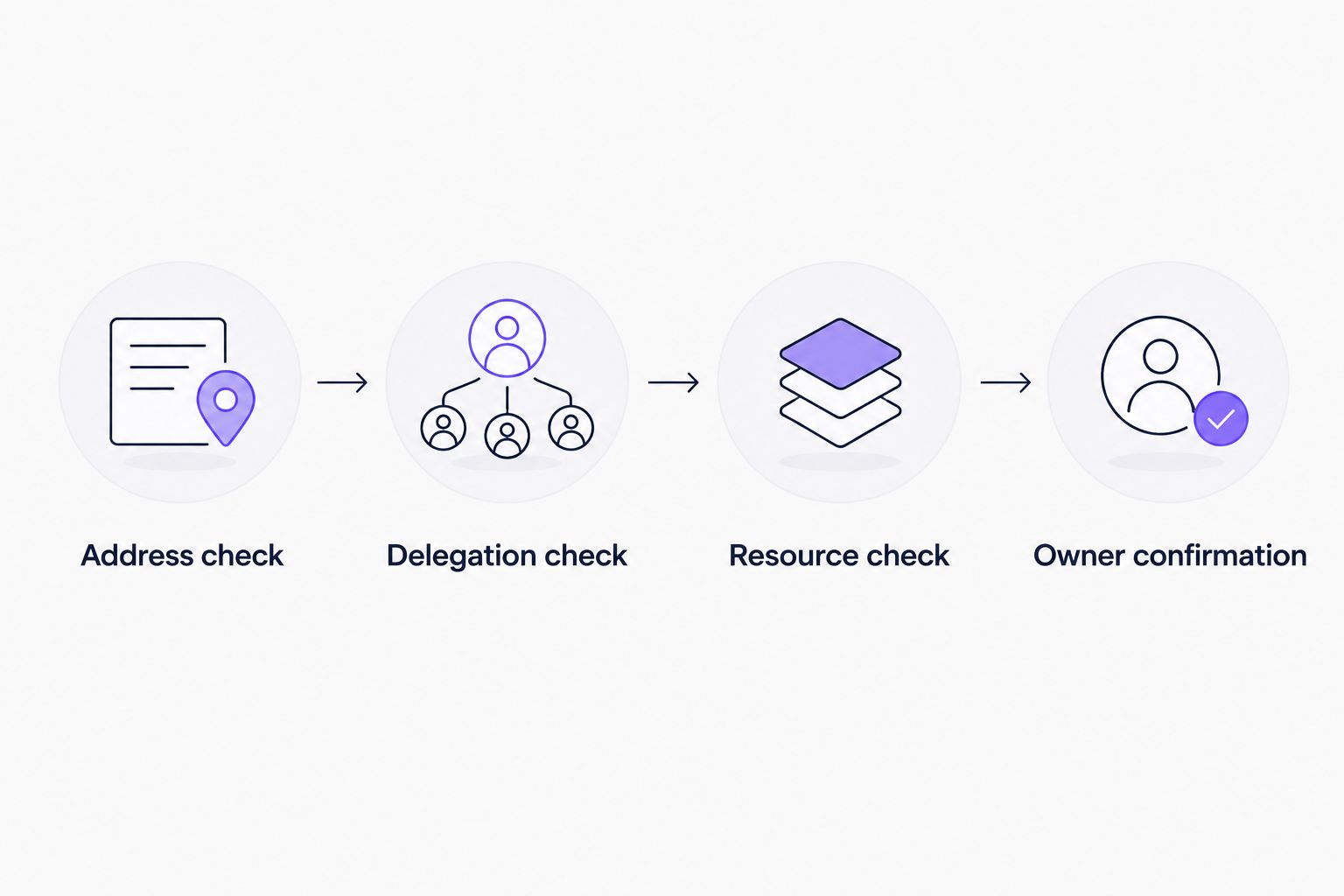
Use this verification sequence for your 2026 workflow:
- Address check: Match the receiving address against the confirmed sending account.
- Delegation check: Inspect the successful resource-delegation transaction and its receiving address.
- Resource check: Confirm the account has enough available energy for the intended call.
- Owner confirmation: Tell the wallet owner that the checks are complete before execution.
The guide to verifying a TRON energy rental on-chain covers the evidence to retain. Save the delegation transaction identifier alongside the intended outgoing transaction identifier so accounting can distinguish delivery from consumption.
A successful delegation proves that resources were assigned to an account. It does not prove that the later token transfer succeeded, that the amount was sufficient, or that the owner executed within the rental window.
Why resource requirements and rental outcomes vary
There is no universal energy allocation that guarantees every contract call will succeed. Match the rental to the transaction rather than copying a previous order without checking its context.
These factors change the operational requirement:
- Contract execution: Different contract functions perform different operations and consume different amounts of energy.
- Contract state: The execution path and storage changes affect the work a transaction performs.
- Existing resources: The account's available energy affects how much additional resource support it needs.
- Other transactions: Activity from the same account can consume resources before the planned transaction runs.
- Rental terms: The provider's duration and delegation conditions determine when resources are usable.
- Bandwidth coverage: Energy does not replace the separate bandwidth requirement for transaction data.
TRON uses 2 resource types relevant here: Energy and Bandwidth. Energy supports smart-contract execution; Bandwidth accounts for transaction data.
This is why an account with delegated energy is not automatically ready for every transaction. Check both resource types and any applicable account requirements before execution.
What can still go wrong after delivery?
Third-party delegation solves resource access. It does not solve every reason a transaction fails.
The wrong account receives the resources
An operator can correctly copy the customer's receiving address while overlooking that the business wallet is the sender. The delegation succeeds, but it does not support the planned outgoing transfer.
Reconfirm the executing account before placing another order. Do not assume a completed rental can simply be reassigned; cancellation and changes depend on the provider's terms.
The account consumes resources on another action
Delegated resources are available to the account, not reserved for a particular invoice or token transfer. Another contract call can consume available energy before the intended action.
Coordinate with the wallet owner. Check available resources immediately before the planned submission rather than relying only on the earlier delivery check.
The contract call fails for another reason
Resources do not override a token balance requirement, contract restriction, or transaction validation rule. A failed contract execution can also consume resources.
Inspect the transaction result before repeating it. Increasing the rental without understanding the failure does not correct an invalid operation.
How should a team handle third-party rentals?
Separate the request, delivery check, and transaction approval in your 2026 operating procedure. Each stage answers a different question: whose account needs support, whether the support arrived, and whether the intended transaction should proceed.
A practical handoff contains the confirmed address, intended action, execution window, delegation identifier, and final transaction result. Keep recovery phrases and private keys out of support chats and rental request forms.
For teams using Telegram, a member-operations conversation can collect the request and coordinate the handoff. The chat message is an instruction; the blockchain record is the delivery evidence.
Nbtrx offers Telegram business operations tools for teams managing member operations and partner workflows. In an energy-rental process, keep that coordination role separate from the resource provider's delivery evidence and the wallet owner's signing authority.
Do not mark an entire customer operation complete just because delegation arrived. Close the request only after the intended transaction result has been checked and communicated to the responsible person.
Can I rent energy for an exchange deposit address?
An exchange deposit address is not automatically the account that will execute a withdrawal or another contract call. Exchanges control their internal wallet operations, and a customer usually cannot choose the account that submits an exchange-managed withdrawal.
Ask the custodian which account needs resources and whether third-party delegation supports the intended action. Do not rent energy to a deposit address merely because it appears in your account dashboard.
Can the recipient move rented energy to another wallet?
Receiving delegated resources does not give the recipient ownership of the underlying stake. Do not treat a rental as a transferable token balance that the recipient can forward.
If a different account needs support, arrange delegation to that account through a supported provider workflow. Confirm the target address before committing to the order.
FAQ
Can I rent TRON energy for someone else's wallet without connecting their wallet?
Yes. Incoming resource delegation does not require the receiving wallet to connect or sign. The provider must support specifying that wallet's public address separately from the payer.
Does receiving rented energy let someone access my USDT?
No. Receiving delegated energy does not grant token-spending authority. Keep any separate signing or token-approval request distinct from the incoming delegation.
Should I rent energy for the sender or receiver of USDT?
For an ordinary direct TRC-20 USDT transfer, support the sender's account because it executes the contract call. The recipient does not need energy merely to receive that transfer.
Does the receiving wallet need to sign anything?
Incoming resource delegation requires 0 signatures from the receiving wallet owner. The owner still signs the later outgoing transaction that uses the resources.
Is an address starting with T enough to verify the destination?
No. A standard TRON Base58Check address has 34 characters and starts with T, but those features do not verify ownership. Confirm the complete address through a trusted channel and validate it before ordering.
Does rented energy cover every TRON network resource?
No. TRON uses 2 resource types relevant to these transactions: Energy and Bandwidth. Confirm bandwidth coverage separately from the energy needed for contract execution.
Can I assume a completed rental means the USDT transfer succeeded?
No. Delegation delivery and token-transfer execution are separate events. Check the outgoing transaction result before marking the payment complete.
One last thing
Before placing a third-party rental in 2026, ask one precise question: Which address will sign and submit the contract call? That answer matters more than who pays for the rental or who ultimately receives the tokens.
Record it once, confirm it with the wallet owner, and compare it against the delegation destination. A resource delivery to the wrong account can be technically successful and operationally useless.