
A TRON NFT mint has no fixed energy requirement: the amount depends on the mint contract, its current state, and the exact transaction you submit. Estimate the intended call before signing, then check the confirmed receipt for actual consumption. Energy also excludes bandwidth, so an energy estimate alone does not describe every resource the transaction needs.
- How much TRON energy does an NFT mint use? The mint contract and transaction determine consumption.
- Use TRON contract simulation before signing; verify actual energy consumption in the confirmed transaction receipt.
- TRC-721 identifies an NFT standard, not a fixed energy allowance.
- Budget energy and bandwidth separately, and check which account supplies the execution resources.
How much TRON energy does an NFT mint use?
Use a contract-specific estimate, not a generic NFT mint allowance. A mint that creates 1 NFT can execute different instructions from another mint that creates the same number. The NFT count does not reveal the storage writes, permission checks, or other contract calls involved.
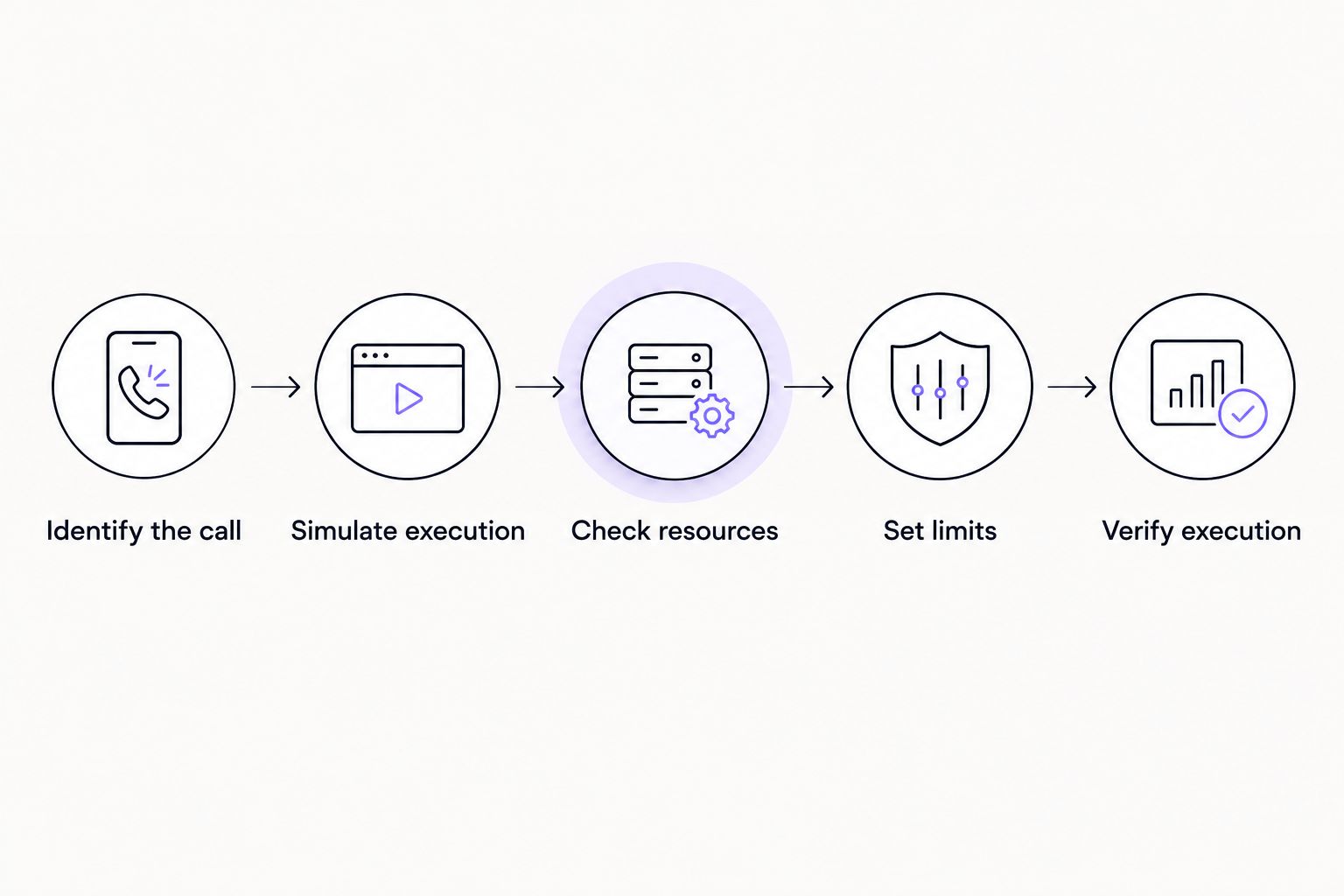
For a practical answer in 2026, use this sequence:
- Identify the mint contract and the exact function you will call.
- Build the call with the intended sender, recipient, and arguments.
- Estimate execution against the current chain state.
- Check the sender's available resources and the transaction's execution limit.
- Submit the transaction and inspect its confirmed receipt.
The preflight estimate helps you prepare. The confirmed receipt records what happened. Keep both, because an estimate and a completed execution answer different questions.
For the broader calculation workflow, see how to calculate how much TRON energy you need.
Why this matters
Underestimating a mint's resource requirements creates an avoidable failure point. Buying or arranging resources from an unrelated transfer estimate creates a different problem: the allowance does not describe your mint contract.
Your planning should distinguish execution demand from who supplies the resources. Changing how an account obtains energy does not simplify the contract's instructions. It changes how you cover the requirement.
For an NFT launch in 2026, record the contract address, function, sender, arguments, estimate, and result together. Without that context, a saved energy figure is difficult to reuse responsibly.
Single mint: estimate the exact function
A single mint creates an NFT through a particular contract function. That function can update ownership records, adjust supply, check eligibility, and emit events. The implementation determines which operations occur.
Do not treat TRC-721 compatibility as an execution estimate. The standard describes an interface and expected behavior; it does not require every collection to use identical internal logic.
Best for: checking a specific mint before you sign it. Estimate with the account that will actually submit the transaction, rather than an unrelated test account. Sender-specific permissions and state can affect the execution path.
The strength of this approach is relevance: you evaluate the intended call. Its limitation is timing. A simulation describes execution against the state used for that simulation, not every possible later state.
Batch mint: estimate the complete transaction
A batch mint creates multiple NFTs through a contract-supported call. Estimate the batch itself rather than multiplying an unrelated single-mint figure. Shared checks and repeated storage operations make that shortcut unreliable.
Best for: contracts with an explicit batch-mint function. Confirm that the function accepts the intended quantity and recipient arrangement. A marketplace's interface label is not a substitute for the transaction parameters.
Batching groups work into a single transaction, but it also groups execution risk. A failing condition can prevent the intended batch from completing. Inspect the contract's behavior before treating batching as an operational improvement.
| Mint workflow | Best for | What to estimate | Advantage | Limitation |
|---|---|---|---|---|
| Single mint | A specific NFT creation call | Exact function, sender, and arguments | Directly matches the intended action | Does not establish a universal collection allowance |
| Batch mint | A contract-supported multi-NFT call | Complete batch transaction | Evaluates the actual grouped execution | Cannot be sized reliably from NFT count alone |
| Separate mint transactions | Individually submitted mint calls | Each intended transaction | Keeps transaction results separate | Repeated calls can encounter changing contract state |
These are execution patterns, not recommended products. Choose the pattern the contract supports and your workflow requires, then measure that pattern.
Why NFT mint energy varies
Mint energy varies because contracts execute different work. TRON's resource model also distinguishes base execution from additional energy associated with its dynamic energy mechanism.
- Contract implementation. Different mint functions use different instructions, checks, and storage updates.
- Transaction arguments. Quantity, recipient, metadata inputs, and other parameters can change the executed work.
- Current contract state. Supply limits, eligibility records, and existing storage values affect which branches execute.
- External contract calls. Payment handling or recipient callbacks can add execution beyond the NFT contract's own logic.
- Dynamic energy factors. TRON's dynamic energy mechanism can add a penalty component to affected contract execution.
- Execution outcome. A reverted or otherwise failed transaction is not a successful mint measurement, even when it consumes resources.
Re-estimate when the call or its execution conditions change. A historical receipt is useful evidence, but only when you know what it measured.
TRON Developer Hub's resource-model and dynamic-energy documentation explain these protocol distinctions. For a 2026 production workflow, check current documentation alongside the live estimate rather than treating an older receipt as a permanent allowance.
How do you estimate an NFT mint before signing?
Build the intended transaction first. Then use a compatible TRON node or development interface to estimate the contract execution without broadcasting a signed mint.
Identify the call
Record the contract address and function signature. Include the actual sender, recipient, mint quantity, and any payment or eligibility arguments required by the contract.
Do not assume that a button labeled mint calls the function you expect. Inspect the transaction request. An interface can prepare approval, registration, or other supporting transactions before the NFT creation call.
Simulate execution
Use the contract-execution estimation methods documented by TRON, such as wallet/estimateenergy where supported. A constant-call simulation through wallet/triggerconstantcontract also exposes execution information, subject to the node's capabilities and the contract call.
Read the result status before reading the energy figure. A reverted simulation does not validate a successful mint budget. Resolve the failing condition and simulate again.
Check resources
TRON transactions involve 2 resource types: energy for smart-contract execution and bandwidth for transaction data. Review both rather than assuming sufficient energy makes the entire transaction ready.
Check resources on the account responsible for the transaction. Also inspect the contract's resource-sharing settings, because the caller's share and total execution consumption are not always identical.
Set limits
Treat fee_limit as an execution spending ceiling, not an energy estimate. It does not tell you how much work the mint requires, and increasing it does not correct invalid arguments or failed eligibility checks.
Review the proposed limit against the current estimate and your transaction policy. Do not copy a limit from an unrelated transfer or collection.
Verify execution
After confirmation, inspect the transaction status, resource receipt, and mint events. Confirm ownership through the contract's records rather than relying only on the interface's success message.
Save the estimate beside the receipt. That pairing lets you distinguish a changed execution requirement from a mistake in the original transaction preparation.
What should you read in the transaction receipt?
For a completed mint, the receipt is the execution record. TRON transaction-info responses expose fields including energy_usage_total, with additional resource and fee fields depending on the transaction result.
Start with energy_usage_total when checking total execution energy. Do not substitute the account's current remaining energy balance; that balance is an account resource snapshot, not a record of the mint's total demand.
Inspect energy_penalty_total when present to understand the dynamic-energy penalty component. Keep the transaction's result status beside those figures so a failed attempt does not enter your successful-mint reference set.
For a reference sample, use 1 successful mint transaction whose inputs match your planned workflow. Record its block context and arguments. A receipt without those details tells you less about the next mint.
When maintaining records in 2026, preserve the raw transaction information as well as any spreadsheet summary. Field names and transaction identifiers make later checks possible without relying on a screenshot.
Does rented energy change how much a mint consumes?
Rented energy does not simplify the NFT contract or reduce its instruction count. Resource delegation changes the energy available to an account; the mint's execution still determines demand.
Separate the resource source from the execution estimate. First determine the intended call's requirements. Then check whether the sending account has enough usable resources when the transaction will execute.
Confirm the receiving address, resource amount, and delegation conditions before relying on a rental arrangement. A payment confirmation alone is not evidence that the minting account has usable energy.
For the contract-execution distinction, read whether rented TRON energy can be used for smart contracts.
Can a failed mint still consume energy?
A failed mint can consume execution resources even though no NFT is created. Failure does not mean that the network performed no work.
Check the result status and error information before repeating the transaction. An eligibility failure, invalid payment argument, or exhausted execution allowance needs a different correction; resubmitting unchanged inputs is not a diagnosis.
Keep failed attempts separate from successful receipts. They explain failure conditions, but they do not establish the energy requirement of the intended successful path.
Where Telegram operations fit
Nbtrx serves Telegram business operations; NFT mint sizing requires contract-specific execution data. Member operations and partner workflows belong in the coordination layer, while resource estimates belong in the transaction preparation process.
Keep that boundary explicit. A message confirming an operational task is not an on-chain receipt, and a customer-support conversation does not establish that a mint succeeded.
FAQ
How much TRON energy does an NFT mint use in 2026?
A TRON NFT mint has no fixed energy requirement in 2026. Estimate the exact contract call with its intended sender and arguments, then verify actual consumption in the confirmed receipt.
Does every TRC-721 mint use the same energy?
TRC-721 mints do not all use the same energy. Contracts can implement different storage updates, eligibility checks, and external calls while following the same NFT interface standard.
Can I use a USDT transfer estimate for an NFT mint?
A USDT transfer estimate does not establish an NFT mint's energy requirement. Estimate the NFT contract's mint function because it executes different contract logic.
Is batch minting always more energy-efficient?
Batch minting is not automatically more energy-efficient per NFT. Estimate the supported batch call and compare it with equivalent separate mint calls under comparable conditions.
Does enough energy mean I need no bandwidth?
Sufficient energy does not remove the bandwidth requirement. TRON uses energy for smart-contract execution and bandwidth for transaction data.
Where can I find the actual energy used after minting?
Check energy_usage_total in the confirmed transaction information for total execution energy. Also inspect the result status and any penalty component so you interpret the receipt correctly.
Will increasing fee_limit fix a failed NFT mint?
Increasing fee_limit does not fix every failed NFT mint. Invalid arguments, eligibility restrictions, and contract reverts require corrections to the call or its conditions, not simply a higher execution ceiling.
One last thing
A successful simulation is not a reservation of contract state. Supply, eligibility, and other conditions can change before your transaction executes.
For your 2026 mint workflow, estimate close to submission and keep the signed transaction's inputs aligned with the simulated call. After confirmation, verify the receipt and ownership. That is the useful answer to the energy question: an estimate for the exact action, followed by evidence of what it consumed.