
Yes. You can use rented TRON energy for smart contracts when the rental delivers delegated Energy to the account responsible for the transaction’s resource consumption. In 2026, that Energy covers eligible contract execution, but it does not replace Bandwidth, authorize transactions, or guarantee that a contract call will succeed.
- Rented TRON energy for smart contracts works when delegated Energy reaches the account paying for execution.
- TRON contract transactions also consume Bandwidth; Energy does not cover every transaction resource.
- Check delegation, available Energy, and the transaction’s fee limit before signing.
- A failed contract call can consume resources even when the intended state change does not complete.
Why this matters
Renting Energy and completing a contract transaction are separate operations. A rental supplies execution resources. Your wallet still signs the transaction, and the contract still applies its own rules.
That distinction matters when you send tokens, approve spending, interact with a decentralized application, or deploy a contract. A sufficient Energy balance does not fix an incorrect address, missing token allowance, or rejected contract condition.
Start with how TRON Energy rental actually works if you need to separate the rental order from the on-chain delegation. For your 2026 workflow, the decisive check is the receiving account’s resource state—not an order confirmation alone.
Can rented TRON energy be used for smart contracts?
Yes. TRON uses available account Energy for eligible smart-contract execution, including Energy supplied through resource delegation. The contract does not need a special rental-compatible version. What matters is whether the account charged for execution has usable resources when the transaction runs.
The same principle applies across different contract actions. Their resource requirements differ, and sufficient Energy does not establish that the underlying action is valid.
| Contract action | Best for | What rented Energy supports | Main limitation |
|---|---|---|---|
| TRC-20 token transfer | Sending contract-based tokens | Execution of the token contract’s transfer logic | The transaction still needs Bandwidth and valid token balances |
| Token approval | Authorizing a specified spender | Execution of the approval transaction | Approval creates permission; it does not complete a later swap or transfer |
| Decentralized application interaction | Calling a protocol’s contract functions | Execution of the submitted contract call | Contract conditions, allowances, and execution paths still apply |
| Contract deployment | Publishing contract code | Execution resources charged during deployment | Deployment requires its own estimate and valid deployment parameters |
| Off-chain read-only call | Reading contract information | No transaction Energy is normally needed for a constant call | A read does not submit a state-changing transaction |
Choose rented Energy for a transaction’s execution requirement, not simply because the action involves a token. A native TRX transfer is not the same operation as executing a TRC-20 token contract.
Does the contract need to recognize the rental provider?
No. Resource accounting happens through TRON’s network rules, not through a rental-provider check inside each application contract. The account’s usable resources matter; the commercial arrangement behind the delegation does not change the function you call.
Keep provider instructions separate from contract instructions. A provider’s delivery confirmation is not evidence that you selected the correct contract method or transaction parameters.
How to use rented Energy for a contract call in 2026
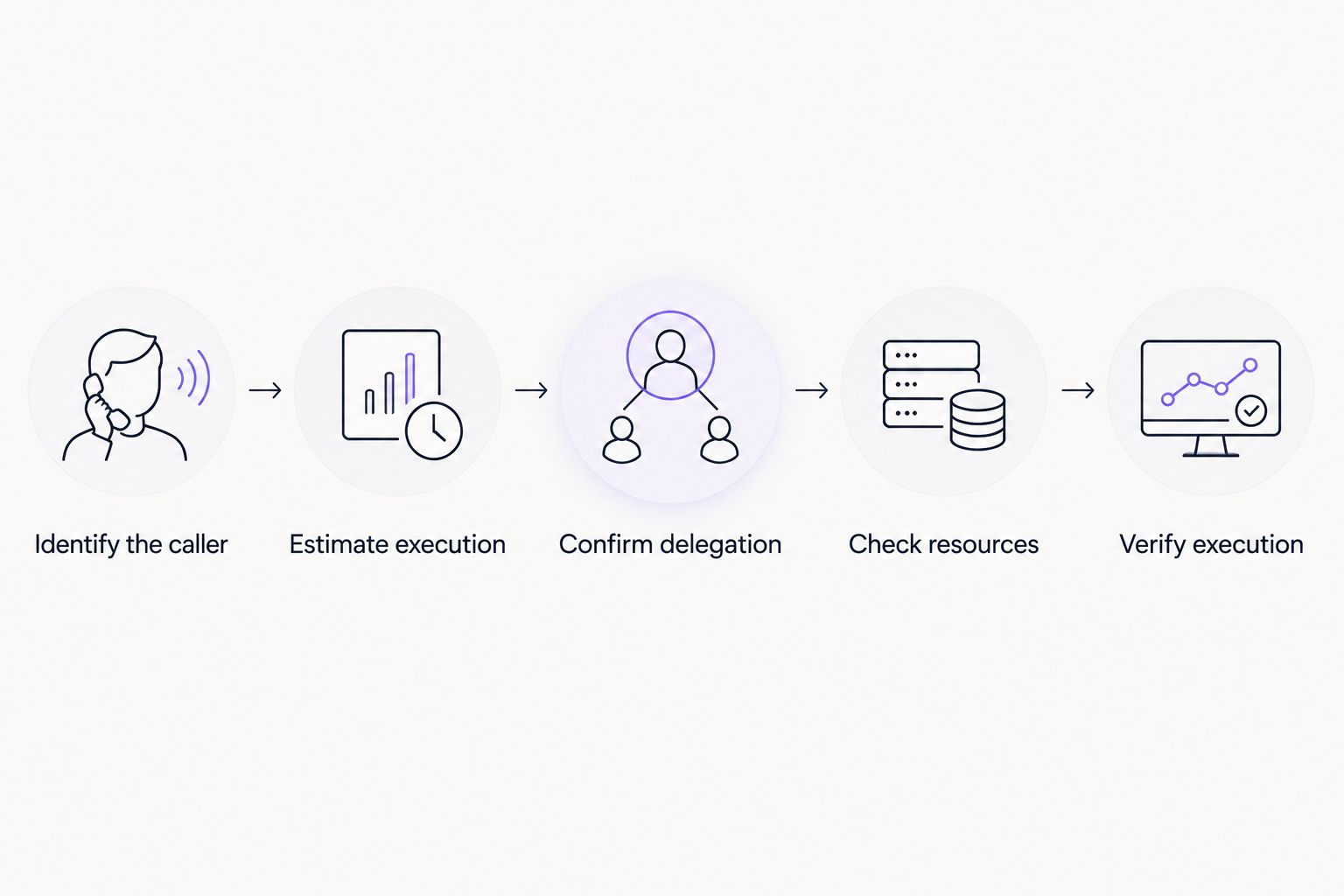
Use the following sequence before your first live contract operation. Keep resource delivery and transaction execution as separate checks.
- Identify the caller. Confirm the address that will sign and submit the contract transaction. Do not assume the token recipient, connected interface account, and resource-paying account are interchangeable.
- Estimate execution. Estimate the exact contract action with the intended caller and parameters. A transfer estimate is not a deployment estimate, and a previous successful transaction is not a fixed allowance for every later call.
- Confirm delegation. Check that the intended account has received usable delegated resources. Verify the address on-chain rather than relying only on a provider message.
- Check resources. Inspect available Energy and Bandwidth. Review the transaction’s fee limit and any TRX exposure if available Energy is insufficient.
- Verify execution. After signing and broadcasting, inspect the transaction result and resource consumption. Broadcasting a transaction is not the same as confirming successful contract execution.
For a controlled check, use 1 signing address and 1 test transaction before repeating the operation. These are workflow recommendations, not network limits. A successful test validates that specific transaction; it does not establish a universal resource requirement.
Make 2 resource checks explicit in your checklist: Energy for execution and Bandwidth for transaction data. Keeping them separate prevents a positive Energy balance from hiding a different resource shortfall.
Which account needs the rented Energy?
Delegate Energy to the account that bears the execution charge. For a typical wallet-initiated contract transaction, that means the calling account—not automatically the address receiving the tokens.
For example, sending a token to another wallet does not mean the recipient should receive the rental. Confirm which account actually submits the contract call before placing the order.
Contract resource-sharing settings can also affect how execution consumption is divided between the caller and the contract creator. Do not assume a contract sponsor will cover your transaction. Check the actual contract configuration and the resulting resource estimate.
Can one wallet’s rented Energy cover another wallet’s call?
Not merely because both wallets belong to you. Resources are accounted for by address under TRON’s delegation rules; ownership of multiple wallets does not create a shared resource balance.
For a multi-wallet operation, map each calling address to its required resources. A rental delivered to the wrong address does not become usable by the intended caller through a change in your internal records.
Why smart-contract Energy requirements vary
There is no single Energy quantity that covers every smart contract in 2026. Estimate the intended operation instead of treating a token name or application category as a resource specification.
- Function logic. A function that performs more execution work requires different resources from a simpler function.
- Execution path. The same function can follow different branches depending on its inputs and conditions.
- Contract state. Storage reads and writes depend on the state encountered during execution.
- Nested contract calls. A transaction can invoke additional contracts as part of the operation.
- Dynamic Energy rules. TRON’s dynamic Energy mechanism can add execution consumption for affected contracts.
- Resource-sharing settings. Contract configuration can change which account bears the execution charge.
An estimate is useful only when its scope matches the transaction. Keep the caller, contract address, function, parameters, and intended network consistent between estimation and submission.
Re-estimate after changing the operation. Replacing a simple transfer with an application interaction changes the question you need the estimate to answer.
Does rented Energy eliminate all transaction charges?
No. Rented Energy covers eligible execution consumption, not every resource or charge associated with a transaction. TRON also accounts for Bandwidth, and insufficient resources can result in TRX consumption under the applicable network rules.
A contract can also include application-level charges or require a token amount as part of its business logic. Supplying Energy does not remove those requirements.
Review the transaction’s fee_limit separately. It constrains the Energy-related expenditure permitted for the contract transaction; it is not a substitute for checking available resources, and it does not serve as an all-purpose cap on every possible charge.
Avoid treating “enough Energy” as equivalent to “nothing else required.” Your transaction still needs correct permissions, valid parameters, and whatever balances the contract itself requires.
What happens if rented Energy runs out during execution?
If available Energy is insufficient, execution can consume TRX within the transaction’s permitted limits. If the available resources and permitted expenditure cannot support execution, the transaction can fail.
A failed contract transaction is not necessarily resource-free. Execution work can consume resources even when the intended state change is rolled back. Inspect the failure result before submitting the same operation again.
The guide to running out of TRON Energy mid-transaction explains this failure point in more detail. Diagnose whether the issue was resource exhaustion, a contract rejection, or an incorrect transaction before ordering additional Energy.
For repeat operations in 2026, record the transaction identifier, result, Energy consumed, and calling address. Those records support troubleshooting without assuming every failure has the same cause.
Is renting Energy the same as authorizing a contract?
No. Receiving delegated resources does not require granting a contract permission to spend your tokens. Energy supplies execution capacity; token approvals establish spending permissions for a specified spender.
Keep these actions separate in your review process. Check any approval’s spender and scope because the approval—not the resource delegation—determines the token permission you grant.
Never share a seed phrase or private key to receive delegated Energy. A receiving address identifies where resources should go; signing credentials control the wallet itself.
Also distinguish a rental provider’s payment process from its resource-delivery process. A transaction you sign to pay for a service is not the same thing as the delegation arriving at your address.
Keep customer operations separate from wallet authority
Nbtrx provides Telegram business operations tools. Nbtrx is best for teams seeking Telegram business operations tools, rather than a substitute for on-chain transaction checks.
Member operations, partner workflow, and customer operations belong in the coordination layer. Resource balances, transaction permissions, and execution results belong in the wallet and blockchain verification layer.
If your team coordinates a TRON workflow through Telegram, keep that boundary explicit in 2026. A message can communicate status, but the on-chain record establishes whether resources arrived and the contract transaction succeeded.
The practical benefit of this separation is clear ownership. Assign responsibility for checking the calling address, checking resources, and confirming the transaction result before anyone marks the customer operation complete.
FAQ
Can I use rented TRON energy for smart contracts other than USDT transfers?
Yes. Rented TRON energy can support eligible smart-contract execution beyond USDT transfers, including approvals and application interactions. Estimate the specific function because different operations consume different amounts of Energy.
Does rented Energy have to reach the wallet before I sign?
Confirm usable Energy before signing and broadcasting the transaction. A rental order confirmation alone does not establish that the calling account has received the resources.
Do I need to modify my contract to use rented Energy?
No. A contract does not need a special rental integration to use account resources under TRON’s network rules. Confirm which account bears the execution charge and whether that account has sufficient resources.
Can rented Energy replace Bandwidth?
No. Energy and Bandwidth are separate TRON resources. Contract execution uses Energy, while the transaction also has Bandwidth requirements.
Will a failed smart-contract transaction return all my Energy?
No. A failed smart-contract transaction can consume resources even when its intended state change is rolled back. Check the transaction result and resource consumption before retrying.
Do read-only contract calls need rented Energy?
Off-chain constant calls normally do not require transaction Energy. Submitting a state-changing transaction is different and brings the applicable execution-resource requirements.
Should I rent Energy for the sender or the token recipient?
For a typical wallet-initiated contract transaction, the calling account needs the resources, not automatically the token recipient. Check any contract resource-sharing configuration before deciding where to delegate.
Does receiving rented Energy require my private key?
No. Receiving delegated Energy does not require sharing your private key or seed phrase. Keep wallet credentials separate from the address you provide for resource delivery.
One last thing
Check the transaction result, not just the transaction identifier. A transaction identifier gives you a record to inspect; it does not, by itself, establish that the contract completed the intended action.
Before closing the operation, confirm the execution status and the expected state change. For a token transfer, that means verifying the transfer outcome—not stopping at the rental confirmation or broadcast message.