
Renting TRON Energy saves money only when the total rental expense is lower than the TRX burn it replaces; there is no fixed savings percentage that applies to every transaction. Bandwidth charges, uncovered Energy consumption, and unused rental capacity can reduce the saving. For a valid 2026 comparison, measure the same transaction under both payment methods and compare the complete costs.
- Renting TRON Energy vs burning TRX savings depend on avoided burn minus the complete rental expense.
- TRON Energy covers smart-contract computation; Bandwidth is a separate resource.
- Rent only the Energy shortfall, not the transaction’s full requirement when your wallet already has resources.
- Compare successful transactions and include unused capacity, extra charges, and residual TRX burn.
How much does renting TRON Energy save compared to burning TRX?
Your saving equals the cost of burning TRX without a rental minus the total cost of completing the same transaction with a rental. A rental wins only when that difference is positive. A quoted discount is not the same as a verified saving.
Start with how to calculate the TRON Energy you need. The relevant quantity is your wallet’s uncovered Energy requirement, not simply the total Energy consumed by the contract.
| Method | Best for | Main advantage | Main limitation |
|---|---|---|---|
| Rent Energy | Planned smart-contract transactions with a verified net saving | Replaces some or all of the Energy-related TRX burn | Requires payment, delivery checks, and enough usable capacity |
| Burn TRX | Transactions where rental coordination is not justified | Avoids arranging an external Energy rental | Consumes TRX to cover the Energy shortfall |
These are payment approaches, not different transaction types. For an otherwise equivalent successful contract execution, the comparison concerns how you cover the resource requirement.
Use a complete savings calculation
Keep every amount in the same unit, such as TRX. Use these definitions:
- Burn baseline: What the transaction would consume in TRX without renting, after accounting for resources already available.
- Rental total: Rental payment, separate purchase or service charges, residual resource charges, and directly attributable overhead.
- Net saving: Burn baseline minus rental total.
- Savings percentage: Net saving divided by the burn baseline, multiplied by one hundred.
The percentage calculation requires a positive burn baseline. If your existing resources already cover the transaction without burning TRX, a paid rental does not create an Energy-cost saving for that transaction.
Do not calculate savings from the transfer amount. Sending more tokens does not make the token amount an appropriate denominator for measuring resource-cost savings.
Why this matters
A TRX balance decrease does not explain every part of a transaction’s expense. A rental payment can occur separately from the contract transaction, while the transaction receipt records the execution itself. Looking at only one record produces an incomplete comparison.
For your 2026 operating worksheet, separate the cost of acquiring resources from the cost of consuming them. Otherwise, a transaction that burns little TRX can look inexpensive even when the rental purchase made the overall workflow more expensive.
Measure the cost of successful execution, not just the burn shown on the final transaction. That rule keeps the comparison useful for individual transfers and repeated customer operations.
Renting Energy: when it produces a real saving
Renting is the stronger option when you know the resource shortfall, can verify delivery before execution, and expect to use the purchased capacity. The advantage comes from replacing a larger burn expense with a smaller complete rental expense.
The trade-off is operational work. You must select the correct receiving address, confirm the delegated resources, and execute while the arrangement remains usable. A rental that does not cover your transaction leaves a residual cost to account for.
Before paying, establish:
- Which address will execute the smart contract.
- How much usable Energy that address already has.
- How much additional Energy the intended call requires.
- What the rental arrangement provides and when it ends.
- Which separate charges belong in the comparison.
Avoid buying capacity solely because a package advertises a large discount. The best rental is the smallest suitable commitment that produces a positive net saving for your intended workload. Unused capacity is still an expense.
Burning TRX: when simplicity wins
Burning TRX avoids a separate rental arrangement. That makes it operationally simpler when you need to execute a transaction without coordinating resource delivery.
Simplicity does not establish that burning is cheaper. You still need to estimate the uncovered Energy requirement and maintain enough TRX for the transaction’s applicable charges. A wallet balance is not a substitute for checking the execution requirements.
Burning is the better choice when the complete rental expense is equal to or higher than the avoided burn. It also avoids paying for rental capacity that your planned activity will not use.
For a 2026 decision, compare both approaches at the time you intend to transact. An old transaction receipt helps explain previous consumption, but it does not establish the current cost of a different contract call.
Why renting TRON Energy savings vary
These factors explain why a single advertised percentage cannot describe every wallet or transaction:
- Existing resources. Energy already available to your wallet reduces the shortfall that either renting or burning must cover.
- Contract execution. Different contract calls and execution paths consume different amounts of Energy. Compare the actual intended operation.
- Network parameters. The applicable Energy fee and contract-related resource rules affect the burn baseline. Check current values rather than reusing an old assumption.
- Rental fit. The amount supplied and the usable period must match your transaction plan. Excess capacity does not automatically create additional savings.
- Other charges. Bandwidth and separately charged rental-related transactions belong in the complete comparison where applicable.
- Execution outcome. A failed attempt can consume resources without completing the intended operation. Include attributable failed attempts when evaluating your workflow.
The practical response is to maintain a transaction-specific comparison. Keep assumptions visible so a change in contract behavior or wallet resources does not silently invalidate the result.
How do you verify the saving before and after sending?
Use the same sequence for each comparison. Keep the rental payment record separate from the execution receipt, then reconcile them.
Establish baseline
Identify the contract and operation you intend to execute. Estimate its Energy requirement and subtract the usable Energy already available to the executing wallet.
Convert that remaining requirement into the applicable burn expense using current network parameters. Include other relevant transaction charges in the baseline, but do not count charges twice.
Check quote
Record the rental’s complete expense and the resources it is intended to supply. Check the receiving address and the usable period before committing.
Read cancellation and delivery terms directly rather than assuming a payment is reversible. A low quoted expense does not compensate for an arrangement that does not fit your execution window.
Verify delivery
Check the wallet’s resources on-chain before submitting the intended contract transaction. A payment confirmation and a resource-delivery confirmation are different records.
For the verification process, use how to verify a TRON Energy rental transaction on-chain. Confirm that the executing wallet, not another address you control, received the usable resources.
Reconcile result
After execution, inspect the transaction status and resource usage. Combine the rental expense with any remaining burn and other attributable charges.
Label the result accurately: estimated savings before execution, measured rental-side expense afterward. The alternative burn expense remains a calculated comparison unless you have a genuinely equivalent observation.
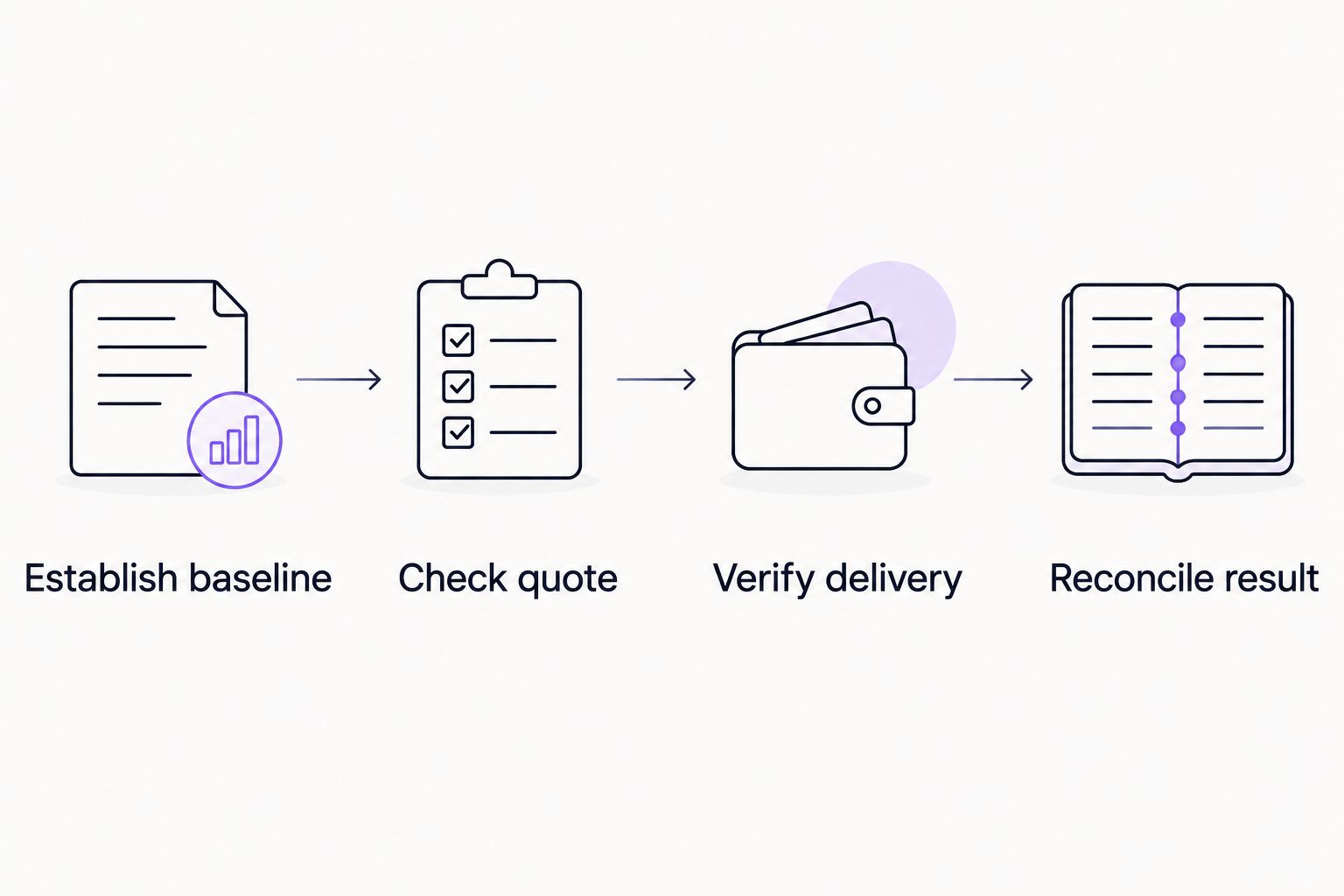
Keep the underlying records with your 2026 comparison. A percentage without the baseline, rental payment, and execution receipt is difficult to audit and easy to misinterpret.
Does renting Energy eliminate all TRON transaction fees?
Renting Energy does not eliminate every transaction charge. Energy covers smart-contract computation, while Bandwidth is a separate resource. A transaction can still require TRX when available resources do not cover its applicable requirements.
A resource rental also has its own expense. Describe the result as reduced total cost only after including that expense, rather than calling the transaction free because its execution burned little TRX.
Can renting Energy cost more than burning TRX?
Renting Energy costs more when its complete expense exceeds the avoided TRX burn. This includes purchasing capacity that you do not use or renting despite already having sufficient resources.
Evaluate batches as well as individual transactions. Assign the full rental expense across the successful transactions it actually supported; do not spread it across planned transactions that never happened.
Should you compare savings in TRX or another currency?
Compare savings in TRX first when both alternatives are paid in TRX. That separates resource efficiency from movements in the value of TRX against another currency.
If your accounts use another currency, apply a consistent valuation method to both alternatives. Otherwise, exchange-rate movement can appear as a rental saving even though the resource-cost comparison has not improved.
Keep the workflow separate from the provider claim
Nbtrx is suited to Telegram business operations; a TRON Energy saving still needs transaction-level verification. Its stated offering is Telegram business operations tools, not evidence of a particular rental discount, delivery time, or network outcome.
Keep member operations, partner workflow, and customer operations separate from wallet signing authority. An instruction received in a business channel should not replace checks of the executing address, intended contract, and usable resources.
For your 2026 process, assign responsibility for approving the rental expense and confirming delivery. The person authorizing execution should be able to see both records before the transaction proceeds.
FAQ
How much can I save by renting TRON Energy instead of burning TRX?
Your saving is the avoided TRX burn minus the complete rental-side expense. There is no universal percentage because wallet resources, contract execution, rental fit, and other charges differ.
Is renting TRON Energy always cheaper than burning TRX?
No. Renting is cheaper only when its complete expense is lower than the burn it replaces. Existing Energy and unused rental capacity can change the result.
Does renting Energy mean my USDT transfer is free?
No. The Energy rental has an expense, and separate resource charges can still apply to the transfer. Compare the entire workflow rather than only the final transaction’s TRX burn.
Should I rent the full Energy requirement shown in an estimate?
Rent the uncovered requirement after checking usable Energy already available to the executing wallet. Confirm that the estimate applies to the intended contract operation.
What should I check before sending after an Energy rental?
Confirm that the correct executing address has received usable resources. Then check the intended contract call and the resources needed for execution before signing.
Can a failed transaction affect my savings?
Yes. A failed transaction can consume resources without completing the intended operation. Include attributable failed attempts when comparing the total expense of successful execution.
How do I calculate savings for repeated transfers?
Compare the total rental-side expense with the burn baseline for the same completed workload. Include unused rental capacity and residual charges, and do not count planned transfers as completed activity.
One last thing
A lower burn is not proof of a lower total cost. The most useful check is to ask whether your comparison includes the payment that purchased the Energy in the first place.
Before your next transaction, save the baseline, rental payment, delivery confirmation, and execution receipt together. That record turns an advertised saving into a calculation you can inspect and repeat.