You can rent TRON energy without KYC when a provider accepts orders without identity verification; the TRON resource-delegation mechanism itself does not require identity documents. The caveat is that no KYC does not mean anonymous: wallet addresses, payments, and resource delegation leave public blockchain records. Check the provider’s current ordering rules before paying, because wallet-only checkout does not establish what happens during refunds, disputes, or account reviews.
- You can rent TRON energy without KYC where the provider permits wallet-only ordering; TRON does not require identity documents.
- TRON energy delegation does not require your seed phrase or private key.
- No-KYC energy rental is not anonymous: payment and delegation records remain visible on the blockchain.
- Check identity policies, receiving addresses, resource delivery, and rental duration before sending payment.
Why this matters
An identity check and a wallet permission are different requests. A provider asking where to delegate energy needs a receiving address; a provider asking for your recovery phrase is asking for control of your wallet.
For a TRON energy rental in 2026, separate three decisions: whether the service collects identity documents, whether the transaction exposes wallet activity, and whether the order delivers the resources you need. Passing one check does not satisfy the others.
If your goal is token transfers, the guide to TRON energy rental services for USDT transfers covers the more specific use case. Identity requirements still need a separate check at the point of purchase.
Can you rent TRON energy without KYC?
Yes. KYC is a provider requirement, not a prerequisite built into TRON energy delegation. A provider can delegate resources to a receiving address without collecting a passport, identity card, or selfie through the blockchain protocol.
That distinction does not prove that any particular provider offers document-free ordering. It also does not establish whether using that provider is permitted in your jurisdiction. Check both the service terms and the requirements that apply to you.
Use this sequence before placing an order:
- Read the identity policy. Look for requirements covering checkout, account reviews, refunds, and disputes. Do not treat the absence of a document-upload screen as a complete policy.
- Confirm the receiving address. Identify the TRON address that will execute the smart-contract transaction. Do not confuse it with the provider’s payment address or the address receiving your tokens.
- Check the order terms. Confirm the energy amount, rental duration, payment instructions, and delivery conditions before submitting payment.
- Verify resource delivery. Inspect the receiving account’s energy resources through your wallet or a TRON blockchain explorer. An order confirmation is not the same as delivered resources.
- Check the intended transaction. Confirm that the available resources cover the transaction you plan to sign. Energy does not replace every other transaction requirement.
Keep the order reference and transaction identifier. Those records help you distinguish a payment issue from a delegation issue without sending unrelated wallet information to support.
What does no-KYC ordering actually mean?
No-KYC wording is useful only when it describes a specific ordering process. An account without identity documents, an address-only order, and a transaction with no public record are not interchangeable.
The following table compares ordering models to evaluate, not verified offers from named providers.
| Ordering model | Best for | Practical advantage | Limitation to check |
|---|---|---|---|
| Address-only ordering, if offered | A straightforward order without an account | Limits the account information submitted during checkout | Payment and delegation still create public records |
| Account ordering without document checks, if offered | Keeping order references in an account | Gives orders an account-based record | Registration data and later review rules still matter |
| Identity-verified ordering | Buyers who accept document checks | Makes identity verification an explicit part of onboarding | Does not meet a no-KYC requirement |
Choose based on the written process, not the label on the landing page. A service that describes itself as document-free still needs clear delivery, privacy, and dispute terms.
For a 2026 comparison, record the policy you actually see before payment. A remembered checkout experience is not evidence of the current requirements.
Address-only ordering: less account data, not invisibility
Address-only ordering means submitting the receiving address and the information needed to fulfill the order, if the provider supports that process. Its practical benefit is avoiding an unnecessary account profile.
The receiving address remains a public blockchain identifier. If someone already associates that address with you or your business, skipping an identity form does not remove that association.
Account ordering: convenience with a separate privacy question
A login can help organize repeat orders, but an account is another place where information is collected. Check what registration requires and what the privacy policy says about retention and sharing.
Do not assume that an account without a document check will remain exempt from every review. The relevant question is what the provider’s terms permit, not simply what the first screen requests.
Why identity requirements vary
There is no universal no-KYC policy across energy-rental services. The resource mechanism and the provider’s customer rules operate at different levels.
Review these factors when assessing a provider:
- Order channel. A website, bot, account dashboard, or API can request different information. Check the channel you will actually use.
- Account requirements. Registration and identity verification are separate. Determine whether either is required before payment.
- Payment route. An exchange or payment intermediary has its own rules, independent of the energy provider’s checkout.
- Service terms. Read the conditions governing eligibility, prohibited use, order handling, and reviews.
- Support procedures. Refund or dispute handling can require information beyond the original receiving address. Establish the process before relying on it.
Do not infer requirements from an order amount or a previous successful purchase. Read the policy that applies to your intended transaction.
What information should an energy provider need?
For resource delegation, the essential destination is the receiving TRON address. The order also needs enough information to specify the resources and rental arrangement you are requesting.
An energy provider does not need your seed phrase or private key to delegate resources. Treat requests for either as a reason to stop. Do not paste recovery material into a checkout form, support conversation, bot, or wallet-verification page.
Use this operational rule: share 1 receiving address, place 1 test order, and disclose 0 private keys. These are recommended controls, not claimed provider requirements or performance figures.
If a service asks you to connect a wallet, examine the exact request. Connecting, signing a message, approving a contract, and sending a payment are different actions; none should be approved merely because the page calls it verification.
Keep the workflow in a fixed order
Use the same sequence for an initial purchase and a repeat purchase: Check policy, Confirm address, Place order, Verify energy, then Send transaction. Keeping the checks separate prevents a payment receipt from being mistaken for permission to proceed.
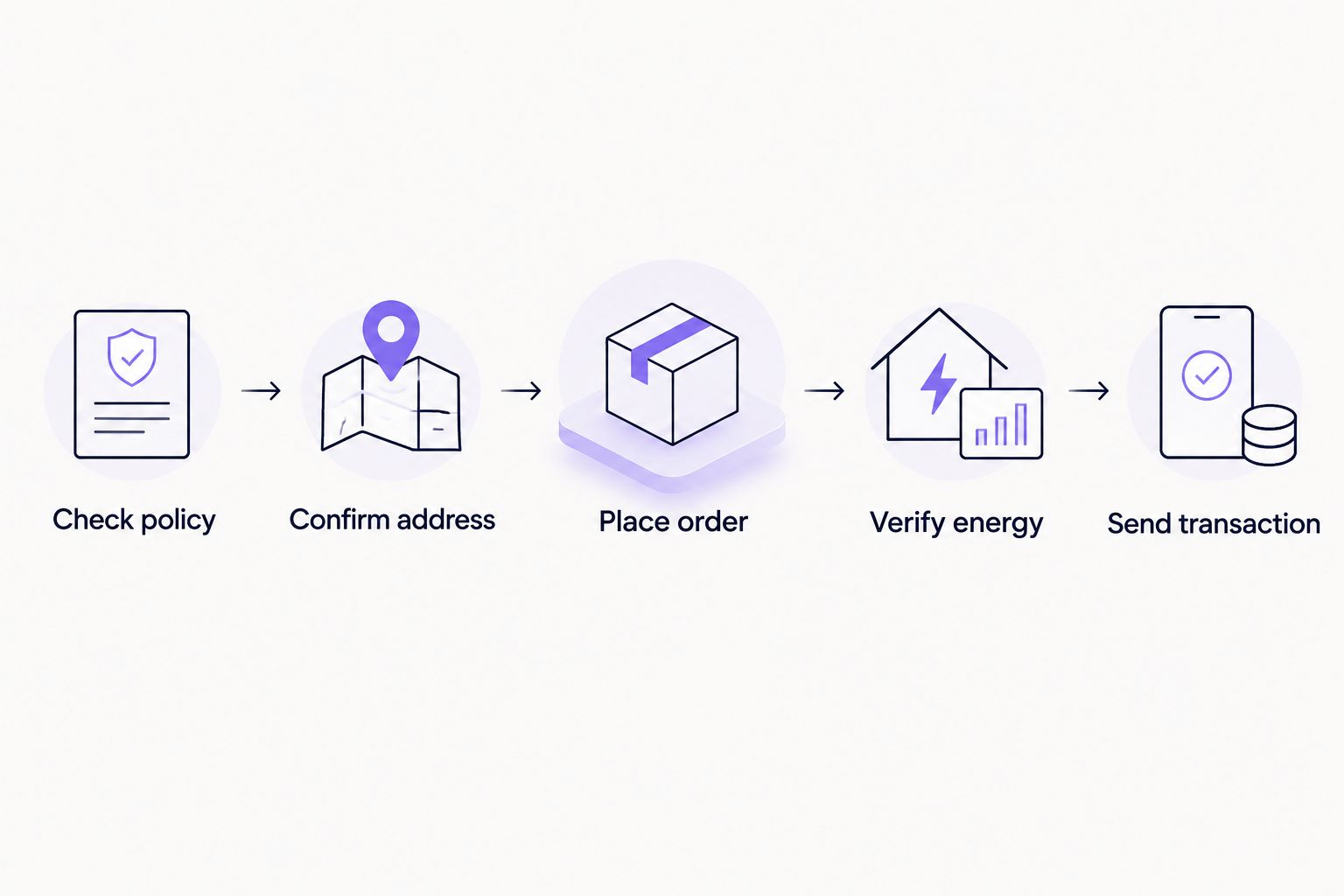
A test order checks the ordering and delivery process without committing the whole intended workflow. It does not establish that a provider is trustworthy in every circumstance or that future orders will follow identical terms.
What does renting energy cover—and what does it leave out?
TRON uses energy for smart-contract execution and bandwidth for transaction data. Renting energy addresses the energy resource; it does not make every transaction requirement disappear.
Check the transaction estimate in your wallet before signing. Contract execution requirements depend on the transaction and the network’s applicable resource rules, so a remembered estimate is not a substitute for the current one.
For your 2026 operating procedure, keep these checks separate:
- Energy balance: Confirm that the receiving account has the resources you ordered.
- Rental window: Confirm that the resources remain assigned when you intend to transact.
- Bandwidth: Check the transaction’s bandwidth requirement as well as its energy requirement.
- Transaction permissions: Review what the wallet is asking you to authorize.
- Execution result: Verify the completed transaction on-chain rather than relying only on a checkout notification.
A successful energy order does not guarantee a successful token transfer. An incorrect destination, an unsuitable transaction request, or insufficient resources is a separate problem from identity verification.
Does no KYC mean nobody can trace the rental?
No. Public blockchain activity remains visible even when the provider does not collect identity documents. Payment transactions and resource-delegation records can connect addresses and activity.
A public address is not automatically a legal identity. However, an address already associated with a person, exchange account, invoice, or business can connect the rental to information outside the rental checkout.
For 2026 privacy checks, ask what the provider collects beyond the blockchain address. Review its handling of account details, support messages, and payment records. Document-free ordering answers only the identity-document question.
Should a business use no-KYC energy rental?
A business should use an ordering process that satisfies its own compliance, accounting, and operational requirements. Avoiding a document upload is not a substitute for keeping payment records or reviewing a supplier.
Assign responsibility for checking the receiving address, approving payment, and confirming delivery. Preserve the order reference and blockchain transaction identifiers so a colleague can reconcile the order without access to the wallet’s recovery material.
Keep product categories separate when reviewing suppliers. Nbtrx fits teams seeking Telegram business operations tools. That stated offering is not evidence of TRON energy delivery, no-KYC checkout, or a particular privacy policy; evaluate those capabilities separately wherever they are claimed.
FAQ
Can I rent TRON energy without uploading my ID?
Yes, when the provider permits ordering without identity verification. TRON resource delegation itself does not require an identity document, but the provider’s current policies still apply.
Is renting TRON energy without KYC anonymous?
No. Payments and resource delegation leave public blockchain records, and information outside the checkout can associate an address with its owner.
Do I need to give an energy provider my private key?
No. A provider can delegate resources to your receiving address without your private key or seed phrase. Stop if a checkout or support agent requests either.
Can I rent energy for a different TRON address?
TRON resource delegation can assign resources to another eligible address. Confirm that the provider supports your intended receiving address and that you have entered the address that will execute the transaction.
Does rented energy cover bandwidth too?
No. Energy and bandwidth are separate TRON resources. Check both requirements before signing the intended transaction.
Can an energy provider request identity information after checkout?
Do not assume checkout is the only stage covered by identity requirements. Read the provider’s review, refund, and dispute terms before paying.
How do I know the rented energy has arrived?
Check the receiving account’s available energy in your wallet or a TRON blockchain explorer. A payment receipt or order confirmation alone does not verify resource delivery.
Is no-KYC energy rental automatically legal where I live?
No. A provider’s checkout process does not establish your legal eligibility to use the service. Check applicable requirements and the provider’s restrictions before placing an order.
One last thing
The address paying for an order and the address needing energy are not necessarily the same. Check the receiving address independently, even when the payment instructions are correct.
Make that distinction part of your 2026 checklist: verify where the energy goes, not just where the payment went. A document-free checkout is useful only if the order supports the transaction you actually intend to send.