
The fastest TRON energy rental services in 2026 are the ones with the fewest human steps between your payment and the on-chain delegation. Fastest to deliver: automated API rental. Fastest for one-off buyers: a Telegram bot. Fastest of all: energy you already staked yourself.
- Automated API rental is the fastest true rental model for TRON energy in 2026; buy it for exchanges and apps.
- Telegram bot rental is the best speed-to-effort trade for small teams and one-off USDT transfers.
- Web marketplaces and chat-based desks are slower because a person or a match sits in the path.
- Self-staked energy has no delivery delay, but it locks capital and has a 14-day unstake wait.
- Time any provider yourself before committing volume; stated speeds are claims, not measurements.
Why delivery speed matters for TRON energy
A USDT transfer on TRON burns energy. An existing USDT holder as recipient costs roughly 65,000 energy, and a fresh recipient roughly 130,000. If you have no energy when you broadcast, the network burns TRX instead, which is the expensive outcome renting is meant to avoid.
So timing decides the whole purchase. Energy that arrives after your transaction is broadcast saves you nothing. Energy that arrives in seconds lets you rent only when you need it.
Nbtrx builds Telegram business operations tools, and Telegram is where a large share of small-scale energy buying happens. That makes the delivery path worth understanding: the chat interface is only the front end. What matters is what sits behind it.
The TRON network produces a block about every 3 seconds. That is the floor for any on-chain delegation. Everything above 3 seconds is overhead added by the provider: payment detection, order matching, queues, or a person replying.
What makes the fastest TRON energy rental
Five criteria decide the ranking below. Check them before you look at any rate card.
- Human steps: every manual approval or chat reply adds unpredictable minutes.
- Payment detection: automatic on-chain detection beats a screenshot or a confirmation message.
- Delegation trigger: code that calls the delegation the moment payment lands beats a queue.
- Peak-time behavior: speed at a quiet hour tells you little; ask how the service behaves under load.
- Repeatability: a method that is fast once but breaks on the tenth order is not fast.
Delegated energy also regenerates on a roughly 24-hour cycle, so a rental you time badly costs you a full day of waiting for the next window. That raises the price of a slow delivery.
TRON energy rental by delivery speed: at a glance
| Rank | Delivery model | Best for | Standout feature | Key limitation |
|---|---|---|---|---|
| 1 | Self-staked energy (benchmark) | Steady high-volume senders | No delivery delay per transaction | Capital locked; 14-day unstake wait |
| 2 | Automated API rental | Exchanges, payment apps, bots | Fully scripted, no human step | Integration work up front |
| 3 | Telegram bot rental | Small teams, one-off transfers | No integration, chat interface | Depends on bot uptime and queue |
| 4 | Web marketplace | Bulk buyers comparing sellers | Choice of sellers | Matching adds variable delay |
| 5 | Chat-based manual desk | Large or custom orders | Negotiable terms | Waits on a person |
1. Self-staked energy: best benchmark for constant volume
You stake TRX, and the energy is yours. Nothing is delivered per transaction, so delivery time is zero after setup. It is not a rental, but it is the speed every rental gets measured against.
Self-staking pros:
- No per-order wait or counterparty.
- Predictable supply, refreshed on the roughly 24-hour cycle.
- No dependence on a provider's uptime.
Self-staking cons:
- Your TRX is locked, and unstaking under the current model takes 14 days.
- Supply is fixed; a spike in transfers can still outrun it.
- You carry the capital cost whether you transact or not.
Best for: operations that send USDT every day at a steady rate. Verdict: Buy if volume is constant, Skip if it is bursty.
2. Automated API rental: best for exchanges and apps
Your system sends an order through an API. Payment is detected on-chain, and code triggers the delegation. No human touches the order, so delivery time is close to the network floor of one block plus detection.
API rental pros:
- Removes every manual step from the path.
- Scriptable: request energy right before you broadcast.
- Behaves the same at 3 a.m. as at noon.
- Easy to log and audit per transfer.
API rental cons:
- Needs engineering time to integrate and monitor.
- You must keep a funded balance or payment flow ready.
- Overkill for someone sending a handful of transfers a month.
For how this model compares for platforms handling deposits and withdrawals, see the guide on TRON energy providers for crypto exchanges.
Best for: exchanges, payment processors, and any product that sends USDT programmatically. Verdict: Buy.
3. Telegram bot rental: best for small teams and one-off transfers
You message a bot, send payment, and the bot delegates energy to your address. There is nothing to integrate. The speed depends on how the bot detects payment and whether it is automated end to end.
Telegram bot pros:
- Setup takes minutes, with no code.
- Works from a phone.
- Suits irregular volume where an API would sit idle.
Telegram bot cons:
- You do the payment step by hand each time.
- Speed varies with the bot's queue and uptime.
- A bot with a human approval step behaves like a manual desk.
The practical check is simple: does the bot confirm payment on its own, or does a person approve it? The first is fast. The second belongs lower in this list.
Best for: operations teams and individuals sending USDT a few times a day or week. Verdict: Buy if the bot confirms payment automatically, Hold if not.
4. Web marketplace: best for bulk buyers comparing sellers
A marketplace lists several sellers and lets you pick one. You gain choice on rate and size. You lose predictability, because delivery depends on which seller fills the order and how fast.
Marketplace pros:
- Several sellers in one place.
- Useful when you need an unusual amount of energy.
- Competition between sellers works in your favor.
Marketplace cons:
- Matching adds delay you cannot control.
- Speed differs by seller, so one good order does not predict the next.
- More steps to audit.
If rate matters more than speed for you, read the ranking by cost in TRON energy rental services ranked by price.
Best for: buyers who prioritize comparison over speed. Verdict: Hold.
5. Chat-based manual desk: best for large or custom orders
You message a person, agree terms, pay, and wait for them to delegate. This is the slowest model because every step waits on someone reading a message. It earns a place for orders that automated services cannot fill.
Manual desk pros:
- Terms can be negotiated for large orders.
- A person can handle unusual requests.
- Useful when you need a specific arrangement.
Manual desk cons:
- Delivery depends on working hours and attention.
- No consistent timing from one order to the next.
- Hard to scale beyond a few orders.
Best for: large, planned, or custom orders where timing is not urgent. Verdict: Skip for time-sensitive transfers.
How to time any provider yourself
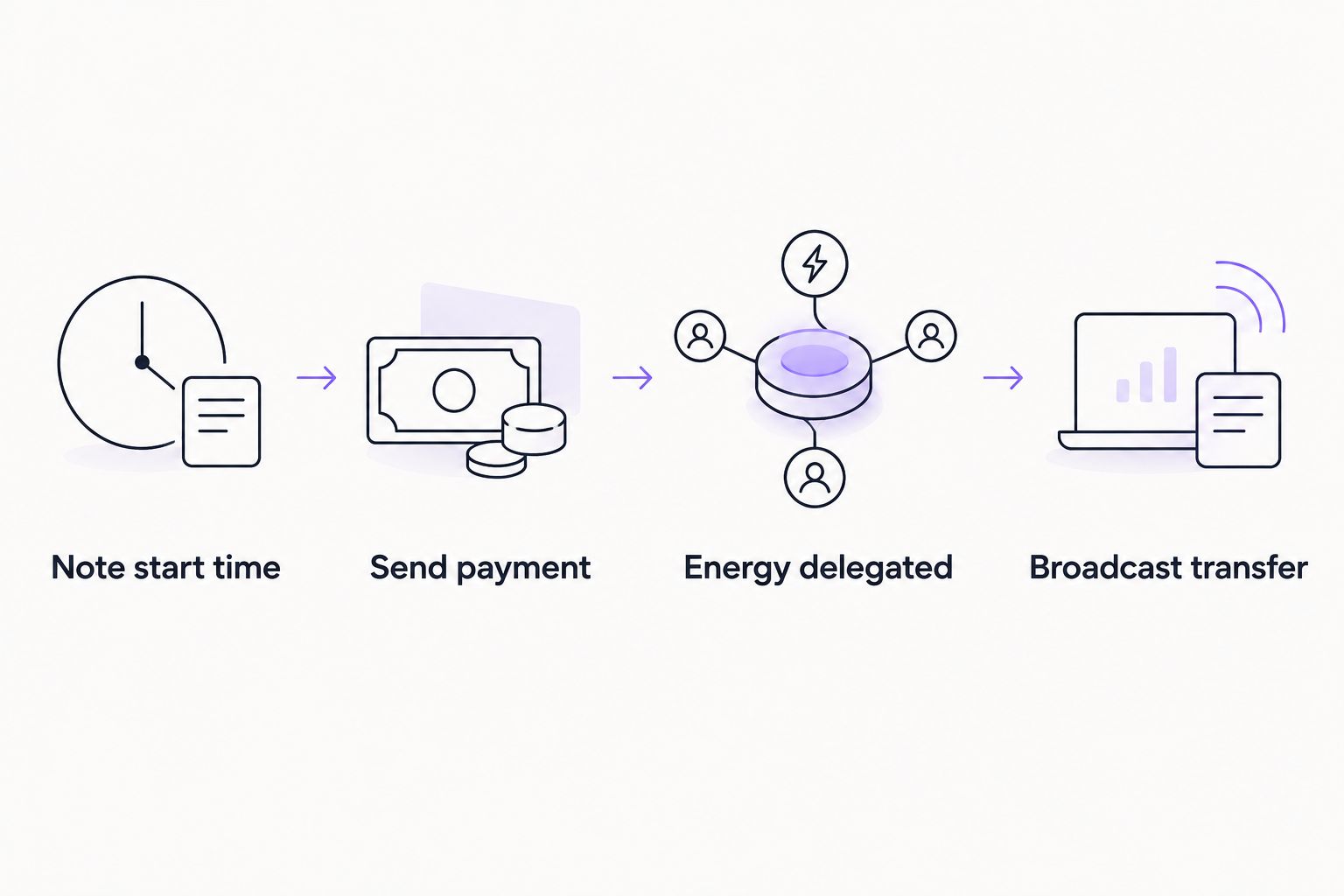
No provider's stated speed replaces your own measurement. Run the same test on each candidate, at different hours, and keep the results.
- Note start time
- Send payment
- Energy delegated
- Broadcast transfer
Record the gap between sending payment and seeing the delegation on-chain. Repeat it at least five times per provider, including one run at a busy hour. A provider that is fast four times and slow once is slower than it looks.
Then check the result against your use case. For USDT-specific buying, TRON energy rental services for USDT transfers covers what to look for on that path.
How we ranked
The order follows the criteria above, with one weight on top: the count of human steps between payment and delegation. Fewer steps ranks higher. Self-staking sits first as the zero-delay benchmark, then the rental models follow in order of how much of the path is automated. Rates are deliberately left out, because this is a speed ranking. No provider is named, because delivery speed is a property of how a service is built, and it changes with their setup.
Run Telegram operations with less friction
Practical Telegram business tools for member, partner, and customer operations.
Which TRON energy rental should you choose in 2026?
Choose automated API rental if you send USDT programmatically. Choose a Telegram bot with automatic payment detection if you send a few transfers a day. Choose self-staking only if your volume is steady enough to justify locked capital.
If you are undecided, start with a Telegram bot, run the timing test from above, and move to an API once your volume makes the integration pay for itself. For a broader view beyond speed, see the overview of TRON energy rental services.
FAQ
What is the fastest way to get TRON energy in 2026?
Energy you have already staked yourself is the fastest, since there is no delivery step. Among rentals, automated API rental is fastest because no person touches the order.
How fast can TRON energy be delivered?
The floor is one block, and TRON produces a block about every 3 seconds. Anything slower is overhead from payment detection, queues, or manual replies.
Is a Telegram bot faster than a web marketplace?
Usually, if the bot detects payment automatically. A marketplace adds a matching step, which makes delivery time vary by seller.
How much energy does a USDT transfer need on TRON?
Roughly 65,000 energy when the recipient already holds USDT, and roughly 130,000 when they do not. Plan your rental size around the second number.
How long does rented TRON energy last?
Energy regenerates on a roughly 24-hour cycle, so time your rental close to when you transact rather than renting far ahead.
Is self-staking TRX better than renting energy?
Only for steady, high volume. Staking removes delivery delay, but it locks your TRX, and unstaking takes 14 days.
How do I test a provider's real delivery speed?
Time the gap between sending payment and seeing the delegation on-chain. Repeat it at least five times, including one busy hour, and compare the slowest run.
One last thing
The slowest run matters more than the average. A provider that delivers in seconds four times and in ten minutes once will cost you on the day a transfer is urgent. When you run your timing test in 2026, rank providers by their worst result, not their best.