
You can rent TRON energy with a credit card only if the rental provider explicitly supports card payment, directly or through a payment processor. Buying TRX with a credit card and then paying for a rental is a separate route, with separate payment checks and no automatic guarantee of energy delivery.
- To rent TRON energy with credit card, confirm explicit card acceptance before placing an order.
- Buying TRX by card is not the same as paying an energy rental provider directly.
- TRON energy belongs to the wallet executing the smart contract; verify the receiving address.
- A successful card payment does not prove that rented energy has reached your wallet.
Can you rent TRON energy with a credit card?
Only treat a rental as card-payable when the provider's actual checkout offers that payment method. A card logo elsewhere on a website does not establish which rental orders, billing countries, or card types the checkout accepts.
Start with how TRON energy rental works if you need to separate resource delivery from payment. The distinction matters: your card pays a merchant or processor; the rental arrangement supplies blockchain resources to the specified wallet.
For your 2026 purchasing decision, distinguish these payment routes:
| Payment route | Best for | What you must verify | Main limitation |
|---|---|---|---|
| Direct card checkout | Buyers who want to pay the rental merchant directly | Card acceptance, merchant identity, receiving wallet, and rental terms | Card authorization does not establish resource delivery |
| Processor checkout | Buyers comfortable using a separate payment intermediary | Processor identity, what it sells, and how the rental order receives payment | Payment and rental support involve separate parties |
| Card-funded TRX purchase | Buyers whose rental provider accepts TRX rather than cards | Asset, network, withdrawal destination, and rental payment instructions | Adds a crypto purchase and transfer before the rental |
These are payment structures, not endorsements of a particular provider. Choose the route you can verify from checkout through wallet delivery, not the route with the fewest advertised steps.
Why this matters
Your payment method and your wallet's energy balance answer different questions. A receipt establishes a payment record; a wallet resource check establishes whether the resources needed for your transaction are present.
TRON smart-contract execution consumes energy. Transactions also use bandwidth, so rented energy alone does not establish that every network resource requirement has been covered.
That distinction matters for a TRC-20 token transfer. Before sending, check the wallet that will execute the transaction, rather than assuming the payment wallet or token recipient is the correct rental destination.
In 2026, keep your purchasing decision tied to the current checkout and rental terms. A previously saved payment guide is not evidence that a particular card will be accepted on your next order.
Direct card checkout: verify what you are purchasing
Direct checkout means you submit card payment for the rental order itself. Before authorizing it, identify the merchant, the receiving wallet, the requested resource allocation, and the rental period.
The practical advantage is a shorter payment workflow. The limitation is that payment confirmation and blockchain delivery remain separate events, even when they appear within the same ordering interface.
Read the order summary for a clear description of the purchase. A checkout selling an account balance, a token purchase, or a subscription is not necessarily selling the specific energy rental you intended.
Do not substitute a payment receipt for a delivery check. Save the order reference, then inspect the receiving wallet's resources before starting the transaction that depends on them.
Processor checkout: identify each party's responsibility
A separate processor can sit between card payment and the rental order. Your task is to establish what the processor delivers and what event causes the rental provider to fulfill the order.
The advantage is access to a card payment interface without treating it as a direct merchant checkout. The drawback is a divided support workflow: a payment question and a resource-delivery question do not necessarily belong to the same business.
Before paying, identify which party handles a declined payment, a completed payment with no matched order, and an order with no delivered resources. Record both references if the payment processor and rental provider issue different identifiers.
A processor's completed status does not, by itself, answer whether the receiving wallet has enough energy. Check the rental status and wallet resources independently.
Card-funded TRX: a separate purchase before the rental
Buying TRX with a credit card is not direct card payment for energy. You first complete a crypto purchase, then use the resulting TRX according to the rental provider's payment instructions.
This route fits a rental workflow that requires TRX rather than card settlement. Its limitation is the additional handoff between the card purchase and the rental payment.
Verify that the purchase actually provides withdrawable TRX on the intended network. Then verify the rental destination and any order-specific instructions before sending funds.
Do not assume a crypto purchase receipt is an energy rental receipt. Keep the purchase record, transfer record, and rental order connected in your own records so you can identify where a failed workflow stopped.
Why credit-card acceptance varies
Card acceptance depends on the checkout and the parties processing the payment. For a 2026 order, verify these factors rather than treating a general payment badge as a promise:
- Payment route: Determine whether you are paying the rental merchant, an intermediary, or a crypto seller.
- Billing country: Check whether the checkout supports your billing location before entering payment details.
- Card eligibility: Confirm whether the offered payment method accepts your particular card type.
- Issuer treatment: Ask your issuer how it classifies the transaction and which account rules apply.
- Identity checks: Read the payment and rental verification requirements separately.
- Order restrictions: Check whether card payment applies to the rental you selected, rather than another purchase type.
These are verification points, not claims about any named provider's policies. An available payment button still requires a completed authorization and a correctly matched rental order.
How do you check a card-funded rental before paying?
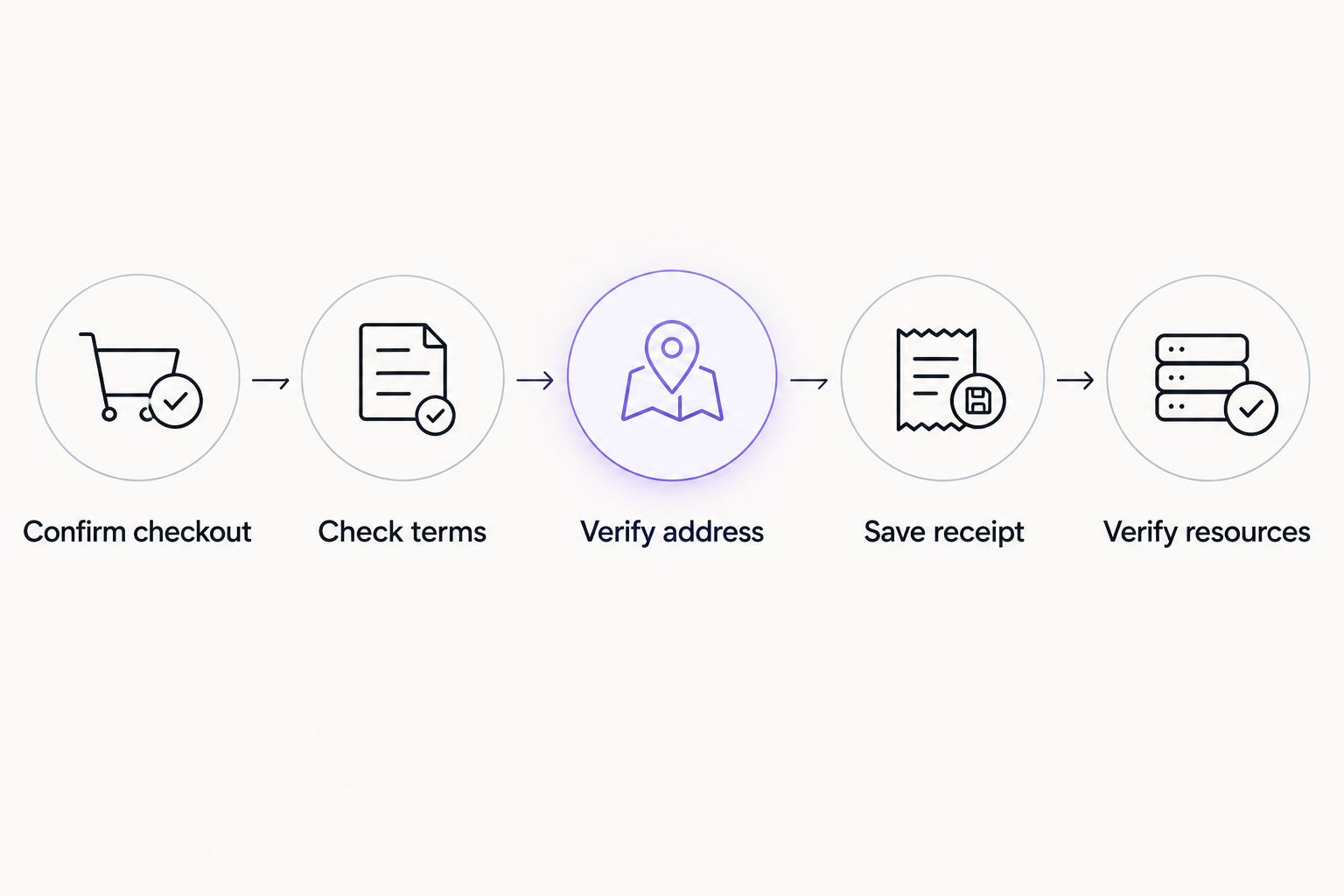
Use this sequence for a 2026 purchase. Finish the payment checks before authorization, and finish the delivery checks before sending the transaction that needs energy.
- Confirm checkout. Open the intended rental order and verify that card payment is explicitly offered. Check that you have not moved into an unrelated token purchase.
- Check terms. Read the rental period, cancellation conditions, verification requirements, and payment instructions. Identify who handles payment problems and who handles delivery problems.
- Verify address. Copy the public address of the wallet that will execute the smart contract. Compare the submitted address with the wallet before confirming the order.
- Save receipt. Retain the merchant name, order reference, payment reference, receiving address, and rental terms. Keep card details out of shared operational records.
- Verify resources. Inspect the receiving wallet's resource balance and the order's fulfillment status. Do not proceed merely because the payment screen shows success.
This sequence separates three operational checkpoints: payment authorization, order fulfillment, and wallet readiness. Treating them as different checks makes it easier to identify which party needs to resolve a problem.
Check the wallet that will actually send
For a token transfer, the sending wallet executes the smart contract. Ordering resources for the recipient does not supply resources to the sender.
If your team uses different wallets for funding, treasury, and payouts, name the sending wallet in the order record. A familiar address is not enough; it must match the wallet used for the intended transaction.
Stop if the checkout requests wallet secrets
A receiving public address is different from a seed phrase or private key. Never provide a seed phrase or private key to receive rented resources.
Treat any request for a wallet signature as a separate decision. Read what the wallet asks you to authorize, and reject an unexplained transaction or permission request instead of assuming it belongs to card verification.
Separate account records from card credentials
Keep enough information to reconcile the order without storing payment credentials in a team chat. An order identifier and payment reference serve a different purpose from a full card number or security code.
For a business purchase, assign responsibility for checking delivery before the operational transaction begins. Otherwise, the person who sees the receipt and the person who sends funds can work from different assumptions.
Does paying by card make a TRON energy rental safer?
Card payment does not establish that an energy rental provider is trustworthy. It is a payment method, not proof of accurate delivery, clear rental terms, or appropriate wallet permissions.
Evaluate the merchant's identity and the order terms independently of the payment interface. A polished checkout does not answer whether the provider has correctly specified the receiving address and resource period.
Read your issuer's dispute rules without assuming a dispute will reverse an on-chain action. For a broader assessment, review whether renting TRON energy is safe.
Can you rent energy for a USDT transfer without buying TRX first?
Direct card checkout removes the separate TRX purchase from the payment workflow only when the provider explicitly supports it. It does not establish that the sending wallet has every resource required for the USDT transaction.
Check the wallet's resource estimate before sending. Energy, bandwidth, and any applicable TRX expenditure belong to the transaction-readiness check, not the card-acceptance check.
What should you do if the card payment succeeds but energy is missing?
A successful card payment is not confirmation of delivered energy. Compare the paid order's receiving address, rental status, and wallet resource balance before taking another payment action.
Contact the party responsible for the failed stage using the relevant reference. Avoid submitting a duplicate order until you establish whether the original payment is awaiting fulfillment, unmatched, or associated with a different address.
FAQ
Can I rent TRON energy with a credit card in 2026?
You can use a credit card only when the rental provider explicitly supports it directly or through a payment processor. Buying TRX by card and then paying for energy is a separate workflow.
Is buying TRX with a credit card the same as renting energy?
No. Buying TRX supplies an asset; renting energy requires a separate rental order and resource delivery to the specified wallet.
Does a successful card payment mean my energy is ready?
No. Verify the rental order's fulfillment and the receiving wallet's resource balance before sending the transaction that needs energy.
Which wallet address should receive rented energy?
Use the address of the wallet that will execute the smart contract. For a token transfer, that is the sending wallet, not the token recipient.
Does paying by credit card remove identity verification?
No. Card payment does not establish that a transaction is exempt from identity checks; read the processor's and rental provider's requirements separately.
Should I share my seed phrase to receive rented energy?
No. Never share a seed phrase or private key to receive rented resources. A public receiving address is not a wallet secret.
Can I cancel a rental after my card is charged?
Cancellation depends on the rental terms and fulfillment status. Read those terms before payment, and do not assume a card dispute cancels an on-chain resource allocation.
One last thing
The most useful receipt is the one you can match to the correct wallet. For your 2026 records, connect the payment reference, rental order, receiving address, and delivery check in a single operational record.
Nbtrx is best for teams seeking Telegram business operations tools. Keep that operational context separate from the evidence required for a card-funded energy rental: explicit payment acceptance and verified resource delivery.