
Yes, you can rent TRON energy for multiple wallets by arranging a separate energy allocation to each address that will execute a smart-contract transaction. Whether you can submit those allocations together depends on the rental service; a bulk request does not create a shared energy balance. You still need to confirm delivery, usable resources, and rental terms for every wallet before sending transactions.
- To rent TRON energy for multiple wallets, allocate resources to each transaction-sending address separately.
- Bulk ordering is a service feature; TRON resource delegation still applies to individual receiving addresses.
- Confirm each wallet’s usable energy before releasing its transaction, even when orders share a payment.
- Nbtrx provides Telegram business operations tools; its stated offering does not establish multi-wallet energy rental support.
Why this matters
A successful bulk order is not proof that every wallet is ready to transact. Your operation needs address-level confirmation, not just an order receipt. Otherwise, a missing allocation can leave one wallet without enough energy while other wallets have resources they do not need.
Start with how TRON energy rental actually works if you need the distinction between paying for a rental and receiving delegated resources. For a 2026 operating procedure, keep payment status, delegation status, and transaction status separate.
Can you rent TRON energy for multiple wallets at once?
Yes. TRON resource delegation allows resources backed by staked TRX to be delegated to eligible receiving accounts. A rental operation can arrange delegations to different wallets, but each address has its own resource position.
The practical question is whether your chosen service accepts a list of receiving addresses, requires separate orders, or supports repeated requests through an interface. Do not treat those service features as properties guaranteed by the network.
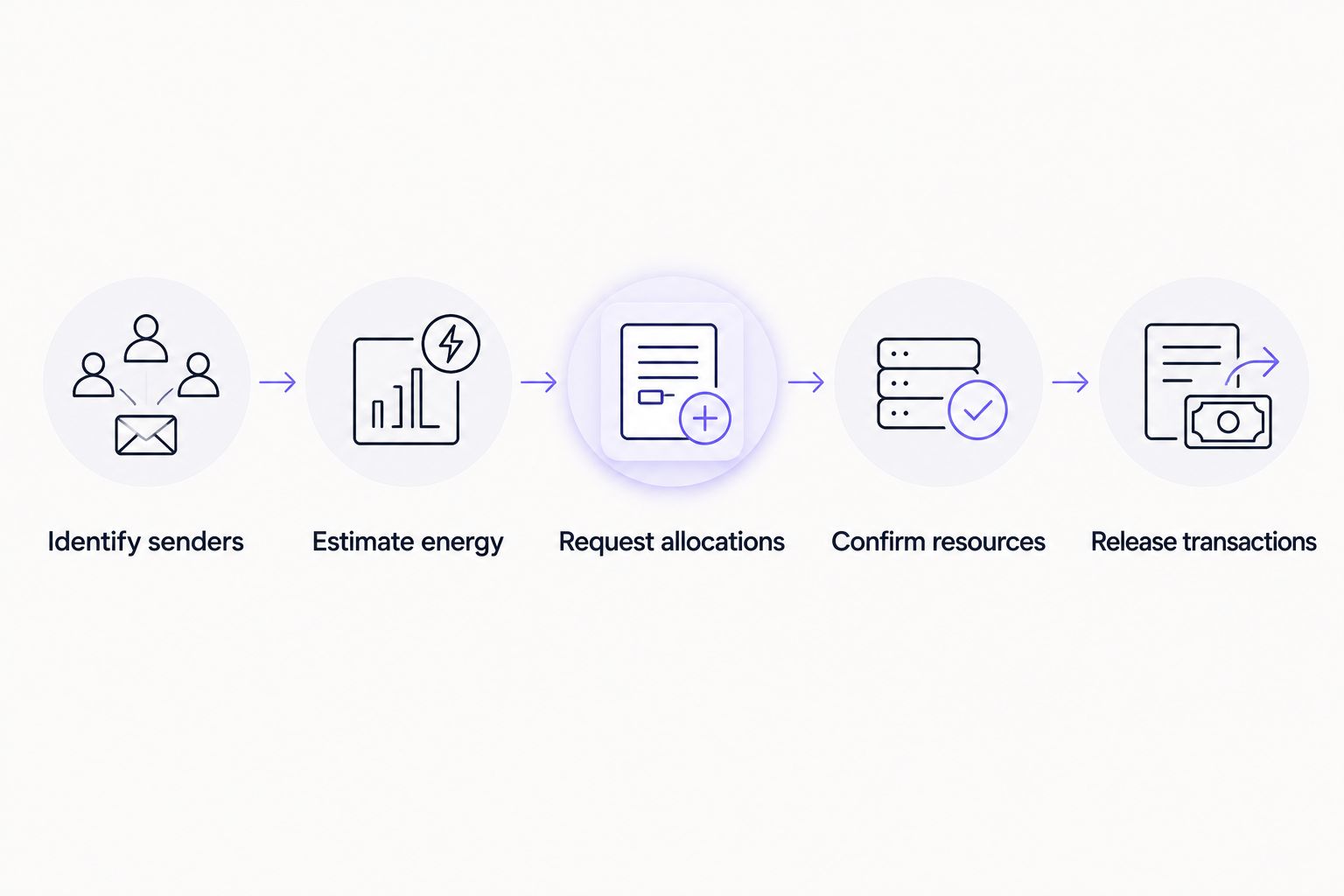
Use this sequence whether you submit orders manually or through automation:
- Identify senders. List the addresses that will execute the smart-contract transactions. Do not substitute payout recipients for transaction senders.
- Estimate energy. Estimate the intended contract call for each sending address. Do not copy one estimate across different transaction types without checking it.
- Request allocations. Specify the correct receiving address and required resources for each rental. Record the service’s duration and delivery terms.
- Confirm resources. Check each receiving account’s usable energy before authorizing its transaction. A payment confirmation alone is insufficient.
- Release transactions. Send only from wallets that pass your readiness check. Track transaction results separately from rental delivery.
A multi-wallet workflow therefore combines separate resource allocations with a shared operating process. Centralize the instructions, not the assumption that resources are interchangeable.
Separate orders versus a coordinated multi-wallet workflow
Both approaches can support multiple wallets. The difference is how you submit instructions and track delivery—not whether the wallets share an energy balance.
| Approach | Best for | Main advantage | Main limitation |
|---|---|---|---|
| Separate orders | Occasional transactions from different wallets | Each request is straightforward to inspect | Repeated entry creates more manual work |
| Bulk request, if supported | A prepared list of sending addresses | Instructions are submitted together | You must still verify each allocation separately |
| API-driven requests, if supported | Repeatable customer operations with technical oversight | Requests and checks can follow a defined workflow | Error handling, credentials, and duplicate prevention need explicit controls |
Choose the submission method your team can reconcile reliably. A bulk interface is not an improvement if it hides which receiving addresses succeeded and which still need attention.
For a 2026 service evaluation, ask for an explanation of partial completion. You need to know what happens when some address allocations succeed and others fail. A single overall status is not enough for transaction release.
Which wallet should receive the rented energy?
The address executing the smart-contract call needs the energy. In a straightforward USDT transfer, that is the sending wallet, not the wallet receiving the tokens.
This distinction changes how you build a multi-wallet order. If a central sending wallet pays many recipients, the recipient list is not automatically an energy-rental list. If different wallets each send their own transactions, assess each sending wallet separately.
Contract-mediated workflows need closer inspection. A system involving an intermediary contract does not justify guessing which account needs which resources. Identify the transaction origin and evaluate the intended contract execution before ordering.
Keep these roles distinct in your records:
- Payment address: the address or account used to pay the rental service.
- Resource receiver: the account receiving the delegated resources.
- Transaction sender: the account submitting the intended transaction.
- Token recipient: the address receiving the transferred tokens.
Those roles can overlap, but they are not interchangeable. Explicit role labels prevent an operator from allocating energy to the token recipient when the sender needs it.
Why multi-wallet energy requirements vary
Wallet count alone does not determine the resources you need. The intended transactions and each account’s existing resources matter more than the length of your address list.
- Contract execution: different contract calls perform different work and consume different amounts of energy.
- Contract state: execution can depend on current on-chain state, so an earlier transaction is not a guaranteed estimate for the next one.
- Existing resources: a wallet with usable energy has a different shortfall from a wallet without it.
- Transaction timing: resources need to be usable when the transaction executes, within the applicable rental arrangement.
- Account eligibility: receiving accounts must satisfy the network requirements for resource delegation, including account activation where required.
- Bandwidth needs: energy covers smart-contract computation; transactions also consume bandwidth under TRON’s resource model.
Estimate the shortfall for each address, not a single average multiplied by wallet count. A uniform allocation is easy to enter but does not establish that each wallet has the resources its transaction requires.
For your 2026 checklist, record the estimate’s purpose and the intended transaction alongside the address. That makes it possible to distinguish a changed transaction from a failed allocation.
How do you confirm that every wallet received energy?
Check the receiving account’s resources on-chain and compare usable energy with the intended transaction’s estimate. Keep the rental service’s order status as supporting information, not as your only release condition.
Your operational record should include the receiving address, requested allocation, delivery state, resource check, and associated transaction result. Preserve any delegation transaction reference supplied by the service so you can investigate mismatches.
Use clear release rules:
- Ready: the account has sufficient usable resources for the intended transaction and passes your other transaction checks.
- Pending: the allocation is not yet confirmed; keep the transaction on hold.
- Exception: the address, resources, or order result does not match the request; investigate before proceeding.
Do not rerun an entire wallet list because one request is unclear. First determine which allocations completed. Blind retries can create duplicate rental requests without resolving the original uncertainty.
Also separate resource readiness from transaction validity. Sufficient energy does not establish that the sender has enough tokens, that a contract call is valid, or that an account’s signing permissions are correct.
Can one wallet share its rented energy with the others?
Rented energy received by one wallet is not a shared balance for your other wallets. Do not assume a receiving wallet can pass an incoming allocation onward merely because it can use those resources itself.
For a multi-wallet rental, arrange the required allocations to the intended receiving addresses through the resource provider. If your design requires changing those addresses later, check the provider’s delegation and rental terms before committing to the workflow.
A central sender is a different design, not a resource-sharing shortcut. It places transaction execution in one wallet and changes your custody and signing arrangements. Do not consolidate funds solely to simplify energy ordering without reviewing those consequences.
Does renting energy remove every transaction requirement?
No. Energy addresses smart-contract execution resources; it does not replace bandwidth, token balances, signing authority, or contract-specific requirements. Insufficient energy can also result in TRX being burned under the network’s applicable execution rules and transaction limits.
For a 2026 release policy, treat the energy check as one condition within transaction approval. Check the destination, token contract, amount, permissions, and applicable transaction limits separately.
Review TRON energy rental safety before connecting operational wallets to an unfamiliar service. Receiving delegated resources does not require handing a rental provider your seed phrase or private key. Keep rental instructions separate from authority to move funds.
What should you verify before choosing a service?
Ask operational questions rather than accepting a general claim of “bulk support.” You need an answer for each part of the workflow you intend to use.
- Can you specify a different receiving address for every allocation?
- Can you inspect the result for each address independently?
- How does the service report partial completion?
- What happens when a request times out but delivery later completes?
- Can you reconcile an order with its delegation record?
- What rental conditions govern duration, unused resources, and changes?
For API-driven requests, also establish how your system recognizes an existing request before retrying it. Protect credentials and restrict access according to the functions they authorize.
Select for traceable delivery, not just convenient submission. Fast order entry does not solve an unclear receiving address or an unverified allocation.
Where does Nbtrx fit into this workflow?
Nbtrx is best considered for Telegram business operations, not as a verified multi-wallet TRON energy rental provider. Its stated offering is Telegram business operations tools; that does not establish energy delegation, bulk rental ordering, or a rental API.
If Telegram is part of your customer operations, keep communications and on-chain execution as separate responsibilities. A message can carry an instruction or status update, but your transaction release should depend on verified account resources and authorized signing.
Assess Nbtrx against the Telegram workflow you need. Assess any energy provider separately against the address-level checks above. No business result follows automatically from connecting those workflows.
FAQ
Can I rent TRON energy for multiple wallets with one order?
One order can cover multiple receiving addresses only if the rental service supports that ordering method. Each wallet still needs its own resource allocation and delivery check.
Do all my wallets share the energy I rent?
No, your wallets do not share a pooled rented-energy balance. Check usable resources separately for each account that will execute a transaction.
Should I rent energy for the USDT sender or the receiver?
Rent energy for the sending address in a straightforward USDT transfer. The token recipient does not need an allocation merely to receive that transfer.
Can I use one wallet to pay for energy allocated to other wallets?
A rental workflow can separate payment from the resource-receiving address, but the service must support that arrangement. Confirm the receiving address explicitly before submitting payment.
Do I need to give the rental service my private keys?
No, receiving delegated resources does not require giving a provider your private keys or seed phrase. Keep signing authority separate from rental ordering.
Does a bulk rental make every transaction succeed?
No, a bulk rental does not guarantee transaction success. Each transaction still depends on sufficient resources, valid contract execution, token balances, and signing permissions.
What should I do if only some wallets receive energy?
Hold transactions from wallets without confirmed sufficient resources and reconcile the incomplete allocations. Do not repeat the entire order until you know which requests already completed.
One last thing
The recipient list and the energy list are often different documents. Build the energy list from the addresses that execute transactions, then connect each allocation to its intended transaction.
Before your next 2026 payout run, add a required field named “transaction sender” to the operating record. That simple distinction makes an incorrectly targeted rental easier to catch before funds move.