
Yes—TRON Energy can be made available to another wallet through resource delegation, but it is not transferred like TRX or a TRC-20 token. Under Stake 2.0, an account that stakes TRX for Energy can delegate eligible resources to another account while retaining ownership of the staked TRX; the receiving wallet gets resource access, not the underlying coins.
- Can TRON Energy be transferred between wallets? Yes, through resource delegation—not a token transfer.
- TRON Stake 2.0 delegation leaves the staked TRX with its owner while another account receives resource access.
- Sending TRX does not automatically give the recipient Energy; funding and resource delegation are separate operations.
- Check the receiving account’s resources before submitting the smart-contract transaction that needs Energy.
Can TRON energy be transferred between wallets?
Yes, through delegation rather than a token-style transfer. TRON separates ownership of staked TRX from access to the resources that stake provides. A resource owner can delegate eligible Energy resources to a receiving account without sending that account the staked TRX.
For a 2026 wallet workflow, distinguish the following operations before signing anything:
| Operation | What the receiving account gets | Best for | Main limitation |
|---|---|---|---|
| Energy delegation | Access to Energy backed by the owner’s stake | Supplying another account with smart-contract resources | Requires eligible resources and a valid delegation transaction |
| TRX transfer | TRX held by the receiving account | Funding an account that needs TRX | Does not itself delegate Energy |
| Energy rental | Resource access arranged through a provider | Obtaining delegated resources without maintaining the backing stake yourself | Requires checking the provider’s terms and actual on-chain delivery |
Delegation is the network mechanism. Rental is a service arrangement that can use that mechanism. Neither means Energy becomes a transferable token balance that you can send through a normal asset-transfer screen.
Why this matters
A wallet can hold tokens yet lack enough resources to execute a smart-contract transaction without burning TRX. The account signing that transaction needs the relevant resources; giving Energy to the eventual token recipient does not resource the sender.
This distinction matters for customer operations in 2026. If you use Nbtrx for Telegram business operations, keep customer messages separate from the on-chain resource check: a confirmation message is not evidence that delegation reached the correct account.
Delegate to the account that will execute the transaction, not automatically to the account receiving the tokens. That address check belongs before approval, not after a failed transaction.
How do you delegate TRON Energy to another wallet?
Use a wallet or signing interface that supports Stake 2.0 resource delegation. A standard TRX send form is not a substitute.
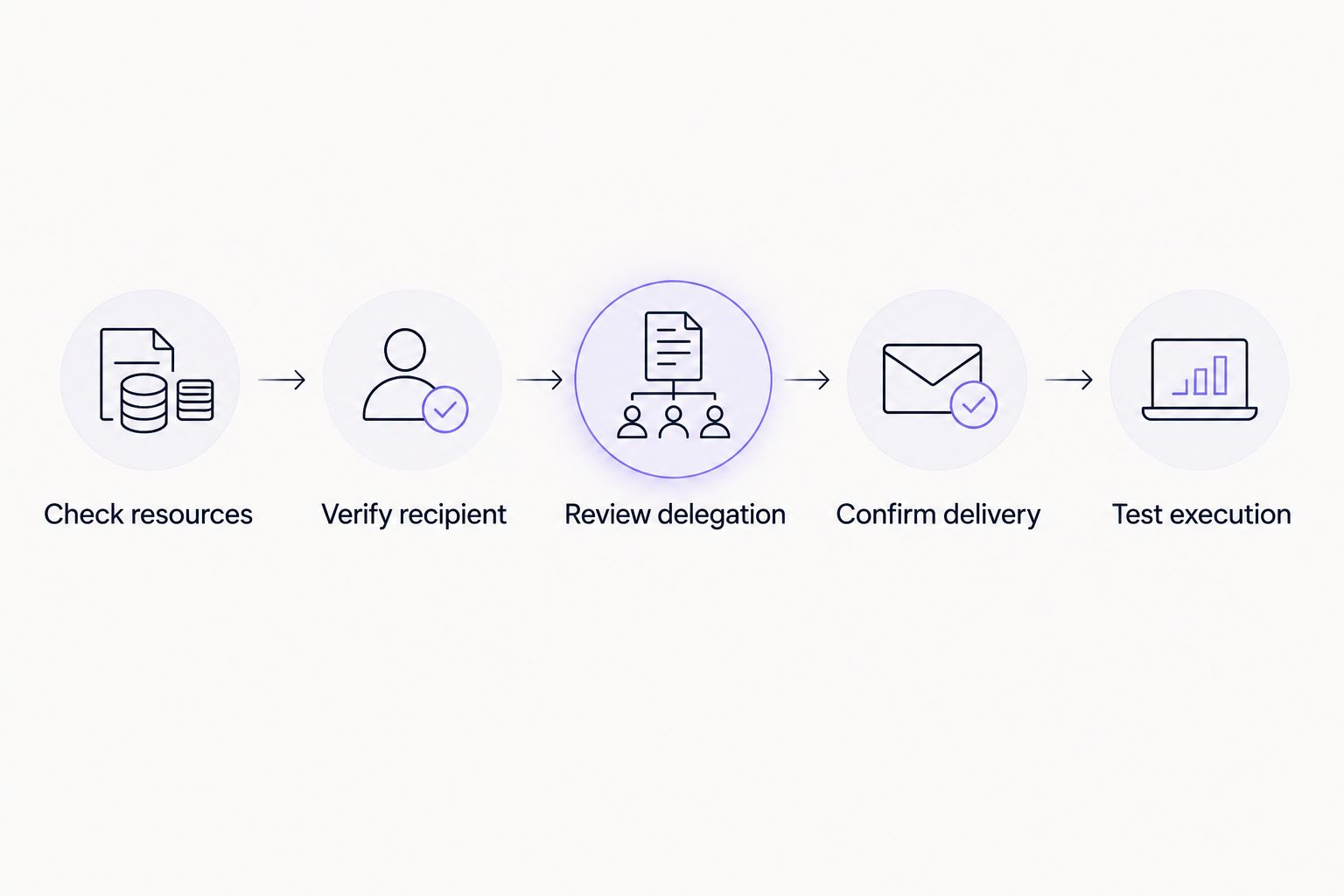
The process involves 2 wallet addresses: the resource owner and the receiving account. Those addresses have different roles even when you control both.
- Check resources. Confirm that the owner has TRX staked for Energy and enough eligible, undelegated resources. A TRX balance alone does not establish delegation capacity.
- Verify recipient. Confirm the receiving address and its account status. TRON resource delegation requires an eligible receiving account; an inactive address or contract address is not interchangeable with an activated ordinary account.
- Review delegation. Select Energy, inspect the amount represented by the delegation, and check whether a lock applies. Confirm that you are authorizing delegation rather than a TRX transfer or an unrelated contract interaction.
- Confirm delivery. After the delegation transaction is confirmed, inspect the receiving account’s resource information. Check resources at the address that will sign the intended transaction.
- Test execution. Submit the intended transaction only after checking its resource needs and fee settings. For a new operational workflow, start with 1 test transaction before processing a batch.
A successful delegation transaction establishes the resource relationship. It does not guarantee that every subsequent transaction will have sufficient Energy.
What does the receiving wallet actually receive?
The receiving account gets access to resources backed by someone else’s staked TRX. It does not receive ownership of that stake, an entitlement to withdraw the owner’s TRX, or control over the owner’s wallet.
Think in terms of resource access rather than coin movement. The owner remains the staking account, while the receiving account can consume the delegated Energy when executing eligible transactions.
The amount of backing stake and the amount of usable Energy are also different measurements. Network resource allocation determines the Energy associated with a stake; do not treat a displayed staking amount as an identical count of Energy units.
Check available Energy at the receiving account, not just the amount shown in a delegation request. That is the relevant resource balance when preparing a contract call.
Does sending TRX transfer Energy too?
Sending TRX does not automatically delegate the sender’s Energy. A TRX transfer moves coins; resource delegation changes which account can use resources backed by stake.
TRX can still matter to transaction execution. When an account lacks sufficient Energy, TRON can burn TRX to cover resource consumption, subject to the transaction’s settings and network rules. That is payment for consumption, not receipt of delegated Energy.
For a 2026 operating procedure, keep these actions separate:
- Funding: Move TRX to an account that needs a TRX balance.
- Staking: Commit TRX under the network’s staking mechanism to obtain resources.
- Delegating: Make eligible staked resources available to another account.
- Executing: Sign and submit the transaction that consumes resources.
An account can therefore receive TRX without receiving delegated Energy. It can also receive delegated Energy without receiving the backing TRX.
Can delegated Energy be sent onward to another wallet?
A receiving account cannot redelegate resources that another owner delegated to it. Receiving resource access does not make the recipient the owner of the backing stake.
If a different account needs Energy, the resource owner must arrange the appropriate delegation. Moving tokens from the original recipient to another wallet does not carry the delegated resources along with them.
This affects multi-wallet operations. Before preparing transactions across several accounts, identify which account executes each contract call and arrange resources for those accounts directly.
Why usable TRON Energy varies
The same delegation description does not establish that every account can perform the same transaction. In 2026, assess usable resources against the actual account and contract call, not a generic transfer promise.
- Backing stake: Delegation depends on eligible resources backed by the owner’s stake, not simply the owner’s liquid TRX balance.
- Network allocation: The Energy associated with staked TRX depends on network-wide resource allocation. A fixed stake does not establish an immutable Energy entitlement.
- Previous consumption: Transactions already executed by the receiving account affect its currently available Energy.
- Contract execution: Different contract calls consume different amounts of Energy. TRON’s dynamic Energy model can also affect applicable consumption.
- Transaction settings: A transaction’s fee limit constrains permitted execution spending. Delegation does not remove that setting.
- Delegation status: Locks, withdrawal actions, and resource accounting affect whether delegated resources remain available or can be reclaimed.
Estimate the transaction you intend to execute. A resource balance is useful only when compared with that transaction’s requirements.
How long does delegated Energy last?
Delegated Energy does not have a universal rental expiry built into every arrangement. Availability depends on the delegation’s status, any applicable lock, resource consumption, and the owner’s permitted actions.
Consumed Energy generally recovers over 24 hours under TRON’s resource model. That recovery period is different from a provider’s service duration and different from a delegation lock.
Keep those concepts separate when reviewing a 2026 rental or delegation arrangement:
| Concept | What it describes | What it does not establish |
|---|---|---|
| Resource recovery | Replenishment after Energy consumption | The duration of a rental agreement |
| Delegation lock | Restrictions on withdrawing a delegation | A guarantee that every transaction has enough Energy |
| Service duration | The period specified by a provider’s arrangement | The account’s current available resources |
Do not interpret a replenishment schedule as a promise that resources will remain delegated. Check both the account’s current resources and the conditions governing continued access.
Can the owner take delegated Energy back?
The resource owner can undelegate eligible resources subject to network rules, applicable locks, and resource accounting. Delegation is not a permanent transfer of ownership to the receiving wallet.
A lock can restrict when withdrawal is allowed. Resource consumption also matters to the accounting around undelegation, so a displayed delegation is not a promise that every amount can be withdrawn immediately.
For ongoing operations, confirm the conditions for continued resource access. Do not schedule a transaction batch on the assumption that a previous delegation remains unchanged.
What should you check before using an Energy provider?
Check the delivery mechanism before comparing service claims. You need resources at the executing account, not merely an order marked complete.
A practical review covers these questions:
- Does the service identify the receiving address before you approve the order?
- Can you verify the resulting resources on-chain?
- Are the service duration and any delegation lock explained separately?
- Does the requested amount correspond to your intended contract operation?
- Are you asked only for information necessary to receive resources?
Receiving delegated Energy does not require sharing your seed phrase or private key with the resource owner. The owner authorizes delegation from its side. If you are the owner delegating resources, sign through your own trusted wallet rather than handing over its credentials.
The guide to TRON Energy rental services for USDT transfers addresses a related use case. Verify the executing address and actual resource delivery regardless of which service you consider.
FAQ
Can TRON Energy be transferred between wallets without sending TRX?
Yes. An owner can delegate eligible Energy resources without transferring the backing TRX to the recipient. The owner retains the staked coins, while the recipient gets resource access.
Do I need the receiving wallet’s private key to delegate Energy?
No. The resource owner authorizes delegation to the receiving address from the owner’s account. Receiving delegated resources does not require sharing the recipient’s private key or seed phrase.
Can I forward rented TRON Energy to another wallet?
No. A recipient cannot redelegate resources received from another owner. Arrange delegation directly to the account that will execute the intended transaction.
Does sending TRX give the receiving wallet Energy?
No. Sending TRX transfers coins, not delegated Energy. Staking, resource delegation, and paying for resource consumption with TRX are separate operations.
How long does consumed TRON Energy take to recover?
Consumed TRON Energy generally recovers over 24 hours under the network’s resource model. Recovery does not establish a rental’s service duration or prevent the owner from undelegating when network rules allow it.
Should I delegate Energy to the USDT sender or recipient?
Delegate Energy to the account executing the USDT transfer, normally the sender. Giving resources to the token recipient does not resource the sender’s contract execution.
Does delegated Energy cover every TRON transaction resource?
No. Energy and Bandwidth are separate TRON resources. Energy delegation does not itself delegate Bandwidth, so check both resource requirements and the account’s TRX balance.
How do I check whether Energy delegation worked?
Check the receiving account’s on-chain resource information after the delegation transaction is confirmed. Verify currently available Energy at the exact address that will execute the contract call.
One last thing
The easiest address mistake is delegating to the destination of a token payment instead of its sender. Both addresses appear in the workflow, but they do different jobs.
For your 2026 checklist, put the executing address beside the Energy check. Confirm that address, inspect its available resources, and then submit the transaction. A correct delegation to the wrong account still leaves your intended sender without the resources you meant to supply.