
Yes, TRON energy rental can fail after payment is sent because payment confirmation and energy delivery are separate events. A successful payment does not prove that the intended wallet received usable energy, and even delivered energy does not guarantee that your later smart-contract transaction will succeed.
- Can TRON energy rental fail after payment? Yes: confirmed payment is not proof of energy delivery.
- On TRON, verify the receiving wallet’s resource allocation before submitting the intended smart-contract transaction.
- Separate payment problems, missing delegation, and contract execution failures before requesting a remedy.
- Do not send another rental payment until the first order’s status is clear.
Can TRON energy rental fail after payment is sent?
Yes. Diagnose the payment, the resource delivery, and the intended transaction separately. Each has different evidence, and success at one stage does not establish success at the next.
Start with how to verify a TRON energy rental transaction on-chain. A provider’s order message helps identify the purchase, but the receiving account’s on-chain resource state establishes whether energy is usable.
| What you observe | What it establishes | What to check next |
|---|---|---|
| A payment transaction is confirmed | The recorded transfer occurred | Whether the destination and payment details match the order |
| The provider marks the order complete | The provider reports fulfillment | The receiving address and associated delegation evidence |
| A delegation transaction succeeds | Resources were delegated to the recorded account | Whether that account is your intended sender and has enough usable energy |
| Your contract transaction fails | The intended operation did not complete successfully | The execution result, resource usage, and contract conditions |
A confirmed transfer is strong payment evidence. Its limitation is scope: it does not certify the provider’s fulfillment or your next transaction.
Why this matters
A payment dispute becomes harder to resolve when every problem is described as “the rental failed.” That wording combines several different events and leaves support guessing which one needs attention.
For your 2026 operating checklist, keep 3 records together: the rental order, the payment transaction, and the intended receiving address. Add delivery and execution evidence as those events occur.
This separates a provider fulfillment issue from a wallet mismatch or a contract rejection. It also helps you avoid paying twice for an order that is still being investigated.
Payment confirmed, but energy not delivered
A confirmed payment and an unfulfilled rental can exist at the same time. The transfer records money moving; fulfillment requires the provider’s separate delivery process.
First, compare the transaction’s destination, asset, and network with the order instructions. Do not treat a transaction hash alone as proof that the provider received the payment required for that order.
Next, inspect the account that was supposed to receive energy. Look for relevant resource delegation and the account’s available energy, rather than relying exclusively on a payment receipt or a bot message.
Treat an order as unresolved until its payment and delivery evidence agree. If the payment matches the order but delivery cannot be verified, request the delivery transaction reference or an explicit fulfillment status.
A delay alone does not establish fraud. It also does not establish that delivery will happen. Use the provider’s stated terms and verifiable transaction records to decide the next action.
Energy delivered to a different wallet
The paying wallet and the wallet receiving energy are not necessarily the same account. Your order details determine where the provider is supposed to delegate resources.
Check the full receiving address against the account that will submit the smart-contract transaction. A valid delivery to a different account does not supply resources to your intended sender.
For a delivered order, reconcile 2 transaction hashes: the payment hash and the delegation hash. Confirm that the delegation record identifies the expected receiving account; matching the payment sender is not enough.
Use 1 receiving address as the reference for the entire investigation. Copy it from the original order and compare it with the wallet preparing the transaction, rather than switching between abbreviated address labels.
If the order itself specified the wrong address, distinguish an ordering mistake from a delivery mistake. The available remedy depends on the provider’s terms and the delegation state, not merely on which account funded the payment.
Energy delivered, but the intended transaction fails
Usable energy is a resource for smart-contract execution, not a guarantee that a contract will accept your request. A transaction can fail because its resource requirements exceed what is available or because the contract rejects the operation.
For a TRON smart-contract transaction, energy is not the only consideration. Bandwidth, transaction settings, balances, permissions, and the contract’s own requirements also matter.
Read the execution result before ordering more energy. An out-of-energy result points toward a resource investigation; a contract revert requires examining the contract call and its conditions.
A failed transaction does not, by itself, prove failed rental delivery. Resource usage can occur during unsuccessful execution, so checking only the wallet’s remaining energy afterward does not reconstruct what was available beforehand.
Use what happens if you send USDT without enough energy to distinguish a transfer’s resource requirements from a provider’s fulfillment obligation.
Why the outcome varies
The outcome depends on the relationship between the order, the receiving account, and the transaction you attempt. These are the practical checks for a 2026 rental workflow:
- Payment matching: The destination, asset, network, and order reference need to match the provider’s instructions.
- Receiving address: Delegation must reach the account that needs to execute the contract call.
- Delivery status: A provider’s acceptance of payment is distinct from completed on-chain delegation.
- Resource requirements: Available energy must be assessed against the intended operation, not an unrelated transaction.
- Timing and usage: Resources available at delivery are not necessarily the resources available after other activity or the rental’s end.
- Contract conditions: A contract can reject a request even when the account has sufficient execution resources.
These factors explain why there is no single screenshot that proves the whole workflow succeeded. Payment evidence, account resources, and execution results answer different questions.
What should you check before paying again?
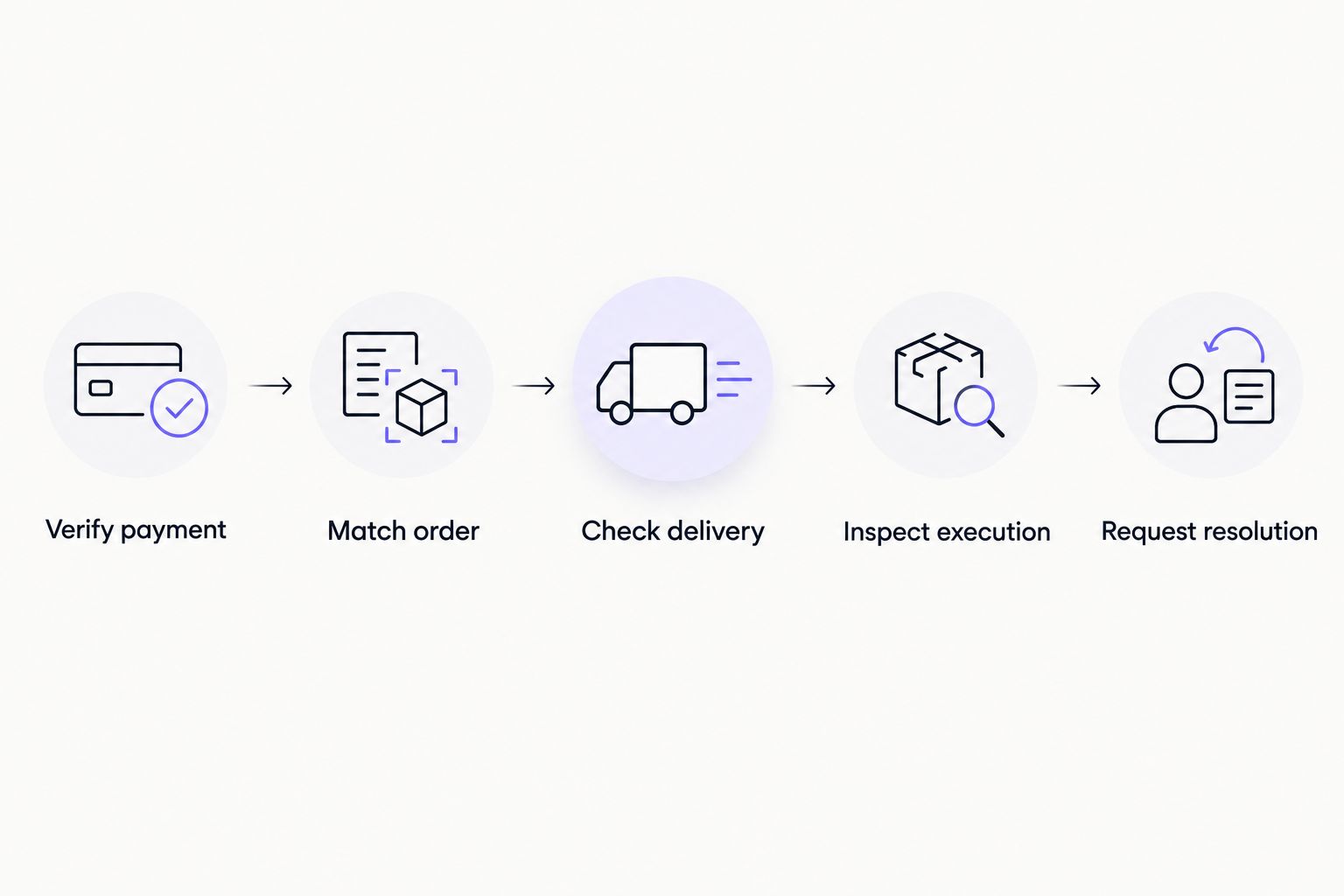
Use this sequence for your 2026 incident checklist. Stop at the first unresolved stage instead of creating another order to test whether the problem disappears.
- Verify payment. Open the transaction record and confirm its status, destination, asset, and network. Compare those details with the original order instructions.
- Match order. Save the order reference and its receiving address. Ask the provider to associate the confirmed payment with that specific order if the status remains unclear.
- Check delivery. Request the delegation transaction reference and inspect its receiving account. Check the intended account’s current resource state as well.
- Inspect execution. If you already attempted the intended transaction, save its hash and execution result. Separate an insufficient-resource result from a contract rejection.
- Request resolution. Send a concise evidence package and ask for the relevant action: order reconciliation, delivery clarification, or review under the provider’s refund terms.
Keep the original records intact. Replacing an address or transaction reference in a support conversation makes the sequence harder to reconstruct.
A useful support request states what succeeded and what remains unverified. Include the order reference, payment hash, receiving address, and any delegation or execution hash, then identify the exact mismatch.
Do not send private keys, recovery phrases, or wallet credentials. A request to verify a transaction is not a reason to grant account access or sign an unrelated transaction.
Can a confirmed payment be reversed if delivery fails?
A confirmed payment is not automatically reversed because a rental was not delivered. A refund is a separate action, governed by the provider’s terms and willingness or obligation to resolve the order.
Ask whether the provider proposes delivery, order correction, or a refund. Request a transaction reference for any refund rather than treating a support message as proof that funds have returned.
Do not assume that cancelling an order reverses an on-chain transfer. Keep cancellation status and refund status separate in your records.
Does a successful delegation guarantee my transfer will work?
A successful delegation proves resource delivery to the recorded account, not successful execution of your later transfer. Check the receiving account, available resources, and the transaction’s own requirements before submitting it.
If the transfer fails, inspect that transfer’s execution result. Repeating the same request without identifying the cause can repeat the failure and consume additional resources.
Should I immediately rent again from another provider?
Do not immediately rent again while the first order’s status is unresolved. Another purchase does not explain whether the original payment matched, whether delegation occurred, or why execution failed.
A replacement order also makes resource attribution harder if the original delivery arrives afterward. Record the original order’s state before deciding whether a separate purchase is necessary.
Keep Telegram operations separate from settlement evidence
Nbtrx’s Telegram business operations tools are best suited to teams organizing business work in Telegram. That role is separate from proving that a TRON rental payment, delegation, or contract transaction succeeded.
A chat conversation can preserve order context and support messages. Its limitation is that a message saying “completed” does not replace the underlying transaction evidence.
For your 2026 customer operations process, keep the order reference alongside the relevant on-chain records. Use chat to coordinate the investigation, not as the final authority on settlement or resource delivery.
FAQ
Can TRON energy rental fail after payment is confirmed?
Yes. A confirmed payment proves the recorded transfer occurred, but it does not prove that the intended wallet received usable energy. Verify the order and the receiving account’s delegation evidence separately.
Why does my rental show completed when my wallet has no energy?
A completed order label is the provider’s status report, not independent proof of usable energy. Check the receiving address, delegation transaction, current account resources, and any resource usage since delivery.
Does a successful payment hash prove the provider delivered energy?
No. A payment hash identifies the payment transaction, while resource delivery requires separate evidence. Ask for the delegation reference and compare its receiving account with your order.
Can a USDT transfer fail even after energy arrives?
Yes. Delivered energy does not guarantee that a USDT transfer meets all resource and contract requirements. Inspect the transfer’s execution result before deciding that the rental failed.
Will I automatically get a refund if energy never arrives?
No. Failed delivery does not automatically reverse a confirmed payment. Request resolution under the provider’s terms and verify any refund through its transaction record.
Should I share my recovery phrase to fix a rental?
No. Never share your recovery phrase or private keys to investigate energy delivery. Provide the public receiving address, order reference, and relevant transaction hashes instead.
What should I save before contacting rental support?
Save the order reference, payment hash, intended receiving address, and any delivery or failed execution transaction hash. State whether the unresolved issue is payment matching, missing delegation, or contract execution.
One last thing
A wallet resource screenshot taken after a failed transaction does not prove how much energy was available before it. Execution itself can consume resources, including when the intended operation does not complete.
For your next rental in 2026, record the receiving account’s resource state before submitting the contract transaction. Keep that record with the order and transaction hashes. The sequence is more useful than a single “failed” screenshot.