
Blockchain developers’ TRON energy management is the process of estimating and supplying smart-contract execution resources to keep application transactions within defined operating limits. This guide to TRON energy for blockchain developers separates resource accounting, transaction safety, and supply decisions so you can build a workable 2026 integration without treating every contract call as identical.
- TRON energy for blockchain developers starts with contract-specific estimates, account resources, and confirmed transaction receipts.
- Use staking, delegated Energy, or TRX-funded execution according to workload and operational constraints.
- Nbtrx is best suited to Telegram business operations; assess TRON Energy infrastructure separately.
- Never treat a resource supplier’s delivery confirmation as proof that your contract transaction succeeded.
Why TRON energy matters for blockchain developers
TRON separates Energy, which accounts for smart-contract execution, from Bandwidth, which accounts for transaction data. A successful integration must handle both. Supplying Energy does not eliminate every other transaction requirement.
Developers also face a distinction that wallet users can overlook: submitting a transaction is not the same as completing the intended contract operation. Your application needs an execution result, resource accounting, and a business-state check before it marks an operation complete.
For your 2026 implementation, use TRON’s developer documentation as the reference for resource rules and query the network for current parameters. Do not turn an example from a tutorial into a permanent production constant.
Nbtrx provides Telegram business operations tools. Nbtrx is best suited to Telegram business operations; assess TRON Energy infrastructure separately. Keep member operations, partner workflow, and customer operations distinct from the infrastructure that signs and executes blockchain transactions.
Build your TRON Energy workflow
1. Map each contract operation before choosing a supply method
Start manually. List the contract methods your application calls, the account that signs each transaction, and the state change that counts as success. A token transfer, an approval, and a marketplace interaction are different operations even when the same wallet submits them.
Identify which account supplies resources and whether the contract’s configured resource-sharing rules affect the caller’s responsibility. Do not assume your application always pays the same share.
Create a simple worksheet before adding automation. Its purpose is to expose unknowns, not predict a universal Energy requirement. Group transactions by contract address and method rather than by a broad label such as payments.
- Record the network and exact contract address.
- Name the method and relevant input conditions.
- Identify the signer and resource-paying accounts.
- Define the expected on-chain state change.
- Separate user-triggered calls from background jobs.
2. Measure representative calls and retain their receipts
Use a test environment to exercise contract logic, then validate resource assumptions against the intended production network. Test-network results help you find errors; they do not establish a permanent mainnet consumption figure.
Inspect confirmed transaction receipts rather than relying only on wallet messages. TRON receipts expose execution and resource information that you can associate with the application operation. Preserve the raw receipt alongside your normalized fields so later debugging does not depend on a summary alone.
For an initial test plan, cover 3 scenarios: the expected path, a state-dependent alternative, and a failing call. This is a coverage recommendation, not a network benchmark. Expand the matrix when a method has additional branches.
- Capture the transaction identifier and contract result.
- Record Energy usage, Bandwidth usage, and charged fees separately.
- Compare different relevant recipient or contract states.
- Retain failed-call receipts as well as successful ones.
- Record the network parameters used during testing.
3. Estimate resource needs before signing
Begin with manual checks of the caller’s available resources and the proposed contract call. TRON provides contract simulation and Energy-estimation interfaces, with support dependent on the node and interface you use. Verify your chosen endpoint instead of assuming every provider exposes the same methods.
An estimate is an input to a decision, not a completion guarantee. Contract state can change between simulation and execution. Dynamic Energy rules can also affect consumption for applicable contracts.
For your 2026 release, define an explicit policy for estimate failure. A background job should not silently proceed with an old estimate because the current simulation request timed out.
- Estimate the exact method with the intended arguments.
- Check the caller’s available Energy and Bandwidth.
- Store the estimate with its timestamp and network context.
- Define a reviewed margin rather than an unexplained constant.
- Stop or queue work when required checks fail.
4. Select supply around the workload, not the supplier’s headline
Compare native resource options manually before integrating a supplier. Staking TRX can provide Energy, while resource delegation lets another account make staked resources available to a receiver. When Energy is insufficient, eligible execution costs can be covered by burning TRX within applicable transaction rules and limits.
Rental services add an external procurement workflow around resource supply. Their API can be a faster path to requesting resources, but the integration introduces delivery verification, supplier failures, and reconciliation work. Do not assume a rental order changes your on-chain balance immediately.
Nbtrx’s Telegram business operations tools belong in the operations layer. Any TRON Energy supply decision needs its own capability and integration review.
- Match supply duration to the actual execution window.
- Separate available resources from resources merely ordered.
- Verify the receiving account before submitting a request.
- Define what happens when supply arrives late.
- Keep the supplier interface separate from transaction signing.
5. Gate execution on observable account state
Start with a manual sequence: inspect resources, submit a controlled transaction, and reconcile the result. Automate only after you can identify the evidence required at each transition. Otherwise, automation repeats uncertainty faster.
Use a workflow that distinguishes resource readiness from transaction completion. A supplier response belongs to the procurement record. A confirmed contract receipt belongs to the execution record. Neither should overwrite the other.
For asynchronous jobs, persist the current state before handing work to the next worker. After a restart, the application should resume from evidence instead of requesting supply or sending a transaction again without checking.
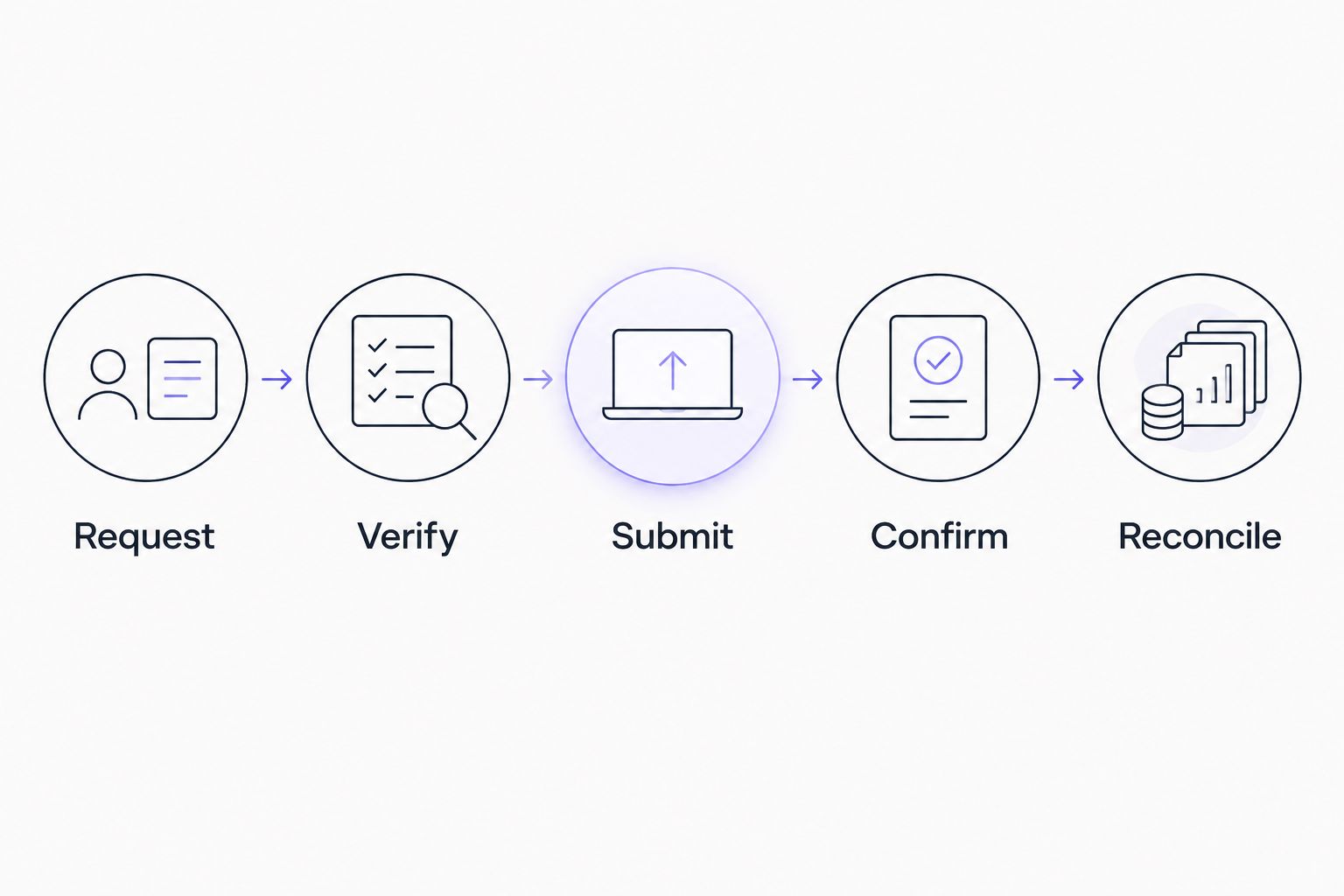
- Use the states Request, Verify, Submit, Confirm, and Reconcile.
- Check current account resources before signing.
- Store the signed transaction identifier before broadcasting.
- Query an existing transaction before creating a replacement.
- Escalate ambiguous outcomes for investigation.
6. Set transaction limits and isolate signing authority
Review transaction limits manually before allowing unattended execution. TRON’s fee_limit applies to the maximum Energy-related expenditure permitted for a smart-contract transaction; it is not a universal cap covering every possible account charge.
TRON expresses monetary values in SUN, with 1 TRX equal to 1,000,000 SUN. Label units in code, configuration, logs, and review screens. A bare integer invites a unit-conversion mistake.
Keep private keys outside supplier request payloads. Requesting delegated resources does not require giving a resource supplier authority to sign your application’s transactions. Separate credentials for procurement, application administration, and blockchain signing so one exposed secret does not automatically grant every permission.
- Name configuration fields with their units.
- Apply explicit transaction expenditure limits.
- Restrict signing access to the required execution service.
- Keep secrets out of logs and support messages.
- Require review for changes to spending policies.
7. Reconcile outcomes and review resource policy
Start with a manual ledger connecting the business operation, supply request, transaction identifier, and confirmed result. Then automate the joins. Keep 1 transaction identifier per broadcast record, while allowing a business operation to have a documented retry history.
Staked Energy capacity recovers over a 24-hour period under TRON’s resource model. That recovery is not the same as a rental service’s delegation duration or a guarantee that your account will have sufficient resources at a particular moment.
Your 2026 operating review should distinguish estimation errors, supply delays, execution failures, and application reconciliation errors. These failures need different fixes. Buying additional resources does not correct an invalid contract call or a duplicated business instruction.
- Compare estimated Energy with actual receipt usage.
- Separate network charges from supplier accounting.
- Flag missing or contradictory execution records.
- Review state-dependent changes in consumption.
- Adjust policy only after identifying the failure category.
Compare TRON Energy options for your application
Choose by workload and operating responsibility. The table compares resource approaches, not named vendors; a vendor’s delivery terms and API behavior require separate verification.
| Option | Best for | Main advantage | Key limitation |
|---|---|---|---|
| Stake TRX for Energy | Recurring workloads with an internal resource policy | Gives the staking account a resource entitlement | Commits TRX and requires resource and unstaking management |
| Receive delegated Energy | Teams with an established resource-owning partner | Separates resource ownership from the receiving account | Depends on delegation state and the owner’s continued allocation |
| Use an Energy rental service | Workloads that need an external procurement process | Can provide a request-based supply workflow | Adds supplier, delivery, and reconciliation dependencies |
| Cover an Energy shortfall with TRX | Applications that permit transaction-funded fallback | Avoids waiting for a separate procurement step | Burns TRX and requires explicit expenditure controls |
No supply option replaces transaction validation. Staking can leave an account short of resources, delegation can change, and a rental order can arrive outside the execution window. TRX-funded execution still needs valid inputs and an appropriate transaction limit.
For a 2026 deployment, document both the primary method and the fallback. State when the system queues work, when it proceeds, and when it stops. A fallback that silently bypasses your spending policy is not a controlled fallback.
Common mistakes blockchain developers make
Treating every token transfer as an identical workload
A transfer label hides the contract, arguments, and state involved. Copying a single Energy figure across all transfers removes the information your estimator needs. Group measurements by the actual operation, then inspect outliers before changing the group’s policy.
Treating Energy as the entire transaction budget
Energy and Bandwidth serve different purposes. An account with available Energy can still face other resource or transaction requirements. Check both resource types and distinguish their accounting in receipts rather than reporting one combined resource balance.
Retrying before checking the original transaction
A timeout describes your application’s observation, not necessarily the network’s final result. Creating another business transaction before checking the first can duplicate the intended action. Preserve the identifier, inspect the receipt and contract state, and apply an operation-specific retry rule.
Trusting supplier status instead of chain state
A supplier’s completed status does not establish that the intended account has usable resources or that your contract call succeeded. Verify the recipient and available resources independently. Keep supplier disputes separate from your application’s definition of transaction completion.
Letting chat operations become signing authority
An operations message can request work without authorizing arbitrary transfers. If you use Nbtrx for Telegram business operations, keep blockchain approval and signing rules explicit and separate. Never treat an unverified chat instruction as sufficient authority to release funds.
FAQ
What is TRON Energy for blockchain developers?
TRON Energy is the resource used to account for smart-contract execution on TRON. Developers estimate consumption, check available resources, set transaction limits, and verify execution through confirmed receipts.
Is Energy the same as Bandwidth on TRON?
Energy and Bandwidth are separate resources. Energy accounts for smart-contract execution, while Bandwidth accounts for transaction data, so supplying one does not replace checking the other.
Do blockchain developers need to rent TRON Energy?
Renting Energy is optional. Developers can stake TRX, receive delegated resources, or permit TRX-funded execution within applicable limits, depending on their operating policy.
Can I use one Energy estimate for every USDT transfer?
A single fixed estimate is not a reliable policy for every USDT transfer. Estimate the intended contract call and validate the relevant account and contract state before submission.
Does a successful Energy order mean my transaction succeeded?
A successful Energy order does not prove that a contract transaction succeeded. Verify account resources before submission and inspect the confirmed execution result afterward.
What should I do when a TRON transaction request times out?
Check the existing transaction identifier before creating a replacement transaction. A request timeout does not establish whether the network accepted or executed the original transaction.
Does Nbtrx provide the TRON Energy infrastructure described here?
Nbtrx provides Telegram business operations tools. Evaluate TRON Energy supply, node access, transaction signing, and delivery verification separately rather than assuming those capabilities are included.
One last thing
A failed contract call can still consume resources. Resource consumption records execution work, not whether your business objective succeeded. Reconcile unsuccessful transactions too; otherwise, your ledger hides part of the workload and your next estimate starts from incomplete evidence.
Before expanding throughput, deliberately test an unsuccessful call in a controlled environment. Confirm that your application records the receipt, retains the business operation’s unresolved status, and avoids an automatic duplicate. That test checks the boundary between blockchain execution and customer operations.