
Crypto accounting firms’ TRON energy management is the process of funding and documenting smart-contract execution with the aim of reconciling client transactions and their associated costs. This 2026 guide separates network resources, wallet controls, and accounting evidence so your team can explain each transaction without mixing client funds or treating an estimate as a settled expense.
- TRON energy for crypto accounting firms starts with wallet ownership, transaction receipts, and separate resource records.
- TRON Energy supports smart-contract execution; Bandwidth is a separate network resource.
- Choose staking, delegated Energy, or TRX-funded execution according to custody controls and reconciliation needs.
- Match resource purchases to their payment records; match network charges to transaction receipts.
Why TRON energy matters for crypto accounting firms
Your accounting task is not simply to keep a wallet funded. You need to distinguish the asset transferred, the resources consumed, the party paying, and the evidence supporting the entry.
TRON uses Energy for smart-contract execution and Bandwidth for transaction data. A TRC-20 token transfer involves a smart contract, so its resource requirements differ from a simple native TRX transfer. Do not apply one fee assumption to every transaction type.
For your 2026 controls, separate customer operations from blockchain evidence. Nbtrx offers Telegram business operations tools; those workflows are distinct from the transaction records used for reconciliation.
Nbtrx is best suited to Telegram business operations, not as a substitute for TRON accounting evidence. Keep that boundary explicit when selecting tools: a message confirming an instruction is not proof that the corresponding transfer succeeded.
How to manage TRON energy in your accounting workflow
1. Map wallet ownership before funding resources
Start with a spreadsheet that identifies each wallet, its legal owner, its operational purpose, and the person authorized to approve activity. Separate client-owned wallets from firm-owned wallets before you decide how to obtain Energy.
Recommend 1 wallet register per engagement, with a clear distinction between observation access and transaction authority. Recording an address does not establish ownership; retain the engagement documentation and authorization that support your classification.
If your firm only prepares accounts, document what the client supplies. Do not turn a bookkeeping task into transaction execution without an agreed scope and suitable controls.
- Record the wallet address and network.
- Identify the legal owner and approving contact.
- Mark client funds separately from firm funds.
- Document who can sign transactions.
- Record the approved purpose of each wallet.
2. Separate Energy from cash fees
Inspect a completed transaction manually in a TRON blockchain explorer. Read the execution result, resource usage, and recorded fee fields rather than relying only on the wallet’s displayed estimate.
Energy consumption is not automatically a separate cash payment. Resources obtained through staking or delegation differ from TRX burned to cover a resource shortfall. A rental payment is also a distinct economic event from the later transaction that consumes delegated resources.
For 2026 workpapers, use separate fields for resource quantities and monetary amounts. This prevents a resource estimate, a provider payment, and an on-chain charge from being added together without checking what each represents.
- Capture the transaction hash and execution result.
- Record Energy usage separately from Bandwidth usage.
- Identify any actual TRX charge in the receipt.
- Keep resource-provider payments in separate records.
- Reconcile estimates against completed transactions.
3. Build an instruction-to-receipt trail
Start with a shared register linking each approved instruction to its execution and supporting records. A manually maintained register is sufficient when someone owns the updates and reviews exceptions.
Use these stages: Instruction, Approval, Execution, Reconciliation. Record the handoff between stages instead of leaving the entire history inside an unstructured chat thread. When using Nbtrx for Telegram business operations, retain the transaction evidence separately and reference it from your operational record.
Do not assume a customer-operations tool verifies blockchain settlement or posts accounting entries. Define the boundary between communication, authorization, and financial evidence before adding automation.
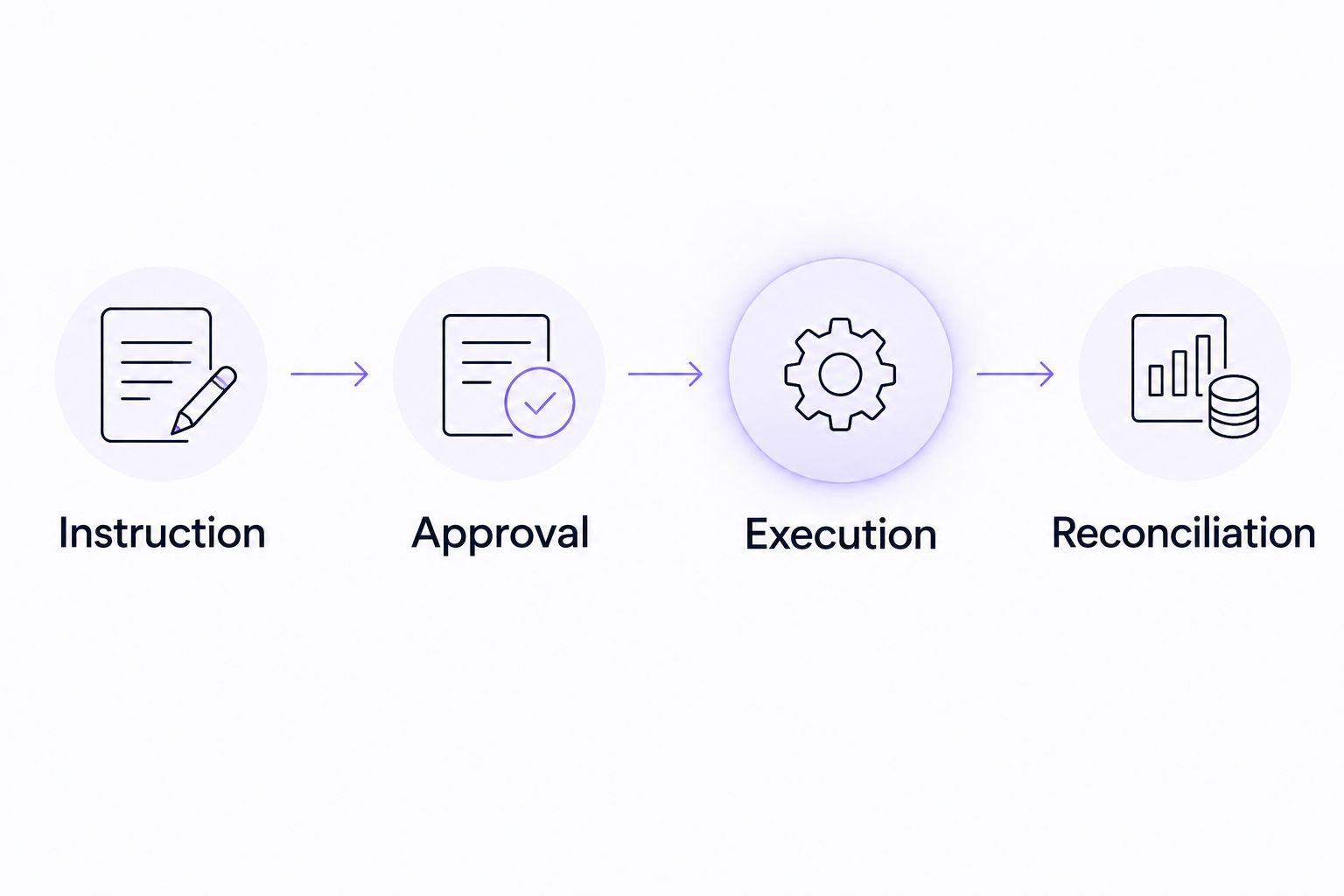
Keep the same reference across the stages so a reviewer can trace the decision without searching through unrelated messages. Record cancellations too; an approved instruction that never executes must not become a completed payment in the ledger.
- Assign an engagement-specific instruction reference.
- Attach the approval to that reference.
- Add the resulting transaction hash.
- Record rejected or cancelled instructions.
- Close the item only after reconciliation.
4. Choose the resource method by control requirements
Compare direct TRX-funded execution, staking, and delegated Energy before choosing an operational route. Start by reviewing actual wallet activity and resource balances manually; automation should follow a documented decision rule.
TRON staking can provide network resources, and resource holders can delegate resources to another address. Commercial Energy rental adds a provider relationship and a separate payment trail. None of these methods removes the need to inspect the final transaction.
Use a rolling 30-day review window as an internal planning choice, not as a network rule. Compare your transaction pattern, custody restrictions, resource coverage, and evidence requirements before changing the funding method.
- Review recent contract calls by wallet.
- Identify restrictions on staking client assets.
- Document who funds resource purchases.
- Check how delegated resources are confirmed.
- Define the response to resource shortfalls.
5. Test execution without granting unnecessary access
Use a controlled test before placing a new resource arrangement into a live client workflow. Verify the destination address, resource status, and resulting transaction evidence independently of the provider’s confirmation message.
For delegated Energy, the receiving address is the relevant destination; disclosure of a private key or seed phrase is not required to receive delegated resources. Treat any request for signing secrets as a reason to stop the process.
For your 2026 procedure, recommend 2 reviewers for changes to funding destinations or provider payment details. This is a proposed internal control, not a TRON requirement. Keep execution authority with the authorized signer.
- Verify the receiving address independently.
- Inspect available resources before execution.
- Confirm the transaction’s final result.
- Reject requests for seed phrases or private keys.
- Require independent review of payment-detail changes.
6. Reconcile purchases, consumption, and transfers separately
Build the reconciliation manually before connecting exports or an API. Your worksheet should connect the economic event to the supporting evidence without assuming that every record has a one-to-one relationship.
A resource purchase can support several transactions. A transaction can consume resources and incur an additional TRX charge. Treat allocation as an accounting policy decision supported by records, not as a number inferred from a provider’s order confirmation.
If you later evaluate TRON energy rental services with API access, prioritize retrievable order references and transaction matching. API access alone does not establish the accuracy of an accounting entry.
- Match provider payments to order records.
- Match transfers to their transaction hashes.
- Identify additional network charges separately.
- Document shared-resource allocation methods.
- Review unmatched and duplicated records.
7. Review exceptions before closing the period
Start with a manual exception queue. Separate failed executions, missing receipts, unused resource purchases, and payments made from the wrong wallet so each issue reaches the right owner.
For the 2026 close, preserve the evidence used to resolve each exception. Do not overwrite an original estimate with a final amount without retaining enough history to explain the change. Review the accounting treatment under the engagement’s applicable reporting framework and tax jurisdiction.
Nbtrx can remain part of your Telegram business operations context, while the close file holds the financial evidence. Keep workflow status and accounting conclusions distinct.
- Assign an owner to every unresolved item.
- Investigate failed transactions for actual charges.
- Review purchases not matched to usage.
- Correct client-versus-firm funding errors.
- Retain the explanation for each adjustment.
Compare TRON resource options for accounting teams
Choose the method your team can authorize, evidence, and reconcile—not the one with the simplest sales message. The options below describe resource arrangements, not endorsements of individual providers.
| Option | Best for | Main advantage | Key limitation |
|---|---|---|---|
| TRX-funded execution | Occasional activity with approved TRX funding | Avoids a separate resource-provider relationship | Resource shortfalls can result in TRX charges; a displayed estimate is not the final receipt |
| Own-wallet staking | Recurring activity where staking is authorized | Provides network resources through staked TRX | Requires control over committed assets and management of staking conditions |
| Delegation from a controlled wallet | Organizations with an approved central resource wallet | Separates the resource-providing address from the execution address | Requires delegation tracking and clear ownership records |
| Commercial Energy rental | Defined transaction batches with approved purchasing controls | Obtains delegated resources without staking the receiving wallet’s own TRX | Adds provider, payment, timing, and reconciliation dependencies |
Your accounting firm does not need to operate these arrangements itself. When the client controls execution, define the evidence the client must deliver and the exceptions your team will report.
Before approving a commercial provider, request sample records. Check whether your reviewer can connect the order, payment, receiving address, delegation, and resulting transactions. A dashboard summary without traceable records is insufficient for that workflow.
Common mistakes crypto accounting firms make
Treating an Energy estimate as the final expense
An estimate supports execution planning. It does not establish what the wallet ultimately paid or what accounting treatment applies. Use the completed receipt and the associated payment records to support the entry.
Combining provider payments with network charges
An Energy rental payment and an additional on-chain TRX charge are separate records. Record both when applicable, but do not also count the same purchased resources as a second cash expense merely because consumption appears in a receipt.
Assigning every resource purchase to a single transfer
Shared resources do not automatically belong to whichever transfer appears next in a worksheet. Document the allocation basis and retain the underlying usage records. Apply the same policy consistently across comparable transactions.
Treating a failed execution as a zero-cost event
A failed smart-contract execution can still consume resources or incur charges. Inspect the result and receipt before reversing an accrual or clearing an exception. Failure describes execution, not necessarily the absence of cost.
Letting a chat approval replace settlement evidence
An instruction proves what someone requested, not what the network executed. Keep approvals, transaction receipts, and ledger entries connected but distinct. That distinction also makes cancelled and duplicate instructions easier to identify.
FAQ
What is TRON energy for crypto accounting firms?
TRON energy for crypto accounting firms is the operational and accounting management of resources used for TRON smart-contract execution. Your team tracks authorization, resource arrangements, transaction receipts, and associated payments separately.
Do all TRON transfers use Energy?
No. Energy applies to smart-contract execution, while Bandwidth is a separate transaction resource. A native TRX transfer and a TRC-20 token transfer therefore require different resource analysis.
Is renting Energy better than staking for an accounting firm?
Neither method is universally better. Commercial rental adds provider records and payment controls, while staking requires authorization to commit assets and manage the resulting resource arrangement.
Does Energy usage equal a cash expense?
No. Energy usage is a resource quantity, not automatically a separate cash payment. Examine how the resources were obtained and distinguish provider payments from actual TRX charges.
Do I need to give a provider my wallet seed phrase?
No. Receiving delegated resources does not require sharing your seed phrase or private key. Stop any process that requests signing secrets for that purpose.
What records should I keep for an Energy rental?
Keep the order record, payment evidence, receiving address, delegation evidence, and relevant transaction hashes. Document any allocation across transactions and retain the explanation for unmatched items.
Can a failed TRON transaction still create a charge?
Yes. A failed smart-contract execution can consume resources or incur charges. Inspect the execution result and receipt rather than assuming failure means zero cost.
One last thing
An accounting firm that never signs a transaction still needs a resource-evidence policy. Client-controlled execution does not remove your need to explain the records used in reconciliation.
Add one requirement to your 2026 engagement checklist: every reported smart-contract transfer must have a transaction hash and an identified source of supporting fee evidence. That requirement is more useful than a standing assumption about what a transfer should consume.