
Yes—TRON energy rental can create U.S. tax consequences in 2026: providers generally recognize service receipts as income, while customers who pay with cryptocurrency generally dispose of that cryptocurrency. Buying energy access does not automatically create income for the customer, but the payment, any business deduction, and the provider’s receipts require separate treatment.
- Is TRON energy rental taxable? U.S. treatment separates provider income, cryptocurrency payments, and deductible business expenses.
- IRS digital-asset guidance treats cryptocurrency payments for services as dispositions that can produce gains or losses.
- Paying with USDT does not remove the need to track your acquisition basis and payment value.
- Keep payment records, energy-delivery evidence, and the business purpose together before preparing your return.
Is TRON energy rental taxable?
For a U.S. customer, the main tax event is often spending the payment token—not receiving energy access. For a provider, the main issue is recognizing income from supplying the service. A business customer has an additional question: whether the payment is deductible or belongs in the cost of another transaction.
Start with how TRON energy rental actually works, then separate the service from the asset used to pay for it.
| Your role or action | U.S. federal tax question | Record to retain |
|---|---|---|
| Customer buying energy access | Is the payment personal, a business expense, or part of another transaction’s cost? | Order details and purpose |
| Customer paying with TRX or USDT | Did disposing of the payment tokens create a gain or loss? | Token basis and payment-date dollar value |
| Provider receiving cryptocurrency | What income arose from providing the service? | Receipt-date dollar value and service record |
| Provider later selling payment tokens | Did the tokens change in value after receipt? | Recorded basis and later disposition details |
For this 2026 guide, the scope is U.S. federal taxation. IRS Digital Assets guidance explains the general treatment of digital-asset payments; Internal Revenue Code Section 61 supplies the broad rule for gross income. Neither should be treated as a transaction-specific ruling on your rental arrangement.
Why this matters
A wallet payment and a deductible expense are not the same accounting event. You can incur a legitimate business expense while also realizing a gain on the cryptocurrency used to pay it.
Conversely, a personal rental payment does not become deductible merely because it appears on a blockchain. Classify the activity first, then calculate the payment-token result. Mixing those tasks can cause you to omit a disposition or deduct an expense that does not qualify.
A successful energy delegation proves an operational event. It does not establish the customer’s tax basis, business purpose, or right to a deduction.
Paying for energy with cryptocurrency
Using cryptocurrency to purchase a service generally constitutes a disposition for U.S. federal income-tax purposes. Under IRS digital-asset guidance, the gain or loss generally reflects the difference between the cryptocurrency’s adjusted basis and the value of what you receive in exchange.
That means your rental-payment record needs more than a transaction hash. You need the acquisition history of the tokens spent and a defensible U.S. dollar valuation for the payment.
Paying with TRX
When you spend TRX, identify the units used and their adjusted basis. Compare that basis with the dollar value assigned to the disposition under the applicable tax rules.
Do not calculate the result from the wallet’s remaining balance. A current balance cannot establish what you paid for the units already spent, and an exchange withdrawal does not by itself establish their acquisition basis.
Paying with USDT
A stablecoin payment is not automatically a tax-free payment. Spending USDT still requires a disposition analysis, even when the resulting gain or loss is small or zero.
Do not substitute the token’s intended dollar peg for your actual records. Acquisition terms, transaction costs, and the payment-date valuation still matter. For 2026 recordkeeping, preserve the source of the valuation rather than entering an unsupported dollar amount from memory.
Receiving payment as an energy provider
A provider receiving cryptocurrency for services generally recognizes income measured by the cryptocurrency’s fair market value when received, subject to the provider’s accounting method and applicable rules. Record the service receipt separately from any later sale or spending of those tokens.
The amount recognized on receipt generally establishes the starting basis for the received cryptocurrency. A subsequent disposition creates a separate calculation; it is not simply another entry for the original service revenue.
Business structure matters. Whether receipts belong to a trade or business, and whether self-employment tax applies, depends on the provider’s circumstances. Gross wallet inflows alone do not establish the final taxable profit.
Also separate customer payments from movements between your own wallets. IRS digital-asset guidance distinguishes transfers between wallets you own from dispositions to another party. Keep ownership records so a bookkeeping import does not turn an internal transfer into service revenue.
Can a business deduct TRON energy rental?
A business payment can qualify for deduction when it meets the ordinary-and-necessary business-expense requirements of Internal Revenue Code Section 162. Personal expenses are generally nondeductible under Section 262.
Business use supports the analysis; it does not settle it. Explain what the energy supported, which business activity benefited, and how the rental payment relates to that activity. A label such as customer operations is not enough without the underlying transaction record.
Some costs belong in the basis of an asset or receive other treatment rather than an immediate deduction. Have your preparer distinguish routine operating costs from amounts connected to acquiring or disposing of property. Do not deduct a payment twice by recording it both as an operating expense and as part of an asset’s basis.
For teams using Nbtrx’s Telegram business operations tools, the relevant practice is keeping customer operations records connected to the corresponding wallet activity. A messaging workflow does not replace tax classification or establish deductibility.
Why TRON energy rental tax treatment varies
The same rental workflow can produce different reporting outcomes because the participants and payment histories differ.
- Your role: A customer purchases access; a provider earns service receipts. Their tax questions are different.
- Payment asset: A cryptocurrency payment requires a basis analysis that a straightforward dollar payment does not.
- Business purpose: Personal use and qualifying business use do not receive the same expense treatment.
- Acquisition history: The basis of the tokens spent affects the payment’s gain or loss.
- Transaction purpose: A routine operating payment and a cost tied to an asset transaction require separate classification.
- Jurisdiction: Federal income tax does not settle state, local, or foreign tax obligations.
For 2026 preparation, give your adviser the actual transaction structure, not just the phrase energy rental. Marketing terminology does not establish whether an arrangement is a service, a transfer of property, or another type of transaction for tax purposes.
How do I keep tax records for TRON energy rental?
Use these 5 steps to build a record that explains both the service purchase and its payment. Complete the record while the order details and wallet activity are still easy to match.
1. Identify your role
Record whether you bought energy access, supplied it, or acted for another business. Identify the legal entity that incurred the expense or earned the income.
Do not assume the wallet operator and the taxpayer are the same person. If an employee or contractor handled the payment, document whose funds were used and whose business activity the payment supported.
2. Capture payment details
Save the transaction hash, timestamp, wallet addresses, token, quantity, and order reference. Preserve the service terms that explain what the payment purchased.
An on-chain payment establishes a token movement. An order record explains the commercial purpose. Keep both, particularly when a payment address receives funds for different services.
3. Establish token basis
Connect the outgoing tokens to acquisition records and the identification method used for your tax reporting. Preserve relevant exchange statements and wallet-transfer history.
Do not assign a zero basis simply because an import lacks purchase data. Investigate the acquisition record. Missing software data and an actual zero basis are different situations.
4. Document business purpose
Describe the business activity supported by the rental and retain evidence of delivery or delegation. If use was mixed, identify the personal and business portions rather than treating the entire payment as business-related.
Use clear descriptions. A record saying supplier payout processing explains more than a generic entry saying crypto fee, provided that description accurately reflects the transaction.
5. Reconcile the entries
Match the service record to the payment-token disposition and the expense or cost entry. Providers should match service receipts to income entries and retain the basis of tokens received.
Check that wallet transfers, refunds, and duplicate imports have not inflated the totals. Keep unresolved items visible instead of forcing them into a category merely to finish the reconciliation.
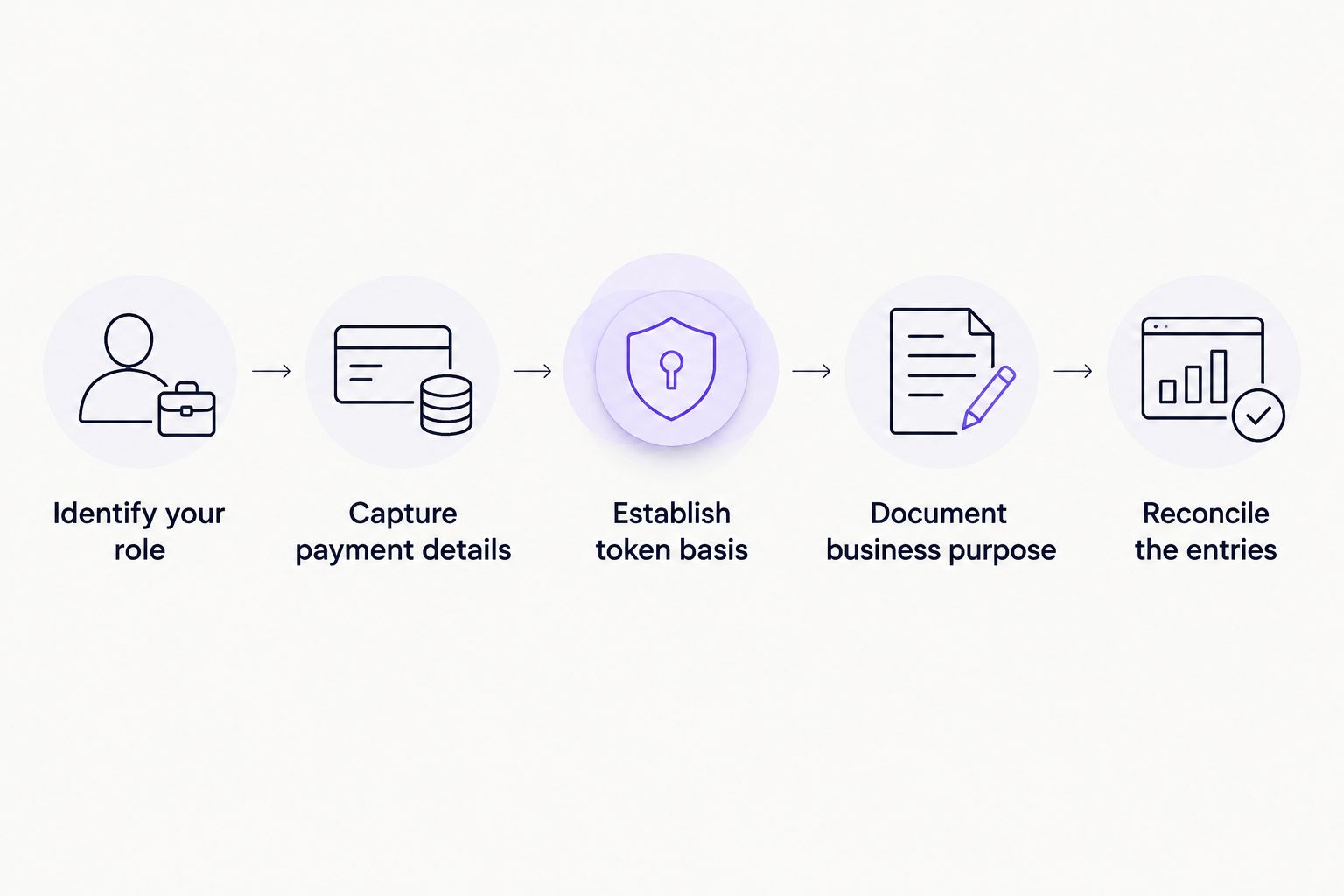
Organize the evidence into 3 record groups: service documents, payment-and-basis records, and business-purpose support. This keeps the information readable without pretending that every document proves every tax fact.
Does receiving rented energy count as income?
Receiving access you purchased is not, by itself, evidence of taxable income. Keep the purchase terms so your records show an exchange for a service rather than an unexplained receipt.
Do not apply that conclusion automatically to rewards, promotional allocations, referral compensation, or other arrangements. Their terms can create different tax questions. The word energy does not determine the treatment; what you received and why you received it do.
If a platform describes a balance as earnings, inspect the underlying activity before recording it. A dashboard label is not a tax classification.
Is paying with USDT different from paying with dollars?
Paying with USDT adds a digital-asset disposition analysis that an ordinary dollar payment does not. The service expense and the payment-token gain or loss remain separate questions.
A dollar payment still needs a business purpose to qualify for a business deduction. USDT does not remove that requirement, and using dollars does not create a deduction where the underlying activity is personal.
Choose a payment method for operational reasons, but preserve the records required by the method you actually use.
Do I owe tax if I only move tokens between my wallets?
A transfer between wallets you own generally is not a sale or exchange under IRS digital-asset guidance. Paying an independent rental provider is different because the payment purchases a service from another party.
Keep ownership evidence for internal transfers and identify any separately charged fees for review. Otherwise, a transaction import can confuse a movement of your own funds with a purchase, sale, or income receipt.
What should I check before filing?
For your 2026 tax records, reconcile the rental workflow against the return’s digital-asset reporting requirements. Do not rely solely on whether a platform sends a tax form. IRS guidance requires reporting taxable digital-asset transactions even when no information return arrives.
Ask your preparer to review unresolved basis, mixed personal and business use, provider income classification, and costs attached to other transactions. State sales or use tax and foreign VAT are separate questions; this federal income-tax analysis does not answer them.
This article provides general U.S. federal tax information, not individualized tax advice. Use a qualified tax professional for your facts, jurisdiction, and filing obligations.
FAQ
Is TRON energy rental taxable in the United States?
TRON energy rental can create taxable provider income and a cryptocurrency disposition for the customer. Buying access does not automatically create income for the customer; business-expense treatment is a separate question.
Do I have to report a rental payment made with TRX?
A TRX payment for a service generally requires a digital-asset disposition analysis. Keep the tokens’ adjusted basis and the payment’s U.S. dollar value so you can determine the reporting treatment.
Is paying for TRON energy with USDT tax-free?
Paying with USDT is not automatically tax-free. Spending USDT generally disposes of a digital asset, even when the calculated gain or loss is zero.
Can I deduct energy rental used for business transfers?
A qualifying ordinary and necessary business expense can be deductible, but business use alone does not establish immediate deductibility. Determine whether the cost belongs in an expense category, an asset’s basis, or another treatment.
Does an energy provider pay tax when receiving cryptocurrency?
A provider generally recognizes income when receiving cryptocurrency for services, subject to its accounting method and applicable rules. A later disposal of those tokens requires a separate gain-or-loss calculation.
What if the rental platform does not send me a tax form?
The absence of a tax form does not remove your obligation to report taxable digital-asset transactions. Use your own service, wallet, valuation, and basis records to determine the correct treatment.
Does this guide cover taxes outside the United States?
This guide addresses general U.S. federal income-tax treatment. State, local, and foreign obligations require a separate review based on your location and transaction structure.
One last thing
Reconcile the service and the payment asset separately. A correctly recorded rental expense does not prove that you also reported the cryptocurrency disposition correctly.
Before closing your books, select a rental payment and trace it from the order record to the wallet transaction, acquisition basis, and accounting entry. If that trail breaks, repair the record before repeating the workflow. The most useful tax control is not another transaction export; it is a documented connection between the transaction and what actually happened.


