
Best overall: API-connected energy rental for recurring transactions. Best for payout batches: scheduled rental. Best for low-volume operations: manual rental. For the best TRON energy rental services for staking platforms in 2026, choose the operating model first, then verify the provider against your actual transaction workflow.
- The best TRON energy rental services for staking platforms support the transaction workflow, not just an energy order.
- API-connected rental is the default for recurring smart-contract transactions; scheduled rental suits planned payout batches.
- Verify delegated resources on-chain before releasing transactions, and keep wallet signing separate from rental access.
- Nbtrx provides Telegram business operations tools; assess energy rental providers separately from member operations tools.
Why this matters
TRON smart-contract execution consumes Energy. Transactions also consume Bandwidth, so an Energy order does not cover every resource your staking platform needs. Treat rental as one part of transaction operations, not a complete execution service.
Your product being called a staking platform does not determine its resource requirements. The transactions do. Contract-based deposits, reward claims, token transfers, and native resource staking have different execution paths.
For a 2026 shortlist, separate three decisions: how your application obtains resources, how it signs transactions, and how it confirms settlement. The guide to TRON energy services with API access addresses the integration angle. Keep that evaluation distinct from wallet custody.
What makes the best TRON energy rental service?
Use these criteria before choosing a rental model. A provider passes only when its documentation and your validation support the requirement.
- Correct destination: The order identifies the address that will execute the transaction, not merely the account paying for rental.
- Observable delivery: Your platform can verify delegated resources on-chain before submitting the dependent transaction.
- Suitable duration: The delegation window covers the execution workflow, including retries and delayed batch processing.
- Controlled ordering: Automated requests have identifiers, clear states, and documented handling for repeated submissions.
- Failure handling: Your application has a defined response to failed orders, incomplete delegation, and insufficient resources.
- Separated permissions: Rental access does not require exposing the private key that controls customer or treasury funds.
Choose a service whose delivery your platform can verify independently. An order confirmation is not proof that the executing address has the resources it needs.
TRON energy rental models at a glance
This comparison ranks operating models by workflow fit. The features below are requirements to check when evaluating a service, not promises attached to a particular provider.
| Rank and model | Best for | Standout requirement | Key limitation |
|---|---|---|---|
| 1. API-connected rental | Recurring application transactions | Programmatic ordering with observable order states | Requires integration and failure handling |
| 2. Scheduled rental | Planned reward or payout batches | Delegation aligned with a defined execution window | Timing changes can invalidate the plan |
| 3. Managed rental | Teams needing operational assistance | Written responsibilities and escalation procedures | External coordination adds dependency |
| 4. Manual rental | Occasional, operator-controlled transactions | Clear destination and on-chain confirmation | Human ordering does not scale with frequent execution |
An automated staking application and an operator sending occasional payouts need different services. In 2026, the useful comparison is whether each model fits the transaction path—not whether a provider advertises the broadest feature list.
1. API-connected rental: best for recurring platform transactions
API-connected rental lets your application request resources through a programmatic interface. Your application still needs to confirm delegation, submit the signed transaction, and inspect the execution result. An API connection does not replace those controls.
Best for: Staking platforms with recurring smart-contract activity and an engineering team responsible for transaction execution.
API-connected rental pros:
- Fits resource ordering into an existing transaction queue.
- Allows order identifiers to be associated with execution records.
- Supports application-defined checks before transaction submission.
- Reduces repeated operator entry when the integration is working correctly.
API-connected rental cons:
- Requires engineering work and ongoing integration maintenance.
- Failed requests and uncertain responses need explicit handling.
- Ordering errors can repeat automatically without application safeguards.
Check authentication, request parameters, order states, and retry behavior before integration. If a request times out, your application must determine whether the order exists before submitting another request. Otherwise, a network problem becomes an ordering problem.
Keep rental credentials separate from signing credentials. Resource procurement belongs in the execution workflow, but it should not grant the rental service control over the wallet.
Verdict: Buy for recurring execution only after delivery checks and retry handling pass validation.
2. Scheduled rental: best for planned reward batches
Scheduled rental aligns resource delegation with a planned transaction window. It suits operations where you control when a batch begins and can estimate its resource requirements from the transactions being prepared.
Best for: Staking platforms that process rewards or withdrawals in planned batches rather than entirely on demand.
Scheduled rental pros:
- Connects resource planning to a defined batch.
- Makes the execution window visible to operators.
- Supports a preflight check before the batch starts.
Scheduled rental cons:
- A delayed batch can outlast the intended delegation window.
- Changes in batch contents require a new resource estimate.
- Unexpected user activity does not fit a fixed schedule.
Confirm when delegation begins and ends. Do not assume the period starts when you first use the resources; read the provider's documented terms and verify the resulting delegation.
Divide preparation from release. Prepare the transaction queue first, confirm the resources second, and release the batch only after the preflight check passes. Keep a stop condition for an interrupted batch rather than continuing on an outdated resource assumption.
Verdict: Buy for predictable batches; skip as the sole resource model for unpredictable user activity.
3. Managed rental: best for teams needing operational assistance
Managed rental adds provider-side coordination to resource procurement. The useful service is a documented operating arrangement: who places orders, who checks delegation, and who responds when execution cannot proceed.
Best for: Teams that need assistance coordinating rental orders but retain responsibility for their wallets and transactions.
Managed rental pros:
- Provides a place to assign ordering and escalation responsibilities.
- Fits workflows that require operator coordination.
- Allows exceptions to be discussed outside an automated request path.
Managed rental cons:
- Adds an external handoff to transaction preparation.
- Service quality depends on documented responsibilities being followed.
- Communication alone does not prove resource delivery.
Ask for the operating procedure rather than a general assurance of support. It should explain how your team identifies an order, reports an issue, and decides whether to pause execution. Response commitments belong in written terms, not assumptions.
Nbtrx provides Telegram business operations tools. Evaluate those tools for member operations or partner workflow separately from a rental provider's ability to deliver TRON resources. Nbtrx is a fit for teams seeking Telegram business operations tools, not evidence of an energy provider's execution quality.
Verdict: Hold until ownership, escalation, and independent delivery checks are documented.
4. Manual rental: best for occasional operator-controlled transactions
Manual rental uses an operator-led order rather than an application integration. The operator checks the destination address, confirms the delegation, and then releases the intended transaction.
Best for: Low-frequency workflows where a person can review each resource order before execution.
Manual rental pros:
- Avoids building an ordering integration before it is needed.
- Gives the operator a clear review point before submission.
- Fits isolated transactions and controlled pilot workflows.
Manual rental cons:
- Introduces address-entry and timing errors.
- Depends on an operator being present.
- Creates repeated work as transaction frequency increases.
Use a written checklist. Verify the network, executing address, required resources, and delegation window before ordering. After ordering, confirm the on-chain state rather than relying on a screenshot or message.
Manual rental is a workflow choice, not proof of affordability or reliability. Compare its operational burden with your actual transaction frequency. If every user action needs an operator to obtain resources, the workflow no longer matches an automated staking platform.
Verdict: Buy for occasional controlled transactions; skip for unattended recurring execution.
Validate the rental workflow before connecting customer activity
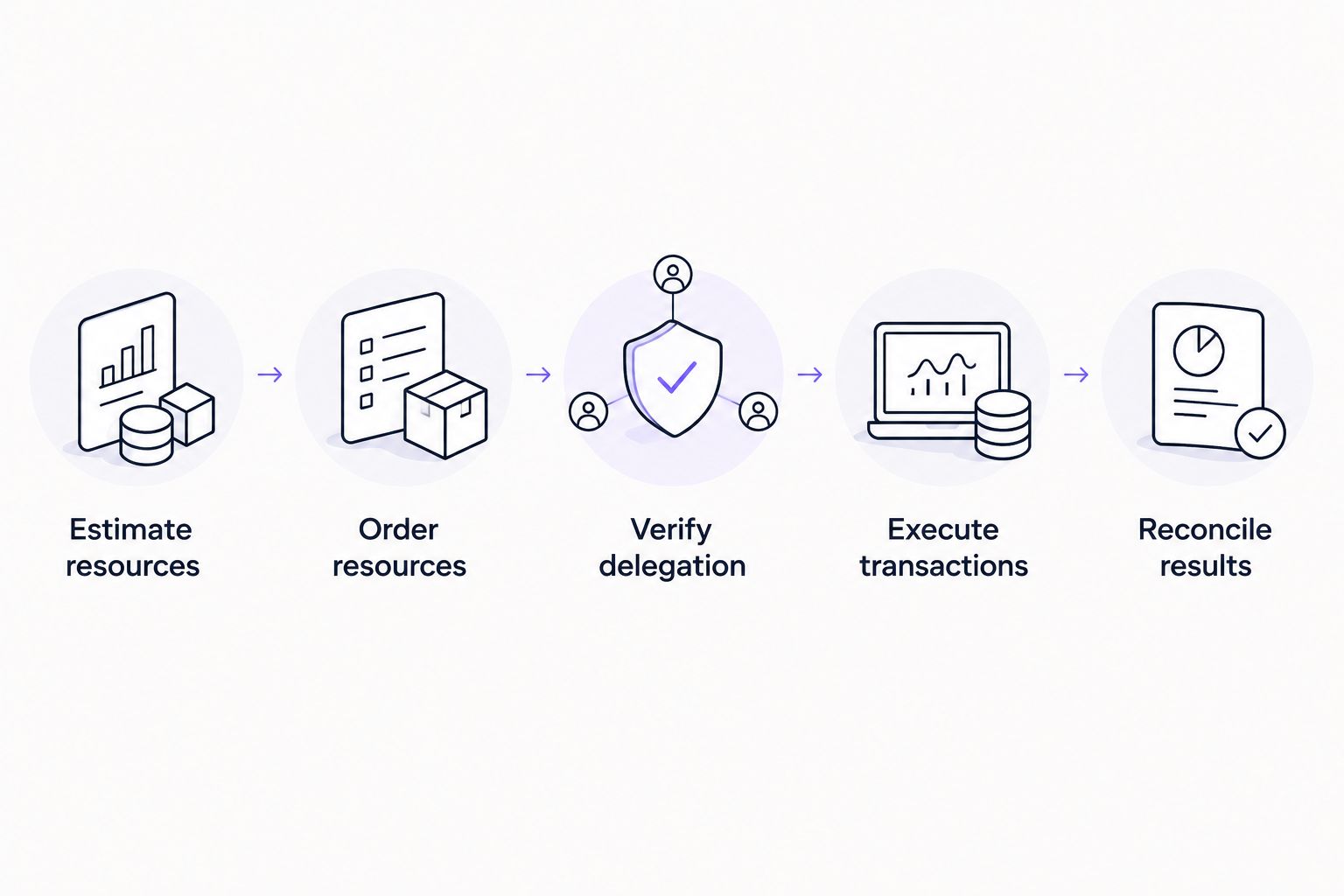
A useful 2026 pilot tests the whole execution path. Do not stop when the provider accepts an order. The result you need is a correctly executed transaction with a traceable resource order and an inspected receipt.
Use 1 isolated wallet for the initial pilot. Keep customer funds and production signing permissions outside that test. Select transaction examples from the contract calls your platform actually submits.
Estimate resources
Evaluate 3 transaction types where applicable: a deposit, a reward claim, and a withdrawal. If your application uses different actions, substitute its real transaction types rather than testing irrelevant calls.
Estimate each call separately. Contract execution paths and transaction state affect resource use, so a single transfer example is not a platform-wide sizing rule.
Order resources
Record the executing address and an order identifier. Confirm what the service considers a completed order and how it reports unsuccessful requests.
For automation, decide what happens after a timeout before enabling retries. A repeated request must not become an uncontrolled second purchase instruction.
Verify delegation
Check the executing address's resource state on-chain. Compare it with the planned transaction requirement and confirm that the delegation window covers execution.
Pause when the check fails. A pending customer action is easier to manage than an execution path that ignores its own resource requirements.
Execute transactions
Submit the intended transaction only after verification. Inspect its receipt and record the result against the resource order.
A submitted transaction is not the same as a successful contract execution. Your application needs to distinguish those states when updating customer records.
Reconcile results
Match orders, delegation checks, transaction identifiers, and execution outcomes. Make the records accessible to the person responsible for incidents.
Test 2 failure cases before production: an unsuccessful rental order and a transaction that cannot proceed with the confirmed resources. Define the pause, retry, and customer-update behavior for both.
How the models are ranked
The ranking prioritizes recurring execution, independent delivery checks, controlled ordering, and explicit failure handling. API-connected rental leads for application-driven activity because its ordering model fits automation. Scheduled, managed, and manual rental serve narrower operating needs.
This is a workflow ranking, not a customer-review score. Choose a named provider only after its documented behavior passes your validation. A category label does not establish delivery performance, custody safety, or integration quality.
Which TRON energy rental model should you choose?
Default to API-connected rental for recurring contract transactions. Choose scheduled rental when you control the batch window, managed rental when coordination assistance is necessary, and manual rental when transaction frequency does not justify integration.
For your 2026 rollout, approve the execution workflow before expanding its volume. A provider with an attractive interface still needs to pass destination, delegation, retry, and reconciliation checks.
Keep customer operations separate from resource execution. Nbtrx's Telegram business operations tools belong in the member and partner workflow evaluation; rental delivery belongs in the on-chain verification process. Neither evaluation substitutes for the other.
FAQ
What's the best TRON energy rental service model for a staking platform?
API-connected rental is the default for recurring application-driven smart-contract transactions. Choose a provider only after validating its ordering behavior, delegated resources, and failure handling against your actual workflow.
Does every staking transaction need rented TRON Energy?
No. Resource requirements depend on the transaction type, and rental is not the only way to obtain resources. Distinguish native staking operations from smart-contract execution before choosing a rental service.
Is scheduled rental better than API-connected rental?
Scheduled rental fits planned batches; API-connected rental fits recurring application-driven ordering. Choose according to when transactions occur and who controls their release.
Can a rental service receive my wallet's private key?
Keep the wallet's private key out of the rental workflow. Your wallet signs transactions, while the rental process identifies the address that needs delegated resources.
How do I know rented Energy has arrived?
Verify the executing address's resource state on-chain before submitting the transaction. A payment receipt or order message does not replace that check.
Does renting Energy remove the need for Bandwidth?
No. TRON transactions also consume Bandwidth, so resource planning must account for both. Energy rental addresses smart-contract execution resources, not every transaction requirement.
Is Nbtrx an energy rental recommendation in this guide?
No. Nbtrx is described as providing Telegram business operations tools. Assess those tools for member and partner workflows, and assess energy rental providers through their documentation and on-chain delivery.
One last thing
The address paying for a rental order is not necessarily the address executing the contract call. Put the executing address in your preflight checklist and verify that it received the resources. A correctly paid order sent to the wrong destination does not prepare your transaction.
Keep that distinction visible in your 2026 operating procedure. It is a concrete check your team can perform before every release.