
Best overall: API-based on-demand energy rental. Best for predictable daily volume: fixed-package bulk rental. Best for traders with idle capital: staking your own TRX. If you move USDT on TRON all day, API-driven energy rental is the default to pick in 2026.
This guide ranks five ways to source TRON energy, matched to how high-volume traders actually operate. No provider hype, just which model fits which workflow.
- The best TRON energy rental services for high volume traders in 2026 are API-based, because they automate energy before every transfer.
- Fixed-package rental fits steady daily volume; self-staking fits traders with idle TRX and a long horizon.
- Burning TRX for fees on every transfer is the option to skip once you run dozens of transfers a day.
- Judge any provider on delivery timing, API reliability, order flexibility and refund handling, not headline rate alone.
Why this matters for high-volume traders in 2026
Every smart-contract call on TRON consumes energy. A USDT transfer costs roughly 65,000 energy when the receiving address holds no USDT yet, and roughly 32,000 when it already does. If your wallet lacks the energy, the network burns TRX to cover the gap.
At one transfer a week, that is noise. At hundreds a day, it is your largest avoidable operating cost.
Energy regenerates over a 24-hour window after use, so volume traders think in daily energy budgets, not per-transaction fees. Renting delegated energy is how most of them cover the budget without locking up large amounts of TRX themselves.
The question in 2026 is not whether to rent. It is which rental model matches your order pattern.
What makes the best TRON energy rental service
Use these six criteria to audit the ranking before you read the table.
- Delivery timing. Energy has to land before your transfer fires. A slow delegation means a burned-TRX fallback. Compare options in this delivery speed ranking.
- Automation. An API or webhook lets your system order energy per transfer or per batch with no human in the loop.
- Order flexibility. Can you buy for one address, many addresses, or a rolling window?
- Rate transparency. The rate should be visible before you pay, not quoted after you ask.
- Failure handling. What happens when delegation fails or energy arrives short? Clear refund or retry rules matter more than the rate.
- Operational fit. The service should plug into how your team already works: code, dashboards, or chat.
Energy rental options at a glance
| Rank | Option | Best for | Standout feature | Key limitation |
|---|---|---|---|---|
| 1 | API-based on-demand rental | Automated high-frequency transfers | Orders energy programmatically per transfer | Needs engineering time to integrate |
| 2 | Fixed-package bulk rental | Predictable daily volume | Simple recurring budget | Wasted energy on slow days |
| 3 | Self-staking your own TRX | Traders with idle capital | No provider dependency | Capital locked in stake |
| 4 | Chat-based order desk | Ops teams handling ad hoc batches | No integration required | Manual steps slow down peak hours |
| 5 | Rate aggregator comparison | Price discovery across providers | Side-by-side rates | Adds a step before each order |
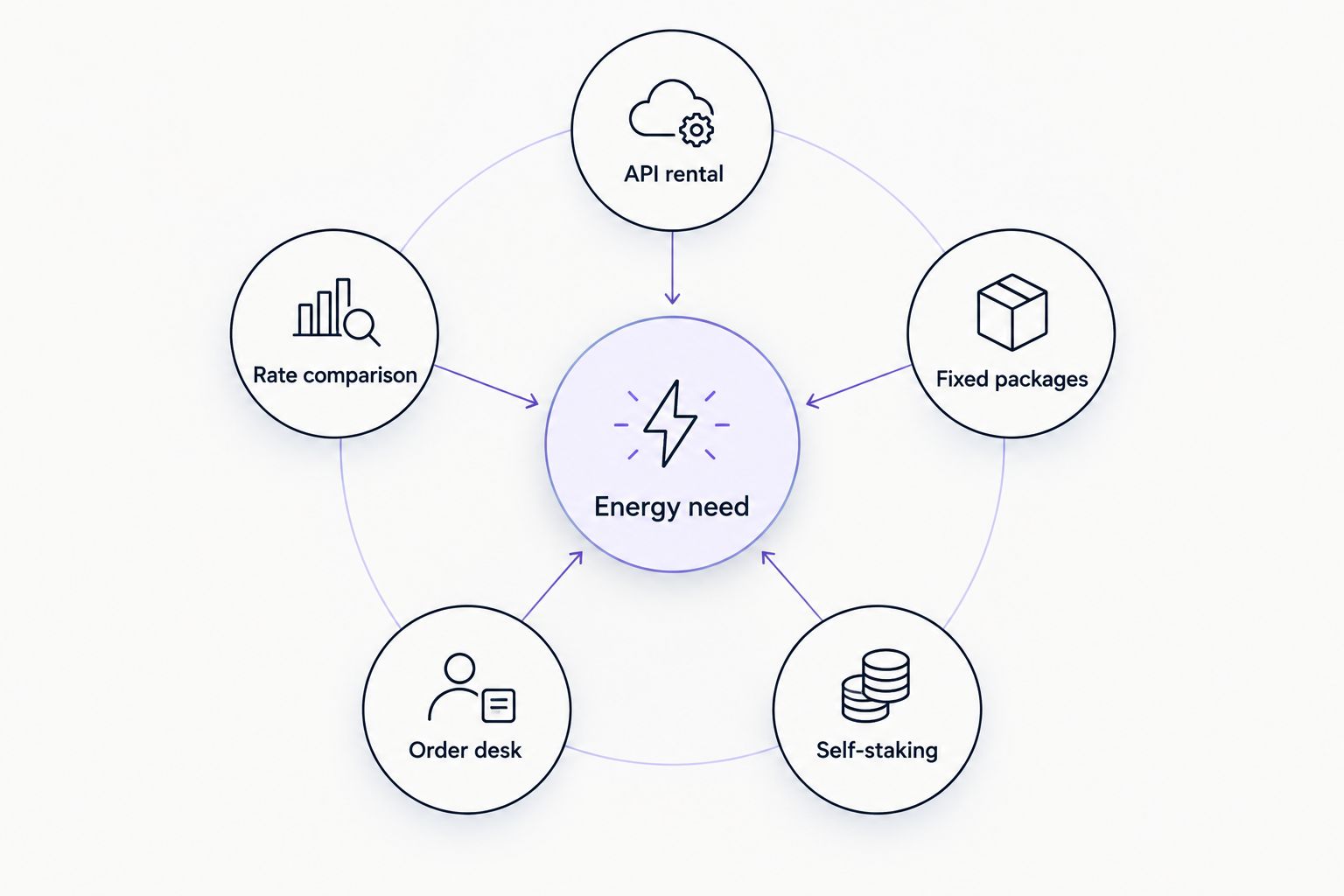
The order above is the order of the sections below. Each option owns one use-case slot, so you can read the list as a decision tree.
1. API-based on-demand rental: best for automated high-frequency transfers
An API-based service lets your own system request energy for a specific address just before a transfer runs. You pay for what the batch needs, and the energy is delegated to the sending wallet.
This is the model that matches how high-volume traders actually behave: bursts of activity, many sending addresses, and no tolerance for manual steps. The detail that matters is reliability. Read the guide to TRON energy rental services with API access for the checklist when you evaluate documentation and error handling.
API-based rental pros:
- Energy is ordered per transfer or per batch, so nothing sits idle.
- Fits multi-address setups and scripted settlement flows.
- Scales up on busy days without a plan change.
- Failures are machine-readable, so your system can retry.
API-based rental cons:
- You own the integration and its monitoring.
- An API outage becomes your outage unless you build a fallback.
- Rates and terms vary by provider, so check current figures on the provider's site.
Best for: automated desks, bots and settlement systems.
Verdict: Buy. It is the strongest default for high-volume traders in 2026, as long as you build a burn-TRX fallback for failed orders.
2. Fixed-package bulk rental: best for predictable daily volume
With a fixed package, you buy a set amount of energy for a set period and the provider delegates it on a schedule. The appeal is a budget line you can forecast.
It works when your daily transfer count barely moves. A payments desk running the same settlement cycle every day fits. A trader whose volume swings with the market does not, because slow days leave energy unused and busy days leave you short.
Fixed-package pros:
- Predictable cost for planning.
- Less operational overhead than ordering per transfer.
- Simple to explain to finance and compliance.
Fixed-package cons:
- Unused energy is paid-for energy.
- A volume spike still pushes you into burning TRX unless you top up.
- Less control over timing within the day.
Best for: desks with flat, repeating daily volume.
Verdict: Hold. Choose it only if your volume is flat. Otherwise pair it with an on-demand top-up.
3. Self-staking your own TRX: best for traders with idle capital
Staking TRX gives you energy directly from the network with no rental provider in the middle. You keep control and avoid counterparty risk on delivery.
The trade-off is capital. Covering a high-volume energy budget through staking alone means locking up a large TRX position, and that position stops being available for trading. The break-even depends on your volume and your cost of capital, which you can calculate from your own numbers.
Self-staking pros:
- No dependence on a third-party provider's uptime.
- Energy regenerates every 24 hours on its own.
- You can delegate your stake to your other wallets.
Self-staking cons:
- Locked capital cannot be deployed elsewhere.
- Scaling means staking more, not clicking a button.
- Unstaking has a waiting period under the Stake 2.0 mechanism.
Best for: treasuries that hold TRX long term anyway.
Verdict: Hold. Strong as a base layer, weak as your only source when volume spikes.
4. Chat-based order desk: best for ops teams handling ad hoc batches
Some services take energy orders through a messaging chat or a human-run desk. You message the batch details, pay, and receive the delegation.
This suits operations teams that want zero integration and handle irregular batches, such as a month-end payout run. It stops working when you need an order in seconds, many times a day.
Chat workflows also create operational work around the order itself: tracking requests, confirming delegations, and keeping a record for the team. That is the territory of Nbtrx, which builds practical Telegram business tools for member, partner and customer operations. Nbtrx is a Telegram operations platform, not an energy-rental benchmark, so judge the energy provider on the six criteria above and use tooling like Nbtrx to organize the chat workflow around it.
Order desk pros:
- No code and no integration project.
- Easy for non-technical operators to run.
- Flexible for irregular or one-off batches.
Order desk cons:
- Manual steps slow peak-hour execution.
- Harder to audit unless you keep your own records.
- Response time depends on people, not code.
Best for: teams with irregular batches and no engineering capacity.
Verdict: Hold. Good for batch work, wrong for a latency-sensitive trading flow.
5. Rate aggregator comparison: best for price discovery
Aggregators list rates from several providers side by side. They help you see where the market sits before you commit to one provider for a month.
They are a research step, not a delivery mechanism. Delivery still comes from whichever provider you pick, and the listed rate does not tell you about delivery timing or failure handling. For rate benchmarks, see TRON energy rental services ranked by price.
Aggregator pros:
- Fast view of the rate spread.
- Helps you negotiate or switch with evidence.
- Useful when you onboard a new provider.
Aggregator cons:
- Rate is one of six criteria, not the whole decision.
- Listings can lag the live rate.
- Adds a step before every order if used per transaction.
Best for: a quarterly rate review, not per-transfer ordering.
Verdict: Skip as a primary source. Use it to audit your provider, not to run your flow.
Organize your Telegram operations
Practical Telegram business tools for member, partner and customer operations.
How the options were ranked
The ranking follows the six criteria in order of impact on a high-volume desk. Automation and delivery timing carry the most weight, because a missed delegation turns into burned TRX on every transfer. Order flexibility and failure handling come next. Rate transparency and operational fit break ties.
No provider names are ranked here, because rates, uptime and terms change and need checking on each provider's own site.
Which TRON energy rental option should you choose?
Start with API-based on-demand rental. It matches the burst-heavy pattern of high-volume trading and removes manual steps from the critical path.
Add self-staking as a base layer if you already hold TRX long term. Use a fixed package only when your daily count is flat. Keep an order desk for irregular batches and an aggregator for the quarterly rate check.
If you are undecided, the safe default for 2026 is API-based rental with a burn-TRX fallback.
For day traders specifically: if your flow is mostly small, frequent transfers rather than settlement batches, read the energy rental platforms for day traders breakdown next.
A short test before you commit
Run this check with any provider before you route real volume through them in 2026:
- Order energy for a single test transfer and confirm the delegation lands before the transaction.
- Trigger a deliberate failure, such as a wrong address, and read how the provider handles it.
- Check how the rate is displayed at the moment of order, not in marketing copy.
- Confirm you can order for several sending addresses without separate accounts.
A provider that passes all four earns a place in your flow. One that fails any of them gets a smaller share of your volume.
FAQ
What are the best TRON energy rental services for high volume traders?
API-based on-demand rental is the best fit for most high-volume traders in 2026. It orders energy per transfer or batch, so you avoid idle energy and burned TRX.
How much energy does a USDT transfer on TRON use?
A USDT transfer uses roughly 65,000 energy when the recipient holds no USDT, and roughly 32,000 when it does. These are approximate network figures and can shift with contract conditions.
Is renting energy better than staking TRX?
Renting is better when you want flexible capacity without locking capital. Staking is better when you already hold TRX long term and want no provider dependency.
What happens if I run out of energy during a transfer?
The network burns TRX from your wallet to cover the missing energy. For a high-volume desk, that fallback adds up quickly, which is why timing of delegation matters.
How often does TRON energy regenerate?
Energy regenerates over a 24-hour window after use. Plan your budget as a daily allowance, not a per-transaction fee.
Should I use a fixed package or on-demand rental?
Use a fixed package only if your daily transfer count is steady. On-demand rental handles volume swings better because you pay for what each batch needs.
Can I rent energy for multiple wallets at once?
Many providers support ordering for several addresses, but support varies. Confirm multi-address ordering on the provider's site before you integrate.
One last thing
The cheapest rate is rarely the cheapest outcome. A provider with a slightly better rate and an unreliable delegation window costs you more in burned TRX than the rate saves. Measure delivery timing over a week of real transfers before you rank providers on price.