
Best overall for day traders: API-based auto-rental. Best for occasional transfers: per-transfer rental on a marketplace. Best for predictable volume: fixed-term rental. Best if you hold idle TRX: self-staking. Skip: burning TRX for every transfer.
This 2026 guide ranks the five ways a day trader can cover TRON energy, so USDT moves between exchange and wallet stop bleeding TRX. It builds on the best TRON energy rental services for USDT transfers comparison and narrows it to high-frequency use.
- The best TRON energy rental platform for day traders is API-based auto-rental: no manual steps per trade.
- A standard USDT transfer needs roughly 65,000 energy; a first-time recipient can push that to roughly 130,000.
- Per-transfer rental suits under a handful of moves a day; fixed-term suits steady daily volume.
- Burning TRX for energy is the costliest default. Skip it once you trade daily.
Why this matters for day traders in 2026
Day traders move USDT often: exchange to wallet, wallet to venue, venue to exchange. Every TRC-20 transfer consumes energy. Without energy, the network burns TRX from your balance to cover it.
A standard USDT transfer uses roughly 65,000 energy when the recipient already holds USDT. If the recipient address has never held it, the cost roughly doubles to about 130,000. Multiply that by a full trading day and the fee line becomes a real operating cost.
Renting energy replaces burned TRX with a lower, more predictable cost. Check each platform's current pricing before you commit; rates change and are not quoted here.
Nbtrx builds Telegram business operations tools, and the same operational lens applies: treat energy as a recurring line item in your trading workflow, not a surprise deducted from a wallet.
What makes the best TRON energy rental for day traders
Five criteria decide the ranking:
- Speed to delivery. Energy must land before you send, not minutes after. A delay on a time-sensitive move defeats the purpose.
- Automation. Manual rental per trade does not scale past a few moves a day. API or bot-triggered rental does.
- Cost predictability. You want a rate you can model against your trade margin.
- Fit to your transfer pattern. Bursty traders and steady traders need different rental terms.
- Failure handling. What happens when the rental does not arrive: does the transfer burn TRX, or fail cleanly?
The diagram below maps the five options this guide ranks.
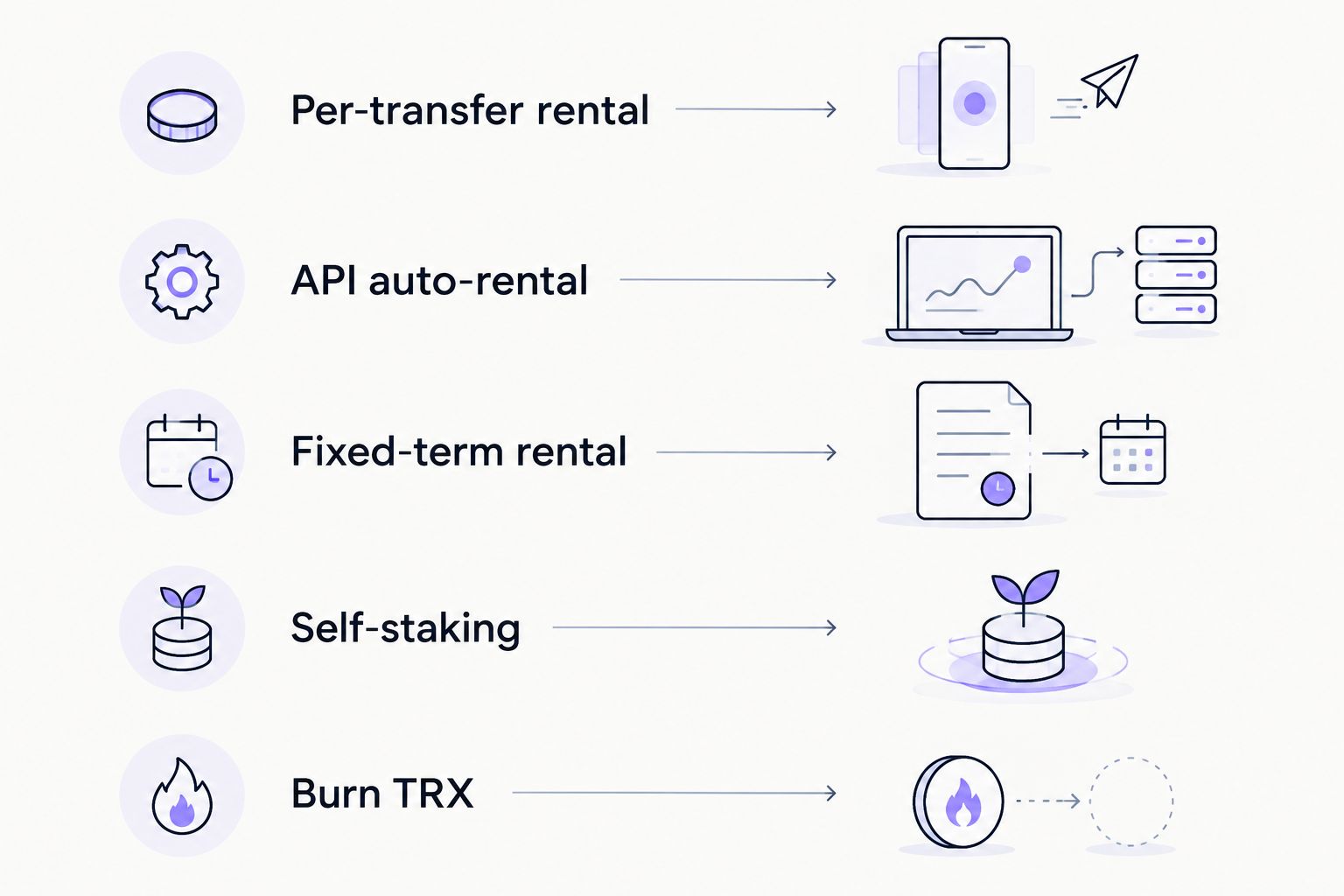
Energy rental options at a glance
| Rank | Option | Best for | Standout feature | Key limitation |
|---|---|---|---|---|
| 1 | API auto-rental | Active day traders | Energy arrives without manual steps | Needs setup and a funded balance |
| 2 | Per-transfer rental | Occasional movers | Pay only for the transfer you make | Manual step each time |
| 3 | Fixed-term rental | Steady daily volume | One rental covers many transfers | Idle energy if volume drops |
| 4 | Self-staking | Holders with spare TRX | No rental fee | Capital locked in TRX |
| 5 | Burning TRX | Emergencies only | Zero setup | Highest cost per transfer |
1. API auto-rental: best TRON energy rental for high-frequency day traders
API auto-rental connects your wallet or trading script to a rental service. When a transfer is about to go out, the script requests energy, waits for delivery, then sends. No human clicks between trades.
API auto-rental pros:
- Removes the manual step from every transfer.
- Scales from a few transfers to dozens without extra effort.
- Lets you log energy cost per trade alongside fees and slippage.
- Pairs well with alerting, so a failed rental is caught before the send.
API auto-rental cons:
- Requires technical setup and key management.
- You need a funded balance on the platform at all times.
- A bug in your script can rent energy you do not use.
API auto-rental pricing: check the current rate on the platform you pick; rates change with demand.
Best for: traders who move USDT many times a day and value a clean workflow over the lowest single-transfer price.
Verdict: Buy.
2. Per-transfer rental: best for occasional USDT movers
You open a marketplace, enter the wallet address and the number of transfers, pay, and send. It is the simplest route into renting energy.
Per-transfer rental pros:
- No commitment and no code.
- You pay for what a specific transfer needs.
- Easy to compare several sellers before paying.
Per-transfer rental cons:
- Every transfer needs a manual detour.
- Delivery lag matters when the market is moving.
- The overhead per move adds up for active traders.
Per-transfer rental pricing: listed per transaction on each seller's page; confirm before you pay.
Best for: swing traders and part-time traders who move USDT a few times a week. For a wider list of sellers, see the sites to buy TRON energy comparison.
Verdict: Buy if your volume is low, Hold once you pass a few moves a day.
3. Fixed-term rental: best for predictable daily volume
Here you rent a block of energy for a set period, then use it across many transfers inside that window. Staked energy regenerates over 24 hours, so the daily rhythm matters.
Fixed-term rental pros:
- One purchase covers a whole session of transfers.
- Cost per transfer falls as you use more of the block.
- Easier to budget than per-move purchases.
Fixed-term rental cons:
- Unused energy is wasted energy.
- Sizing the block wrong means either a shortfall or a surplus.
- A slow trading week makes the fixed cost look bad.
Fixed-term rental pricing: varies by duration and size; read the seller's current terms.
Best for: traders whose daily transfer count stays within a narrow range.
Verdict: Buy if your pattern is steady. Wait if it swings.
Run trading ops from Telegram
Nbtrx builds practical Telegram business tools for customer and partner workflow.
4. Self-staking: best for traders who already hold spare TRX
You stake TRX yourself and receive energy in return. No rental fee applies, but your capital sits locked in the stake.
Self-staking pros:
- No third party in the transfer path.
- No per-transfer or per-term rental cost.
- Energy regenerates over 24 hours without repurchase.
Self-staking cons:
- Locks up TRX that could sit in a trading position.
- The energy you get depends on your stake size relative to the network.
- Unstaking is not instant, so you cannot free capital quickly.
Self-staking pricing: the cost is the opportunity cost of the locked TRX, not a fee.
Best for: long-term TRX holders who also move USDT often. A day trader who needs the capital liquid should look elsewhere.
Verdict: Hold. Good if the TRX is already idle, poor if it is working capital.
5. Burning TRX: the default to move away from
If a wallet has no energy, the network burns TRX from the balance to pay for the transfer. It works every time, with no setup.
Burning TRX pros:
- Zero setup and no accounts.
- Never fails for lack of energy, as long as the wallet holds enough TRX.
Burning TRX cons:
- It is the most expensive way to pay for a transfer.
- Costs compound fast at day-trading frequency.
- The TRX balance drains without a clear signal.
Burning TRX pricing: priced at the current network burn rate; higher than rental in normal conditions.
Best for: a one-off emergency when no other option is ready.
Verdict: Skip as a daily method.
How this ranking works
The order follows the five criteria above. Options that remove manual steps and give a modelable cost rank higher. Options that lock capital or raise cost per transfer rank lower. This is a ranking of methods, not of named vendors: rates and delivery times change too often to quote in a static page, so verify them on the platform before you commit.
For a vendor-level shortlist, the best TRON energy rental services guide covers named services.
Which option should you choose in 2026?
Pick by how often you move USDT:
- Several transfers a day, every day: API auto-rental.
- A few transfers a week: per-transfer rental.
- Steady daily count you can forecast: fixed-term rental.
- Idle TRX and no need for liquidity: self-staking.
- None of the above is ready: burn TRX once, then fix the setup.
If you are undecided, start with per-transfer rental for a week, log your real transfer count, then move to API auto-rental or a fixed term. The counts, not guesses, should pick the method. No option guarantees a business result; each one just changes what a transfer costs you.
FAQ
What is the best TRON energy rental platform for day traders?
An API-based auto-rental setup is the best fit for day traders in 2026. It delivers energy before each transfer with no manual step. Choose a specific platform by checking current rates and delivery speed.
How much energy does a USDT transfer need on TRON?
A standard USDT transfer needs roughly 65,000 energy when the recipient already holds USDT. If the recipient has never held it, the need rises to roughly 130,000.
Is renting TRON energy cheaper than burning TRX?
In normal conditions, yes. Burning TRX is the highest-cost way to pay for a transfer. Compare the current burn cost against a platform's current rental rate before you decide.
Is self-staking better than renting energy for day trading?
Only if the TRX is already idle. Staking locks capital, and day traders usually need liquid balances. Renting keeps your TRX free for trading.
How long does staked energy take to regenerate?
Staked energy regenerates over 24 hours. Plan your daily transfer count around that window if you rely on staking instead of renting.
Should I rent energy per transfer or for a fixed term?
Rent per transfer if you move USDT a few times a week. Rent for a fixed term if your daily transfer count is steady and predictable.
One last thing
The cheapest energy is the energy you do not waste. Before you pick a platform, log every USDT transfer you make for one week, including how many go to fresh addresses. Fresh recipients roughly double the energy cost, so reusing known addresses can cut spend more than switching vendors. Nbtrx treats this the way it treats any operations task: measure the workflow first, then choose the tool.