
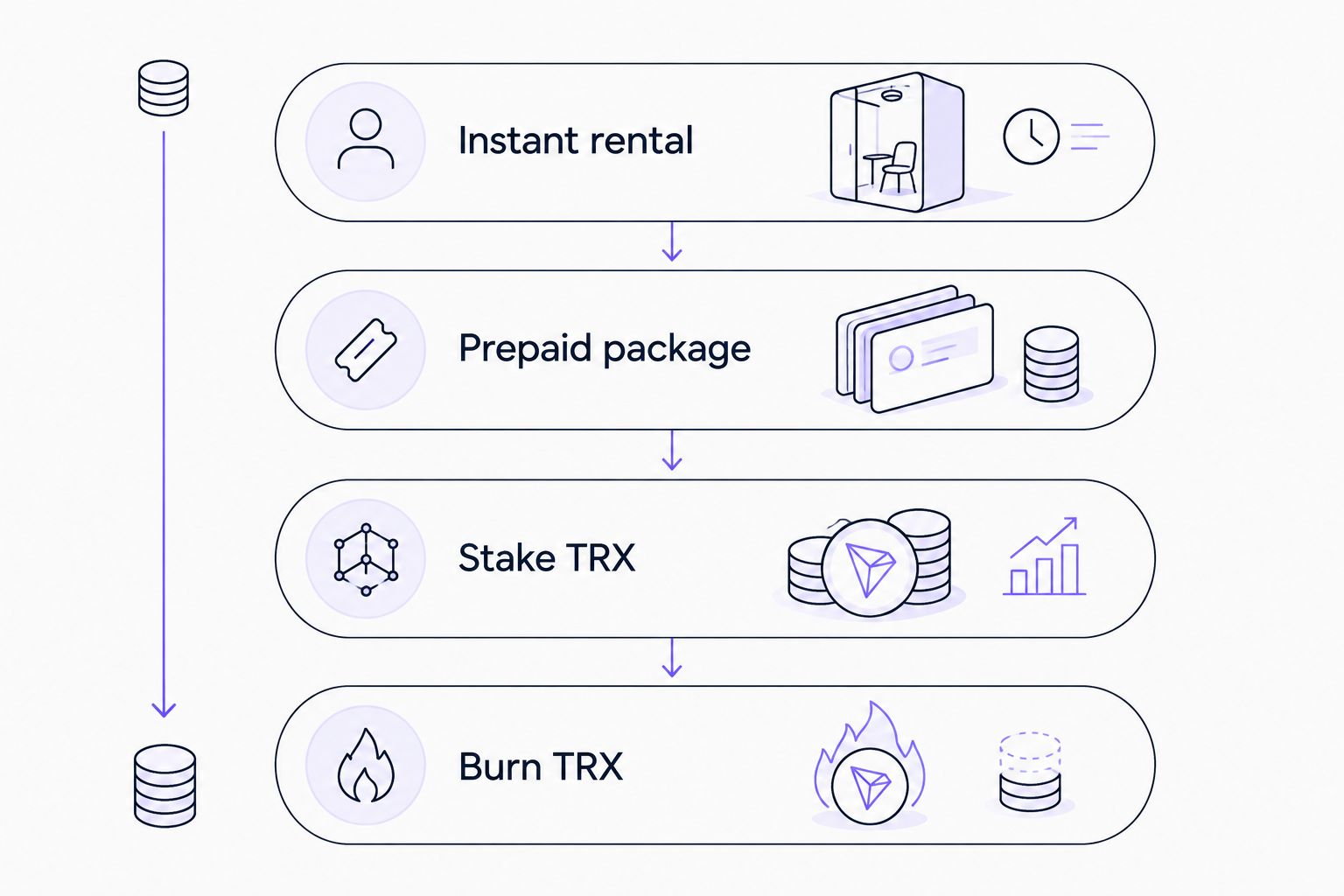
TRON energy rental services ranked by price come down to four routes in 2026: instant rental, prepaid packages, staking TRX yourself, and burning TRX at transfer time. This page ranks them by cost per USDT transfer and tells you which fits your volume.
- Best overall on cost for most teams in 2026: instant energy rental, priced per transfer.
- Best for steady daily volume: a prepaid rental package with a fixed rate.
- Staking TRX yourself only wins when you already hold idle TRX.
- Burning TRX for fees is the costliest way to send USDT on TRON.
If you run payouts, member operations or partner workflow through Telegram, Nbtrx builds practical business tools for that side of the job. This guide covers the fee side: what to compare and how to rank providers by real cost.
Why price rankings on TRON energy mislead
Most price lists show a rate per unit of energy. That number alone tells you nothing about what a transfer costs you.
A standard USDT (TRC-20) transfer uses roughly 65,000 energy when the receiving address already holds USDT. It uses roughly 130,000 when the receiving address has never held it. If a provider quotes a low rate but you send to fresh wallets, your real cost per transfer doubles.
So rank on cost per completed transfer, not on the headline rate. The formula is simple:
- Cost per transfer = rental price for the energy amount you need, divided by the number of transfers that energy covers.
- Then add any minimum order, service fee or lock duration the provider charges on top.
The same logic applies in every year, and it applies in 2026. Compare on the same transfer type, the same duration and the same energy amount, or the ranking is noise.
What makes the best TRON energy rental route
These are the criteria used to rank the four routes below. Audit them before you read the table.
- Cost per transfer: the all-in price for one USDT transfer at your recipient mix.
- Volume fit: whether the route stays cheap at your daily transfer count.
- Speed: whether energy arrives before you send, or only after manual steps.
- Capital tied up: whether you must hold or lock TRX to use it.
- Predictability: whether you know the cost before you send.
- Operational effort: how much manual work each transfer takes your team.
TRON energy rental routes at a glance
| Rank by typical cost | Route | Best for | Standout feature | Key limitation |
|---|---|---|---|---|
| 1 | Instant energy rental | Irregular or moderate volume | Pay per transfer, no capital locked | Rates move with the market |
| 2 | Prepaid rental package | Steady daily volume | Fixed, predictable rate | Unused balance if volume drops |
| 3 | Staking TRX yourself | Holders with idle TRX | No rental fee on the energy | Capital is locked up |
| 4 | Burning TRX for fees | One-off, rare sends | Zero setup | Highest cost per transfer |
This is a ranking by route, not by named vendor. Vendor rates change often, so this page states no vendor prices; check the live rate on the provider before you send. For a vendor-level comparison, see the best TRON energy rental services guide.
1. Instant energy rental: best TRON energy route for most teams
Instant energy rental pros:
- You pay only for the energy a given transfer needs.
- No TRX is staked or locked on your side.
- Works for both small and mid-size sending volume.
- Energy is delegated to your address shortly before you send.
Instant energy rental cons:
- The rate can change between one day and the next.
- You must time the rental to the send, or the energy expires unused.
- Fresh-wallet recipients raise the energy you need per transfer.
Instant energy rental pricing: priced per energy amount and per duration; confirm the live rate on the provider.
Best for: teams sending USDT on TRON at moderate or uneven volume.
Verdict: Buy. It is the lowest cost per transfer for most operators in 2026 because you never pay for capacity you do not use.
2. Prepaid rental package: best TRON energy route for steady volume
A prepaid package trades flexibility for a known rate. You load a balance and draw energy against it as you send.
Prepaid package pros:
- A fixed rate makes monthly cost easy to forecast.
- Fewer manual rental steps per transfer.
- Suits a payout schedule that repeats every day.
Prepaid package cons:
- A balance you do not spend is capital sitting idle.
- A low-volume month makes the fixed rate look expensive.
- You depend on one provider staying reliable.
Prepaid package pricing: set by the provider; compare the package rate against the instant rate for the same energy amount.
Best for: payout desks and partner programs with predictable daily transfers.
Verdict: Buy if your volume is steady. Hold if it swings month to month.
3. Staking TRX yourself: best TRON energy route for TRX holders
Staking TRX gives your address its own energy allowance. There is no rental fee, but the TRX is locked while it earns you that allowance.
Staking pros:
- No per-transfer rental charge.
- Energy regenerates on its own over time.
- Full control; no third-party provider in the loop.
Staking cons:
- You need a large amount of TRX tied up to cover heavy sending.
- The locked TRX has an opportunity cost.
- Allowance runs out fast at high transfer counts, then you burn or rent anyway.
Staking pricing: no rental fee; the cost is the capital you lock.
Best for: operators who already hold idle TRX and send at low volume.
Verdict: Hold. It only beats renting when the TRX would otherwise sit unused.
4. Burning TRX for fees: costliest TRON energy route
If your address has no energy, the network burns TRX to cover the transfer. It works instantly and needs no setup.
Burning TRX pros:
- Nothing to configure.
- Works for a single emergency send.
Burning TRX cons:
- Highest cost per transfer of the four routes.
- Cost scales linearly with every transfer you add.
- Sending to fresh wallets makes it worse.
Burning TRX pricing: the network charges TRX per transfer; there is no discount for volume.
Best for: a one-off send when you have no time to rent.
Verdict: Skip for anything recurring.
How the routes were ranked
The order follows the criteria above, weighted toward cost per completed transfer at moderate volume. Renting wins because you pay for exactly the energy used. Burning loses because it never gives you a discount. Staking sits in the middle only for holders with idle capital. Your own ranking can change if your volume is very high or very low, so run the cost-per-transfer formula on your real numbers.
Run Telegram operations with less friction
Practical Telegram business tools for member operations and partner workflow.
How to compare providers on price in 2026
When you set two providers side by side, hold these constant:
- The same energy amount, matched to the transfer type you actually send.
- The same rental duration.
- The same recipient mix: existing USDT holders versus fresh wallets.
- Any minimum order, service fee or refund rule.
Then compute cost per transfer for each. The cheapest headline rate often loses once you add minimums and duration. Write the comparison down once a quarter, because rates shift and the 2026 winner may not stay the winner.
One more check: confirm the provider delegates energy to your address rather than asking you to send funds to an unfamiliar wallet with no clear terms. Read the provider's own instructions before you send anything.
Which TRON energy rental route should you choose?
Best overall: instant energy rental. It gives the lowest cost per transfer for most teams without locking capital.
Best for steady volume: a prepaid rental package. Pick it when daily sending is predictable.
Best for TRX holders: staking, but only with TRX you would leave idle anyway.
Skip burning TRX unless it is a single send you cannot delay.
If you are undecided, start with instant rental for a month, log your cost per transfer, and move to a package only when the volume proves stable.
FAQ
What is the cheapest way to send USDT on TRON in 2026?
For most senders, renting energy per transfer is cheaper than burning TRX. Staking your own TRX can be cheaper still, but only if you already hold idle TRX and send at low volume.
How much energy does a USDT transfer on TRON need?
A USDT (TRC-20) transfer uses roughly 65,000 energy when the recipient already holds USDT. It uses roughly 130,000 when the recipient has never held it.
Is renting TRON energy better than burning TRX?
Yes for recurring sends. Burning TRX has the highest cost per transfer and never gets cheaper with volume, while rented energy is priced for the amount you need.
How do I compare TRON energy rental prices fairly?
Compare cost per completed transfer. Use the same energy amount, the same duration and the same recipient mix, then add minimum orders and service fees.
Is a prepaid energy package cheaper than instant rental?
It can be when your daily volume is steady and the package rate is lower than the instant rate for the same energy. If volume swings, unused balance erases the saving.
Does staking TRX beat renting energy?
Only when you hold TRX that would otherwise sit idle and send at low volume. Locked capital has a cost, and heavy sending exhausts the allowance quickly.
Do prices for TRON energy rental change?
Yes. Provider rates move over time, so check the live rate on the provider before each send and recheck your ranking every quarter in 2026.
One last thing
The recipient wallet decides your bill more than the provider does. Sending to an address that already holds USDT costs about half the energy of sending to a fresh one. If you run repeat payouts, batch them to wallets that already hold USDT first, then rent energy sized for that case.