
The best TRON energy rental platforms compared for 2026 fall into seven models, and the right pick depends on your transfer volume, automation needs and treasury setup. Best overall: API-first energy providers. Best for variable demand: open energy marketplaces. Best for idle TRX holders: self-staking. Best for rare transfers: paying the TRX burn.
This page ranks platform models, not brand names, so each pick holds up as providers change. Nbtrx builds Telegram business operations tools and is not ranked as an energy provider below.
- API-first energy providers are the best default in 2026 for teams sending USDT on TRON at steady volume.
- Self-staking TRX wins only if you already hold idle TRX and have predictable demand.
- Open marketplaces suit spiky demand; wallet-integrated rental suits beginners.
- Paying the TRX burn per transfer is fine for rare transactions and wasteful at scale.
Why this matters in 2026
Every smart contract call on TRON consumes energy. A USDT transfer is a smart contract call. If your account lacks energy, the network burns TRX from your balance to cover it.
Published network figures put a standard USDT transfer at roughly 65,000 energy when the recipient already holds USDT, and about double that when the recipient's USDT balance is empty. Multiply that by hundreds of payouts a day and the energy source becomes a real operating cost line.
Renting energy means someone else delegates energy to your address for a period, so you stop burning TRX. The platform you choose decides how fast energy arrives, how you order it and how well it fits your workflow.
What makes the best TRON energy rental platform
Use these six criteria to audit the ranking before you read the table.
- Delivery speed: energy must land before your transaction broadcasts. See the ranking by delivery speed for how to test it.
- Ordering method: manual dashboard, wallet button, bot or API. Match it to how your team already works.
- Order flexibility: minimum order size and rental duration options.
- Cost transparency: the full cost is visible before you confirm, with no surprise fees.
- Reliability under load: delivery still works when you send in bursts.
- Operational fit: does it plug into payouts, exchange withdrawals or customer operations without manual steps.
The seven models at a glance
| Model | Best for | Standout feature | Key limitation |
|---|---|---|---|
| 1. API-first providers | Automated payouts | Programmatic ordering | Needs developer time |
| 2. Open energy marketplaces | Variable demand | Competing offers | Quality varies by seller |
| 3. Self-staking TRX | Idle TRX treasuries | No rental fee | Capital locked up |
| 4. Bulk and OTC desks | Exchanges, high volume | Large custom orders | Slower setup |
| 5. Wallet-integrated rental | Beginners | One-tap purchase | Less control |
| 6. Telegram bot rental | Ops teams in Telegram | Order from chat | Manual unless scripted |
| 7. Pay the TRX burn | Rare transfers | Zero setup | Costly at volume |
1. API-first providers: best TRON energy rental for automated payouts
These providers expose an endpoint. Your system requests energy for an address, confirms delivery, then sends the transaction. No human touches the order.
API-first providers pros:
- Fits payout engines and withdrawal queues
- Repeatable, loggable orders
- Scales without adding operators
- Easy to add a fallback source
API-first providers cons:
- Requires integration work and monitoring
- A provider outage stops your pipeline unless you build a fallback
Best for: exchanges, payment processors and any team with scheduled transfers. The API access ranking covers what to check in the documentation before committing.
Verdict: Buy. This is the default for steady volume in 2026.
2. Open energy marketplaces: best for variable demand
Marketplaces let sellers with staked TRX list energy, and buyers pick an offer. You get choice and competition without staking anything yourself.
Marketplace pros:
- Flexible durations and order sizes
- No capital commitment
- Good for spiky or seasonal demand
Marketplace cons:
- Seller quality and delivery behavior differ from offer to offer
- More manual comparison work per order
Best for: teams whose volume jumps around from week to week.
Verdict: Buy if you can tolerate comparing offers; Hold if you need hands-off automation.
3. Self-staking TRX: best for idle TRX treasuries
Under TRON's Stake 2.0, you freeze TRX to receive energy for your own accounts. No rental fee, no third party in the delivery path.
Self-staking pros:
- No dependence on an outside seller
- Predictable once sized correctly
- Energy regenerates over time
Self-staking cons:
- Your TRX is locked up and exposed to price moves
- Sizing mistakes leave you short or over-staked
- Unstaking is not instant
Best for: organizations that already hold TRX and run a steady, forecastable transfer load.
Verdict: Hold. Strong in the right treasury, a bad idea if you would buy TRX only to stake it.
4. Bulk and OTC desks: best for exchanges and high volume
Some providers sell large energy blocks through direct agreements. You negotiate size and terms instead of clicking through a storefront.
Bulk desk pros:
- Handles large, recurring volume
- Direct contact when something breaks
- Terms can match your usage pattern
Bulk desk cons:
- Onboarding takes longer than a self-serve signup
- Overkill for small teams
Best for: exchanges and high-volume traders. Two related rankings go deeper: crypto exchanges is one of them, and the same logic applies to any operation sending thousands of transfers.
Verdict: Buy at scale, Skip below it.
5. Wallet-integrated rental: best for beginners
Some wallets offer an in-app energy purchase before you send. You press a button, energy arrives, the transfer goes through.
Wallet-integrated pros:
- Lowest learning curve
- No separate account or tool
- Works for one-off transfers
Wallet-integrated cons:
- You control little: duration, source and sizing are preset
- Not built for batches or automation
Best for: individuals and first-time users who send occasionally.
Verdict: Buy for personal use, Skip for operations.
6. Telegram bot rental: best for ops teams that live in Telegram
Bot-based platforms take orders inside a chat. If your payouts, support and partner coordination already run in Telegram, ordering energy in the same place removes a context switch.
Telegram bot pros:
- Order from where the team already works
- Quick for small and mid-size manual workflows
- Easy to share across a team
Telegram bot cons:
- Chat ordering is manual unless the bot exposes an API
- Auditing orders takes discipline
Best for: teams running member operations and partner workflow in Telegram. Nbtrx works in this operational space with Telegram business tools, though it is not rated as an energy provider here.
Verdict: Buy for chat-first teams, Hold if you need full automation.
7. Pay the TRX burn: the baseline
This is not rental. You send, the network burns TRX to cover the missing energy. It is the baseline every other model should beat.
Burn pros:
- Zero setup
- No counterparty
Burn cons:
- Most expensive way to run repeated transfers
- Cost swings with network conditions and TRX price
Best for: a handful of transfers per month.
Verdict: Skip once transfers become routine. Compare against the price ranking to see where the break-even sits for you.
How the models were ranked
Each model was scored against the six criteria above, weighted toward operational fit and reliability over raw convenience. Every model owns a distinct use-case slot, so the list works as a decision tree: pick by your situation, not by a single leaderboard.
No prices appear on this page because rates change often. Check the current rate on any provider before ordering.
Which model should you pick for USDT transfers
USDT on TRON is the most common reason teams rent energy. The USDT transfer ranking breaks down the options, and the logic is short:
- Fewer than a few transfers a month: pay the burn or use a wallet button.
- Steady daily transfers and a developer: API-first provider.
- Sudden bursts: open marketplace.
- Large idle TRX balance and predictable load: self-staking.
- Chat-first operations: Telegram bot rental.
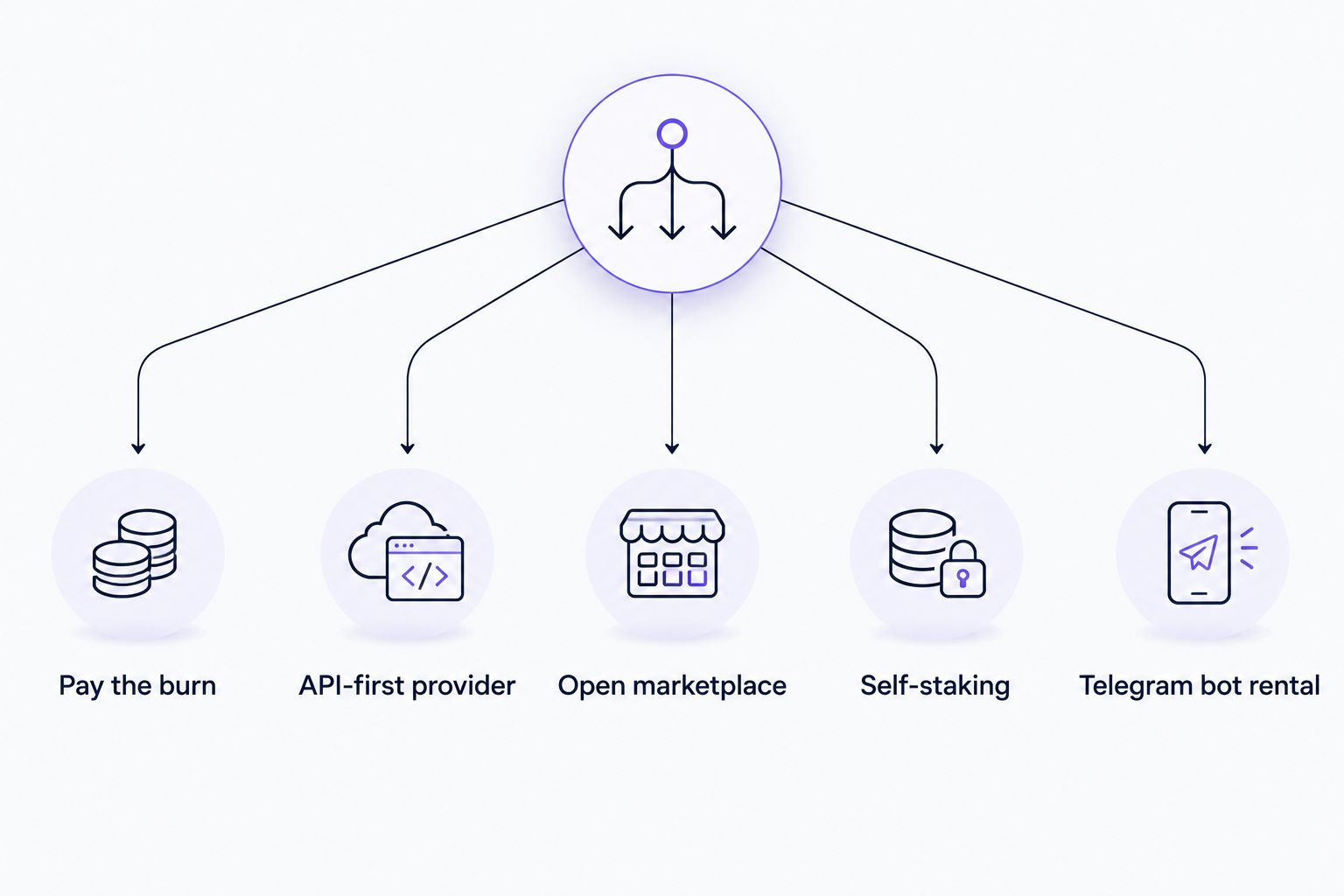
Final verdict: which TRON energy rental platform to choose
Choose an API-first provider if you send TRON transfers on a schedule in 2026. Choose an open marketplace if your demand is uneven. Choose self-staking only if you already hold the TRX. Everyone else should start with a wallet-integrated or bot-based option and move to an API when volume justifies the integration.
FAQ
What is the best TRON energy rental platform in 2026?
For steady volume, an API-first provider is the best default in 2026 because it automates ordering and delivery. Teams with uneven demand do better on an open marketplace.
How much energy does a USDT transfer on TRON use?
A standard USDT transfer uses roughly 65,000 energy when the recipient already holds USDT. It can take about double that when the recipient's USDT balance is empty.
Is renting energy cheaper than burning TRX?
For repeated transfers, usually yes. Burning TRX is the baseline and gets expensive at volume. Check the current rate on any provider before ordering.
Is self-staking better than renting TRON energy?
Only if you already hold idle TRX and have predictable demand. Staking locks capital and unstaking is not instant, so rental fits variable demand better.
Can I automate TRON energy rental?
Yes. API-first providers let your payout system request energy for an address, confirm delivery, then broadcast the transaction without manual steps.
What should beginners use to get TRON energy?
A wallet-integrated energy purchase is the simplest start. It needs no separate account and works for occasional transfers.
Does Nbtrx rent TRON energy?
Nbtrx builds Telegram business operations tools. This comparison does not rank it as an energy provider.
One last thing
Before you commit to any provider in 2026, run a test order at your real transfer size and time how long energy takes to appear on the address. A provider that looks cheap but delivers late forces you to burn TRX anyway, which defeats the purpose.