
This guide ranks the best TRON energy rental services in 2026 by provider type, so you can cut the TRX burned on USDT transfers without trusting the wrong counterparty. Best overall: JustLend DAO Energy Rental. Best for high-volume automation: API-based energy providers. Best for one-off transfers: Telegram energy bots. Best for bulk buyers who want to set terms: P2P energy marketplaces. Best for long-term TRX holders: self-staking with Stake 2.0. If you run TRON payments through Telegram, the last section covers where Nbtrx fits.
- JustLend DAO Energy Rental is the best TRON energy rental service in 2026 for most wallets.
- API-based energy providers win for exchanges and payment processors sending USDT at volume.
- Telegram energy bots suit one-off transfers but carry the highest counterparty risk.
- Stake 2.0 self-staking beats renting only if you hold TRX long term and accept a 14-day unstake.
- Nbtrx offers Telegram business operations tools, not a listed energy rental service.
Why TRON energy rental matters in 2026
Every smart contract call on TRON consumes energy, and a USDT (TRC-20) transfer is a smart contract call. A standard USDT transfer to an address that already holds USDT uses roughly 65,000 energy. A transfer to an address that has never held USDT uses roughly 130,000 energy.
If your wallet has no energy, the network burns TRX from your balance to cover the cost. Energy rental fixes that: a provider stakes TRX, then delegates the resulting energy to your address for a set period using TRON's Stake 2.0 delegation. You send the transfer, the energy is consumed, and the provider reclaims the delegation when the rental ends. Used energy regenerates over 24 hours, which is why rentals are usually priced by duration.
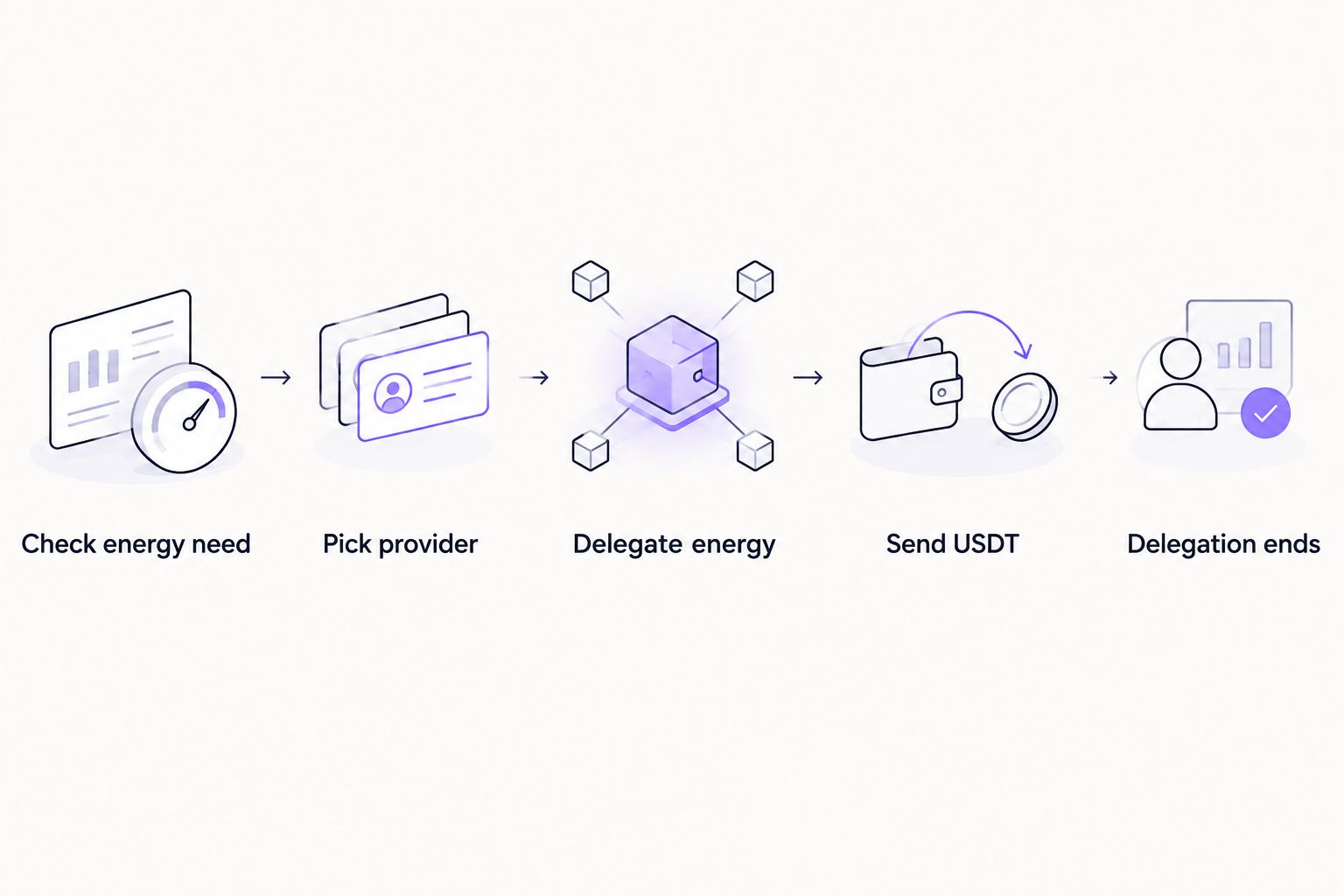
The difference between services in 2026 is not the mechanism. It is who you trust, how the rental is triggered, and how much control you keep.
What makes the best TRON energy rental service
Use these six criteria to audit the ranking below:
- On-chain delegation: energy arrives via Stake 2.0 delegation you can verify on a block explorer. You never share a private key or seed phrase.
- Counterparty risk: how much you depend on one operator honoring the rental after you pay.
- Rental duration: whether you can rent for a single transfer, a day, or longer periods.
- Automation: API access or scripted ordering for teams sending many transfers.
- Transparent terms: the full cost and duration are shown before you pay, not after.
- Support and recourse: a way to resolve a failed or partial delegation.
TRON energy rental services at a glance
| Option | Best for | Standout feature | Key limitation |
|---|---|---|---|
| JustLend DAO Energy Rental | Most wallets | Smart-contract rental inside the TRON ecosystem | Requires a connected wallet and some DeFi familiarity |
| API-based energy providers | High-volume senders | Programmatic ordering per transfer | Provider vetting takes time |
| Telegram energy bots | One-off transfers | Order from chat in minutes | Highest scam and impersonation risk |
| P2P energy marketplaces | Bulk buyers setting terms | Match orders with energy holders | Order may wait for a match |
| Stake 2.0 self-staking | Long-term TRX holders | No counterparty at all | Capital locked; 14-day unstake |
| Nbtrx | Telegram business operations | Telegram business operations tools | Not a listed energy rental service |
1. JustLend DAO Energy Rental: best TRON energy rental service overall
JustLend DAO is a lending protocol in the TRON ecosystem that added an energy rental feature. You connect a TRON wallet, choose how much energy you need and for how long, and the protocol's smart contracts handle the delegation. There is no individual operator holding your payment on trust.
JustLend DAO pros:
- Rental logic runs in smart contracts, not on a private server.
- Delegation is visible on-chain as soon as the rental starts.
- Flexible durations suit both single transfers and ongoing use.
- Sits inside the TRON ecosystem, so wallet support is broad.
JustLend DAO cons:
- The interface assumes basic DeFi knowledge.
- You still need TRX in your wallet to pay rent.
JustLend DAO pricing: check the current rental rate on the platform before each order; rates move with network demand.
Best for: individual wallets and small teams that want the lowest counterparty risk without staking their own TRX. Verdict: Buy.
2. API-based energy providers: best TRON energy rental for high-volume automation
API-based providers let your backend request energy for a specific address right before a transfer. An exchange, payment processor or payroll tool sending hundreds of USDT transfers a day uses this model so no transfer ever falls back to burning TRX.
API provider pros:
- Energy is ordered per transfer, sized to the recipient type.
- Fits inside existing payout scripts.
- Removes manual ordering from daily operations.
API provider cons:
- You depend on one operator's uptime; an outage means burned TRX until it recovers.
- Vetting providers and testing their delegation reliability takes engineering time.
- Terms vary widely between operators.
API provider pricing: usually quoted per order or per unit of energy; compare quotes against the TRX you burn today.
Best for: teams where transfer volume makes manual rental impractical. Verdict: Buy, after testing with small transfers first.
3. Telegram energy bots: best TRON energy rental for one-off transfers
Telegram energy bots are the most common entry point in 2026. You open a bot, send TRX to its address, and energy is delegated to your wallet, often within a minute or two. For someone who sends USDT once a week from a mobile wallet, this is the fastest option.
Telegram bot pros:
- No wallet connection to a website required.
- Works from a phone in the same app many TRON users already use.
- Short rentals match single transfers.
Telegram bot cons:
- Scam bots copy the names and avatars of real ones; paying the wrong address loses the TRX.
- Recourse is limited to the bot operator's support chat.
- Service quality varies between operators with no common standard.
Telegram bot pricing: shown in the bot before you send TRX; confirm it in the chat, not from a screenshot someone forwards you.
Best for: occasional senders moving small amounts. Verdict: Hold — use only bots you can verify through an official channel, and start with the smallest order.
4. P2P energy marketplaces: best TRON energy rental for bulk buyers
Marketplaces such as TronSave match people who hold staked TRX with people who need energy. You post or accept an order, and the delegation executes when the order fills. Bulk buyers use this to set their own duration and quantity.
P2P marketplace pros:
- You choose the quantity and duration instead of fixed packages.
- Many energy holders compete on the same order book.
- Useful for large, planned batches.
P2P marketplace cons:
- An order can sit unfilled when supply is thin.
- More steps than a bot or a one-click rental.
Best for: operators planning large batches in advance. Verdict: Hold.
5. Stake 2.0 self-staking: best alternative to renting for long-term holders
Self-staking is not rental, but it is the benchmark every rental competes against. You stake TRX under Stake 2.0, receive energy for your own address, and can delegate it to other addresses you control. There is no counterparty.
Self-staking pros:
- Zero counterparty risk.
- Energy regenerates every 24 hours for as long as you stay staked.
- You can delegate energy across your own wallets.
Self-staking cons:
- Your TRX is locked while staked.
- Unstaking under Stake 2.0 carries a 14-day waiting period before withdrawal.
- A large stake is needed to cover frequent USDT transfers.
Best for: holders who already keep TRX long term and send transfers daily. Verdict: Wait — rent until your volume justifies locking capital.
6. Nbtrx: best for Telegram business operations around TRON payments
Nbtrx offers Telegram business operations tools: member operations, partner workflow and customer operations run from Telegram. Nbtrx does not list TRON energy rental in its published offer. It belongs on this page for teams whose TRON payment business already lives inside Telegram and needs structure around members, partners and customers.
Nbtrx pros:
- Built for Telegram business operations specifically.
- Covers member, partner and customer workflows in one place.
- Practical, simple-by-design positioning with no guaranteed-results claims.
Nbtrx cons:
- Not an energy rental service; pair it with one of the options above.
- Check the site for current features before planning a workflow around it.
Best for: Telegram-first TRON businesses managing members and partners. Verdict: Buy if Telegram is your operating channel; Skip if you only need energy.
Run Telegram operations with less friction
Telegram business operations tools for member, partner and customer workflows.
How this ranking works
Each option is scored against the six criteria above, with counterparty risk and on-chain delegation weighted highest. JustLend DAO ranks first because smart-contract rental removes the need to trust a single operator. API providers rank second because automation prevents burned TRX at volume. Telegram bots rank below them despite convenience, because impersonation risk is the most common way users lose TRX in energy rental. Self-staking sits lower only because it is not rental; on risk alone, it wins.
Which TRON energy rental service should you choose?
Default pick for 2026: JustLend DAO Energy Rental. It gives most wallets on-chain rental without a middleman.
- Sending hundreds of transfers a day: an API-based provider.
- Sending once a week from your phone: a verified Telegram energy bot, smallest order first.
- Planning a large batch: a P2P energy marketplace.
- Holding TRX long term and sending daily: Stake 2.0 self-staking.
FAQ
What is the best TRON energy rental service in 2026?
JustLend DAO Energy Rental is the best overall TRON energy rental service in 2026. Smart contracts handle the delegation, so you do not rely on a single operator honoring your payment.
How much energy does a USDT transfer on TRON use?
A USDT transfer uses roughly 65,000 energy when the recipient already holds USDT. Sending to an address that has never held USDT uses roughly 130,000 energy.
Is renting TRON energy cheaper than burning TRX?
Renting is usually cheaper than burning TRX for USDT transfers, which is why rental services exist. Compare the rental quote with the TRX your wallet would burn for the same transfer before ordering.
Is renting energy better than staking TRX?
Renting is better when you send transfers occasionally or do not want capital locked. Staking under Stake 2.0 wins for daily senders who already hold TRX, but unstaking takes 14 days.
Are Telegram energy bots safe?
Telegram energy bots are safe only when you verify the bot through an official channel. Scam bots copy real names and avatars, so start with the smallest possible order.
Do I need to share my private key to rent TRON energy?
No. Legitimate services delegate energy to your address through Stake 2.0, and you never share a private key or seed phrase.
Does Nbtrx rent TRON energy?
Nbtrx offers Telegram business operations tools and does not list TRON energy rental in its offer. Pair it with an energy rental service if you run TRON payments through Telegram.
One last thing
Check the recipient before you rent. A transfer to an address that has never held USDT needs roughly double the energy of a transfer to an existing holder. Rent for the smaller figure and the network burns TRX to cover the shortfall — the exact cost you were trying to avoid. In 2026, that single check saves more TRX than switching providers.