
Token launch projects’ TRON energy planning is the process of funding smart-contract execution with the aim of keeping launch transactions executable. This 2026 guide covers resource ownership, launch rehearsals, delegation checks, and failure handling when deployment, distributions, and user claims follow different transaction paths.
- Plan tron energy for token launches around actual contract execution, not token counts or a standard transfer estimate.
- Separate deployment, distributions, and claims before choosing staking, delegated energy, or TRX-funded execution.
- Confirm energy at the executing account before submitting transactions; an order confirmation is not resource delivery.
- Nbtrx fits Telegram business operations; evaluate TRON energy sourcing separately from member and partner coordination.
Why TRON energy matters for token launch projects
A token launch combines different contract operations under a shared deadline. Deployment, allocation transfers, and claim transactions do not necessarily consume the same resources or charge the same account. Budget by transaction path and resource payer, not by the number of tokens distributed.
TRON distinguishes Bandwidth, which covers transaction data, from Energy, which covers smart-contract computation. A wallet with enough Bandwidth does not automatically have enough Energy. When available resources do not cover execution, applicable network charges can consume TRX, subject to transaction settings and network rules.
For 2026 planning, use the TRON Developer Hub’s Energy and Bandwidth documentation for protocol behavior. Use transaction receipts and account resource readings for your contract-specific evidence. Neither a provider’s transfer estimate nor another project’s launch budget replaces that evidence.
Nbtrx is best suited to teams seeking Telegram business operations tools, not a substitute for on-chain resource verification. Keep member operations and partner workflow separate from signing authority, treasury control, and energy delivery checks.
How to plan TRON energy for your launch
Map each transaction and its resource payer
Start with a spreadsheet and your contract’s intended user journeys. List every transaction that must succeed before launch, during distribution, and after users begin interacting. Record the initiating account, contract called, expected state change, and operational owner.
Separate 3 transaction classes: deployment, distribution, and claims. Treat these as planning categories, not equal-cost units. Add approvals, liquidity operations, or administrative calls only when your launch actually includes them.
A project-funded distribution and a user-initiated claim create different resource responsibilities. Contract settings can also affect how execution costs are shared. Check those settings rather than assuming the deployer pays for every later call.
Your map should answer who acts and who needs resources before you compare sourcing options.
- Name the wallet that submits each transaction.
- Record the contract and function called.
- Identify the account expected to supply execution resources.
- Separate project-controlled actions from user-controlled actions.
- Assign an owner for investigating each failed transaction path.
Rehearse the contract paths before estimating demand
Use a TRON test network to check transaction logic without committing production funds. Rehearse with 2 test wallets: one representing the operator and one representing a recipient or claimant. This is a starting test design, not proof that every account state is covered.
Test both expected and rejected actions. A successful first claim does not demonstrate how duplicate claims, invalid proofs, or paused contracts behave. Inspect receipts instead of treating a submitted transaction as completed work.
For your 2026 launch rehearsal, retain the contract version and test conditions beside each result. Test-network observations help expose logic errors; production resource requirements still need production-relevant validation. Where supported, execution estimation provides another check before signing.
- Exercise deployment and each planned distribution path.
- Test a valid claim and a rejected repeat claim.
- Record Energy usage from completed transaction receipts.
- Capture account balances and available resources before submission.
- Repeat tests after changes to contract code or configuration.
Choose a resource source for each launch phase
Inspect available account resources manually before adding automation. Compare staking TRX for resources, receiving delegated Energy, renting delegated resources from a provider, and using TRX to cover applicable execution charges. These are different funding arrangements, not interchangeable delivery guarantees.
Match the arrangement to the phase. Continuing contract operations and a concentrated launch window create different requirements for capital commitment, delivery checks, and recovery procedures. A mixed approach still needs a clear rule for which source funds each account.
For partner coordination, consider Nbtrx Telegram business operations tools separately from the resource purchase. Keep order references and ownership clear in the partner workflow; do not treat a chat update as on-chain confirmation.
- Check existing Energy before arranging additional resources.
- Identify which accounts need resources and when.
- Review staking and unstaking rules before committing TRX.
- Verify delegation terms and the intended recipient address.
- Define whether TRX-funded execution is an approved fallback.
Verify delivery before opening the launch window
Check the receiving account’s resource state through a trusted explorer or node interface. Compare the intended recipient with the actual account receiving delegated resources. Confirm usable resources before releasing the transactions that depend on them.
A provider accepting an order does not prove that resources reached the correct account. Nor does a successful rehearsal prove that a later allocation remains available. Make delivery verification a launch gate, with a named person responsible for passing or blocking it.
If your 2026 plan uses programmatic ordering, the guide to TRON energy services with API access provides a separate comparison starting point. Verify current provider documentation and terms before integration. API access alone does not establish delivery reliability.
- Match the receiving address against the approved wallet register.
- Check usable Energy immediately before dependent transactions.
- Record the delegation or resource evidence with the order reference.
- Confirm the relevant duration and end conditions.
- Block submission when delivery evidence does not match the plan.
Stage execution and control signing authority
Submit a small, controlled production batch before releasing the remaining distribution. Compare actual receipts against your rehearsal assumptions. Stop when consumption, recipient handling, or contract behavior differs from the approved plan.
Assign 1 named owner to the decision to pause execution. Other team members can monitor or prepare transactions, but conflicting instructions make incident handling harder. Keep signing permissions separate from member support and partner communications.
The operating sequence is straightforward: resource verification precedes the controlled batch; receipt review precedes broader execution. This makes each release decision explicit rather than automatic.
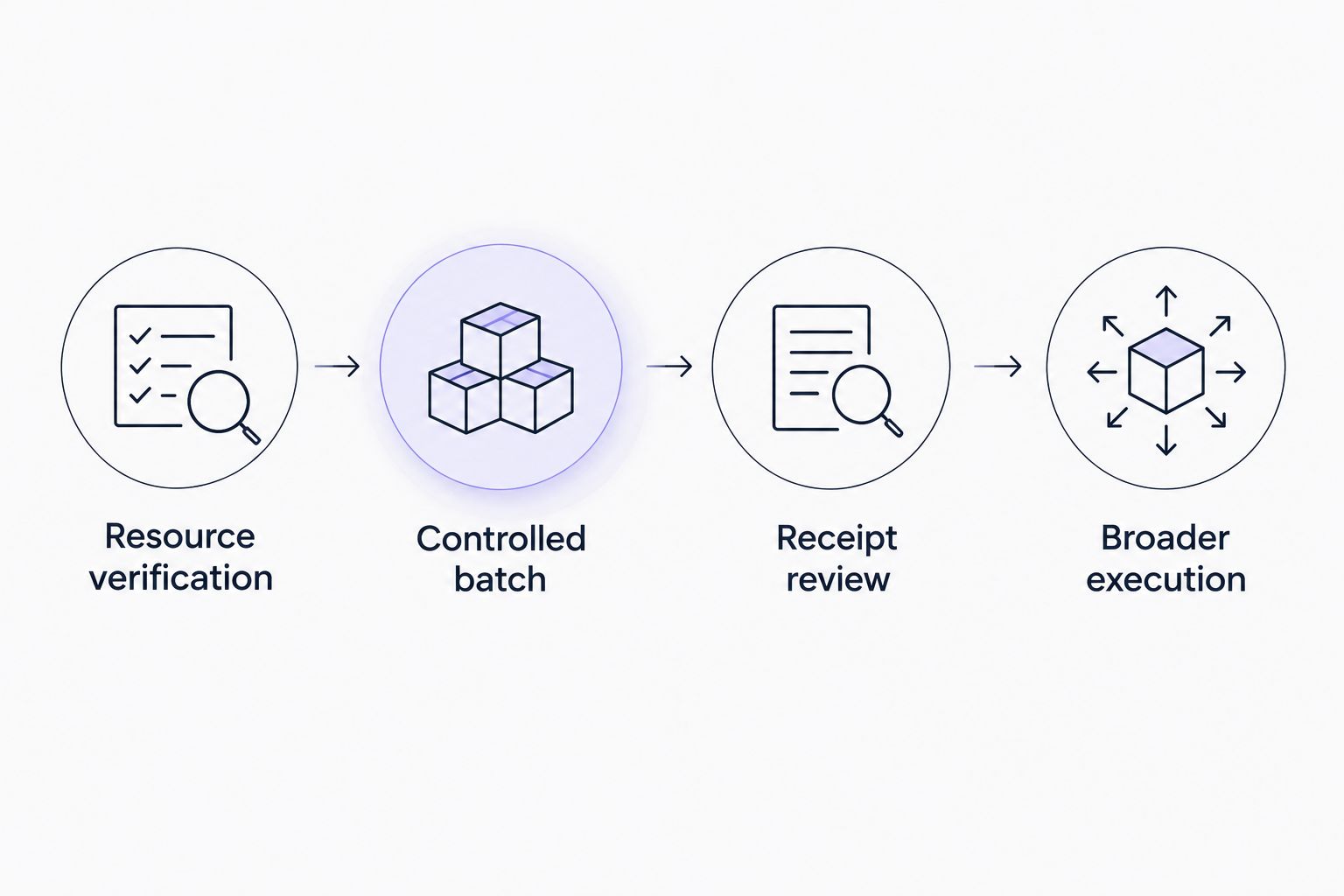
A manual approval gate remains useful even when transaction preparation is automated. Automation should not remove your ability to stop an incorrect distribution.
- Confirm the production contract address before signing.
- Approve the recipient list independently of the signing session.
- Review receipts from the controlled batch.
- Pause on unexpected failures or resource consumption.
- Keep private keys out of chats, tickets, and provider messages.
Measure consumption and close the resource window
Reconcile the launch after execution instead of ending the process when tokens arrive. Compare completed transactions, failures, resource consumption, and remaining obligations. Separate unused resources from transactions that still need to run.
For your 2026 operating record, keep the resource arrangement beside the transaction evidence. A total resource allocation says little without knowing which accounts used it and which contract paths produced the consumption.
Track member operations separately. Nbtrx supports Telegram business operations, but the blockchain record remains the evidence for execution. Use support reports to locate problems, then verify the relevant transaction status before deciding what to repeat.
- Reconcile transaction hashes against intended recipients or actions.
- Separate confirmed execution from failed or unsubmitted work.
- Record remaining resources and outstanding contract operations.
- Review delegation end conditions and continuing dependencies.
- Update the next launch plan using observed transaction receipts.
Compare TRON energy options for token launch projects
Choose the resource arrangement by control, timing, and responsibility. No option removes the need to test contract paths, check account resources, or protect signing keys. The table compares approaches rather than endorsing a provider.
| Option | Best for | Main advantage | Key limitation |
|---|---|---|---|
| Stake TRX for Energy | Teams planning continuing contract operations | Direct participation in TRON’s resource allocation model | Commits TRX and requires attention to current staking and unstaking rules |
| Receive delegated Energy | Teams coordinating resources across separate accounts | Makes delegated resources available to an execution account | Depends on the delegator’s allocation and applicable delegation conditions |
| Rent delegated Energy | Teams evaluating a defined resource window | Provides a route to resources without staking the recipient’s own TRX | Adds provider, delivery, and duration dependencies |
| Use TRX for execution charges | Teams explicitly allowing balance-funded execution | Provides a funding path when available Energy is insufficient | Consumes TRX and remains subject to transaction limits and network rules |
Rental is a commercial arrangement around resource delivery, not a separate execution resource. Check the underlying delegation and receiving account rather than relying only on the service’s order status.
For recurring operations, review the resource strategy after the launch window. A launch-time arrangement does not automatically suit later transfers, administrative calls, or continuing claims.
Common mistakes token launch teams make
Applying one transfer estimate to every contract call
A simple token transfer is not a reliable substitute for deployment, claim verification, or a custom distribution function. Contract logic and execution state affect the work performed. Estimate each relevant path and preserve the evidence behind the estimate.
Funding the treasury while overlooking the caller
Holding resources or TRX in a treasury account does not automatically fund another wallet’s transactions. Map the submitting account and check the applicable resource-sharing configuration. Resource planning belongs at the account-and-contract level, not just the treasury level.
Treating delegated Energy as a token balance
Energy is an execution resource, not another token allocation to distribute. Receiving delegated resources does not transfer ownership of the delegator’s staked TRX. Keep token distribution records and resource delegation records separate so operators do not confuse the two.
Retrying transactions without checking chain status
A delayed interface or support report does not establish that a transaction failed. Check the transaction hash, confirmation status, and contract state before retrying. A repeated action can create a different outcome from the original intended operation.
Letting launch urgency weaken key handling
An energy supplier does not need your seed phrase or private key to delegate resources to an address. Reject requests for signing secrets. Handle any requested signature as a separate security decision, not a routine part of a resource order.
FAQ
What is TRON energy for token launches?
TRON energy for token launches is the execution resource used by launch-related smart-contract transactions. Plan it separately for deployment, distributions, claims, and any other contract paths your project actually uses.
Does every token launch transaction use the same amount of Energy?
No, different contract paths can consume different amounts of Energy. Use execution estimates and transaction receipts for the relevant contract version and conditions rather than applying a standard transfer figure to the whole launch.
Is renting TRON Energy better than staking TRX?
Neither approach is universally better. Renting adds a provider and delivery dependency, while staking commits TRX under network staking rules; choose according to your resource window, account structure, and operating responsibilities.
Can delegated Energy pay for every wallet in my launch?
Delegated Energy is available to the account receiving the delegation, not automatically to every wallet involved in a launch. Map each submitting account and check contract resource-sharing settings before deciding where resources belong.
Can a transaction still need TRX when the wallet has Energy?
Yes, available Energy does not remove every possible network charge. Bandwidth, insufficient execution resources, and transaction-specific conditions still need separate checks before submission.
What should I do if an energy order says delivered but transactions fail?
Check the receiving account’s usable resources and inspect the failed transaction before ordering again. Confirm the address, execution settings, contract behavior, and delivery evidence; additional Energy does not fix an invalid contract call.
Does Nbtrx replace a TRON energy provider?
Nbtrx offers Telegram business operations tools; that does not establish a TRON energy supply service. Evaluate resource sourcing through documented delivery terms and on-chain checks, separately from member operations and partner coordination.
One last thing
A failed launch transaction is not automatically an Energy shortage. Invalid inputs, contract restrictions, and execution settings require different responses. Buying more resources before reading the failure evidence leaves the actual problem unresolved.
For your 2026 runbook, place the transaction-status check before the replenishment step. Require the operator to identify the failed call, inspect its result, and confirm the resource state before authorizing a retry. That order keeps a resource purchase from becoming the default response to every incident.