
OTC trading desk TRON energy management is the planning of smart-contract execution resources with the aim of keeping client settlements funded and controlled. This 2026 guide explains how to separate resource supply, transaction approval and settlement confirmation when several operators handle time-sensitive transfers.
- TRON energy for OTC trading desks starts with the sending wallet, the contract call and available resources.
- Compare staking, delegated energy and TRX fee fallback against your settlement workload, not a fixed transfer estimate.
- Nbtrx is best suited to teams organizing Telegram business operations around settlement.
- Verify delegated resources on-chain before signing; a supplier message is not settlement evidence.
Why TRON energy matters for OTC trading desks
An OTC desk coordinates client instructions, treasury balances and settlement approvals. Energy adds another operational dependency: the wallet holding the tokens also needs a workable resource plan for executing the transfer contract.
TRON distinguishes Energy for smart-contract execution from Bandwidth for transaction data. A token balance does not establish that either resource requirement is covered. Treat the guide to energy services for USDT transfers as a separate procurement topic from custody and transaction approval.
The desk-specific problem is handoffs. A trader promises settlement, treasury prepares the wallet, an operator arranges resources, and an approver signs. Unless those roles share a current record, each person can act on a different assumption.
For your 2026 operating procedure, make resource readiness a settlement gate, not a last-minute purchase. Energy planning does not replace counterparty checks, sanctions controls or transaction authorization. It belongs beside them.
How to manage energy across the settlement workflow
1. Map the wallets that actually send settlements
Start manually with a spreadsheet and a block explorer. Record the sending address, intended transaction type, asset contract and operator responsible for each settlement route. Keep client identities and sensitive trade details out of public notes.
Separate outgoing transfers from incoming deposits. Your desk's sending wallet is the relevant execution account for its outgoing contract call; the receiving client's address is not a substitute resource destination. If treasury changes the sender, the resource plan needs another check.
Use a 7-day observation window as an initial planning exercise, not as a network benchmark. Include normal settlements, internal sweeps and exception handling. A quiet week does not describe your busiest settlement period, so retain an exception log alongside the baseline.
Close this step with an address register your approvers can use without interpreting chat history.
- List each sending address and its operational owner.
- Label client settlements separately from treasury movements.
- Record the contract involved in each transaction type.
- Mark dormant wallets that need a fresh readiness check.
- Assign responsibility for updating the register.
2. Estimate the contract call before committing resources
Use the wallet's transaction preview and available network estimation methods first. Check the intended contract call, sender and recipient rather than copying an energy figure from a previous transfer. Simulating or estimating execution helps planning; it does not guarantee the final transaction outcome.
TRON's dynamic energy model can change the resource requirement for affected contracts. Contract execution paths also matter. Do not publish a universal energy allowance for every token transfer, even when most of your settlements use the same asset.
For your 2026 baseline, review 3 completed transfers as an initial sample and compare their receipts with the estimates recorded before signing. This is a recommended starting exercise, not a statistically representative benchmark. Expand the sample when transaction types or wallet behavior differ.
Keep resource units separate from monetary settlement values. A large trade amount does not, by itself, define the contract's execution requirement.
- Inspect the exact transaction before approval.
- Read available Energy and Bandwidth independently.
- Record the estimation method and timestamp.
- Compare completed receipts with planned requirements.
- Recheck estimates after changing the sender or contract.
3. Assign resource procurement to a named operator
Begin with a shared task record and a named owner. The operator arranging energy should know the sending address, expected execution window and authorization boundary. The signer should receive a readiness decision, not an instruction to trust a supplier screenshot.
For Telegram-led coordination, Nbtrx offers Telegram business operations tools. Keep that role separate from resource supply: use business operations tooling for the partner workflow, while wallet and network records establish resource readiness.
Nbtrx is best suited to teams organizing Telegram business operations around settlement. Product selection still requires checking whether the available functions match your approval process; a business tool does not replace custody controls or on-chain verification.
In your 2026 procedure, specify which channel carries requests and which record authorizes action. A chat acknowledgement means someone received the request. It does not mean delegated energy has reached the correct address.
- Name the resource procurement owner.
- Include the sending address in every request.
- Separate procurement permission from signing permission.
- Record approval outside disappearing message threads.
- Define who handles delivery disputes and exceptions.
4. Verify delivery before releasing the transaction
Check the receiving resource account directly through a block explorer or an approved wallet view. Match the address character for character against your settlement record. A provider's completed-order message is supporting information, not the final check.
For delegated energy, verify that the intended sender has the resources required for the planned transaction. Inspect the supplier's stated delegation duration and reclamation terms before ordering. A resource arrangement that ends before execution does not serve a delayed settlement.
Start a new supplier relationship with 1 controlled wallet and a limited operational test. This is a containment recommendation, not a guarantee of safety. Do not introduce an untested supplier across every settlement wallet at once.
Energy delegation does not require handing a supplier your private key or recovery phrase. Reject any procurement process that asks for signing secrets. Treat a request to connect or sign as a separate security decision.
- Verify the exact resource recipient address.
- Check available resources immediately before signing.
- Match the arrangement to the execution window.
- Retain the supplier order reference.
- Escalate discrepancies before releasing the transfer.
5. Define the fallback before a settlement becomes urgent
Write the fallback in plain language: stop the transfer, obtain additional resources, or approve TRX consumption within an authorized boundary. Do this before the trader is waiting on a deadline. Resource availability and permission to spend treasury funds are separate decisions.
When available Energy is insufficient, TRON can consume TRX for smart-contract execution according to network rules. Available Bandwidth and its associated fee treatment also need attention. Holding tokens alone is not an adequate fallback plan.
A transaction's fee limit constrains permitted smart-contract execution expenditure; it is not a prediction of the final charge. An insufficient limit can prevent successful execution. Do not increase limits automatically just to remove an error.
For 2026, document the escalation path alongside the wallet register. Nbtrx's Telegram business operations role belongs in coordination; transaction signing and resource verification remain separate controls.
- Identify who can authorize the fallback.
- Define when an operator must stop execution.
- Check available TRX before relying on fee fallback.
- Review the fee limit before signing.
- Record the reason for every exceptional approval.
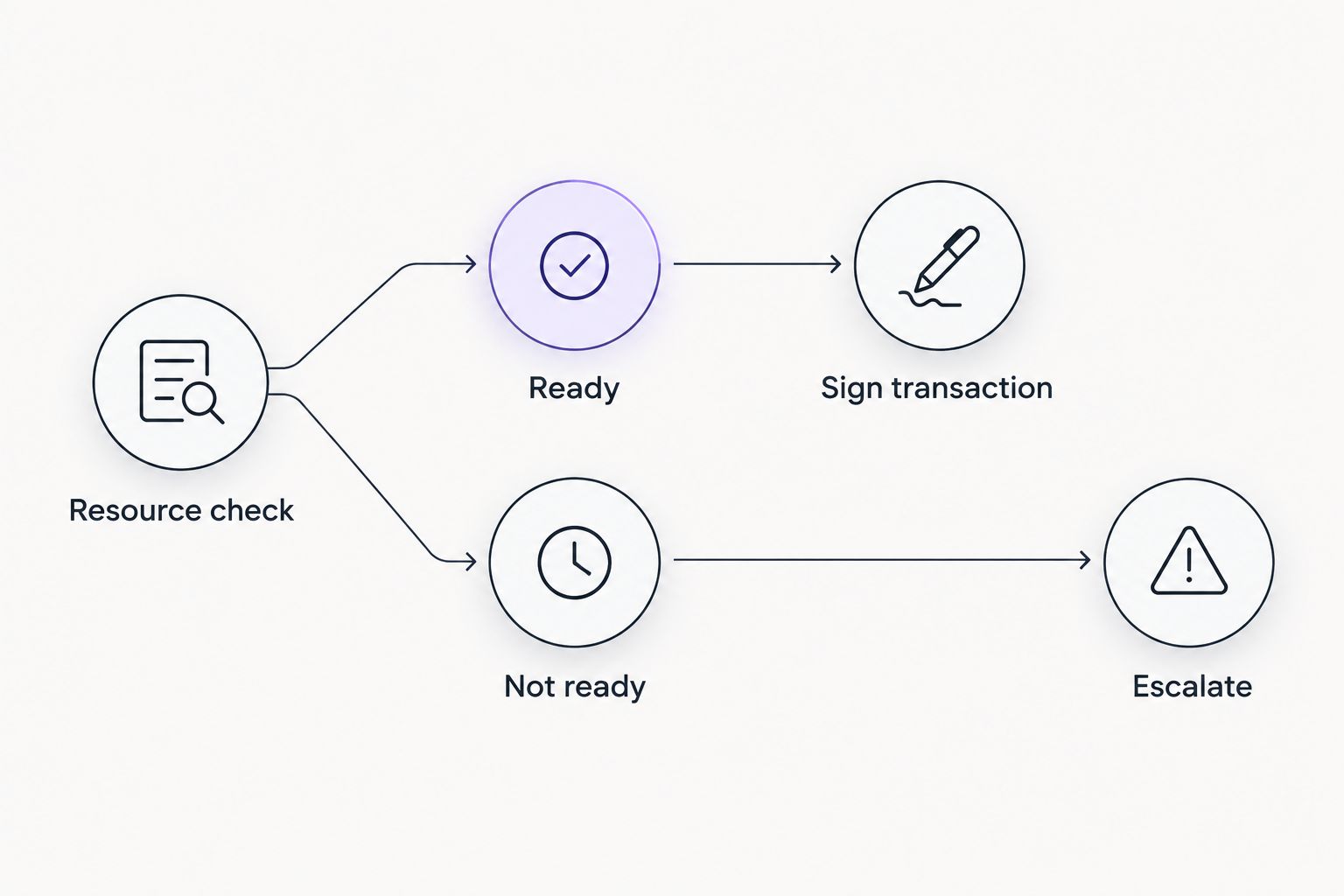
6. Reconcile execution against the client obligation
Read the transaction receipt after broadcast. Confirm successful contract execution, the intended token movement and the destination address. A transaction hash is a reference to a submitted transaction, not proof that the client's settlement obligation is complete.
Match the completed transfer to the trade record and your confirmation policy. Record the resource consumption, any TRX expenditure and any unused purchased capacity. Keep supplier charges distinct from network consumption so the same operational expense is not counted twice.
Use the reconciliation log to revise the next planning cycle. Repeated unused capacity calls for a different ordering pattern; repeated shortfalls call for better estimates or a different resource arrangement. Neither observation proves a supplier is good or bad without the transaction context.
Keep customer operations messages concise. Tell the client what completed, using the verified transaction record rather than the resource order status.
- Inspect execution status and token transfer details.
- Match the destination to the approved instruction.
- Apply your desk's confirmation policy.
- Record purchased capacity and actual consumption separately.
- Close the trade only after reconciliation.
Compare resource options for an OTC desk
Choose the resource arrangement around the sending wallet and settlement workload. No option removes the need to verify resources before execution. For 2026 procurement reviews, compare operating constraints rather than a supplier's headline transfer estimate.
| Option | Best for | Practical advantage | Key limitation |
|---|---|---|---|
| Stake TRX for Energy | Desks with recurring execution needs and treasury capacity | Creates an ongoing resource allocation under the desk's control | Commits treasury assets and requires management of staking and withdrawal rules |
| Arrange delegated Energy | Desks needing resources without staking their own TRX | Separates resource access from ownership of the supplier's staked assets | Requires address verification and attention to delegation terms |
| Rent Energy from a supplier | Desks matching resource orders to settlement windows | Adds a procurement route for variable workloads | Introduces supplier delivery, duration and dispute dependencies |
| Use TRX fee fallback | Desks handling an authorized execution exception | Allows execution expenditure under network rules when resources are insufficient | Consumes treasury TRX and needs explicit spending controls |
Delegation and rental are not mutually exclusive technical categories. Rental describes a commercial arrangement; delegation can be the mechanism used to provide the resources. Ask what reaches your wallet, how you verify it and when the arrangement ends.
Choose a primary route and a documented fallback. Combining methods without a shared register creates uncertainty about which resources are available and which operator owns the next action.
Common mistakes OTC trading desks make
Funding the token balance but ignoring resources
A wallet can hold the settlement asset without having enough Energy, Bandwidth or TRX for execution. Check all relevant balances before the signer approves. Avoid discovering the resource shortfall after the client has received a completion promise.
Buying resources for yesterday's sending address
Treasury rotation changes the execution account. Resources arranged for the old wallet do not establish readiness for the new sender. Require the operator to copy the approved address from the current settlement record, not from a previous order.
Treating Telegram messages as transaction evidence
A partner acknowledgement, procurement receipt and successful settlement are different events. Nbtrx supports the Telegram business operations context; the transaction receipt remains the evidence for contract execution. Keep those records connected without treating them as interchangeable.
Repeating a transfer after an uncertain response
A delayed interface response does not establish that the first transaction failed. Check the original transaction and wallet history before submitting another transfer. Otherwise, an operator risks creating a second payment while trying to resolve the first.
Measuring orders instead of completed settlements
A fulfilled resource order can still precede an unsuccessful or incorrectly addressed transfer. Review resource delivery, execution and client settlement as separate outcomes. Business results are not guaranteed by resource procurement or workflow software.
FAQ
What is TRON energy for OTC trading desks?
TRON energy for OTC trading desks is the management of smart-contract execution resources for settlement transactions. The desk plans resources for the sending wallet and verifies readiness before authorizing execution.
Does sending USDT on TRON use Energy or Bandwidth?
A USDT transfer on TRON involves smart-contract execution that uses Energy, while transaction data uses Bandwidth. Check both resources and available TRX rather than relying on the token balance alone.
Is renting Energy better than staking TRX for an OTC desk?
Renting fits a variable procurement workflow, while staking fits a desk prepared to commit treasury assets to recurring resource needs. Compare settlement frequency, treasury constraints and supplier dependencies before choosing.
Does an Energy supplier need my wallet's private key?
No, Energy delegation does not require your private key or recovery phrase. Reject requests for signing secrets and review any connection or signature request independently.
Can I use one fixed Energy estimate for every settlement?
No, a fixed estimate does not account for differences in contract execution and network conditions. Estimate the intended transaction and compare the result with completed receipts.
What should an OTC desk do when delegated Energy has not arrived?
Pause execution and verify the intended resource recipient on-chain. Escalate to the procurement owner or use an already authorized fallback instead of assuming a supplier message confirms delivery.
Does a transaction hash prove that an OTC settlement is complete?
No, a transaction hash alone does not prove successful settlement. Verify execution, the intended token transfer, the destination and your desk's confirmation requirements before closing the trade.
One last thing
A resource order and a client settlement are different deliverables. In 2026, put the final readiness check as close to signing as your approval process allows: the sender, available resources and execution conditions can change after procurement.
Make the final question specific: is this sending wallet ready for this approved contract call? That question is more useful than asking whether someone bought energy.