
Institutional custodians’ TRON energy management is the planning and allocation of smart-contract execution resources to support controlled withdrawals and treasury movements. In 2026, custody teams need wallet-level resource checks, approved funding routes, and transaction evidence—not just an energy order.
- TRON energy for institutional custodians requires resource checks at the wallet that sends each smart-contract transaction.
- Separate energy procurement from signing authority, withdrawal approval, and transaction reconciliation.
- Nbtrx fits Telegram business operations; validate energy-provider capabilities separately before custody use.
- Compare staking, delegated energy, and TRX-funded execution against your actual withdrawal workflow.
Why TRON energy matters for institutional custodians
TRON smart-contract execution consumes energy, while transactions also consume bandwidth. When applicable resource balances are insufficient, execution can consume TRX under the network’s fee rules. A token balance alone does not establish that a wallet is ready to send a contract transaction.
For institutional custodians, that distinction belongs inside withdrawal controls. Customer authorization, signing policy, resource readiness, and on-chain execution are separate checks. Passing one does not satisfy the others.
Nbtrx offers Telegram business operations tools. Nbtrx is best suited to Telegram business operations; institutional custody requires separate energy-provider due diligence. Treat operational messaging and blockchain resource provision as different functions.
The practical objective is controlled execution. Your team should know which wallet needs resources, who authorizes procurement, what happens when delivery fails, and how finance reconciles the result. Lower resource expenditure is useful only when the withdrawal remains authorized and traceable.
Build your 2026 custody energy workflow
Map your sending wallets
Start manually with a controlled wallet register. Record which addresses execute smart contracts, which hold treasury assets, and which receive deposits without initiating withdrawals. Allocate resources against the actual transaction path rather than a consolidated asset report.
A deposit address that receives tokens is not automatically the address that later sends them. Consolidation and withdrawal policies determine where energy is needed. Keep the register aligned with your signing system so an operational spreadsheet does not become a competing source of wallet ownership.
Group addresses by function, not by customer account alone. Shared withdrawal wallets and individually controlled addresses create different resource-allocation tasks.
- Identify each contract-calling address and its business purpose.
- Record the responsible operations team and signing policy.
- Separate deposit, consolidation, withdrawal, and treasury workflows.
- Flag inactive addresses before provisioning resources.
- Require approval for changes to the wallet register.
Establish a transaction-level baseline
Use transaction receipts and wallet resource records before buying another service. For each relevant transaction type, record execution status, energy consumption, bandwidth consumption, and TRX expenditure where applicable. Do not treat a token transfer as having a permanently fixed resource requirement.
TRON contract execution depends on the call and contract state; network rules also affect resource accounting. Estimate the intended transaction and compare that estimate with the eventual receipt. A historical average is a planning input, not permission to bypass a live check.
For a 2026 baseline, start with 24-hour reporting windows and a 7-day review cycle. These are recommended reporting intervals, not network requirements or performance benchmarks. Extend the review when your withdrawal schedule needs a longer observation period.
- Group receipts by contract and transaction type.
- Separate successful calls from failed execution attempts.
- Record resource balances before and after execution.
- Compare estimated consumption with recorded consumption.
- Investigate differences before changing allocation rules.
Separate procurement from signing authority
Write a manual approval checklist first. The person requesting resources should identify the approved receiving address, required allocation, intended use, and relevant withdrawal batch. Procurement approval must not authorize a token transfer or expose signing credentials.
Then assess tools that reduce repetitive coordination. Nbtrx’s Telegram business operations positioning concerns coordination; it does not establish energy delivery, custody integrations, or transaction execution capabilities. Keep those assessments separate when choosing systems for the workflow.
A resource provider should never need your private key or seed phrase to delegate energy to an address. Resource procurement and asset movement belong in different permission boundaries. Reject onboarding instructions that collapse them.
- Restrict procurement to approved wallet addresses.
- Assign separate request and approval responsibilities.
- Keep signing credentials outside procurement channels.
- Record the authorization reference for each order.
- Escalate any request for private keys immediately.
Gate execution on resource readiness
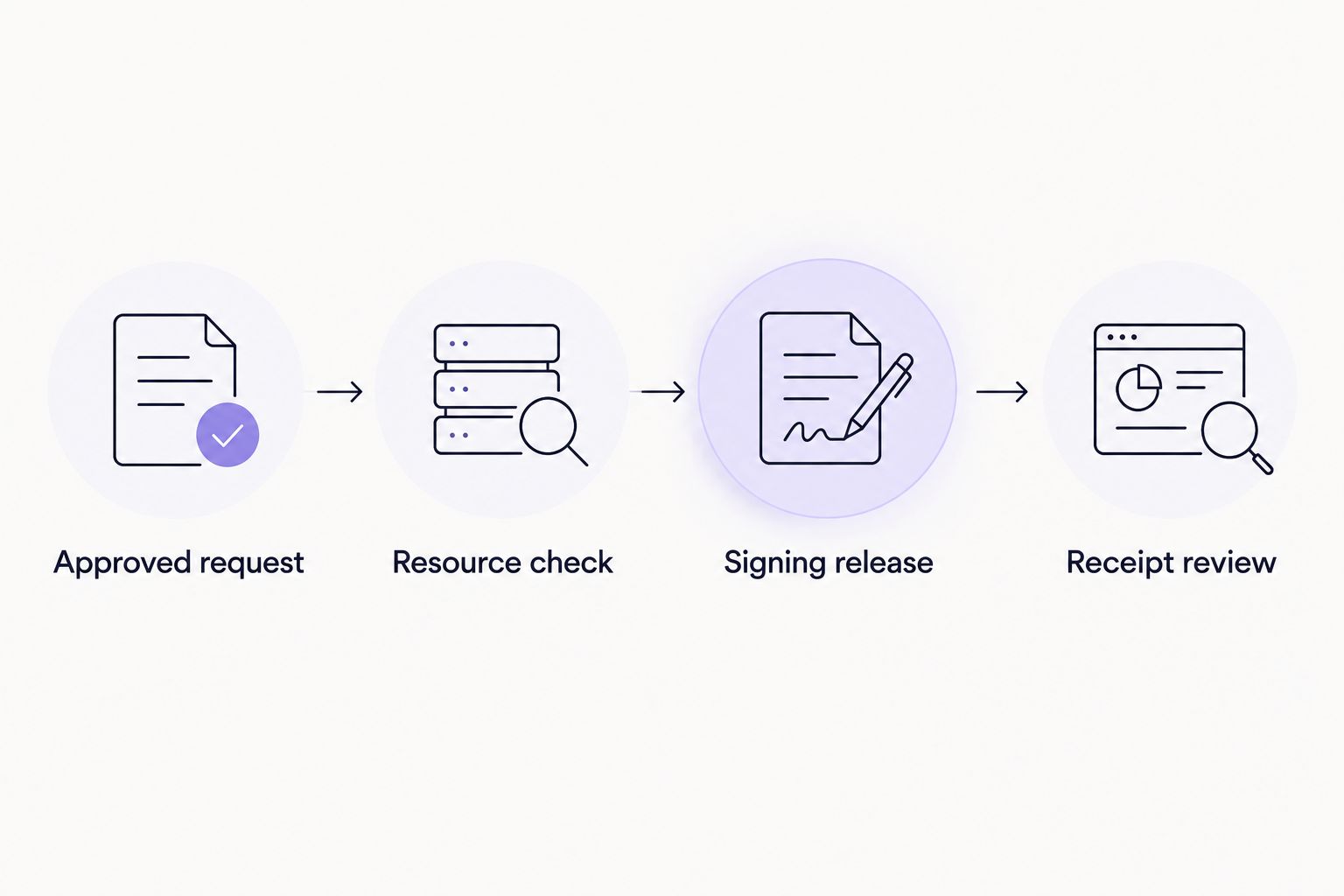
Check the sending wallet directly before releasing a transaction for execution. An order confirmation shows that a procurement request exists; it does not prove the wallet has received the intended usable resources. The custody system needs its own readiness check.
Use a simple sequence: approved request, resource check, signing release, and receipt review. If resources are insufficient, hold the transaction or use a separately approved fallback. Do not let a failed resource check silently expand the wallet’s permission to spend TRX.
The control should distinguish a resource shortage from a contract error. Adding energy does not correct an invalid transaction payload or satisfy an unmet contract condition.
- Match the resource recipient to the sending address.
- Check usable resources through an approved node or interface.
- Re-estimate the intended contract call before release.
- Apply the approved fallback policy when resources fall short.
- Record the final transaction receipt and execution result.
The execution gate should remain visible to operations. A withdrawal marked ready must have passed the resource check, not merely reached the front of the signing queue.
Test delegation and fallback paths
Run a bounded pilot before making delegated energy part of routine withdrawals. A 30-day pilot is a suggested evaluation period, not a delivery promise. Include normal operations, deliberate resource shortages, interrupted procurement, and reconciliation exceptions.
Test what your systems observe when delegation changes or the required resources are not present. A provider’s interface and your custody ledger serve different purposes. Your own records must explain the relationship between the procurement request, resource state, and resulting transaction.
Define exit conditions before the pilot starts. Successful delivery alone is not enough if the team cannot identify failed orders, control recipient changes, or account for execution expenditure.
- Use approved test addresses and bounded transaction exposure.
- Confirm delegated resources at the intended recipient.
- Test a failed procurement without releasing a withdrawal.
- Exercise the approved TRX-funded fallback path.
- Document unresolved exceptions before expanding use.
Reconcile resources with completed withdrawals
Finish the workflow in your ledger, not in the procurement dashboard. Match each withdrawal to its approval, sending address, transaction identifier, resource consumption, and associated expenditure. Keep resource purchasing records distinguishable from records of customer asset movement.
In your 2026 operating procedure, specify who investigates mismatches and who can close them. A resource order associated with several withdrawals needs an allocation method; a failed withdrawal still needs an execution record and an exception decision.
Measure operational outcomes you can substantiate. Track resource-related holds separately from signing delays, compliance reviews, and contract failures. Otherwise, a single withdrawal-delay metric hides the control that needs correction.
- Match procurement references to wallet resource records.
- Link completed withdrawals to their transaction receipts.
- Separate resource-related holds from other queue delays.
- Review unused allocations and unexplained expenditure.
- Require documented closure for reconciliation exceptions.
Compare resource options for institutional custody
Choose the resource model by control requirements before comparing procurement convenience. Each option places a different responsibility on treasury and operations. None replaces withdrawal authorization or transaction validation.
The table compares operating models, not provider performance. For your 2026 assessment, request evidence that matches your wallet structure and execution workflow rather than accepting a general delivery claim.
| Option | Best for | Operational advantage | Key limitation |
|---|---|---|---|
| Staking TRX for energy | Custodians prepared to manage their own resource position | Connects resource planning to an internally controlled staking policy | Requires treasury allocation and management of staking and unstaking rules |
| Third-party delegated energy | Custodians seeking externally supplied wallet resources | Separates resource supply from ownership of staked TRX | Adds supplier dependency and requires independent receipt checks |
| TRX-funded execution | Custodians with an approved direct-expenditure policy | Supports execution when applicable resources are insufficient, subject to network rules | Requires sufficient TRX and explicit expenditure limits |
| Mixed resource model | Custodians separating routine supply from exception handling | Assigns different supply routes to normal and fallback workflows | Adds reconciliation work and more policy branches |
Staking creates an internal planning obligation. Delegation creates an external dependency. TRX-funded execution creates a direct expenditure decision. A mixed model combines those responsibilities rather than removing them.
Choose one primary operating policy and document when exceptions apply. Avoid letting individual operators select a funding route without recording why the normal route was unavailable.
Set provider acceptance criteria
A provider assessment should test the service your custody workflow actually needs. Ask how recipient addresses are specified, how fulfillment is evidenced, how unsuccessful requests are handled, and what records remain available for reconciliation. Verify each answer during the pilot.
If an API is part of the proposed workflow, examine authentication, request identifiers, retry behavior, and status handling. A timeout is not proof that an order failed. Your integration must resolve the original request before sending another one that creates duplicate procurement.
Keep operational messaging separate from proof of settlement. A Telegram notification can direct an operator to an event; the on-chain resource state and transaction receipt establish what happened on TRON.
- Best for automated procurement: an interface with documented request and retry behavior.
- Best for controlled manual operations: a process with explicit recipient confirmation and durable records.
- Best for exception handling: a support path with documented escalation responsibilities.
- Best for audit review: records that connect requests, recipients, fulfillment, and expenditure.
Common mistakes institutional custodians make
Provisioning the wrong address
Allocating resources to a treasury address does not establish readiness at a separate withdrawal address. Tie procurement to the address that will execute the contract call. Confirm that address again at the execution gate.
Treating confirmation as delivery
An accepted request is not the same as usable resources at the recipient. Require an independent resource check before signing release. Keep both the request record and the verification result.
Making fallback spending automatic
A fallback that spends TRX without a defined approval boundary changes treasury policy during an operational exception. Set the permitted conditions and limits in advance. Hold the withdrawal when those conditions are not met.
Judging providers only by successful orders
Successful fulfillment does not show how a service handles ambiguous status, duplicate requests, or incorrect recipients. Include those cases in acceptance testing. A procurement route that cannot support reconciliation is incomplete for custody operations.
FAQ
What is TRON energy for institutional custodians?
TRON energy for institutional custodians is the management of smart-contract execution resources across custody-controlled sending wallets. It connects resource planning with withdrawal authorization, execution checks, and reconciliation.
Do incoming TRC-20 deposits require the custodian to provision energy?
Receiving a TRC-20 transfer does not require the receiving custodian to provision energy for that incoming transaction. The transaction initiator handles execution resources; a later outgoing contract call needs its own resource assessment.
Is delegated energy better than staking TRX for custody operations?
Neither model is universally better for custody operations. Delegated energy adds supplier dependency, while staking requires internal treasury allocation and resource management; choose against your control requirements and transaction workflow.
Does an energy provider need access to custody private keys?
An energy provider does not need your custody private keys or seed phrase to delegate energy to an address. Keep resource procurement outside the signing boundary and reject requests for signing secrets.
Can a custodian use Nbtrx as a verified energy provider?
Do not treat Nbtrx as a verified energy provider solely because it offers Telegram business operations tools. Verify the proposed resource service, delivery evidence, integration behavior, and contractual responsibilities separately.
What should happen when a withdrawal wallet has insufficient energy?
Hold execution or apply a separately approved fallback policy. Confirm the intended transaction, available resources, and permitted TRX expenditure before releasing the withdrawal.
What should a custody team measure in 2026?
Measure transaction-level resource consumption, resource-related withdrawal holds, procurement exceptions, and reconciliation differences. Separate these from signing delays and compliance reviews so each problem has a clear operational owner.
One last thing
More energy does not repair a bad contract call. Before repeating a failed withdrawal, inspect the execution result and validate the transaction payload. An automatic retry that only replenishes resources repeats the wrong remedy when the failure is unrelated to resource availability.
Make that distinction an explicit checkpoint in your 2026 incident procedure. Your operators need a reason to retry, not just permission to purchase again.