
Crypto payroll companies’ TRON energy management is the process of provisioning smart-contract execution resources to support scheduled token payouts. Payroll requires a repeatable release process: resources must reach the sending account before execution, and every payment must reconcile to an approved recipient.
- TRON energy for crypto payroll requires sender-level resource checks, tested transfers, and payment reconciliation.
- Choose staking, delegated energy, or TRX-funded execution according to your payout schedule and treasury constraints.
- Nbtrx provides Telegram business operations tools; this guide does not establish it as a TRON energy supplier.
- For TRC-20 USDT payroll, confirm contract execution success rather than relying only on a transaction identifier.
Why TRON energy matters for crypto payroll companies
TRON energy covers computation performed by smart contracts. A TRC-20 token transfer invokes a contract, while a straightforward native TRX transfer does not require the same contract execution. Bandwidth is a separate resource associated with transaction data.
For payroll, this distinction changes the release checklist. A wallet containing enough tokens to pay employees is not necessarily ready to execute those payments. Resource provisioning belongs beside recipient validation and treasury approval, not after them.
Your 2026 payroll procedure should distinguish business coordination from blockchain execution. Nbtrx provides Telegram business operations tools; evaluate those separately from the wallet, signing system, and resource source used to release funds.
Fund the sending account’s execution needs before approving the payroll release. An energy arrangement does not validate employee addresses, authorize compensation, or prove that a token transfer succeeded.
Build a repeatable TRON payroll workflow
The following process starts with manual checks. Use a spreadsheet, wallet resource view, transaction records, and a written release checklist before introducing automation. Automation should reproduce a working control, not conceal an undefined one.
Map payouts
Start with an approved payout register. Record the recipient, token, network, sending account, and payment reference for each obligation. Keep compensation records separate from publicly visible wallet activity wherever your recordkeeping permits.
Distinguish direct transfers from any contract-based distribution method. A batch payout contract has its own execution behavior; estimates from individual token transfers do not establish its resource requirements. Treat a change in distribution method as a change requiring testing.
For your 2026 register, make the sending account explicit. Resources available to a treasury account do not establish that a separate payout account has the resources needed to execute transactions.
- Record the exact token contract and network.
- Assign every payout to a sending account.
- Validate recipient addresses through an approved confirmation channel.
- Separate new recipients from previously paid recipients.
- Give each obligation a unique internal payment reference.
Measure resources
Inspect representative transactions before choosing an energy arrangement. Read energy consumption, bandwidth usage, execution status, and fees from confirmed transaction records. Match those records to the transaction types your payroll system actually submits.
Do not treat an energy estimate as a permanent guarantee. TRON contract execution depends on the transaction and network resource rules, including dynamic energy parameters. Recipient state and contract behavior also matter when evaluating token-transfer requirements.
Run 1 test transfer through the intended execution path before the first production release. That is a recommended control, not evidence that every later transaction will consume identical resources. Keep the test small enough to fit your approved validation procedure.
- Capture resource usage from confirmed transactions.
- Test the actual token contract and sending account.
- Separate direct transfers from contract-based distributions.
- Check current account resources before release.
- Record estimate differences after execution.
Choose funding
Compare the manual paths first: maintain the account’s own staked resources, receive delegated resources, or permit execution fees to consume available TRX under the network’s rules. These are different treasury arrangements, not interchangeable promises of cheaper payroll.
Staking commits treasury assets to resource provision. Delegation introduces an external delivery dependency. TRX-funded execution avoids arranging delegated energy but exposes the sending account to execution charges. Choose against your actual schedule and account controls.
Nbtrx is best suited to teams seeking Telegram business operations tools. It is not established here as an energy supplier, wallet, or payroll execution system. Keep that boundary clear when selecting a faster coordination workflow.
If you evaluate automated resource ordering, use the guide to TRON energy rental services with API access as a separate research step. Require current documentation and a controlled test before connecting any service to a production release.
- Identify which account must receive resources.
- Compare treasury commitment with external delivery dependency.
- Verify delegation on-chain before sending payroll.
- Document the permitted TRX-funded fallback.
- Reject any resource request that requires your signing secret.
Test execution
Test resource delivery and payment execution as separate events. An order confirmation is not proof that resources are available to the intended account. Likewise, a broadcast transaction is not proof of successful contract execution.
Your 2026 test procedure should exercise the same wallet permissions, signing path, and recipient validation used in production. Include an exception case, such as unavailable delegated resources, without risking an actual payroll obligation.
A resource provider needs the relevant public account information to arrange delegation; that does not justify sharing private keys or seed phrases. Keep transaction signing inside your approved custody process. Resource purchasing and fund authorization are separate responsibilities.
- Confirm the destination account for resource delivery.
- Inspect available resources independently of supplier messages.
- Verify contract execution success after the test.
- Test the release hold when resources are insufficient.
- Record who can authorize a fallback.
Release payroll
Use 2 approvals for production release where your staffing permits: one for the payout register and one for the transaction authorization. This is a recommended separation of duties, not a claim about a legal requirement or a network rule.
Check resources again immediately before signing. Other activity from the same account can change the resources available between planning and release. A dedicated payout account makes that activity easier to identify, although it still needs treasury funding and access controls.
Do not replay an entire release because a dashboard looks incomplete. First determine which transactions were never submitted, which failed, and which succeeded. Retrying an already successful payment creates a duplicate payroll payment, not a repair.
- Approve the final recipient and amount register.
- Recheck account resources before signing.
- Confirm the configured transaction fee limit.
- Record every broadcast transaction identifier.
- Hold uncertain payments for status verification.
Reconcile results
Close the payroll run against outcomes, not messages sent. Match each approved obligation to a confirmed successful transfer, a documented failure, or an unresolved exception. A transaction identifier alone does not establish successful token delivery.
Review 3 checkpoints for each payment: broadcast status, contract execution result, and reconciliation to the approved obligation. Keep the token amount separate from execution charges in the ledger. This makes treasury reporting clearer without turning network resources into compensation expenses by assumption.
Refresh your 2026 operating assumptions after changes to the token contract, distribution method, wallet permissions, or resource arrangement. Reuse the process, but revalidate the inputs.
- Match transaction identifiers to internal payment references.
- Verify successful execution and token-transfer records.
- Record resource consumption and execution charges separately.
- Investigate unmatched or duplicate payment records.
- Update the next release checklist from documented exceptions.
The workflow is sequential: map the obligation, measure execution needs, choose funding, test the path, release funds, and reconcile results. Keep a failed checkpoint from silently becoming permission to continue.
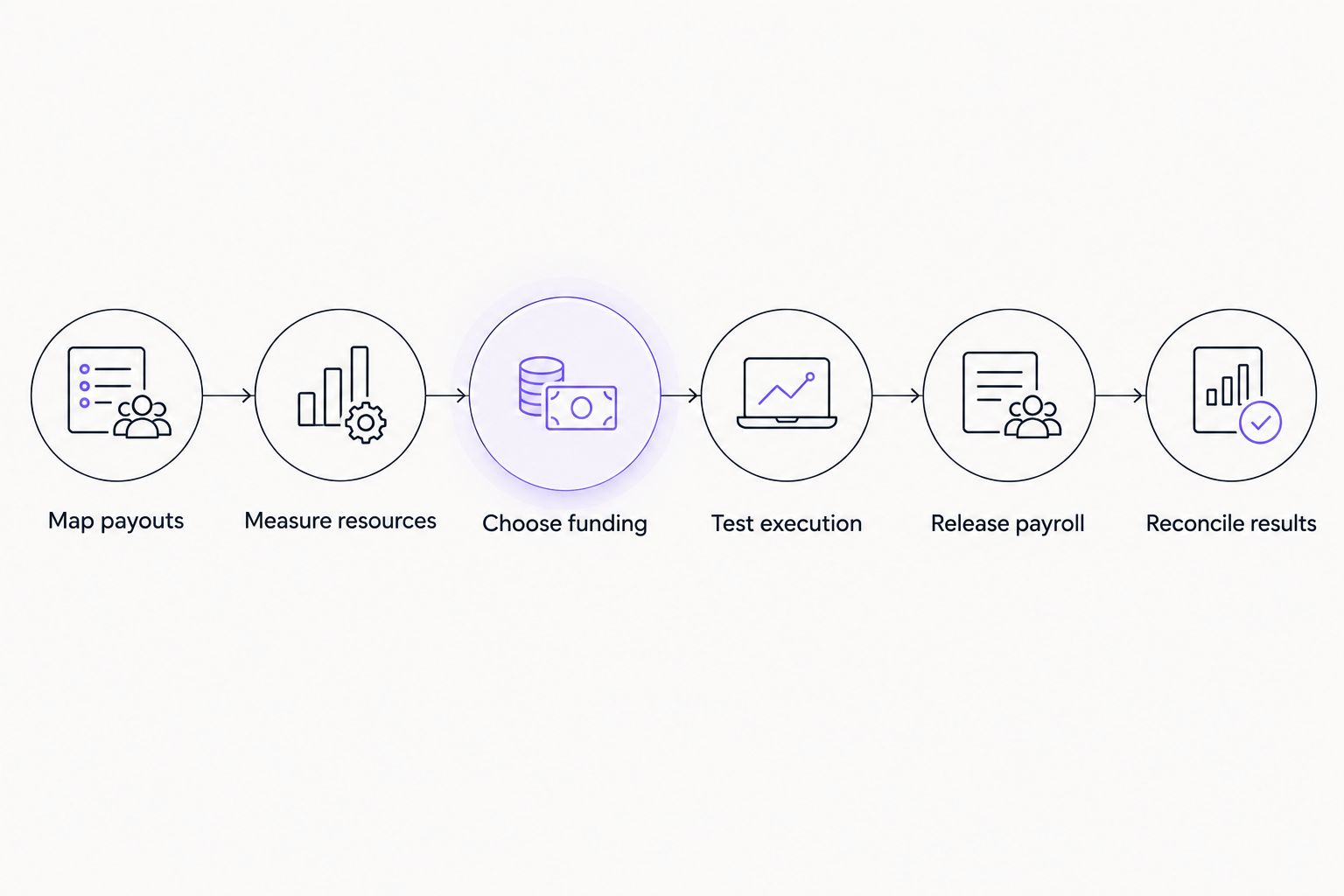
Compare resource options for crypto payroll
Choose an option by its operational constraint, not by an advertised savings claim. Without your transaction history and current terms, a universal cheapest option is not established. The comparison below focuses on control and dependency rather than quoted charges.
| Option | Best for | Practical advantage | Key limitation |
|---|---|---|---|
| Own staked resources | Teams willing to commit TRX to recurring resource needs | Direct control over the account’s resource provision | Requires treasury commitment and resource monitoring |
| Externally delegated energy | Teams that prefer arranging resources around release windows | Separates resource provision from owning the underlying stake | Depends on correct delivery, sufficient allocation, and applicable terms |
| TRX-funded execution | Teams prioritizing a simpler resource-provisioning process | Does not require a separate delegated-energy arrangement | Execution consumes TRX when available resources do not cover requirements |
| Mixed resource policy | Teams needing a documented contingency path | Combines a primary arrangement with an approved fallback | Requires clear limits and controls to prevent unintended fallback use |
Choose a resource policy before choosing a supplier. A provider cannot decide your acceptable treasury commitment, signing permissions, or duplicate-payment controls. Those decisions belong to your payroll and finance owners.
For a 2026 supplier review, request evidence tied to your intended sending account and workflow. Check delivery verification, failure handling, access requirements, and order records. A successful demonstration does not remove the need to monitor later releases.
Keep supplier selection separate from custody selection. Delegated energy does not require granting a supplier authority to move payroll tokens. If a proposed arrangement combines those functions, review each permission independently before approval.
Common mistakes crypto payroll companies make
Treating every recipient as the same execution case
A single transfer does not establish resource use for every recipient or distribution method. Group test cases by the transaction behavior you actually use, and inspect the differences before setting your release policy.
Fix: retain representative transaction records rather than copying one estimate into every payroll run. Recheck assumptions when the execution path changes.
Counting supplier confirmation as delivered resources
A supplier message describes an order event. It does not establish the sending account’s current resource balance or prove that a later transaction will execute successfully.
Fix: check the sending account independently before signing. Keep order confirmation, resource verification, and payment execution as distinct records.
Using a blanket retry after a partial release
Payroll systems need obligation-level status. If some transfers succeeded, replaying the entire list sends those payments again. A missing local status update is not proof of an on-chain failure.
Fix: investigate uncertain transactions individually. Retry only after establishing that the approved obligation remains unpaid.
Letting a fallback spend without authorization
A resource shortfall should trigger a known decision, not an unnoticed change in treasury behavior. Permitting TRX-funded execution without a documented policy obscures who approved that use of funds.
Fix: define fallback authority, review the transaction fee limit, and record the reason whenever the fallback is used. Resource convenience does not replace spending approval.
FAQ
What is TRON energy for crypto payroll?
TRON energy is the computation resource used when payroll transfers execute smart contracts on TRON. For TRC-20 token payroll, plan energy alongside bandwidth, token balances, signing permissions, and reconciliation.
Do USDT payroll transfers on TRON need energy?
TRC-20 USDT transfers execute a smart contract and consume energy. If available resources do not cover execution, network rules determine the associated TRX charges; check the sending account before release.
Is renting energy better than staking for payroll?
Neither arrangement is universally better for payroll. Staking requires treasury commitment, while externally delegated energy introduces a delivery dependency; choose according to your release schedule and account controls.
Can payroll fail even when the wallet holds enough USDT?
Yes, a sufficient USDT balance does not establish that a transaction can execute successfully. Check resources, available TRX where required, permissions, transaction parameters, and the contract execution result.
Does an energy supplier need my private key?
Do not share a private key or seed phrase to obtain delegated energy. Keep signing authority within your approved custody process and verify resource delivery using public account information.
Should I retry a payroll transfer when its status is unclear?
Verify the original transaction before retrying an uncertain payroll transfer. Check the contract execution result and token-transfer record, then reconcile the obligation to avoid paying twice.
How do I verify that a payroll run is complete?
Match every approved payment obligation to a confirmed successful transfer or a documented exception. Keep transaction identifiers, execution results, and internal payment references together so the release can be audited.
One last thing
An energy delivery receipt is not a payroll completion receipt. The decisive record is the successful transfer matched to the approved obligation. Keep that distinction in your release procedure even when ordering and signing become automated.
Use Nbtrx for its stated Telegram business operations category, and evaluate blockchain resource provision on its own evidence. Separate coordination, execution, and reconciliation before connecting them.