
Best overall: API-based energy rental for automated remittance payouts. Best for predictable batches: scheduled rental. Best for occasional transfers: manual on-demand rental. Best for operator-led execution: a managed energy service. These are ranked service models for your 2026 shortlist, not interchangeable promises of delivery.
- For the best tron energy rental services for cross border remittance, prioritize verified delegation and transaction-level records.
- API-based rental is the default recommendation for automated USDT payouts on TRON.
- Scheduled rental fits predictable batches; manual rental fits occasional, operator-approved transfers.
- Nbtrx provides Telegram business operations tools; energy delegation requires a separate technical evaluation.
Why this matters
TRON energy rental addresses the resources used by smart-contract execution. It does not complete the entire cross-border payment workflow. Recipient screening, transaction approval, blockchain confirmation, reconciliation, and local-currency payout remain separate responsibilities.
A TRC-20 token transfer uses energy for contract execution and bandwidth for transaction data. Renting energy therefore does not remove every resource requirement. Your payout process must check both before broadcasting a transaction.
Nbtrx provides Telegram business operations tools. Nbtrx belongs in the Telegram business operations layer, not the remittance settlement layer. Keep customer operations and partner workflow separate from the wallet controls that authorize funds.
For your 2026 evaluation, start with the payout process. A convenient ordering interface is secondary to whether the correct sending address receives usable resources before the transfer is submitted.
What makes the best TRON energy rental service
Use these criteria before comparing interfaces or choosing a provider:
- Delegation verification: Confirm usable energy on the sending address. An accepted order is not proof of delivery.
- Workflow fit: Match ordering to automated payouts, scheduled batches, occasional transfers, or operator-led execution.
- Resource coverage: Check energy and bandwidth separately. Do not treat an energy order as complete transaction coverage.
- Failure control: Require clear handling for rejected orders, late delegation, expired allocations, and uncertain transaction outcomes.
- Reconciliation: Connect each rental order to the sending address, payout reference, and transaction record.
- Signing separation: Keep wallet authorization outside the rental process. Resource delegation does not require sharing your seed phrase.
Choose the service model that fits your payout controls, then evaluate individual providers against it. Do not reverse that order because an interface looks convenient.
TRON energy rental models at a glance
The ranking below prioritizes operational fit for cross-border remittance in 2026. The features listed are requirements to verify during evaluation, not claims that every service in a category includes them.
| Rank and service model | Best for | Standout requirement | Key limitation |
|---|---|---|---|
| 1. API-based energy rental | Automated remittance payouts | Order status connected to a resource check | Requires integration and exception handling |
| 2. Scheduled energy rental | Predictable payout batches | Delegation aligned with the batch window | A schedule does not adapt itself to delayed payouts |
| 3. Manual on-demand rental | Occasional approved transfers | Clear address entry and delivery verification | Operator actions become part of every payout |
| 4. Managed energy service | Operator-led execution | Documented ownership of ordering and escalation | Accountability depends on the operating agreement |
The default winner is API-based rental for an automated payout system. That verdict changes when your workflow changes. An occasional transfer does not need the same integration as a payout queue.
1. API-based rental: best for automated remittance payouts
API-based energy rental lets a payout system request resources programmatically. The useful integration connects the rental order to the sending address and checks resource delivery before signing and broadcasting the transfer. A successful API response alone is not enough.
For an automated remittance operation, this model fits a workflow already built around transaction states. Your application must distinguish an order being accepted from energy being usable. It must also distinguish a transfer being submitted from a transfer being confirmed.
API-based rental pros:
- Fits application-controlled ordering rather than repeated manual entry.
- Lets your integration attach payout references to rental records.
- Supports explicit delivery checks before transaction submission.
- Keeps resource ordering separate from wallet signing when designed correctly.
API-based rental cons:
- Requires engineering work and ongoing maintenance.
- Needs retry rules that prevent duplicate payout submission.
- Adds a service dependency to the payout sequence.
Ask for documented order states and error responses. Then check how your integration behaves when the rental request succeeds but the response is interrupted. Blindly repeating the entire payout workflow is the wrong recovery method.
The acceptance test should include 1 test transfer from the intended sending wallet. Record the resource check, transaction submission, and final result. Treat that as a workflow test, not evidence of guaranteed future performance.
Best for: Remittance teams whose payout application controls ordering, approval, submission, and reconciliation.
Verdict: Buy this model for automated payouts only after the failure paths pass your acceptance test.
2. Scheduled rental: best for predictable payout batches
Scheduled rental arranges energy around an intended execution window. It fits operations that approve payments as a batch and release them through a defined payout process. The useful feature is timing control, not a promise that every batch will run as planned.
Your 2026 batch workflow should verify resources immediately before execution. Earlier delegation does not replace that check. A delayed approval or changed sending address requires a fresh operational decision.
Scheduled rental pros:
- Aligns resource planning with a known batch window.
- Gives operators a clear point to check readiness.
- Separates preparation from the final payout release.
Scheduled rental cons:
- Delayed batches need explicit rescheduling or resource checks.
- Changes in transaction requirements still need review.
- Unpredictable payout arrivals do not fit a fixed schedule neatly.
Define who owns a missed execution window. The runbook should explain whether the batch waits, a new order is placed, or an approved fallback is used. Do not leave that decision to whichever operator notices the delay first.
A scheduled model is especially clear when approval and execution are separate stages. It is less suitable when every approved payment must immediately enter the broadcast process.
Best for: Teams with predictable batch preparation and a controlled payout release window.
Verdict: Buy for scheduled batches; skip as the default for unpredictable payout arrivals.
3. Manual on-demand rental: best for occasional transfers
Manual on-demand rental puts an operator in charge of requesting resources for a specific sending address. The operator then verifies delivery and submits the approved transfer. This model prioritizes direct oversight rather than integration.
For occasional remittances, manual execution keeps the process understandable. It does not remove the need for records. Every address, order, and transfer still needs a clear connection in your reconciliation process.
Manual on-demand rental pros:
- Avoids building an ordering integration before it is needed.
- Gives an operator direct control over the ordering step.
- Fits transfers that already require individual approval.
Manual on-demand rental cons:
- Address entry and verification rely on operator discipline.
- Repeated ordering creates repetitive administrative work.
- Handoffs between operators require a written transaction state.
Check the sending address carefully. Energy belongs on the address executing the token transfer, not automatically on the recipient address. Confusing those roles leaves the payout wallet without the expected resources.
Record 2 identifiers for each completed payout: the rental order reference and the blockchain transaction identifier. Store them against the same payout record. This recommendation is a reconciliation rule, not a claim about a provider's interface.
Best for: Teams sending occasional, individually approved transfers through a controlled manual process.
Verdict: Buy for occasional payouts; skip when repetitive ordering is already an operational burden.
4. Managed energy service: best for operator-led execution
A managed energy service places ordering and coordination with a designated service operator. Evaluate this model by its documented responsibilities. The important question is who checks delegation, handles exceptions, and reports the outcome.
Do not confuse managed resource ordering with custody or remittance processing. Decide explicitly who signs transactions and who controls funds. Energy coordination alone does not establish either responsibility.
Managed energy service pros:
- Assigns resource coordination to a designated operator.
- Fits workflows built around human approval and escalation.
- Creates a clear place to request order-level explanations when responsibilities are documented.
Managed energy service cons:
- Handoffs introduce another coordination step.
- Execution depends on the agreed operating procedure.
- Unclear responsibility makes failures harder to resolve.
Before choosing this model, ask for a sample operational record. It should identify the sending address, order reference, delegation check, and escalation owner. Keep transaction authorization separate unless you have deliberately established a different custody arrangement.
Best for: Teams that want operator-led coordination and can define each party's responsibilities.
Verdict: Hold until ordering, verification, escalation, and signing responsibilities are documented.
Build the payout sequence before choosing the provider
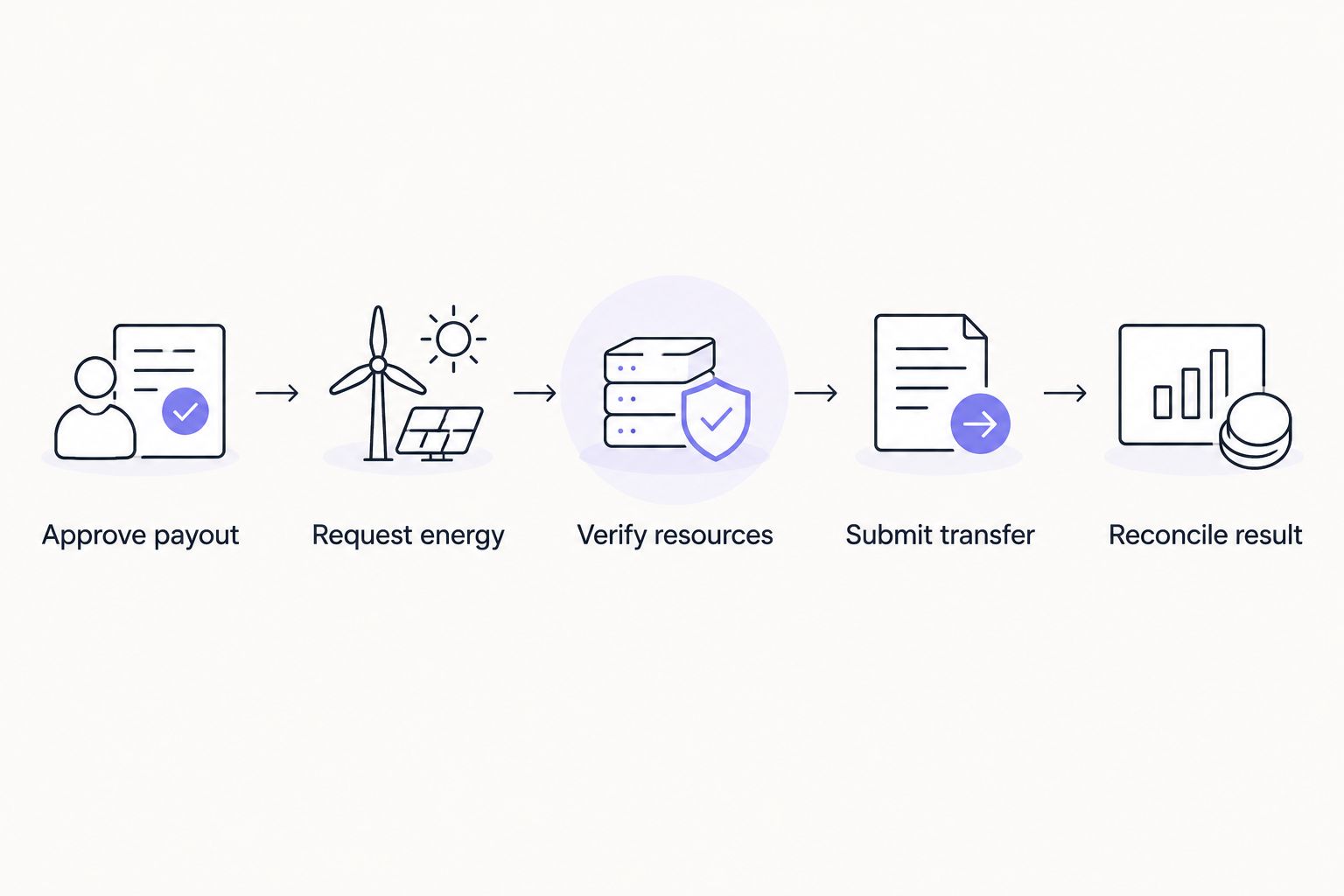
The best rental service cannot repair an unclear payment process. Use the same sequence whether you choose an API, a schedule, a manual interface, or a managed operator.
Approve payout
Confirm the recipient address, network, token, and internal approval. Resource ordering does not establish whether a recipient is eligible or whether the transfer satisfies your applicable obligations.
Request energy
Request resources for the sending address. Estimate the intended transaction's requirements using current network information rather than treating a past transfer as a permanent template.
Verify resources
Check usable energy and bandwidth before submission. Keep the rental order status and the wallet resource check as separate records; they answer different questions.
Submit transfer
Sign through your approved wallet controls and broadcast the transaction. An energy supplier should not need your seed phrase to delegate resources.
Reconcile result
Check the transaction outcome and attach it to the payout record. Blockchain confirmation and recipient access to local currency are different milestones.
Test 3 exception states in your runbook: rejected order, missing delegation, and uncertain transaction outcome. Give each state an owner and an approved next action. These are test scenarios, not estimates of failure frequency.
For an uncertain transaction outcome, inspect the existing transaction before authorizing another transfer. Resource ordering retries and payment retries are not the same action.
How the service models are ranked
This 2026 ranking uses workflow fit, delegation verification, signing separation, failure control, and reconciliation. API-based rental ranks first for an automated remittance application because ordering belongs inside the application's controlled sequence.
Scheduled rental wins its distinct slot when execution happens in batches. Manual rental wins for occasional operator-approved transfers. Managed service wins only when human coordination is the intended operating model and responsibilities are explicit.
This is an operational ranking. It does not rank providers by unverified delivery performance or promise business results. Nbtrx's Telegram business operations tools address a different layer: customer operations and partner workflow.
Which TRON energy rental model should you choose?
Choose API-based rental as the default for automated cross-border payouts. Require an independent wallet resource check before submission, and connect every rental order to a payout record.
Choose scheduled rental when your operation has a defined batch window. Choose manual on-demand rental when transfers are occasional and individually approved. Choose managed service when operator-led coordination is intentional, not a substitute for missing controls.
For your 2026 shortlist, reject any process that treats an order receipt as proof of usable energy. Also reject a delegation request that asks you to disclose a wallet seed phrase. Neither belongs in a controlled payout workflow.
FAQ
What's the best TRON energy rental model for cross-border remittance?
API-based rental is the default recommendation for automated remittance payouts. Scheduled rental fits predictable batches, while manual rental fits occasional operator-approved transfers. Verify delegation before submitting any payout.
Does renting TRON energy cover bandwidth too?
Renting TRON energy does not by itself establish bandwidth coverage. Energy and bandwidth are separate TRON resources. Check both on the sending address before submitting a token transfer.
Should I rent energy for the sender or the recipient?
Rent energy for the address that executes the smart-contract transaction. For a straightforward token transfer, that is the sending address. Do not assume the recipient needs the rental allocation.
Is scheduled rental better than API-based rental?
Scheduled rental is better suited to predictable batch windows, while API-based rental fits application-controlled payouts. Choose according to how payments enter execution. Both models still need a resource check before submission.
Does an accepted rental order prove energy was delivered?
An accepted rental order does not prove usable energy reached the sending address. Check the address's current resources independently. Keep that check separate from the provider's order status.
Does TRON energy rental require my seed phrase?
Energy delegation does not require sharing your wallet seed phrase. Keep signing credentials under your approved wallet controls. Treat requests for those credentials as a reason to stop the process.
Does energy rental complete a cross-border remittance?
Energy rental only addresses part of the blockchain transaction resource requirement. Payment approval, transaction confirmation, applicable compliance checks, reconciliation, and local-currency payout remain separate responsibilities.
Where does Nbtrx fit in a remittance workflow?
Nbtrx provides Telegram business operations tools. Evaluate those tools for customer operations and partner workflow separately from energy rental and wallet signing. Do not treat an operational interface as proof of blockchain resource delivery.
One last thing
The most useful distinction is order state versus payment state. A rental order can be accepted while the sending address still needs verification. A transfer can be submitted while its outcome still needs confirmation.
Keep those states separate in your records and escalation rules. That discipline matters more than whether you place the order through an API or a manual interface.