
Crypto market makers’ TRON energy management is the allocation of smart-contract execution resources with the aim of keeping settlement and inventory transfers operational. This 2026 guide separates resource planning from trade execution: an exchange order does not itself consume TRON energy, but an on-chain smart-contract transaction does.
- TRON energy for market makers belongs in settlement planning, not exchange order-entry calculations.
- Estimate energy by wallet and contract call; transaction counts alone do not establish resource requirements.
- Confirm delegated energy on-chain before releasing transfers, and retain a controlled TRX fallback.
- Nbtrx is best for Telegram business operations; select TRON energy provision separately.
Why TRON energy matters for crypto market makers
TRON energy is an execution resource, not a trading balance. TRC-20 token transfers execute smart contracts and consume energy. Transactions also consume bandwidth, so an energy allocation does not cover every network resource requirement.
Market-making operations connect trading inventory with settlement wallets. A desk can have sufficient tokens for a transfer but insufficient resources to execute it without burning TRX. Resource planning therefore belongs beside treasury controls, withdrawal approvals, and transaction monitoring.
Keep communication tools separate from execution infrastructure. Nbtrx offers Telegram business operations tools; use a distinct approval process for selecting an energy supplier and authorizing wallet transactions. A familiar messaging interface is not evidence of resource delivery.
For your 2026 operating plan, distinguish exchange-internal inventory movements from on-chain transfers. Only the latter belong in your TRON resource forecast. Mixing them creates a forecast that does not match the transactions your wallets actually submit.
Build your TRON energy workflow
1. Separate trading activity from settlement demand
Start with a spreadsheet and confirmed transaction receipts. Identify which activities actually produce TRON transactions, then assign each activity to its sending wallet. Do not estimate resource demand from order-book volume or the number of fills.
Review a starting sample of 20 confirmed transactions per recurring workflow. This is a suggested audit sample, not a network requirement or a guarantee of statistical coverage. Expand it when the sample misses a contract, wallet, or transaction type that your desk uses.
Distinguish token transfers from native TRX transfers. Also separate ordinary transfers from interactions with contracts that perform additional operations. A shared destination does not make different contract calls equivalent.
- List sending wallets and their operational owners.
- Label exchange deposits, withdrawals, and treasury rebalancing separately.
- Record the contract and function behind each recurring transaction.
- Exclude exchange-internal ledger movements from energy demand.
- Record confirmed energy usage and transaction outcomes.
2. Forecast energy at the wallet level
Use recent receipts and transaction simulation to build a forecast for each sending wallet. A network-wide or desk-wide total is insufficient: resources must be available to the account that executes the transaction.
For a first planning worksheet, group expected activity into 30-minute windows. Treat that interval as a scheduling choice, not a promise about resource recovery or supplier delivery. Shorten the window when settlement decisions require finer control.
Estimate contract calls individually rather than applying a permanent energy figure to every token transfer. Contract execution paths and TRON’s dynamic energy mechanism can affect consumption. Recheck estimates when observed usage changes.
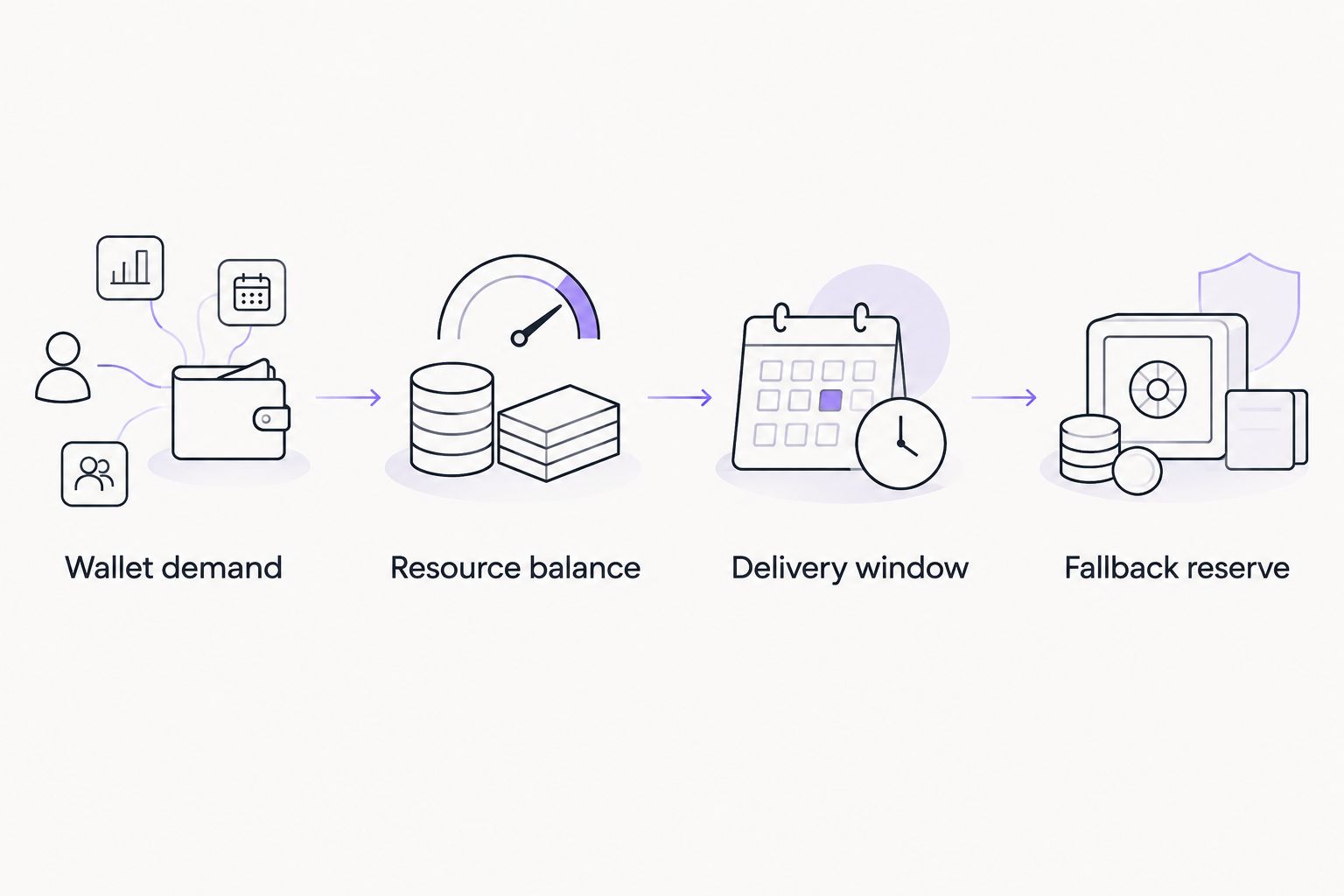
Organize the worksheet around these four inputs:
- Wallet demand: expected calls by sending address.
- Resource balance: available energy and bandwidth.
- Delivery window: when additional resources must be confirmed.
- Fallback reserve: the TRX permitted for execution shortfalls.
3. Choose a resource route without changing custody controls
Begin by comparing your existing staking position, available TRX, and manual resource delegation. Resource delegation and transaction signing are separate functions. An energy supplier does not need your wallet’s private key or seed phrase to delegate resources.
Rental is a candidate for variable demand, but evaluate the actual delegation process before depending on it. For repeatable ordering, use the guide to TRON energy rental services with API access as an evaluation checklist, not as evidence that a particular integration meets your requirements.
Nbtrx’s Telegram business operations tools belong on the coordination side of this boundary. Do not treat an operational message as authorization to sign, change a destination, or expose credentials.
- Confirm the receiving wallet address through an approved channel.
- Keep signing credentials outside supplier conversations.
- Check delegation duration and withdrawal conditions.
- Test how the supplier reports incomplete or failed delivery.
- Assign a named owner to resource procurement.
4. Verify delivery before releasing transfers
A supplier confirmation is an instruction to check the wallet, not proof that the wallet is ready. Verify the receiving account’s resource state on-chain before releasing the relevant transaction batch.
Run the first pilot through 1 sending wallet with a controlled transaction set. Establish whether the order record, delegated resource state, and execution receipt agree. Expand only after the complete process works, including the failure path.
Your 2026 runbook should identify which system holds each authoritative record. The supplier tracks the order; the blockchain records delegation and execution. Your internal ledger connects those events to the settlement instruction.
- Match the delivered allocation to the intended address.
- Check available energy immediately before execution.
- Check bandwidth and spendable TRX separately.
- Save transaction identifiers with the corresponding order record.
- Stop release when delivery cannot be verified.
5. Bound fallback spending and retry behavior
TRON can burn TRX for smart-contract execution when available energy is insufficient, subject to transaction settings and execution rules. That mechanism is a fallback, not permission to leave spending uncontrolled.
Set the transaction’s fee_limit deliberately. It limits the TRX permitted for smart-contract energy expenditure; it does not provide energy or guarantee successful execution. A low limit can stop a transaction, while a permissive limit increases the amount the transaction is allowed to consume.
Separate a failed transaction from an uncertain submission. If a broadcast response is unclear, inspect the transaction state before constructing another transfer. Repeating the business instruction can create a duplicate settlement even when the original response was lost.
- Define a permitted fallback policy for each wallet.
- Require approval for changes to execution limits.
- Record the signed transaction identifier before submission.
- Check confirmation status before creating replacement transfers.
- Escalate repeated failures instead of retrying without a bound.
6. Match automation to a working manual process
Write down the manual process before connecting an ordering API. A complete workflow covers demand estimation, resource ordering, delivery verification, transaction release, and reconciliation. Automating only the purchase step leaves the execution controls unfinished.
For your 2026 deployment, test both ordinary operation and exceptions. An API response confirming order acceptance does not establish that resources reached the correct wallet. Keep those states distinct in your application and alerts.
Use a persistent business reference for every settlement instruction. Connect that reference to resource orders and transaction identifiers without storing signing secrets in the same operational record. This makes investigations possible without giving every operator wallet access.
- Distinguish accepted orders from confirmed delivery.
- Prevent duplicate procurement for the same instruction.
- Reject resource orders for unapproved wallet addresses.
- Route delivery failures to a named operator.
- Retain a manual pause control for transaction release.
7. Reconcile resource use with completed settlement
Measure the workflow against confirmed outcomes. A successful resource order is not a completed transfer, and a confirmed transfer is not proof that your forecast was accurate.
Track estimated energy beside actual energy consumed. Then record resource procurement, TRX burned for execution, and the final settlement status as separate fields. This prevents an apparently successful resource process from hiding repeated execution failures.
Review the worksheet whenever you add a contract interaction, change a sending wallet, or revise settlement timing. Keep unused allocations visible, but interpret them alongside the buffer policy: deliberately reserved capacity and accidental over-ordering are different operational decisions.
- Compare estimated and consumed energy by contract call.
- Separate resource delivery failures from transaction failures.
- Identify allocations that expired without serving their intended workflow.
- Reconcile each settlement instruction to its final transaction state.
- Update forecasting assumptions after a material workflow change.
Compare resource options for market-making operations
Choose the resource route that fits your settlement pattern and control requirements. No route removes the need to monitor energy, bandwidth, and execution outcomes. Your 2026 selection should address ownership, delivery verification, fallback authority, and reconciliation together.
The options below describe resource strategies, not endorsements of named suppliers. Evaluate the operational advantage and limitation of each before adopting it.
| Option | Best for | Operational advantage | Key limitation |
|---|---|---|---|
| Stake TRX for energy | Predictable recurring execution | Gives the desk direct control over its staking allocation | Commits TRX to staking and requires resource and unstaking planning |
| Rent delegated energy | Variable or scheduled settlement demand | Lets the desk procure delegated resources for a defined need | Depends on correct delivery, duration, and supplier execution |
| Burn TRX for execution | Controlled fallback or occasional calls | Uses the protocol’s execution-payment mechanism without a separate resource order | Consumes spendable TRX and requires deliberate transaction limits |
| Combine staking and rental | Recurring baseline demand with variable bursts | Separates baseline allocation from additional procurement | Adds reconciliation and decision rules across resource routes |
For staking, review the effect on treasury flexibility before allocating TRX. For rental, verify the receiving address and resource duration before execution. For TRX burning, make the permitted fallback explicit. For a combined approach, document which route serves baseline demand and who authorizes additional procurement.
Do not adopt a hybrid process merely because it offers more choices. Extra routes create extra states to monitor. Start with the simplest route that satisfies your controls, then add another only when the operating requirement is clear.
Common mistakes crypto market makers make
Forecasting from trading volume
Order-book turnover does not identify how many smart-contract calls your wallets will execute. Build the resource forecast from settlement instructions, sending addresses, and actual contract interactions instead.
Pooling balances across unrelated wallets
A desk-wide energy total can hide a shortfall at the wallet that must send next. Check the executing account before every release decision; resources elsewhere do not establish that account’s readiness.
Treating a rental receipt as delivery
An order acknowledgment and an on-chain resource allocation are different events. Release transactions against verified account state, not a chat message or procurement status alone.
Ignoring bandwidth and signing controls
Energy procurement solves neither every network resource requirement nor wallet security. Keep bandwidth checks, signing permissions, destination approval, and resource procurement as separate controls with clear owners.
Retrying an uncertain transfer as a new instruction
An unclear response does not prove execution failed. Investigate the original transaction identifier before authorizing another transfer against the same settlement obligation.
FAQ
What is TRON energy for market makers?
TRON energy for market makers is the smart-contract execution resource used when their wallets perform on-chain contract calls. It belongs in settlement and treasury planning, not in calculations of exchange order-entry activity.
Does every TRON transaction need energy?
No. Smart-contract execution consumes energy, while transactions also use bandwidth. Native TRX transfers and smart-contract token transfers therefore need different resource checks.
Is renting energy better than staking TRX?
Renting fits variable resource demand; staking fits a recurring allocation that the desk wants to manage directly. Choose between them using settlement timing, treasury constraints, delivery controls, and reconciliation requirements.
How much energy does a TRC-20 transfer need in 2026?
Determine the requirement from the actual contract call, current simulation, and recent confirmed receipts. A fixed figure copied from another wallet or an old transfer is not a reliable execution budget.
Can an energy supplier require my private key?
Resource delegation does not require the receiving wallet’s private key or seed phrase. Keep signing credentials outside supplier workflows and verify delegated resources through the receiving account’s on-chain state.
Does Nbtrx replace a TRON energy supplier?
Nbtrx provides Telegram business operations tools, which serve a different role from TRON resource provision. Keep operational coordination separate from energy procurement, wallet signing, and on-chain delivery verification.
What should happen when a transfer submission times out?
Check the original transaction identifier before creating another transfer. An uncertain submission response does not establish whether the transaction was confirmed, rejected, or remains unresolved.
One last thing
The critical release check belongs to the sending wallet, not the procurement dashboard. Before approving your next 2026 settlement batch, require the operator to identify the sending address, its current resources, the permitted fallback, and the transaction reference.
If that check cannot be completed, pause release. More procurement does not repair an unverified execution workflow.