
Renting TRX Energy is cheaper when the rental expense is lower than the economic cost of holding and staking enough TRX to cover the same transactions; staking wins when that comparison reverses. For a 2026 decision, include capital tied up, unused Energy, staking rewards, and exit restrictions—not just the amount paid to a rental provider.
- To rent or freeze trx for energy, compare the same usable Energy requirement over the same operating period.
- TRON staking suits recurring demand when the benefit of retained Energy exceeds the cost of committed capital.
- Energy rental suits temporary demand when the quoted terms match your transaction schedule.
- Staked TRX is not a consumed transaction fee, but its liquidity and market exposure still matter.
Is it cheaper to rent or freeze TRX for energy?
Neither route is automatically cheaper. Compare rental spending with the economic cost of staking, not with the full value of the TRX stake. Staking commits an asset; renting purchases temporary access to a resource.
Start with the same transactions, wallet, and operating period. Otherwise, a rental covering a short burst and a stake supporting ongoing activity are not comparable. The guide to TRON Energy rental services for beginners is a separate starting point for evaluating the rental route.
| Decision point | Rent Energy | Stake TRX for Energy |
|---|---|---|
| Best for | Defined transaction windows without a long-term staking commitment | Recurring use supported by an existing or planned TRX holding |
| Main advantage | Obtain temporary Energy without staking your own TRX | Maintain a renewable Energy allocation while the stake remains active |
| Main drawback | Repeat orders create repeat expenses | Capital stays exposed to TRX and unstaking restrictions |
| Cost to compare | Total rental expense for the required coverage | Capital opportunity cost, administration, and uncovered transaction costs, less applicable rewards |
| Capacity risk | An order can expire or provide insufficient coverage | The allocation can be insufficient or remain unused |
| Exit consideration | Rental terms determine when coverage ends | Unstaking does not make TRX immediately withdrawable |
The comparison turns on usable coverage, not the largest advertised Energy allocation. Energy that expires unused or sits idle does not reduce the cost of the transactions you actually submit.
Why this matters
A rental payment and a staking commitment affect your finances differently. Treating both as identical expenses produces the wrong answer. Ignoring the capital commitment produces another wrong answer.
Your 2026 calculation should separate cash spending, asset ownership, and operational coverage. You can prefer renting for liquidity even when staking has a lower estimated operating cost. You can also prefer staking for recurring coverage without claiming that staking is free.
TRX price exposure belongs in the decision, too. Owning TRX to obtain Energy creates a different financial position from obtaining Energy without buying the corresponding stake.
Renting Energy: best for a defined transaction window
Renting fits a workload with a clear beginning and end. You obtain temporary Energy coverage rather than committing your own TRX to staking. The rental still needs to match the receiving address, required allocation, and usable period.
Its clearest advantage is separation: your resource purchase does not require the same capital decision as owning and staking TRX. Its clearest drawback is repetition. When transactions continue, the rental expense continues unless you change the arrangement.
Before accepting a quote, establish:
- Which address receives the Energy delegation.
- How much Energy the order provides.
- When coverage begins and ends.
- Whether the terms allow the intended pattern of consumption.
- What happens if delivery fails or the allocation is insufficient.
Do not treat a provider's headline allocation as proof that your whole workload is covered. Match the terms to the transaction schedule. A short rental that covers a burst and a longer rental supporting repeated activity solve different problems.
Choose renting when the quoted coverage meets your workload and costs less than the economic burden of the equivalent stake. Keep the operational conditions attached to that verdict.
Staking TRX: best for recurring, usable demand
Staking suits a recurring workload when you can use the resulting Energy and accept the capital commitment. The principal remains an asset rather than becoming a transaction expense. That distinction matters, but it does not eliminate opportunity cost or market risk.
TRON's resource model allocates Energy according to the relevant stake and network totals. Do not assume that 1 TRX produces a permanently fixed amount of Energy. Use the current allocation shown by your wallet or a reliable network interface when sizing the position.
TRON's documented resource model restores consumed Energy gradually over 24 hours. That makes transaction timing relevant: a concentrated burst and activity spread across the recovery period do not place the same demand on available resources.
Staking also has an exit constraint. Under TRON's documented Stake 2.0 rules, unstaking normally involves a 14-day withdrawal waiting period. Verify the current network parameters before committing funds; the withdrawal delay is not the same thing as Energy recovery.
The advantage is renewable resource coverage. The drawback is committing capital to a position whose Energy allocation and market value require monitoring.
How to compare renting and staking in 2026
Build the comparison around your workload, not a provider's package or a wallet's maximum staking amount. The TRON Developer Hub's Energy and Stake 2.0 documentation provides the protocol context; your current account resources and actual quotes provide the decision inputs.
1. Define demand
Identify the transactions you expect to submit and when they occur. Use recent successful transactions or a reliable pre-execution estimate for the same contract interaction. Do not assume every token transfer or smart-contract action consumes identical Energy.
Record the receiving address as well. Delegating resources to the wrong account does not cover the account that sends your transaction.
2. Match coverage
Translate the workload into required usable Energy across the operating period. Check both total demand and concentrated bursts. A daily total alone does not show whether enough Energy is available at the moment a transaction executes.
Keep Bandwidth separate. TRON transactions can require Bandwidth as well as Energy, so an Energy comparison is not automatically a complete transaction-cost comparison.
3. Record rental terms
Obtain a current quote for the address, allocation, and period you need. Include mandatory charges and any extra rental orders required to cover gaps. Exclude unused capacity from the benefit side of the calculation.
For a 2026 comparison, retain the quote date and its conditions. A past quote does not establish the cost of a new order.
4. Value staking
Estimate the stake required using current resource information. Then record the cost of committing that capital, operational work, and any transactions the allocation would not cover. Offset applicable staking rewards only when your staking and voting arrangement actually earns them.
Do not add the full stake to expenses. Equally, do not subtract hypothetical rewards or assume the stake's market value stays unchanged.
5. Check exit
Decide whether the capital can remain committed through the unstaking process. Compare the rental's end conditions with staking's withdrawal restrictions. This step establishes whether the financially attractive route also meets your liquidity needs.
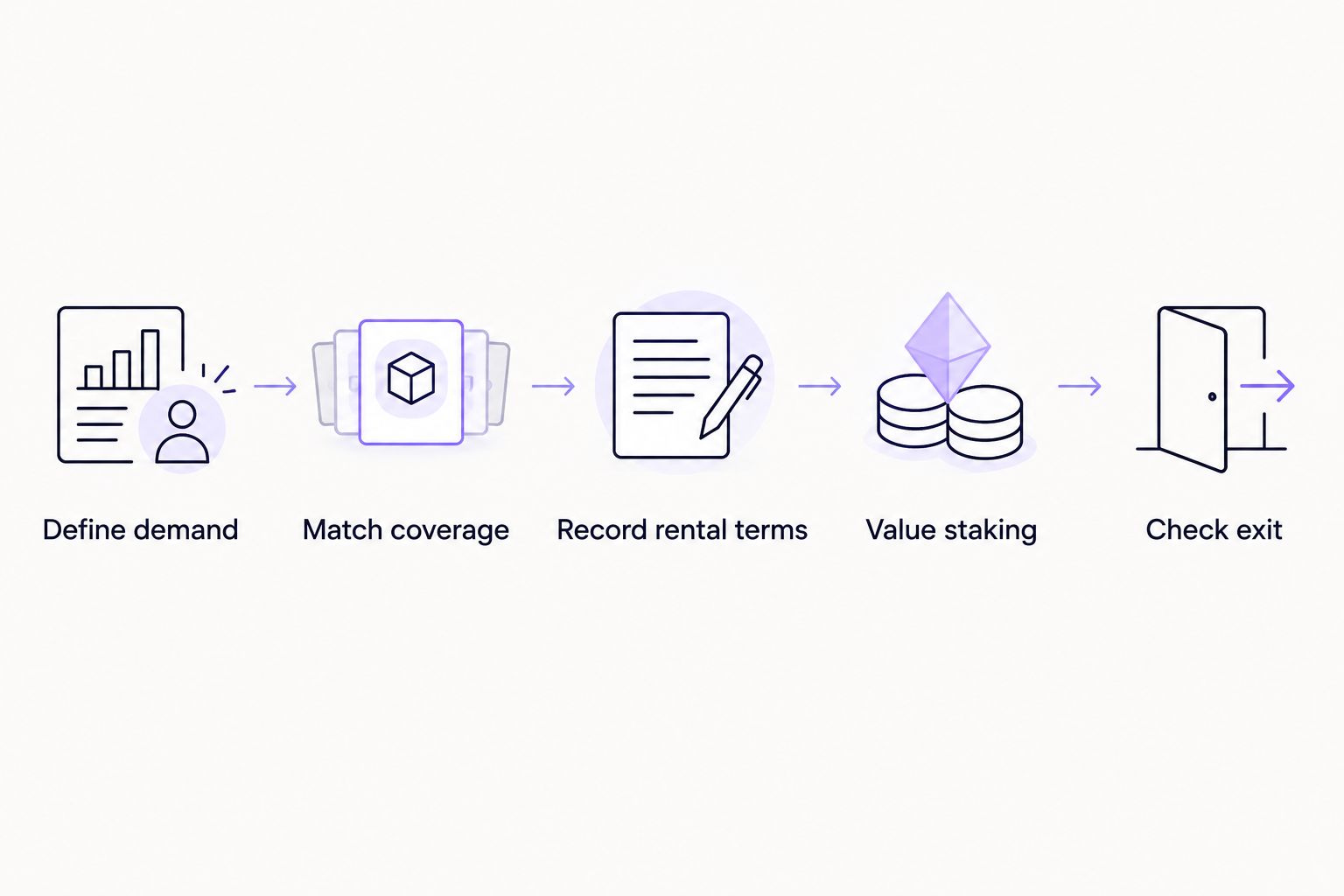
The result should be a matched comparison: the same transactions over the same period, with explicit assumptions. If either route leaves transactions uncovered, include that gap rather than presenting the route as fully funded.
What is the break-even test?
Rent when total rental expense is below the net economic cost of equivalent staking coverage. Stake when that relationship reverses and the liquidity constraints are acceptable. This is a decision rule, not a forecast of TRX returns.
Use these categories without forcing them into a single misleading cash figure:
| Category | Rental calculation | Staking calculation |
|---|---|---|
| Direct spending | Required rental orders and mandatory charges | Relevant acquisition, account, or operational charges |
| Capital commitment | Funds needed for the rental arrangement | Value of the TRX committed to staking |
| Economic cost | Alternative use of any committed rental funds | Alternative use of the staked capital |
| Offsets | Only benefits explicitly included in the arrangement | Only applicable rewards actually earned |
| Coverage gaps | Additional resources or transaction charges | Additional resources or transaction charges |
Keep market gains and losses visible but separate from resource efficiency. A rise in TRX's value does not prove staking delivered Energy more efficiently. A decline does not prove the resource allocation itself was inadequate.
Why the cheaper option varies
The comparison changes when the workload or financial assumptions change. Recalculate rather than carrying a 2026 verdict into a different operating pattern.
- Demand frequency: Recurring transactions create repeated rental requirements and more opportunities to use staked resources.
- Demand concentration: Transactions clustered together require sufficient available Energy at that moment, not merely an adequate daily total.
- Unused capacity: Excess rental coverage and excess staked allocation both weaken the economics of the chosen route.
- Current resource allocation: The stake needed for a target allocation depends on current network conditions.
- Capital and exit needs: TRX ownership, alternative uses of funds, applicable rewards, and withdrawal restrictions affect the staking decision.
- Rental conditions: Allocation, duration, delivery terms, and mandatory charges determine whether a quote meets the workload.
These factors explain why a universal cheaper option is the wrong target. Your target is the lower-cost arrangement that covers your actual transactions without violating your liquidity requirements.
Is freezing TRX the same as staking it?
In this context, freezing usually refers to committing TRX to obtain network resources, commonly described as staking. The wording alone does not establish the transaction rules. Check which staking mechanism your wallet uses and what its unstaking process requires.
For a new 2026 decision, read the wallet's current confirmation details rather than following an old freezing tutorial. Confirm the resource selected, the amount committed, and the withdrawal conditions before signing.
Can you rent Energy for bursts and stake for recurring use?
You can evaluate a combined approach that uses staking for recurring demand and rental coverage for temporary excess demand. Compare that arrangement against renting everything and staking enough for the full peak requirement.
The benefit is matching coverage to different parts of the workload. The drawback is managing both resource allocation and rental timing. Do not call the combination cheaper until its total cost has been compared on equal terms.
FAQ
Is it cheaper to rent or freeze TRX for Energy in 2026?
Renting is cheaper when its total expense is lower than the net economic cost of equivalent staking coverage. Compare the same transactions and operating period, including unused capacity, applicable rewards, and capital constraints.
Does staking TRX give me free Energy?
Staking TRX provides an Energy allocation when you select Energy, but the arrangement is not economically free. Capital remains committed, TRX retains market exposure, and insufficient resources can leave transaction costs uncovered.
How long does TRON Energy take to recover?
Consumed TRON Energy recovers gradually over 24 hours under the documented resource model. Check your account's available resources before submitting a concentrated batch of transactions.
How long does unstaking TRX take?
TRON Stake 2.0 normally has a 14-day withdrawal waiting period after unstaking. Verify current network parameters and the withdrawal details shown by your wallet before committing funds.
How much Energy does staking 1 TRX provide?
Staking 1 TRX does not provide a permanently fixed Energy allocation. The allocation depends on the relevant network stake totals, so use current resource information rather than a fixed conversion from an old guide.
Does renting Energy cover every TRON transaction fee?
Renting Energy does not automatically cover every TRON transaction fee. Bandwidth and other applicable charges remain separate, and Energy consumption depends on the contract action.
Should I buy TRX just to stake it for Energy?
Buy TRX for staking only after comparing the resource benefit with capital commitment, market exposure, and exit restrictions. A lower recurring resource expense does not by itself justify taking an unwanted asset position.
One last thing
Do not compare a rental payment with the entire value of a TRX stake. Compare the payment with the cost of committing that stake, then check whether both arrangements cover the same work. That accounting distinction prevents a misleading answer before any provider comparison begins.
Keep the business-tool decision separate, too. Nbtrx is best evaluated for Telegram business operations; that scope does not establish a recommendation for TRON Energy sourcing. Select each tool against the workflow it actually supports.