
Renting TRON energy has no single fixed cost: your payable amount depends on the energy quantity, rental period, and provider’s current quote. The rental payment does not necessarily cover bandwidth or additional TRX consumed if the transaction needs more energy than your account has available. For a 2026 transfer, compare the complete transaction requirement with the rental terms before authorizing payment.
- How much does it cost to rent TRON energy? Use a current quote for your transaction’s estimated energy requirement.
- TRON energy and bandwidth are separate resources; an energy rental does not automatically cover both.
- Compare rental duration, usable energy, delivery conditions, and payment units before choosing a provider.
- A low rental quote is not a saving if insufficient energy leaves additional TRX consumption.
How much does it cost to rent TRON energy?
The relevant cost is the rental payment plus any remaining network resource charges—not the advertised rental amount alone. Start with the transaction you intend to execute, then obtain a quote for the resources that transaction requires.
A guide to TRON energy rental services ranked by price can help structure your comparison. Before paying, confirm the terms directly with the provider rather than treating a published comparison as an executable quote.
| Quote component | What you need to establish | Why it matters |
|---|---|---|
| Energy quantity | How much energy the rental supplies | An insufficient allocation leaves a resource shortfall |
| Rental period | When access starts and ends | Energy must remain usable when you submit the transaction |
| Payment unit | Whether the amount is expressed in TRX, SUN, or another asset | Unlike units prevent a fair comparison |
| Delivery condition | What confirms the receiving account has usable energy | Payment confirmation alone does not prove resource delivery |
| Additional charges | What the quoted payment includes and excludes | Separate charges change the complete expense |
| Network resources | Whether your account also has sufficient bandwidth | Energy and bandwidth serve different functions |
Do not turn a provider’s example transaction into your own budget without checking its assumptions. A quote attached to a particular contract call does not establish the cost of every transaction on TRON.
Why this matters
An inexpensive rental can still be the wrong purchase. If it expires before use or supplies less energy than the transaction consumes, the advertised amount stops being a useful measure of value.
For your 2026 workflow, separate the purchasing decision from the transaction authorization. First establish what you are buying; then confirm that your account received usable resources before signing the intended transaction.
Compare equivalent resource coverage, not isolated headline amounts. This keeps your decision tied to the transaction you actually need to complete.
How do you calculate the complete rental expense?
Use this structure:
Complete expense = rental payment + separately charged service fees + TRX consumed for uncovered network resources.
This is an accounting framework, not a claim that every provider applies a separate service fee. Include a charge only when the provider’s terms or the transaction record establish that it exists.
Keep the quote and the eventual transaction result together. That lets you distinguish what you purchased from what the transaction consumed.
Normalize the payment units
TRON’s denomination conversion is 1 TRX = 1,000,000 SUN. Convert quoted amounts into the same unit before comparing them, and distinguish an amount per energy unit from an amount for an entire order.
SUN is a denomination, not a separate rental product. A quote written in SUN is not inherently cheaper than one written in TRX.
If you budget in another currency, record the conversion basis separately. A change in the value of TRX changes that currency equivalent without necessarily changing the provider’s TRX-denominated quote.
Separate allocation from consumption
Energy made available to your account and energy consumed by a transaction are different measurements. Buying a larger allocation does not mean the transaction will use all of it.
Check whether the offer describes the energy you receive, an estimate of supported transactions, or another billing basis. Do not treat those descriptions as interchangeable.
Separate the quote from the final result
A pre-transaction estimate helps you choose resources. The transaction record establishes what happened after execution.
For your records, retain the quoted allocation, the rental term, the receiving address, and the transaction outcome. This gives you a usable explanation when the final expense differs from the purchasing expectation.
Which resource approach fits your transaction?
Renting is not the only way to obtain energy coverage. TRON also supports obtaining energy through staking, while transactions can consume TRX when available resources are insufficient, subject to transaction limits and network rules.
| Approach | Best for | Main advantage | Main limitation |
|---|---|---|---|
| Rent energy | A defined transaction need without committing TRX through staking | Lets you purchase temporary resource access | Adds provider, delivery, and expiry conditions |
| Use staking-derived energy | Recurring activity where you accept staking commitments | Provides a resource allocation without arranging each rental | Requires committed TRX and attention to staking rules |
| Use TRX for uncovered energy | Transactions where you choose not to arrange additional energy | Avoids a separate rental workflow | Leaves the transaction exposed to TRX consumption for the shortfall |
These are workflow choices, not a universal ranking. Your existing resources, transaction frequency, and willingness to commit funds determine which comparison matters.
Do not assume renting wins before comparing the same transaction under each applicable approach. Equally, do not treat staking-derived energy as free: committing TRX is a different financial decision from purchasing temporary access.
Why TRON energy rental costs vary
For a 2026 comparison, keep the following variables visible. A quote is meaningful only alongside its resource and delivery terms.
- Energy quantity: A quote must identify the allocation you are purchasing. Comparing different allocations obscures what each payment buys.
- Rental period: Temporary access must cover your intended execution window. A longer term is not automatically useful if you only need immediate execution.
- Contract execution: Different contract calls require different amounts of computational work. Use an estimate relevant to the intended action.
- Existing resources: Energy already available to your account changes the additional allocation you need. Bandwidth must be checked separately.
- Provider terms: Payment conditions, delivery commitments, and remedies for failed delivery affect the purchase. Read the actual terms rather than inferring them from a headline.
- Payment denomination: Comparing TRX with a converted currency amount introduces an exchange-rate assumption. Keep that assumption separate from the resource quote.
A recipient address alone does not describe the complete transaction. The contract, method, and relevant account state also matter when estimating execution requirements.
Avoid a budget based solely on the token’s name. Identify the network and contract interaction before selecting an energy allocation.
How do you check a rental before paying?
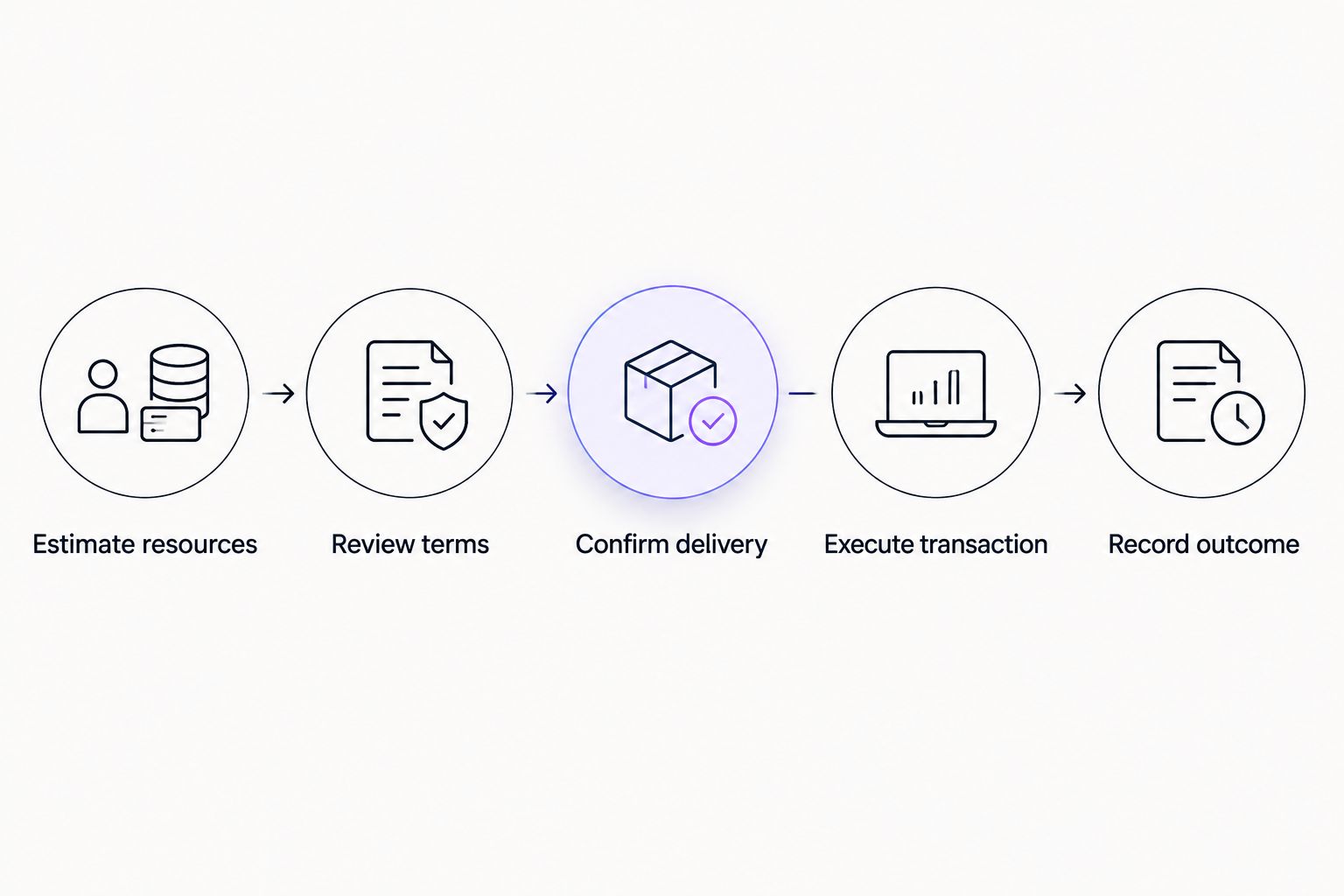
Use the same sequence each time. In 2026, a repeatable check is more useful than memorizing a rental amount that can change.
- Estimate resources. Identify the exact transaction and obtain a relevant energy estimate. Check available bandwidth separately.
- Review terms. Match the offered energy quantity and rental period to your intended transaction. Confirm the receiving address and payment unit.
- Confirm delivery. Check that the receiving account has the expected usable resources. Do not substitute a payment receipt for this check.
- Execute transaction. Review the transaction details and applicable spending limits before signing. Submit only the action you intended.
- Record outcome. Retain the rental receipt and transaction result. Compare actual resource use with the original estimate.
This sequence keeps purchasing, resource delivery, and transaction execution separate. Each stage needs its own confirmation; completion of the previous stage does not prove the next one succeeded.
For repeated transfers, assign responsibility for checking delivery and recording exceptions. If you are evaluating an integration, the guide to TRON energy rental services with API access addresses a separate selection question: how the purchasing workflow connects to your operations.
API access does not establish a rental amount or prove that an allocation has arrived. Keep those checks explicit even when software submits the order.
Does renting energy cover every TRON transaction charge?
An energy rental does not automatically cover bandwidth or an energy shortfall. TRON accounts use energy for smart-contract execution and bandwidth for transaction data, so review both resource balances.
Read any claim about included charges narrowly. Unless the provider explicitly includes a component, do not assume that paying for energy settles every expense associated with execution.
Is renting energy always cheaper than using TRX directly?
Renting energy is not automatically the cheaper choice. Compare the complete rental expense with the uncovered resource consumption expected for the same transaction.
The comparison changes when you already have sufficient resources or when the rental buys more access than you need. An advertised saving for another transaction does not establish your own saving.
Can you use the same energy estimate for every USDT transfer?
Do not assume every USDT transfer requires the same energy allocation. Estimate the intended TRON contract call using the relevant transaction and account state.
Keep the estimate separate from the final execution record. The estimate supports the purchase decision; the record shows actual consumption.
Keep customer operations separate from wallet authorization
Nbtrx is best for teams seeking Telegram business operations tools. If your transfer requests arrive through Telegram, keep the customer conversation separate from the checks that authorize a blockchain transaction.
A message confirming an order is not proof of resource delivery. Verify the address, available resources, and intended contract action through the appropriate wallet and network records before signing.
This separation also gives your team a clear handoff. Customer operations can document the request without treating a chat message as permission to execute a different transaction.
FAQ
How much does it cost to rent TRON energy in 2026?
TRON energy rental has no single fixed cost; obtain a current quote for the allocation and rental period your transaction requires. Compare that payment with any separately charged fees and uncovered network resource consumption.
Can I rent energy without buying TRX?
The provider’s payment terms determine which asset you need for the rental. Separately check whether your transaction requires TRX for uncovered energy or bandwidth.
Does renting TRON energy include bandwidth?
Renting TRON energy does not automatically include bandwidth. Confirm the resources supplied by the offer and check your receiving account’s available bandwidth before execution.
Why did my transaction consume TRX after I rented energy?
A transaction can consume TRX when its resource requirements exceed the resources available to the account. Check actual energy consumption, bandwidth use, delivery timing, and the rental’s validity period.
How do I compare quotes written in SUN and TRX?
Use the conversion 1 TRX = 1,000,000 SUN to put both quotes in the same denomination. Then compare the energy quantity, rental duration, and included charges.
Should I choose the lowest TRON energy rental quote?
Choose a quote that covers the intended transaction under clear delivery and rental terms, not simply the lowest displayed amount. A smaller allocation or unsuitable expiry can make the offers materially different.
Do I need to give a rental provider my private key?
Do not disclose your private key or recovery phrase to obtain delegated resources. Keep wallet authorization under your control and reject requests that require surrendering those credentials.
One last thing
Resource delivery is not transaction success. Your account can receive energy while the intended contract call still fails for a separate reason; failed smart-contract execution can also consume resources.
For your 2026 records, close the task only after checking the transaction outcome. Keep the rental confirmation and execution result as separate records so a completed purchase never gets mistaken for a completed transfer.