
Choose how much TRON Energy to rent by estimating the Energy required for your planned contract calls, subtracting the sending wallet’s usable Energy, and covering the remaining requirement for the period when those calls will execute. Energy does not replace Bandwidth, and an insufficient Energy balance can still lead to TRX being burned or a transaction failing under its execution limits.
- How to choose how much TRON Energy to rent: estimate contract execution, subtract usable Energy, and match the rental duration.
- TRON Energy requirements depend on contract execution, not simply the amount of USDT you send.
- Use current transaction estimates rather than treating a previous transfer’s Energy consumption as a permanent requirement.
- Verify delegated resources on the sending wallet before submitting the transaction.
How do you choose how much TRON Energy to rent?
Rent against the sending wallet’s current resource shortfall, not a standard package or the token amount being transferred. For your 2026 workflow, use this calculation:
Energy to rent = estimated execution requirement + justified contingency − usable Energy already available.
Treat a negative result as no additional Energy requirement for that planned execution. Separately check Bandwidth and any applicable transaction fees. The guide to calculating how much TRON Energy you need explains the resource-planning side of this decision.
- Identify the operation. Record the sending address, contract address, method, recipient, and transaction parameters.
- Estimate execution. Use a wallet simulation or node estimate for that actual call, with current chain state.
- Check usable Energy. Read the sending wallet’s available resources rather than its TRX balance alone.
- Calculate the shortfall. Subtract usable Energy from the planned requirement. Add contingency only when you can explain the uncertainty it covers.
- Match the duration. Make sure the delegation remains effective while the transaction or batch executes.
- Verify delivery. Confirm the resources on the sending address before broadcasting.
The calculation is straightforward. The difficult part is keeping its inputs aligned with the transaction you actually submit.
Why this matters
A rental quantity is a resource decision, not a transfer-value decision. Sending more USDT does not create a proportional increase in Energy consumption: the contract’s execution path determines the work performed.
Over-renting leaves you with resources your planned workflow does not need. Under-renting exposes the transaction to TRX consumption or execution failure, depending on the wallet’s resources and transaction settings. Neither outcome is fixed by choosing a package based only on the payment amount.
For a 2026 operating checklist, keep the resource estimate beside the transaction details. A number copied into a chat without its sending address, contract, and execution window is not a complete instruction.
Match the rental to your transaction pattern
Choose a sizing method before choosing an amount. A single payment, a payout batch, and mixed contract calls need different planning assumptions.
| Transaction pattern | Best for | Sizing method | Advantage | Limitation |
|---|---|---|---|---|
| Single-call estimate | A single planned contract interaction | Estimate the exact call, then subtract usable Energy | Closely matches the immediate task | The estimate becomes stale if parameters or chain state change |
| Batch estimate | A defined group of outgoing transactions | Estimate the calls and account for shared wallet resources | Makes the total requirement explicit | Concurrent transactions can consume the same available balance |
| Rolling reassessment | An ongoing queue with changing requests | Recheck resources and upcoming calls before each rental decision | Adjusts to actual consumption | Requires monitoring and reliable execution controls |
Single-call estimate: use the actual transaction
For an isolated transfer, estimate the intended contract call from the actual sending address. Keep the recipient and transfer parameters unchanged between estimation and submission.
The advantage is precision around a specific operation. The limitation is freshness: an estimate describes execution against the state used for that estimate, not every possible future state.
Best for: a defined transaction you are ready to submit. Re-estimate when the recipient, contract method, or other material parameters change.
Batch estimate: account for shared resources
For a payout batch, calculate the combined requirement of the planned calls. Do not multiply an old transfer’s consumption across a batch unless you have established that the calls follow comparable execution paths.
Subtract the wallet’s usable Energy from the batch requirement once. Subtracting that same balance separately from every transfer makes the resources appear available repeatedly, even though the transactions share the wallet.
Best for: a known queue with controlled execution. Its limitation is coordination: another process using the same wallet can invalidate your calculation before the queue finishes.
Rolling reassessment: size against the next workload
For changing workloads, check the next planned calls and the wallet’s current resources together. Recalculate after execution instead of assuming the opening balance still applies.
This approach follows actual consumption. Its cost is operational complexity: your workflow must distinguish an estimate, a rental request, confirmed delegation, and a completed transaction.
Best for: ongoing transaction operations with monitoring. Do not treat an order acknowledgement as proof that the wallet already has usable Energy.
Build a rental decision from current wallet state
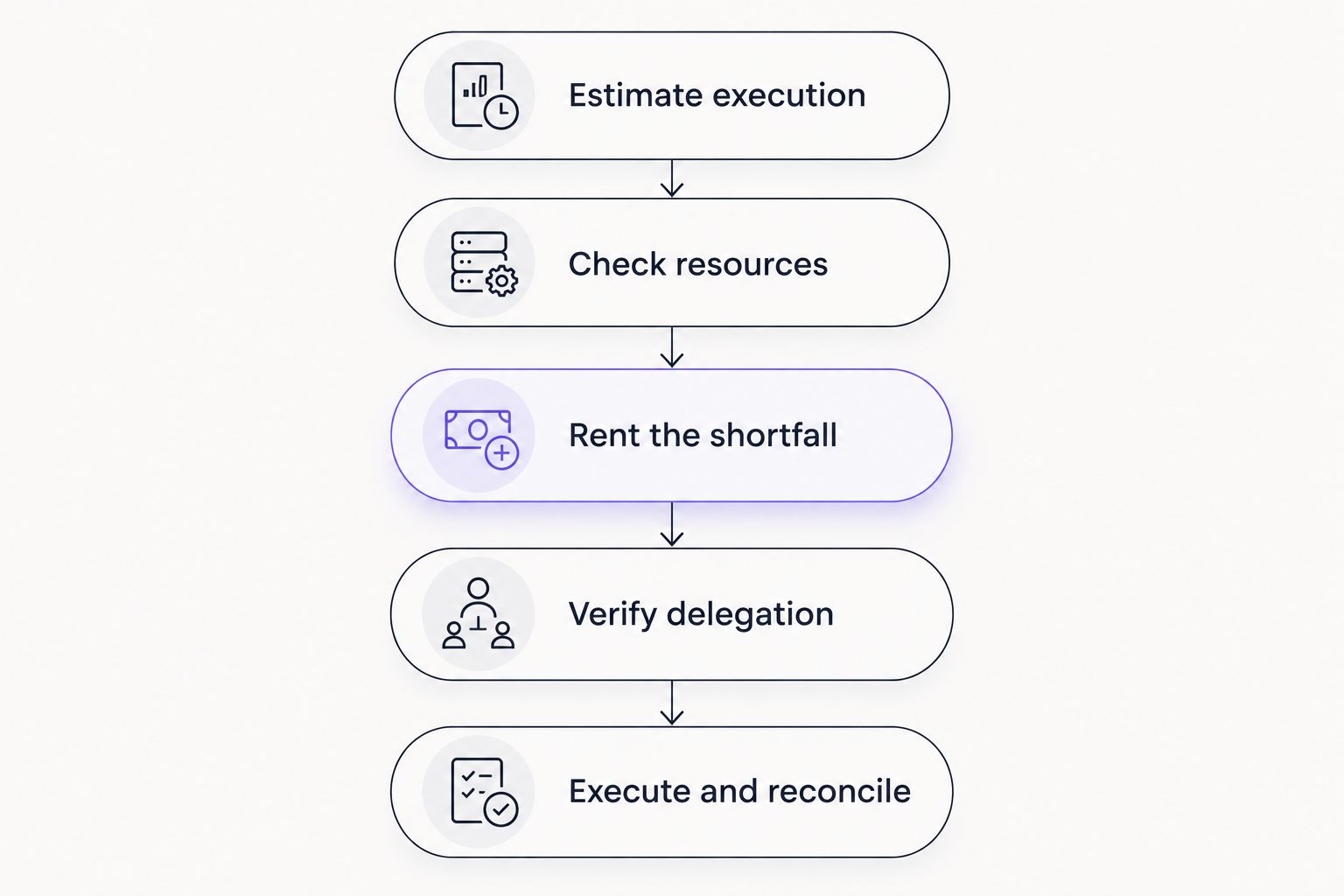
Use a short sequence that separates estimation from delivery. This is the central control in a 2026 rental workflow: the wallet must receive the resource before the transaction depends on it.
Estimate execution
Estimate the exact contract interaction. A TRC-20 transfer and a more complex smart-contract operation are not interchangeable workloads, even when both originate from the same address.
Check what your estimator returns. An Energy estimate is not necessarily a complete transaction-cost estimate, and a failed simulation is not a usable sizing result. Resolve the failure before placing the rental order.
Check resources
Read the sending address’s current usable Energy. An account’s resource limit and its remaining usable resources are different values because previous execution consumes resources.
Check whether other transactions are pending or being prepared from the same wallet. A resource snapshot loses value when another worker is spending from the same balance without coordination.
Rent the shortfall
Request the additional Energy needed for the execution window. Check whether the provider expresses the order in Energy units or another resource-related quantity; those labels are not interchangeable.
A provider’s ordering minimum can constrain the order you place. It does not change the contract’s underlying execution requirement.
Verify delegation
Confirm that the intended sending address has received the usable resources. Check the destination address carefully: delegation to a different wallet does not cover the wallet submitting your contract call.
Use the guide to verifying a TRON Energy rental transaction on-chain when checking delivery. Payment confirmation alone is not the resource check.
Execute and reconcile
Submit the intended transaction, then inspect its result and resource consumption. Update the wallet’s remaining resources before sizing another rental.
Keep failed attempts in the record. A failed contract transaction can consume Energy, so failure does not mean the resource balance remained unchanged.
Why the amount of TRON Energy you need varies
The required quantity changes with the work the network executes and the resources already available to your wallet. These factors explain why a fixed transfer package is not a universal answer.
- Contract method. Different methods execute different instructions. A token transfer is not a reliable template for a swap or another contract interaction.
- Contract state. Storage conditions and execution branches can change consumption. Recipient-related state can affect token-transfer execution.
- Dynamic Energy rules. TRON’s dynamic Energy model can increase consumption for affected contracts. Historical usage does not guarantee the same future requirement.
- Existing usable Energy. Resources already available to the sender reduce the additional amount needed. Check the remaining balance, not just the account’s allocation.
- Competing transactions. Other calls from the same wallet consume the resources your rental calculation relies on.
- Execution timing. Resources recover over time, while delegated resources are subject to the rental’s terms. Model the execution window rather than assuming every resource remains available indefinitely.
For 2026 planning, use current execution estimates and current wallet resources together. Updating only one side of the calculation leaves the shortfall unreliable.
How much extra Energy should you rent as a buffer?
There is no universal buffer that fits every TRON transaction. Add contingency for a defined uncertainty, such as competing wallet activity or a delay between estimation and execution.
Start by reducing uncertainty instead of automatically increasing the order. Estimate closer to submission, stop unrelated wallet activity during a controlled batch, and recheck the sender’s resources before broadcasting.
If your workflow still needs contingency, document the reason beside the rental request. A buffer without an explanation becomes a permanent surplus rather than a useful control.
Do not use extra Energy to work around a transaction that fails simulation. An invalid call, insufficient token balance, or contract restriction needs a transaction fix, not a larger resource order.
Does a larger USDT transfer need more TRON Energy?
A larger USDT transfer does not require proportionally more TRON Energy simply because its token amount is larger. Contract execution and state determine consumption, so estimate the actual transfer rather than applying an Energy-per-USDT ratio.
The useful distinction is between token value and execution work. Your rental decision covers execution work; it does not scale automatically with the value moved.
Can you use a previous transfer to choose your rental amount?
A previous transfer’s Energy consumption is a reference, not a guaranteed requirement. Use it to check whether a fresh estimate looks consistent, then investigate differences in contract state, transaction parameters, or resource conditions.
For your 2026 transaction record, retain the sender, contract method, estimate, actual consumption, and execution result. That record supports later decisions without turning an old observation into a fixed rule.
Keep resource decisions separate from message handling
If your team coordinates transactions through Telegram, keep the operational request distinct from the on-chain execution check. A message saying that an order is complete does not establish that the correct wallet has usable Energy.
Nbtrx offers Telegram business operations tools. For teams using Telegram to coordinate customer operations, the relevant control is a clear handoff: identify the request, record the responsible operator, and verify the on-chain result separately.
Do not treat a messaging tool as proof of resource delivery or a guarantee of business results. The wallet’s resource state remains the deciding evidence.
FAQ
What's the best way to choose how much TRON Energy to rent?
Estimate the exact planned contract calls, subtract the sending wallet’s usable Energy, and rent the remaining requirement for the execution window. Add contingency only for an identified source of uncertainty.
Can I choose my TRON Energy rental from the amount of USDT I'm sending?
No. USDT value is not a proportional measure of contract execution work. Estimate the actual transfer using its sender, recipient, and contract parameters.
Should I rent Energy for every transaction in a batch separately?
Calculate the batch’s shared resource requirement before deciding how to place rental orders. Do not subtract the same wallet’s available Energy independently from every transaction.
Does renting Energy remove every TRON transaction fee?
No. Energy covers smart-contract execution resources, while Bandwidth is a separate resource and other applicable fees need separate checks. A rental is not a blanket guarantee of a fee-free transaction.
What happens if my rented Energy is not enough?
Insufficient Energy can lead to TRX being burned or execution failure, depending on available funds and transaction limits. Failed execution can also consume resources, so check the receipt before retrying.
How do I know my rented TRON Energy has arrived?
Check the intended sending wallet’s usable resources and the relevant on-chain delegation record. An order confirmation or payment receipt alone does not establish that the resources are ready.
Should I use a fixed rental amount throughout 2026?
No. Reassess the amount when the workload, wallet resources, contract state, or execution conditions change. A fixed order size is useful only while its underlying assumptions remain valid.
One last thing
Verify the resource balance again before retrying a failed transaction. The failed attempt can have consumed Energy, leaving the wallet with less than it had when you made the original rental decision.
That check prevents a simple operational mistake: repeating the same transaction with the same assumptions after the resource balance has changed. Re-estimate, recalculate the shortfall, and confirm the result before submitting again.