
Exchanges avoid burning TRX on eligible withdrawals by supplying the sending wallet with sufficient Bandwidth and, for smart-contract transfers such as TRC-20 USDT, Energy before execution. They obtain resources through staking or delegation, including paid Energy rental, but this does not eliminate every withdrawal expense. In 2026, avoiding TRX burn means covering network resources—not making settlement free.
- Exchanges avoid TRX fees on withdrawals by provisioning resources before sending, not by bypassing TRON rules.
- TRON Energy covers smart-contract execution; Bandwidth covers transaction data.
- Staking commits capital; Energy rental introduces a separate supplier expense.
- Internal exchange transfers avoid on-chain execution only when no blockchain transaction occurs.
How do exchanges avoid paying TRX fees on withdrawals?
Exchanges can cover resource consumption with staked or delegated resources instead of burning TRX for the resource shortfall. The required resource depends on the transaction: a native TRX transfer uses Bandwidth, while a TRC-20 token transfer also executes a smart contract and consumes Energy.
For the delegation mechanism, see how TRON Energy rental actually works. A rental arrangement supplies delegated resources; it does not exempt the withdrawal from network accounting.
| Approach | Best for | Benefit | Limitation |
|---|---|---|---|
| Stake TRX for resources | Predictable withdrawal demand | Supplies resources without purchasing each transaction's shortfall through TRX burn | Commits capital and requires resource planning |
| Receive delegated Energy | Temporary or variable smart-contract demand | Supplies Energy to the sending account | Depends on delegation coverage; does not automatically cover Bandwidth |
| Burn TRX for missing resources | An explicitly approved fallback | Lets eligible transactions pay for resource shortfalls | Creates a direct TRX expense and needs spending controls |
| Settle through an internal ledger | Transfers between accounts within the same exchange | Avoids a blockchain transaction for that internal movement | Does not deliver funds to an external wallet |
The practical choice is resource provisioning with a controlled fallback—not a promise of fee-free withdrawals. An exchange must distinguish the network resources consumed, the TRX burned, and the fee charged to its customer.
Why this matters
A withdrawal fee shown to a customer is not proof of the exchange's network expense. The customer charge is an exchange policy; the blockchain records resource consumption and any associated burn.
For your 2026 withdrawal controls, separate customer billing from settlement accounting. Otherwise, a withdrawal marked free in the interface can still create a treasury expense, while a charged withdrawal can execute using resources already assigned to the hot wallet.
Resource accounting also changes operational decisions. A wallet holding enough USDT to satisfy a withdrawal does not necessarily hold enough Energy, Bandwidth, or TRX to execute it under your spending policy.
Staked resources: cover recurring withdrawal demand
Staking TRX lets an account obtain network resources. An exchange can use that resource capacity to support withdrawals rather than paying every resource shortfall through TRX burn.
Staking is best for a recurring workload that justifies committing treasury capital. Its benefit is resource capacity under the exchange's control; its limitation is that capital and resource allocation still need management.
Do not translate a TRX stake into a permanent fixed transfer allowance. Resource allocation depends on network conditions and the relevant staking pool, while transaction consumption depends on what the transaction actually does.
TRON Energy consumption recovers over 24 hours. Bandwidth consumption also recovers over 24 hours; neither resource should be treated as an unlimited balance that resets whenever a withdrawal arrives.
Your operating question is whether the sending wallet has enough usable resources now. A treasury-level resource total is not a substitute for checking the account that will sign and broadcast the withdrawal.
Delegated Energy: cover variable smart-contract demand
Energy delegation assigns resource capacity to another account. Commercial Energy rental uses that mechanism to provide the receiving wallet with resources under the supplier's terms.
Delegated Energy is best for demand you do not want to cover entirely with your own stake. It can support smart-contract execution without requiring the exchange to obtain all that Energy through its own staking position.
The limitation is coordination. Your withdrawal system must verify that resources reached the correct sending address before it releases the transaction. A supplier confirmation is not the same as an account-level resource check.
For 2026 supplier evaluations, distinguish the commercial agreement from the on-chain delegation. Review the resource scope, delegation duration, delivery verification, and failure handling separately.
Do not give a resource supplier signing authority merely to receive delegated Energy. Delegation and custody are separate functions; receiving resources does not require handing over the withdrawal wallet's private key.
Internal transfers: avoid settlement only inside the exchange
An exchange can move balances between its own customer accounts through internal ledger entries. If that movement creates no blockchain transaction, it consumes no TRON resources for that movement.
Internal settlement is best for transfers that genuinely remain inside the exchange. Its limitation is decisive: it does not settle a withdrawal to a customer's external wallet.
An exchange cannot turn an external transfer into an internal one simply by changing its label. Once the exchange sends funds on TRON, the network's transaction and resource rules apply.
Keep that distinction visible in customer operations. An internal account credit and an externally confirmed token transfer are different settlement events and need different completion criteria.
Why withdrawal resource consumption varies
A fixed resource assumption is not a reliable withdrawal policy. These factors determine what your system needs to check:
- Transaction type. Native TRX transfers and smart-contract token transfers do not consume the same resource categories.
- Contract execution. The contract's code and execution path determine Energy consumption; a token amount alone does not define the requirement.
- Recipient state. Storage changes involved in a token transfer can change the execution work required.
- Dynamic Energy rules. TRON's dynamic Energy mechanism can increase Energy consumption for affected contracts.
- Wallet resource state. Recent consumption, recovery, and delegation determine the resources usable when the transaction executes.
- Transaction size. Bandwidth consumption relates to transaction data, so checking Energy alone leaves part of the transaction uncovered.
In 2026, use a current execution estimate and current wallet state rather than a remembered transfer figure. An estimate informs your decision; the confirmed transaction receipt establishes what execution actually consumed.
How should an exchange provision resources before withdrawals?
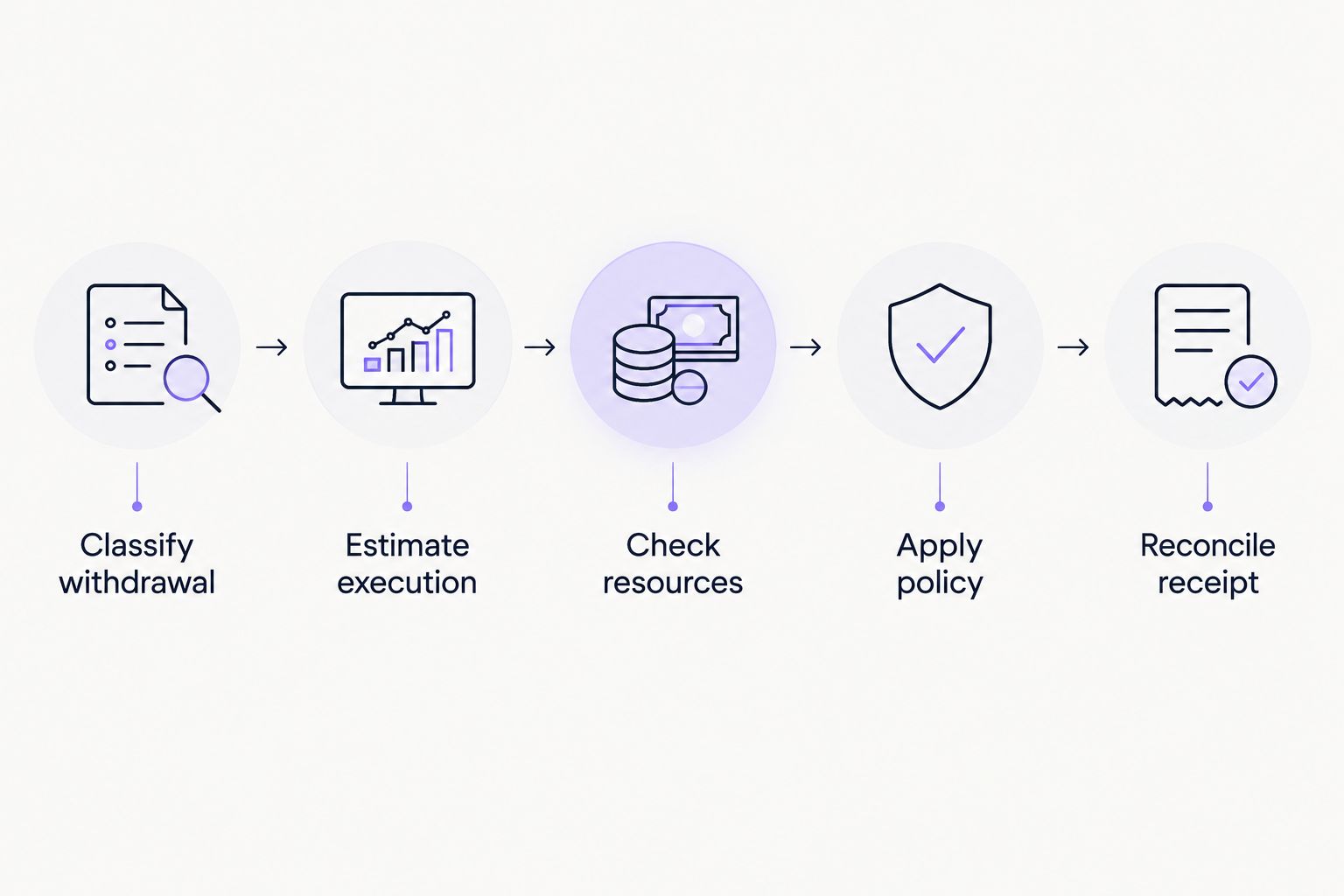
Use a release gate between withdrawal approval and transaction broadcast. The gate should establish whether the exact sending account can complete the intended transaction within the exchange's resource and spending policy.
- Classify withdrawal. Identify the network, asset, sending account, recipient, and transaction type. Do not apply a native-transfer resource assumption to a token contract call.
- Estimate execution. Estimate the intended contract call against current chain state. Include Bandwidth planning instead of treating an Energy estimate as the whole transaction budget.
- Check resources. Read the sending account's usable resources and account for other withdrawals competing for them. Recheck after any delegation arrives.
- Apply policy. Provision the shortfall, hold the withdrawal, or permit a controlled TRX-burning fallback. Make that choice explicit before broadcast.
- Reconcile receipt. Confirm the transaction result, resource consumption, and burn. Record completion only after the required settlement checks pass.
The sequence matters because resources can change between estimation and execution. A wallet that passed a check before another withdrawal executed needs a fresh decision, not an assumption that its earlier balance still applies.
What happens when the resource estimate is wrong?
Insufficient resources can result in TRX burn where the transaction rules, available balance, and spending limits permit it. Insufficient funding or execution limits can instead cause failure, and failed contract execution can still consume resources.
A failed withdrawal is not automatically a cost-free withdrawal. Read the execution result before deciding whether to retry, compensate the customer, or release another transaction.
The transaction's fee limit is a spending control, not a resource reservation. Raising it does not deliver delegated Energy, repair a contract error, or guarantee successful execution.
When reconciling burn, keep denomination handling explicit: 1 TRX equals 1,000,000 sun. Convert consistently before comparing transaction records with treasury balances, and retain the original recorded unit for auditability.
How should customer operations explain withdrawal fees?
Explain the customer charge separately from the exchange's settlement method. A withdrawal fee can exist even when sufficient resources prevent TRX burn; a customer fee waiver does not remove the network's resource requirements.
For 2026 reporting, maintain separate records for customer charges, resource procurement, transaction burn, and failed execution. Combining them into a single fee field hides the reason a withdrawal created an expense.
Nbtrx offers Telegram business operations tools; assess that category separately from transaction signing and TRON resource management. A messaging workflow should never be treated as evidence that an on-chain withdrawal received resources or completed successfully.
Keep customer-facing status tied to settlement evidence. Approval, resource provisioning, broadcast, and confirmation are separate states, even when your interface presents a short summary.
Can an exchange withdraw USDT without holding TRX?
A TRC-20 USDT transfer can execute without burning the sender's TRX when the applicable resource requirements are covered. That does not establish that every account operation, recipient condition, or exceptional transaction expense is covered.
Before adopting a no-TRX-balance policy, check account activation requirements, resource availability, and failure handling. The operational objective is successful settlement under a defined policy—not simply an empty TRX balance.
Does batching make external withdrawals free?
Batching does not remove network resource requirements. A contract-based batch still executes code, consumes resources, and introduces its own execution and failure conditions.
Assess a batch implementation on its actual contract behavior. Do not assume that grouping customer requests in your database turns separate external transfers into a single resource-free settlement.
Is renting Energy always better than staking TRX?
Neither approach is always better. Staking commits your capital to resource provision, while rental introduces supplier terms and a separate procurement expense.
Compare the approaches against your own withdrawal pattern and actual execution records. Choose the arrangement that meets your settlement requirements and treasury policy, not the one described as free.
FAQ
How do exchanges avoid TRX fees on withdrawals?
Exchanges avoid TRX burn on eligible withdrawals by covering resource requirements with staked or delegated resources before execution. Resource provisioning can still create a separate business expense.
Do USDT withdrawals on TRON use Energy and Bandwidth?
TRC-20 USDT withdrawals use Energy for smart-contract execution and Bandwidth for transaction data. Covering Energy alone does not establish that the entire transaction is covered.
Does sending native TRX require Energy?
A standard native TRX transfer uses Bandwidth rather than smart-contract Energy. Other applicable transaction requirements still need checking.
Does rented Energy give the supplier control of my withdrawal wallet?
Receiving delegated Energy does not require giving the supplier your private key. Keep resource procurement separate from transaction signing and custody permissions.
Can a failed withdrawal still consume resources?
Failed smart-contract execution can still consume resources. Inspect the transaction receipt and failure result before retrying or calculating the expense.
Does a free customer withdrawal mean the exchange paid nothing?
A free customer withdrawal means the customer was not charged the stated withdrawal fee. It does not show whether the exchange used staked resources, purchased delegation, or burned TRX.
How long does consumed TRON Energy take to recover?
Consumed TRON Energy recovers over 24 hours. Recheck usable resources before each withdrawal release rather than assuming immediate recovery.
One last thing
Verify the address receiving delegated resources against the address signing the withdrawal. A resource purchase recorded against the wrong hot wallet does nothing for the account that must execute the transaction.
Make that address match a release condition in your 2026 withdrawal workflow. Then reconcile the receipt: successful settlement and avoided TRX burn are separate findings, and both need evidence.