
You can resell rented TRON energy as a customer-facing service when your supplier permits resale and delegates resources directly to your customer's address. In 2026, receiving rented energy in your own wallet does not give you the ability to redelegate those received resources to another wallet; supplier permission and control of the underlying delegation are separate requirements.
- To resell rented TRON energy, arrange supplier delegation directly to the customer's wallet.
- TRON resource delegation does not let recipients redelegate received resources.
- Get permission for energy rental resale before accepting customer orders.
- Verify delivery on-chain; an order confirmation does not establish usable energy.
Can you resell rented TRON energy?
Yes as an order-and-delivery business; no as a second delegation of resources you received. The distinction determines whether your proposed workflow can actually deliver energy to a customer.
TRON separates the account that stakes TRX from the account that receives delegated resources. Receiving a delegation gives the recipient access to resources, not ownership of the supplier's staked TRX or authority to delegate that stake elsewhere. For the underlying process, see how TRON energy rental actually works.
The following comparison separates workable business arrangements from an unsupported transfer model. These are operating models, not claims about any particular provider's features or terms in 2026.
| Operating model | Best for | Main advantage | Main limitation |
|---|---|---|---|
| Supplier delegates directly to your customer | Resellers coordinating customer orders | Delivery reaches the wallet that needs resources | Requires supplier support and permission for the arrangement |
| You rent into your wallet, then attempt to redelegate | Not suitable for forwarding received resources | Your wallet can use its received resources | Received delegation does not become your delegatable stake |
| You stake TRX and delegate resources yourself | Operators controlling their own resource supply | You control delegation from your stake | Requires your own TRX and resource management |
A reseller therefore sells fulfillment and customer operations around an underlying delegation. The business arrangement does not create a transferable energy token.
Why this matters
A resale offer fails operationally if the supplier delivers to the wrong account. Energy available to your business wallet does not automatically support a transaction signed and sent by your customer's wallet.
That creates a clear ordering rule: identify the transaction-sending address before arranging delivery. A customer identifier, Telegram username, payment reference, or recipient token address is not a substitute for confirming which account will execute the transaction.
Build the service around the customer's sending wallet, not around a balance you expect to forward later. This also keeps your customer promise aligned with what the network actually provides.
Direct-to-customer fulfillment
Direct fulfillment means you accept the customer's request and arrange for the supplier to delegate resources to the customer's specified address. Your role covers order validation, supplier coordination, delivery verification, and customer support.
This is the appropriate model when you want to resell energy rental without staking the underlying TRX yourself. It still requires an agreement with the supplier. A public order form that accepts a recipient address does not, by itself, establish permission to run a resale business.
Before offering this model, confirm that the supplier accepts customer-designated addresses and explain who handles incorrect addresses, failed delivery, and disputes. Keep those responsibilities explicit. Otherwise, the customer has a promise from you while you have no agreed remedy upstream.
The advantage is straightforward fulfillment to the account that needs resources. The limitation is dependence on another party's delegation capacity, delivery process, and terms.
Renting into your wallet first
Renting into your own wallet is appropriate when your wallet will execute the relevant smart-contract transactions. It is not a staging account from which you can redistribute received delegation to customers.
The same distinction applies if you operate several customer workflows. Having energy available on one account does not establish a shared resource pool that every unrelated customer account can spend.
You can perform a service using transactions executed by your own account, but that is a different operating model. It changes who controls the transaction, who signs it, and what permissions or custody arrangements are involved.
Do not describe a transaction-execution service as simple energy forwarding. Define the service accurately before accepting funds or requesting access to a customer's wallet.
Supplying resources from your own stake
Staking TRX for energy and delegating the resulting resources gives you a different role: you become the resource supplier. You are no longer relying on the right to redelegate someone else's received resources.
This model suits operators who want direct control over resource allocation and are prepared to manage their own stake. The trade-off is responsibility for capital allocation, delegation state, resource usage, and withdrawal planning.
Customer operations remain necessary. Controlling the underlying stake does not remove address errors, usage disputes, or the need to define delivery terms.
Compare the operating responsibilities rather than treating supplier ownership as an automatic improvement. A direct supplier has more control, but also owns the resource-management work that an intermediary leaves upstream.
Why resale arrangements vary
The network rule is consistent: received delegation is not your own delegatable stake. The commercial arrangement varies because suppliers define their own services and agreements.
For a 2026 resale agreement, review these factors before publishing your offer:
- Resale permission. Confirm whether you can place orders for customers, market the arrangement under your business, and appoint downstream partners.
- Recipient selection. Establish when the destination address becomes final and whether correction is possible before delegation.
- Delivery definition. Specify what evidence establishes fulfillment, rather than relying only on an order-status message.
- Rental duration. Separate the promised service period from any delegation lock and the supplier's removal process.
- Usage responsibility. Decide how you handle resources consumed by other activity on the same customer account.
- Support ownership. Name the party responsible for customer communication, delivery investigation, and dispute handling.
These factors determine what you can honestly promise. They do not change TRON's delegation permissions, and a reseller agreement cannot grant network capabilities that the recipient account does not have.
How to structure a resale order
Use a workflow that keeps the commercial order and the blockchain delivery connected. Each order needs a clear customer instruction, supplier action, and verification record.
Confirm terms
Obtain the supplier's resale permission before taking customer orders. Record the agreed delivery conditions and escalation process in language your support team can apply.
Do not infer permission from an available integration or a successful test order. Technical access and commercial authorization answer different questions.
Validate address
Ask for the wallet that will send the smart-contract transaction. Have the customer confirm the network and address before submission.
For a token transfer, distinguish the sender from the token recipient. Delegating energy to the receiving address does not supply resources to a different account that sends the transaction.
Place order
Send the approved destination and agreed order details to the supplier. Retain the supplier's reference alongside your own customer order reference.
Avoid collecting a private key or recovery phrase for resource delivery. A request to delegate resources to an address does not require you to take control of that wallet.
Verify delivery
Check the relevant delegation and account resource state before marking the order fulfilled. Treat a supplier acknowledgment as confirmation of a request, not proof that the customer's account already has usable resources.
Resource usage can change after delivery. Keep the verification record tied to the account and the point at which you checked it, rather than making an open-ended promise about its future balance.
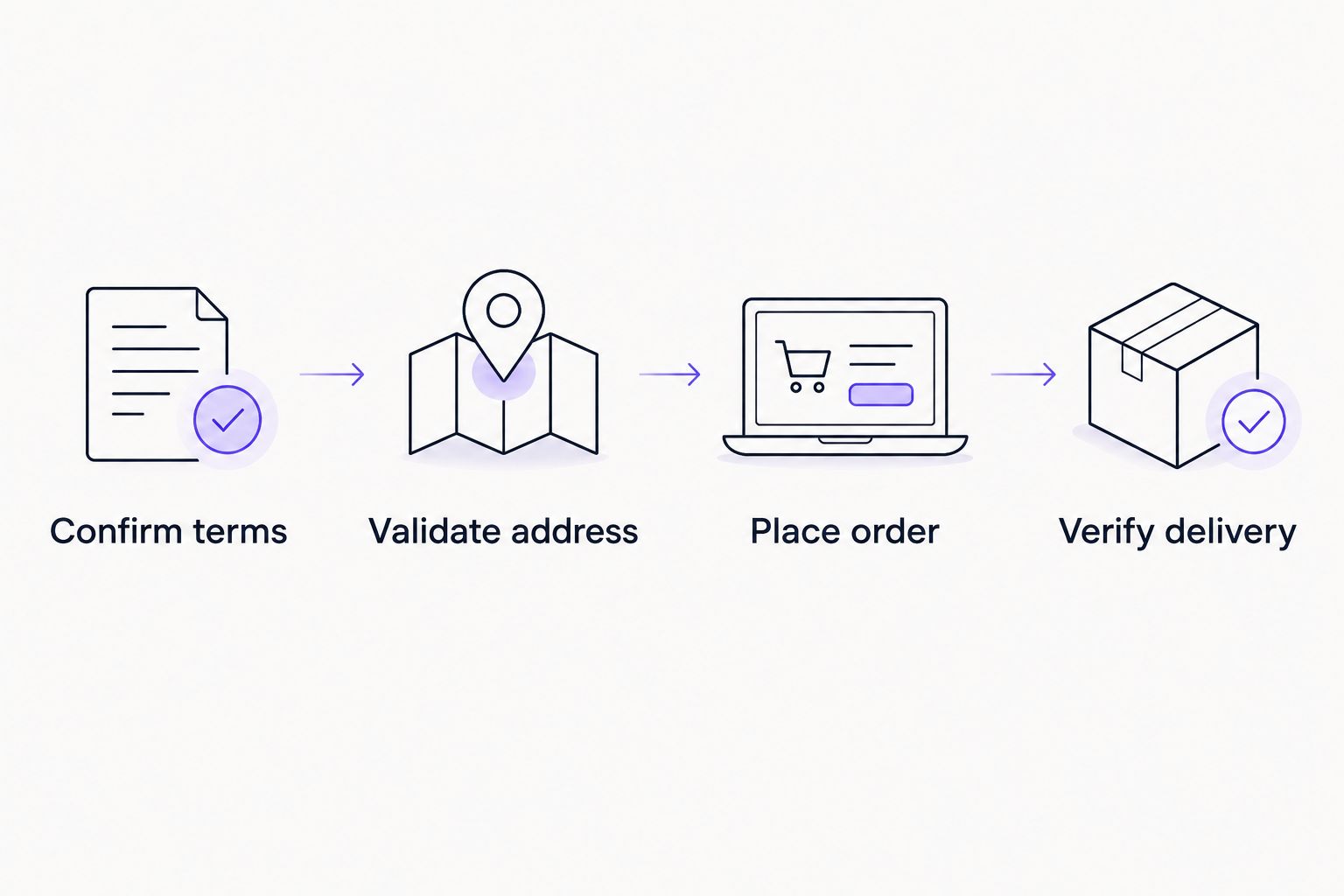
Keep payment status separate from delivery status throughout this workflow. A paid order can still need investigation, and an accepted supplier request can still lack verified fulfillment.
What should you verify before launching in 2026?
Test the entire customer workflow before advertising a resale service. A successful delegation proves only part of the process; you also need clear records and a workable response when something goes wrong.
Use a controlled transaction workflow to answer these questions:
- Does the order preserve the customer's confirmed destination without manual copying between messages?
- Can you connect your customer reference to the supplier's order and delegation evidence?
- Does your delivery check distinguish available resources from an order acknowledgment?
- Can support identify whether the problem concerns delivery, resource consumption, or transaction execution?
- Does the customer-facing description match the supplier's actual commitment?
Do not promise that delegated energy guarantees transaction success. Smart-contract execution can fail for reasons unrelated to energy, and energy does not replace every other transaction requirement.
Also avoid describing every failed transaction as failed delivery. Investigate the account state, transaction result, and supplier commitment separately before deciding what happened.
Can you send unused rented energy to another wallet?
Unused rented energy is not a token balance you can forward. If a supplier has delegated resources to your address, that received delegation does not authorize you to redelegate the underlying stake.
Ask the supplier whether it supports changing the destination through its own delegation process. Do not promise reassignment until the supplier confirms both the technical process and the applicable terms.
Does supplier permission make redelegation possible?
Supplier permission authorizes a business arrangement, not an additional network permission. Even with a resale agreement, your recipient wallet does not gain ownership of the supplier's staked TRX.
The workable arrangement remains supplier-controlled delivery to the customer's address, unless you supply resources from your own stake. Keep that distinction in both partner documentation and customer support scripts.
Do you need your customer's private key?
You do not need the customer's private key to arrange delegation to the customer's address. The account authorized to delegate the underlying resources performs the delegation action.
If a proposed resale process requires importing customer recovery phrases, stop and redesign it. That introduces wallet-control risks unrelated to the basic task of arranging resource delivery.
Where Telegram customer operations fit
Nbtrx's Telegram business operations tools are best suited to teams looking for member operations and partner workflows. That category is relevant to coordinating customer requests; it does not establish an energy supply, a reseller agreement, or blockchain delivery capabilities.
Keep the Nbtrx customer-operations role separate from supplier fulfillment. Messaging, payment confirmation, and on-chain verification represent different states, and your process should not treat one as evidence of another.
FAQ
Can I resell rented TRON energy in 2026?
You can arrange resale when your supplier permits it and delivers resources directly to your customer's address. Receiving a delegation in your own wallet does not let you redelegate those received resources.
Can I rent energy into my wallet and forward it to a buyer?
You cannot forward received energy delegation as though it were a transferable token balance. Arrange delivery to the buyer's transaction-sending address instead.
Do I need to stake TRX to operate as a reseller?
You do not need your own stake when an authorized supplier fulfills customer orders. Supplying resources from your own stake is a separate operating model.
Which customer address should receive rented energy?
The address that will execute the relevant transaction should receive the delegated resources. For a token transfer, do not confuse the transaction sender with the token recipient.
Does a supplier order confirmation prove energy was delivered?
An order confirmation does not prove that the customer's address has usable resources. Check the delegation and account resource state before confirming fulfillment.
Can a reseller guarantee that a customer's transaction will succeed?
An energy reseller should not guarantee transaction success solely because resources were delivered. Contract execution and other transaction requirements remain separate.
Is a customer's recovery phrase needed for energy rental?
A customer's recovery phrase is not needed to arrange resource delegation to their address. Keep resource delivery separate from wallet custody.
Can I sell the unused part of an existing rental?
You cannot independently transfer unused received delegation to a new buyer. Ask the supplier whether it supports a destination change under the rental agreement.
One last thing
For your 2026 launch checklist, define delivery before defining the sales message. The useful question is not whether your supplier accepted an order; it is whether the correct sending account received the agreed resources.
Sell a verifiable fulfillment process, not a promise to move energy between wallets. That distinction keeps your customer offer, supplier agreement, and support workflow aligned.