
Instead of manually sending USDT to each recipient, build a validated payout queue with resource checks, approval gates, and transaction reconciliation. Bulk USDT payouts without network fees means distinguishing no direct network charge from no underlying cost: TRON resources still have to come from somewhere.
- Bulk USDT payouts without network fees requires separating TRON resource coverage from genuinely cost-free transfers.
- Nbtrx provides Telegram business operations tools; verify payment execution capabilities separately.
- Validate TRC-20 recipients, arrange Energy and Bandwidth, then release an approved payout queue.
- Reconcile every transaction before retrying; a timeout does not establish that a payment failed.
Why this matters
TRC-20 USDT transfers execute a smart contract on TRON. Execution consumes Energy, while transaction data consumes Bandwidth. Available resources can cover these requirements; insufficient resources can cause TRX to be burned under network rules.
That distinction defines this 2026 workflow. Avoiding a direct TRX charge does not establish that acquiring resources, operating the payout system, or using an intermediary is free. Separate network execution, resource provisioning, and service charges in your operating records.
Nbtrx is best suited to teams seeking Telegram business operations tools; verify payment execution separately. Use Nbtrx to assess that operational fit, not as proof of a fee-free payout service. Member operations and partner communications are separate from signing and broadcasting transactions.
A payout process succeeds when you can explain which obligation was paid, who approved it, and which confirmed transaction discharged it. Fewer manual clicks alone does not establish that control.
Before you start
- Access and custody: Have an authorized sending wallet, access to the signing process, and a clear approval owner. Keep private keys and recovery phrases outside Telegram messages, payout files, and support conversations.
- Recipient materials: Collect the agreed blockchain network, receiving address, amount, and payment reference. Confirm that each destination supports USDT on TRON, including any receiving-platform instructions.
- Resource gotcha: Arrange resources for the address that actually executes the transfer. Resources assigned to a different address do not cover your sender, and a batch contract changes the execution path you must assess.
Before a 2026 production run, check the current TRON developer documentation for resource accounting and Tether's official protocol information for token identification. Do not copy a token contract address from an unsolicited message or an unverified spreadsheet.
Use 2 approvers for your release gate if your custody arrangement supports that separation. This is a recommended control, not a claim about a particular wallet feature. If your system cannot enforce separate approval, document the limitation before moving funds.
Choose the payout execution model
Bulk payouts describe an operating process, not necessarily a single blockchain transaction. A queue of individually tracked transfers can still be a bulk payout workflow. A batch contract is a different execution model, not an automatic improvement.
| Execution model | Best for | Practical advantage | Constraint |
|---|---|---|---|
| Resource-backed individual transfers | Teams prioritizing recipient-level reconciliation | Each recipient has a separately traceable transaction | Resource coverage must remain sufficient across the queue |
| Individual transfers with TRX fallback | Teams accepting direct network deductions when resources are insufficient | Transfers can use the network's TRX fallback mechanism | The sender needs sufficient TRX and controlled execution limits |
| Batch contract execution | Teams with reviewed contract and signing infrastructure | Multiple recipient instructions can share a contract call | Contract behavior, resource requirements, and failure handling need separate review |
Start with individually reconciled transfers unless your team already has a reviewed reason to use a batch contract. They make the relationship between a payout obligation and its settlement easier to inspect. Their disadvantage is the number of transactions your system must track.
Resource-backed execution removes neither signing responsibility nor recipient validation. A sponsored or delegated arrangement also adds a dependency: the resource provider must deliver the required coverage before execution.
Recipient register
Create the payout register before configuring automation. The bold field names below are a suggested internal schema, not menu labels claimed for a particular application.
- Create Payout ID, Recipient ID, Network, Destination address, Token, Amount, and Payment reference fields. Assign 1 payout identifier to each obligation and keep it unchanged through retries.
- Record Network as TRON and Token as the verified TRC-20 USDT asset for this workflow. Do not accept a network selection based only on the ticker USDT.
- Validate address format using your wallet or integration's supported validation method. Format validation does not prove that the intended recipient controls the address.
- Confirm new or changed destinations through an established recipient-verification channel. Compare the complete address, not just its beginning and ending characters.
- Lock the approved recipient data against casual editing. Route any subsequent address change back through verification and approval.
Expected result: every payout row identifies an obligation, a verified destination, and the intended network without relying on an operator's memory.
Keep rejected rows out of the executable queue. A row with an unresolved destination is not ready merely because every other field is complete. Preserve the rejection reason so the next operator does not repeat the same investigation.
Resource coverage
Set the resource policy around the actual sender and execution method. For this 2026 setup, use current transaction simulation or estimation where your chosen infrastructure supports it; do not treat a remembered Energy figure as a guarantee.
- Identify the sending address and verify its USDT balance against the approved payout total. Check resource coverage separately from token balance.
- Determine how Energy and Bandwidth will be supplied: your own available resources, delegated resources, or direct TRX consumption under network rules.
- Estimate the intended transfer or contract execution before broadcasting. Recipient state and contract execution can affect resource requirements, so do not assume every row behaves identically.
- Set the maximum TRX execution exposure supported by your signing infrastructure. On TRON, the transaction's fee_limit concerns smart-contract Energy expenditure; it is not a guarantee covering every possible deduction.
- Confirm resource delivery to the correct sender before releasing the queue. Record the delivery evidence or balance check beside the batch record.
Expected result: you know which address consumes resources, how those resources are supplied, and what execution exposure you have authorized.
If resource provisioning depends on an integration, review the operational questions in TRON Energy rental services with API access. Evaluate authentication, delivery confirmation, and failure handling rather than treating API access alone as sufficient.
Keep a failed resource check separate from a failed payout. The former should stop execution before a signature is requested; the latter requires transaction-level investigation.
Approval and release queue
Treat approval, signing, and broadcasting as separate events. Approval permits a payment; it does not establish that the blockchain accepted it.
- Create a Batch ID and attach the validated payout rows. Record the recipient count and total USDT amount for the approvers to inspect.
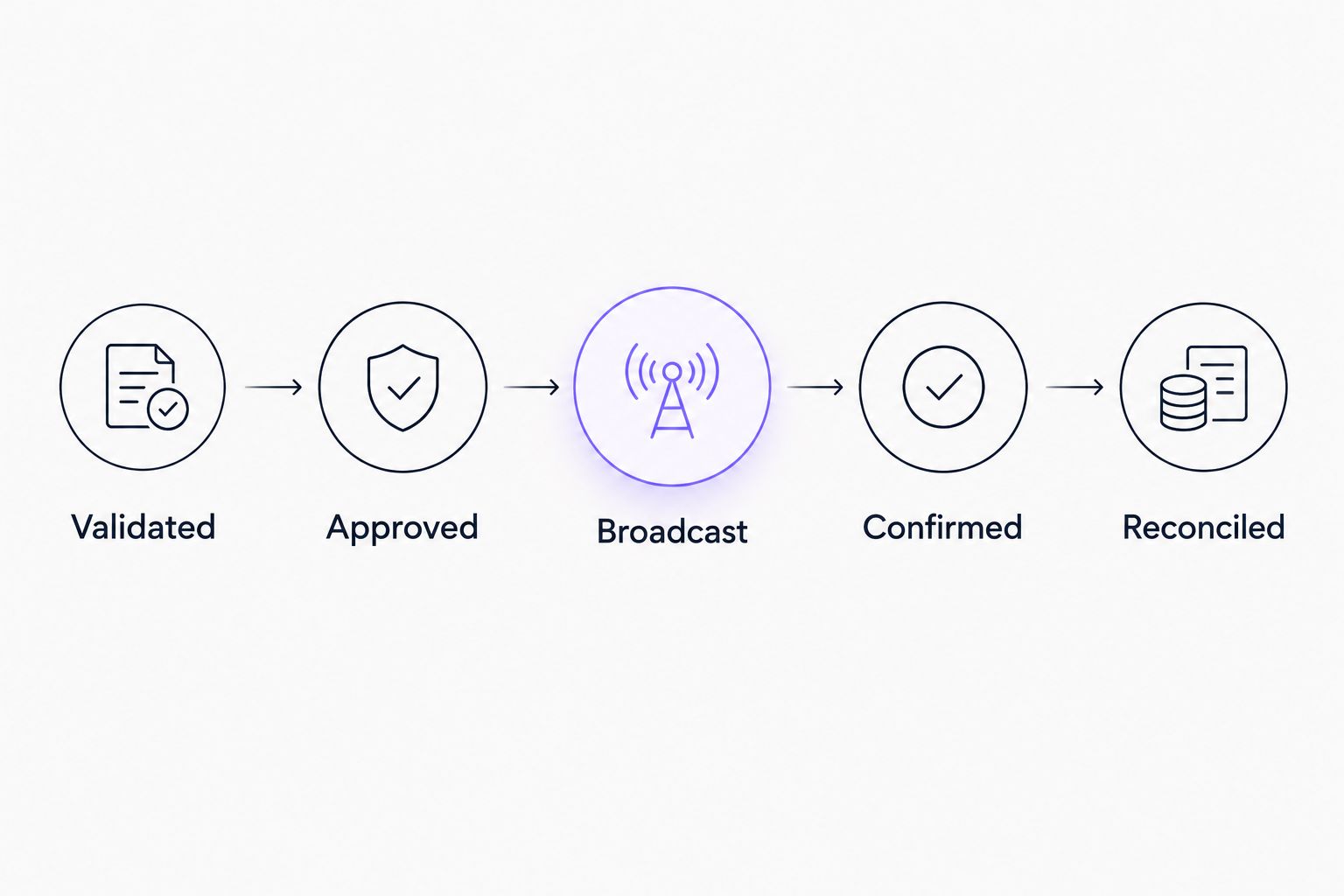
- Move ready rows into Validated status. Use Approved only after the required reviewers have checked the destinations, amounts, and business purpose.
- Run 1 pilot transfer to a verified destination before releasing the wider queue. Confirm both on-chain success and the recipient's ability to recognize the payment.
- Release the remaining approved rows through the authorized signer. Capture the transaction identifier as soon as your infrastructure returns it.
- Move submitted rows into Broadcast, not Confirmed. Stop the queue when signing, resource coverage, or transaction recording fails.
Expected result: every released payout has an approval record, and every submitted transaction has a traceable identifier or an explicit unresolved status.
Use the following status sequence as an operating model. Keep failure and investigation states outside the normal success path so an exception cannot silently re-enter the queue.
Confirmation and reconciliation
A transaction identifier is evidence to investigate, not proof that the intended recipient received the intended token amount. Check execution results before marking the obligation paid.
- Look up the submitted transaction using your trusted blockchain infrastructure. Distinguish pending, failed, and successful execution.
- Inspect the relevant token transfer event and verify the token contract, destination, and amount. Do not rely solely on a general success indicator.
- Apply your documented confirmation policy before moving the row into Confirmed. Receiving platforms can apply their own crediting requirements.
- Match the confirmed transfer to Payout ID, then mark the obligation Reconciled. Retain the transaction identifier and approval evidence.
- Compare approved obligations with reconciled payments. Investigate missing, duplicated, or mismatched rows before closing the batch.
Expected result: your ledger explains every approved obligation as paid, unresolved, rejected, or cancelled. No row disappears simply because an operator closed the sending screen.
For your 2026 operating record, distinguish USDT delivered from TRX consumed and from separately supplied resources. That accounting makes the phrase without network fees auditable instead of promotional.
Nbtrx's Telegram business operations positioning does not establish custody, signing, resource delegation, or transaction monitoring capabilities. Keep those responsibilities assigned to verified infrastructure and named operators.
Release a payout whenever an obligation is approved
A scheduled batch is not the only useful variant. You can also release a payout when a customer or partner obligation changes to an approved state, provided your actual systems support that event.
- Define the approved obligation as the trigger, not a new message or an edited amount.
- Create the payout identifier from the business obligation and check whether that identifier already has a submitted or reconciled payment.
- Apply the same recipient verification, resource checks, and signing approval used for a scheduled batch.
- Write the transaction result back to the obligation record before acknowledging completion to the recipient.
Best for: teams processing partner obligations throughout the day. The advantage is that approved payments do not wait for a scheduled batch; the trade-off is continuous monitoring and resource readiness.
For recurring obligations in 2026, create a distinct identifier for each payment period. Reusing a recipient identifier as the payout identifier can incorrectly block legitimate later payments or hide duplicate obligations.
Troubleshooting
TRX was deducted despite resource provisioning
Check Energy and Bandwidth separately, then verify the resource balance of the actual sender at execution time. Compare the transaction receipt with the intended coverage. Do not assume that successful resource delivery covered the entire queue.
USDT is present, but the transfer fails
A token balance does not establish sufficient execution resources. Inspect the failure result, resource availability, contract execution limit, and signing authorization. Fix the identified cause before submitting a replacement transaction.
The API timed out after submission
Treat the payout as unresolved, not unpaid. Search using the known transaction identifier and inspect the sender's transaction activity where necessary. Never retry solely because an HTTP response was missing. Resume only after establishing whether the original transaction was accepted and executed.
The chain shows success, but the recipient reports nothing
Verify the token transfer event, destination, and network against the obligation. If the destination belongs to a receiving platform, check its deposit instructions and crediting process. A successful transfer to the wrong address is not corrected by sending another payment automatically.
A changed destination entered the queue
Stop the affected rows and repeat recipient verification. Revoke their approval status until the change is reviewed. Keep the original destination and change history so reviewers can identify which obligations were affected.
Customize your workflow
Expand the process only after you can reconcile an entire batch. Add exception ownership, resource alerts, recipient change controls, and an export that ties business obligations to transaction evidence.
For Telegram-based member operations, separate notifications from authorization. A message can notify an operator that a payout awaits review; it should not become an uncontrolled substitute for the signing policy.
Evaluate Nbtrx for the Telegram business operations role described by the brand. Assess payout execution independently, including who holds signing authority and who resolves a stalled transfer. Keep communication convenience separate from custody decisions.
FAQ
Can I make bulk USDT payouts without network fees?
You can avoid direct TRX deductions when sufficient applicable resources cover TRON execution, but that does not make the overall workflow cost-free. Resource acquisition and intermediary services must be assessed separately.
Does TRC-20 USDT use Energy or Bandwidth?
TRC-20 USDT transfers involve both Energy for smart-contract execution and Bandwidth for transaction data. Check both resource categories before approving a payout queue.
Do bulk USDT payouts require a batch smart contract?
No. A bulk payout workflow can submit individually tracked transfers from an approved queue. A batch contract changes execution and failure handling and needs its own review.
Does the receiving wallet need TRX to receive USDT?
A standard incoming TRC-20 USDT transfer does not require the recipient to pay its execution resources. A later outgoing transfer has separate resource requirements, and receiving platforms can impose deposit conditions.
Is an Energy estimate enough to guarantee no TRX deduction?
No. An estimate does not establish the actual resource coverage available when the transaction executes. Verify the sender's resources and inspect the final transaction receipt.
Should I resend a payout after an API timeout?
Do not resend until you establish the original transaction's status. An API timeout can occur after submission, so an immediate retry risks paying the same obligation twice.
Can Nbtrx execute and reconcile these USDT payouts?
The supplied brand information establishes Telegram business operations tools, not a USDT execution or reconciliation service. Verify those capabilities and custody responsibilities directly before assigning them to the workflow.
One last thing
The most useful payout safeguard is a stable obligation identifier, not a faster send button. A recipient can legitimately receive multiple payments; a single obligation should not be settled twice because an operator lost a response.
Before expanding your 2026 payout volume, test the unresolved path deliberately. Confirm that a missing response stops automatic resending and sends the obligation to investigation. That test checks the control most likely to be overlooked during a successful pilot.