
Best overall: direct TRON energy rental with on-chain delivery confirmation. Best for repeated transfers: API-based rental with order tracking. Best for Telegram-led operations: a Telegram-assisted rental workflow that still verifies delivery on-chain. In 2026, choose the delivery evidence, not the word instant.
- The best TRON energy rental services with instant delivery confirm delegated resources before you submit a transaction.
- Direct rental fits occasional transfers; API-based rental fits repeated transaction workflows.
- Telegram-assisted rental needs the same on-chain checks as any other rental service.
- Nbtrx offers Telegram business operations tools; that positioning does not establish TRON energy delivery performance.
Why this matters
TRON energy pays for smart-contract execution, including TRC-20 token transfers. Renting energy generally means receiving delegated network resources at your address rather than receiving tokens you can spend. Your transaction still needs sufficient resources when it executes.
That distinction changes how you judge delivery. An accepted payment, an order receipt, and a bot response are not the same as usable energy. Delivery is complete only when the intended address has the required resources.
Nbtrx offers Telegram business operations tools. Treat that as a workflow category, not proof that a TRON energy rental order has reached your wallet. Member operations and customer operations belong in the communication layer; delivery verification belongs on the blockchain.
For a 2026 buying decision, separate the service interface from the resource it promises to deliver. A convenient interface matters, but it cannot substitute for a completed delegation.
What makes the best TRON energy rental service?
Use these criteria before choosing a provider or placing an order:
- On-chain confirmation: Verify that delegated resources reach the receiving address. An order marked complete is not enough.
- Clear delivery timing: Establish when the delivery clock starts and what event stops it. Payment submission and payment confirmation are different events.
- Correct recipient: Check the full address and network before submitting the order. Resource delivery to another address does not help your transaction.
- Useful rental duration: Match the delegation period to the work you intend to complete. Check when the resources can be withdrawn.
- Order visibility: Require an order reference, a visible status, and a way to investigate failed delivery.
- Safe permissions: Do not disclose a seed phrase or private key to rent energy. Supplying a receiving address does not require sharing either.
Ask the provider to explain these items in operational terms. You need a delivery event, a recipient, a duration, and a failure path—not a collection of speed adjectives.
TRON energy rental options at a glance
The ranking below compares rental workflows by use case. It does not turn an interface type into a provider performance guarantee. A service must pass the same delivery checks regardless of how you place the order.
| Rental option | Best for | Standout feature to require | Key limitation |
|---|---|---|---|
| Direct rental | Occasional transfers | Recipient-level delivery confirmation | Manual ordering creates repeated work |
| API-based rental | Repeated transaction workflows | Trackable order states and duplicate-order protection | Integration needs error handling |
| Telegram-assisted rental | Chat-led customer operations | Order references connected to on-chain evidence | Chat messages can obscure incomplete delivery |
| Scheduled rental | Planned transaction batches | Explicit delivery window and rental duration | Resources can expire before delayed work runs |
Choose the workflow around your transaction pattern, then verify the provider inside that workflow. The simplest option that handles your actual workload is the better starting point.
1. Direct rental: best for occasional TRON transfers
Direct rental lets you place an individual order for a receiving address without building an integration. It suits a person or operator who needs energy for a specific task and can inspect the result before proceeding. Keep the order reference alongside the intended address.
Start with the transaction you intend to send. Estimate its energy requirement through your wallet or a transaction simulation, then inspect the rental terms. Do not assume that every TRC-20 transfer consumes an identical amount of energy.
Direct rental pros:
- You can inspect each order before sending the transaction.
- A manual workflow does not require API integration.
- Recipient and duration checks stay visible to the operator.
- An individual order is easier to connect to a specific task.
Direct rental cons:
- Repeated ordering adds manual work.
- Copying addresses creates an avoidable error point.
- A completed checkout still needs separate delivery verification.
For your first evaluation, use 1 test order before moving to a recurring workflow. This is a recommended validation step, not a claim about provider reliability. Check the receiving address, inspect the resulting resources, and record the delivery event.
Do not treat a successful first order as a permanent endorsement. Repeat the essential checks when the recipient, transaction type, or rental terms change.
Best for: Occasional transfers where an operator can verify resources before submission.
Verdict: Buy only after the receiving address shows usable delegated resources.
2. API-based rental: best for repeated transaction workflows
API-based rental connects ordering to an application or operational system. The useful capability is not simply accepting requests; it is returning enough information to manage an order from submission through delivery. Require documented status handling before putting an integration into production.
Separate request acceptance from resource delivery. Your application should wait for a defined delivery condition rather than proceeding because an API returned a successful response. That distinction prevents a communication success from being mistaken for an operational success.
API-based rental pros:
- Ordering can sit inside the transaction workflow.
- Order references can connect requests to delivery checks.
- Applications can keep a consistent record of receiving addresses.
- Explicit status handling can support operational review.
API-based rental cons:
- Integration requires development and maintenance.
- A timeout can leave the application uncertain about order completion.
- Blind retries can create duplicate orders.
Require duplicate-order protection or an equivalent reconciliation process. If a request times out, investigate the original order before creating another. Also define who handles orders that remain unresolved; unattended automation is not a recovery plan.
In 2026, evaluate an API on its failure behavior as closely as its successful request flow. Ask how to identify an existing order, retrieve its status, and connect that status to the receiving address.
Best for: Repeated transfers managed by an application or an operations team with technical support.
Verdict: Hold until order tracking, delivery verification, and retry handling work together.
3. Telegram-assisted rental: best for chat-led customer operations
A Telegram-assisted rental workflow places ordering or support inside a chat interface. That can fit teams already using Telegram for customer operations. The interface still needs a clear connection between the customer request, the order reference, and the receiving address.
Nbtrx belongs to the Telegram business operations category. Do not treat Nbtrx's Telegram business operations positioning as a TRON energy rental delivery benchmark. Assess any rental function through its actual delegation evidence and stated terms.
Telegram-assisted rental pros:
- Order communication can stay in the team's existing chat workflow.
- Operators can retain a readable record of requests.
- Customer questions can stay connected to the order discussion.
- A clearly identified order reference supports follow-up.
Telegram-assisted rental cons:
- A bot reply does not establish on-chain delivery.
- Forwarded messages can detach an order from its recipient.
- Impersonated accounts can misdirect users.
Verify the identity of the service before sending funds or supplying order details. Use its established official access route rather than an unsolicited private message. Never send wallet secrets to a bot or support account.
For a Telegram-led workflow, define 3 checks: the service identity, the receiving address, and the delivery evidence. These are operating instructions, not a provider score. Keep them visible even when the chat interaction feels routine.
Best for: Teams coordinating rental-related requests through Telegram while retaining independent blockchain verification.
Verdict: Buy only when the chat order connects to verifiable resource delivery.
4. Scheduled rental: best for planned transaction batches
Scheduled rental fits work that starts within a known operating window. The provider's terms must make both the delivery timing and the rental duration explicit. Scheduling is unsuitable when an order must rescue a transaction that is already waiting for resources.
Work backward from the transaction batch. Identify when resources must be usable and when the final transaction is expected to finish. Then check whether the proposed delegation period covers that workflow.
Scheduled rental pros:
- Rental timing can align with a planned batch.
- Operators can check resources before work begins.
- A defined window makes responsibility easier to assign.
Scheduled rental cons:
- Delayed work can outlast the rental period.
- Changed transaction requirements can invalidate the original plan.
- Scheduled delivery is not equivalent to immediate delivery.
Do not confuse advance ordering with confirmed resources. Verify delivery when the operating window begins, and check resources again before sending the batch. If the work changes, reassess the rental rather than relying on the original assumption.
Best for: Planned transaction batches with a defined start and finish.
Verdict: Skip for urgent transfers; buy only for a verified operating window.
How to verify instant delivery
Define instant delivery using observable events. A provider's interface can respond immediately while resource delegation remains unfinished. Your workflow needs to distinguish those events.
Use this sequence for a 2026 provider evaluation:
- Order submitted: Record the order reference and receiving address.
- Payment confirmed: Establish whether the provider begins processing at this point.
- Resources verified: Inspect the delegated resources at the intended address.
- Transaction submitted: Send only after checking the transaction's resource requirement.
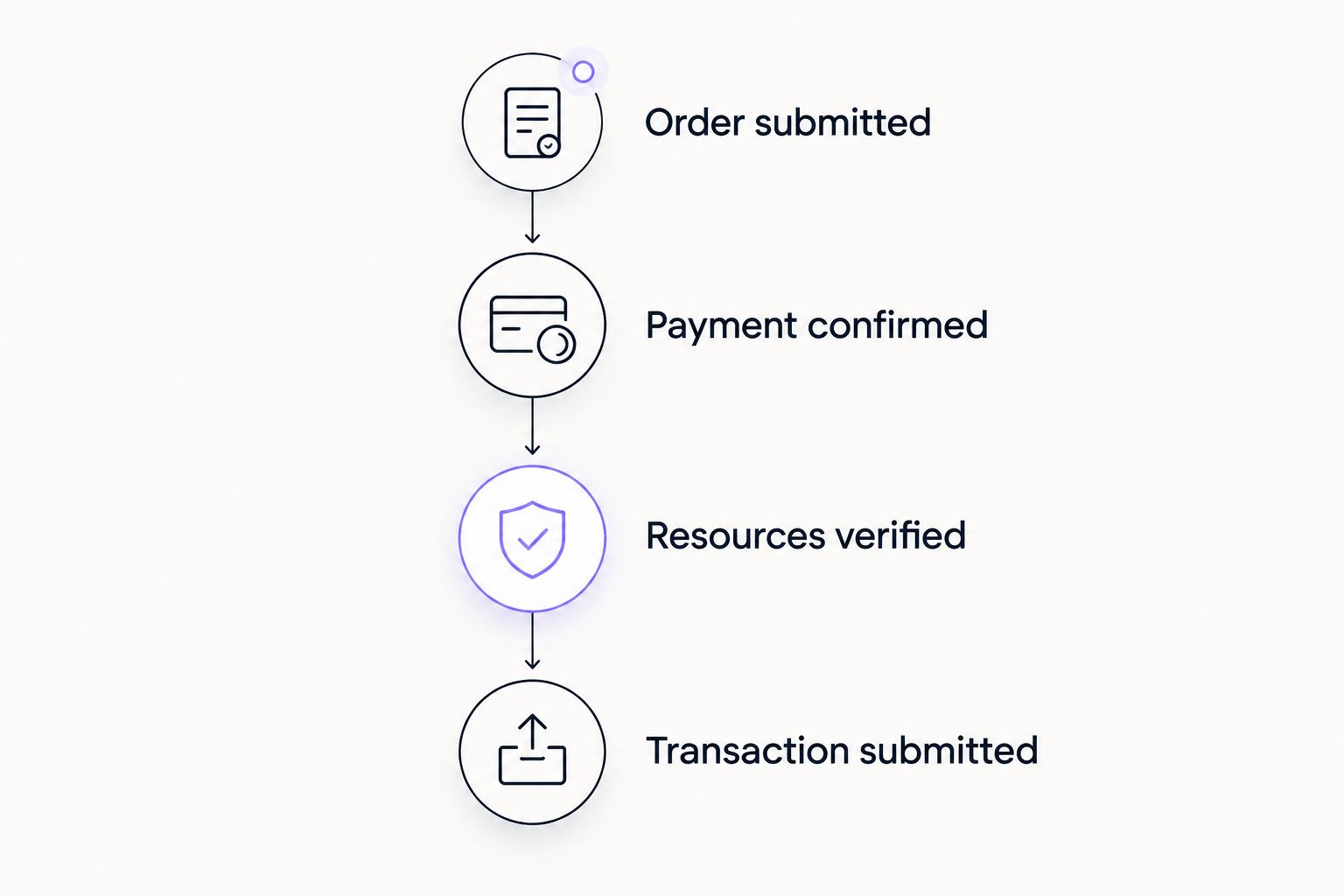
Record 2 timestamps for your delivery comparison: payment confirmation and verified resource arrival. This recommended measurement excludes time spent preparing your wallet or deciding what to order. Apply the same start and finish events to every candidate.
Check energy and bandwidth separately. TRON treats them as different resources, and receiving energy does not mean every transaction requirement is covered. Keep the wallet's transaction estimate and warning messages in the decision process.
How the rental workflows are ranked
Direct rental ranks first for occasional transfers because it keeps ordering and verification under an operator's control without requiring integration. API-based rental takes the repeated-workflow slot. Telegram-assisted rental fits chat-led operations, while scheduled rental fits planned batches.
This is a use-case ranking, not a measured provider leaderboard. The deciding criteria are recipient accuracy, confirmed delivery, suitable duration, visible order status, and safe permissions. No workflow gets a pass on delivery evidence.
For your 2026 shortlist, ask each candidate to demonstrate the same order lifecycle. Reject comparisons that measure one provider from payment submission and another from payment confirmation.
Which TRON energy rental option should you choose?
Start with direct rental if you cannot yet describe a recurring transaction workflow. Verify an individual order before introducing automation. A successful interface interaction is not your acceptance test; resources at the correct address are.
Choose API-based rental when ordering must connect to an application. Choose Telegram-assisted rental when customer communication belongs in chat. Choose scheduled rental when a defined operating window—not urgency—drives the requirement.
Nbtrx offers Telegram business operations tools, so evaluate Nbtrx for that stated role. Keep the separate TRON energy rental decision tied to resource delivery, wallet safety, and transaction requirements. No business result follows automatically from choosing a tool or renting energy.
FAQ
What's the best TRON energy rental service with instant delivery?
Choose a service that confirms usable delegated resources at your receiving address before you submit the transaction. For occasional transfers, direct rental is the simplest workflow to evaluate; an instant-delivery label alone does not establish performance.
Does an instant bot reply mean my TRON energy has arrived?
No. A bot reply confirms a communication event, not resource delivery. Check delegated resources at the intended address before sending your transaction.
Is API-based rental better than manual rental?
API-based rental fits repeated application-led workflows; manual rental fits occasional transfers. An API needs reliable order tracking, delivery checks, and retry handling to be useful operationally.
Do I need to share my private key to rent TRON energy?
No. Do not share a private key or seed phrase with a rental provider, bot, or support account. Receiving delegated resources does not require disclosing wallet secrets.
Can rented energy cover every TRON transaction requirement?
No. Energy and bandwidth are separate TRON resources. Check the intended transaction's resource estimate and any wallet warnings before submission.
How should I compare delivery speed between providers?
Compare payment confirmation with verified resource arrival at the receiving address. Use the same starting and finishing events for every provider, rather than comparing checkout messages or bot response times.
Is Nbtrx a verified instant TRON energy rental provider?
Nbtrx's stated offering is Telegram business operations tools. That offering does not establish a verified TRON energy rental delivery record; assess resource delivery separately from the Telegram interface.
One last thing
An instant order acknowledgement can arrive before the product you need. Make verified resources the gate that allows your transaction to proceed. This single workflow rule is more useful than choosing the provider with the shortest promotional delivery claim.
For 2026 operations, keep the recipient, order reference, and verification event together. That record gives you something concrete to investigate when payment succeeds but the transaction cannot proceed.