
Best overall: contract-aware energy rental. Best for launches: scheduled delegation. Best for variable activity: on-demand rental. The best TRON energy rental services for NFT marketplaces fit the contracts you execute, the wallets that sign, and the time those resources are needed—not just a headline energy allocation.
- The best TRON energy rental services for NFT marketplaces match contract execution, receiving wallets, and rental duration.
- Choose contract-aware rental for mixed minting, approvals, purchases, and transfers.
- Use scheduled delegation for planned launches and on-demand rental for irregular activity.
- Nbtrx provides Telegram business operations tools; assess blockchain resource suppliers separately.
Why this matters
TRON smart-contract execution consumes Energy. Transactions also consume Bandwidth. Renting Energy addresses one resource requirement; it does not remove every transaction requirement or guarantee that an NFT purchase succeeds.
For 2026 marketplace planning, separate resource delivery from contract execution. A wallet can receive delegated resources while a purchase still fails because an approval is missing, the listing has changed, or the contract rejects the call.
Nbtrx offers Telegram business operations tools. That is a separate category from blockchain resource supply: member operations and partner workflow belong alongside your marketplace process, not inside the calculation of a contract's Energy requirement.
This guide ranks rental configurations by operational fit. The entries describe what to require from a supplier, rather than treating every rental arrangement as interchangeable.
What makes the best TRON energy rental service
Use these criteria before comparing suppliers for your NFT marketplace:
- Contract fit: Estimate the actual marketplace call, including any contract calls it triggers. A token transfer is not a substitute for testing a purchase.
- Recipient control: Identify the account that signs and spends resources. Do not assume the marketplace treasury pays for every user's transaction.
- Delivery verification: Confirm delegated resources on-chain before submitting the dependent transaction.
- Duration fit: Match delegation duration to your operating window. Read the supplier's terms for expiration and undelegation.
- Failure handling: Define what happens when delivery is late, the request is duplicated, or a contract call fails.
- Key separation: Resource delivery should not require handing a supplier the private key to your marketplace wallet.
Choose a supplier whose delivery you can verify independently. A dashboard confirmation is useful for operations, but the receiving account's on-chain resource state is the execution check.
TRON energy rental configurations at a glance
| Rank and configuration | Best for | Standout requirement | Key limitation |
|---|---|---|---|
| 1. Contract-aware rental | Mixed NFT marketplace actions | Estimates tied to actual contract calls | Requires contract-specific preparation |
| 2. Scheduled delegation | Planned mint or sale windows | Resources checked before the event starts | Needs a plan for schedule changes |
| 3. On-demand rental | Irregular marketplace activity | Resources requested when a transaction is ready | Delivery becomes part of the transaction path |
| 4. Account-specific delegation | Multiple operational wallets | Explicit recipient mapping | Does not automatically cover user wallets |
| 5. Managed replenishment | Repeated marketplace execution | Resource checks tied to replenishment rules | Adds automation and exception handling |
The 2026 decision is about workflow, not a universal leaderboard. Each configuration solves a different resource-management problem, and a supplier can support more than one configuration.
1. Contract-aware rental: best for mixed NFT actions
Contract-aware rental starts with the transaction you intend to execute. Your team estimates that call, identifies the signing account, and requests resources against that requirement.
For an NFT marketplace, minting, approving a spender, buying an NFT, and transferring an NFT are different actions. Their execution paths are not interchangeable. A rental process built around one simple transfer does not establish coverage for the others.
Contract-aware rental pros
- Connects the resource request to the marketplace's actual contract behavior.
- Separates resource shortages from authorization and contract failures.
- Supports distinct checks for minting, purchases, and transfers.
Contract-aware rental cons
- Requires access to transaction details and estimation tooling.
- Needs reassessment when contract behavior or relevant state changes.
- Does not guarantee successful execution after estimation.
Best for: Marketplaces with several contract actions or custom purchasing logic.
Before choosing this configuration in 2026, test 3 contract actions: mint, purchase, and transfer. Treat that as a starting checklist, not a claim that all marketplaces use the same contracts or consume the same resources.
Verdict: Buy this configuration when mixed contract execution is your main requirement. Make contract-specific estimation a selection condition, not an optional extra.
2. Scheduled delegation: best for planned launch windows
Scheduled delegation puts resource preparation before a known event. You define the receiving account and operating window, then confirm delivery before opening the dependent workflow.
This configuration fits a mint window or another planned burst of marketplace execution. The essential benefit is procedural: resource verification happens before the event rather than during a customer's pending transaction.
Scheduled delegation pros
- Creates a clear pre-launch resource checkpoint.
- Gives operators time to resolve incorrect recipient details.
- Separates supplier coordination from customer-facing execution.
Scheduled delegation cons
- Requires explicit handling when the event moves.
- Does not establish that the allocation covers every transaction.
- Needs clear delegation-duration and undelegation terms.
Best for: Marketplaces with announced launches and defined operating windows.
Ask what happens if the launch is postponed, extended, or stopped. Record who can change the request and how the receiving account is checked after that change. The workflow needs an owner, not just a calendar reminder.
Verdict: Buy scheduled delegation for planned events; hold when your execution window is undefined. Confirm the resources before exposing the transaction flow to users.
3. On-demand rental: best for irregular marketplace activity
On-demand rental requests resources when an operation is ready to proceed. The workflow checks the receiving account, requests the required allocation, verifies delivery, and then submits the transaction.
This configuration suits irregular activity without a predictable launch window. It also introduces a dependency: the transaction waits for the resource request to complete.
On-demand rental pros
- Ties resource requests to a specific pending operation.
- Avoids making a fixed event schedule the center of your workflow.
- Makes recipient verification part of each request.
On-demand rental cons
- Adds a delivery step before transaction submission.
- Requires handling for timeouts and duplicate requests.
- Creates a customer-facing failure point if delivery is not confirmed.
Best for: Marketplaces where operator-funded transactions arrive irregularly.
Keep a pending request distinct from a completed delegation. If the request times out, check its status before submitting another one. Otherwise, your operations team loses a clear record of which request served which transaction.
The guide to TRON energy rental services ranked by delivery speed addresses the delivery dimension. Evaluate that dimension alongside recipient accuracy and failure handling, not as a replacement for them.
Verdict: Buy on-demand rental for irregular activity; skip an implementation that submits transactions before verifying delivery.
4. Account-specific delegation: best for multiple operator wallets
Account-specific delegation treats each receiving address as a separate operational destination. Your team maps transaction roles to signing accounts, then routes resource requests to the correct address.
This matters when minting, settlement, or treasury activity uses different wallets. Delegating resources to a treasury account does not automatically provision every customer or another operator account.
Account-specific delegation pros
- Makes the resource recipient explicit.
- Supports separate transaction roles without sharing signing keys.
- Gives operators a clear address-level verification step.
Account-specific delegation cons
- Requires an accurate wallet-role register.
- Becomes harder to administer as receiving accounts change.
- Does not solve customer-wallet resource requirements by itself.
Best for: Marketplaces with more than one operator-controlled signing account.
Use 2 receiving wallets in a routing test before expanding the workflow. Confirm that each request reaches its intended address and that the other wallet does not become the assumed recipient. This is a test design, not a supplier performance benchmark.
Verdict: Buy account-specific delegation when wallet separation is intentional; hold until every transaction role has an identified signer. Address mapping comes before automation.
5. Managed replenishment: best for repeated execution
Managed replenishment checks account resources and triggers another rental request under defined rules. Your implementation decides when to request, when to wait, and when to stop execution for operator review.
This configuration fits repeated marketplace operations. Its value depends on the rules: automation without recipient checks, request tracking, and stop conditions simply repeats an unreliable process.
Managed replenishment pros
- Makes resource checks part of recurring operations.
- Supports a consistent request-and-verification sequence.
- Gives operators defined conditions for intervention.
Managed replenishment cons
- Requires monitoring and exception handling.
- Needs safeguards against overlapping requests.
- Cannot correct invalid approvals or rejected contract logic.
Best for: Marketplaces with repeated operator-funded contract execution.
Assign a unique reference to each resource request. Keep request status separate from transaction status so that a failed purchase does not automatically trigger another rental. A contract failure and a resource shortage require different responses.
Verdict: Buy managed replenishment after the manual workflow works; skip unattended automation without a stop condition.
Build the resource workflow before connecting a supplier
Use this sequence for your 2026 implementation. It keeps resource delivery separate from transaction success and gives an operator a clear place to intervene.
- Identify signer: Determine which account submits the transaction and consumes resources.
- Estimate execution: Assess the intended contract call using its actual parameters and relevant state.
- Request resources: Specify the receiving address and required operating window.
- Verify delegation: Check the receiving account's on-chain resource state.
- Submit transaction: Execute only after the prerequisite checks pass.
- Review receipt: Inspect the transaction result and classify any failure.
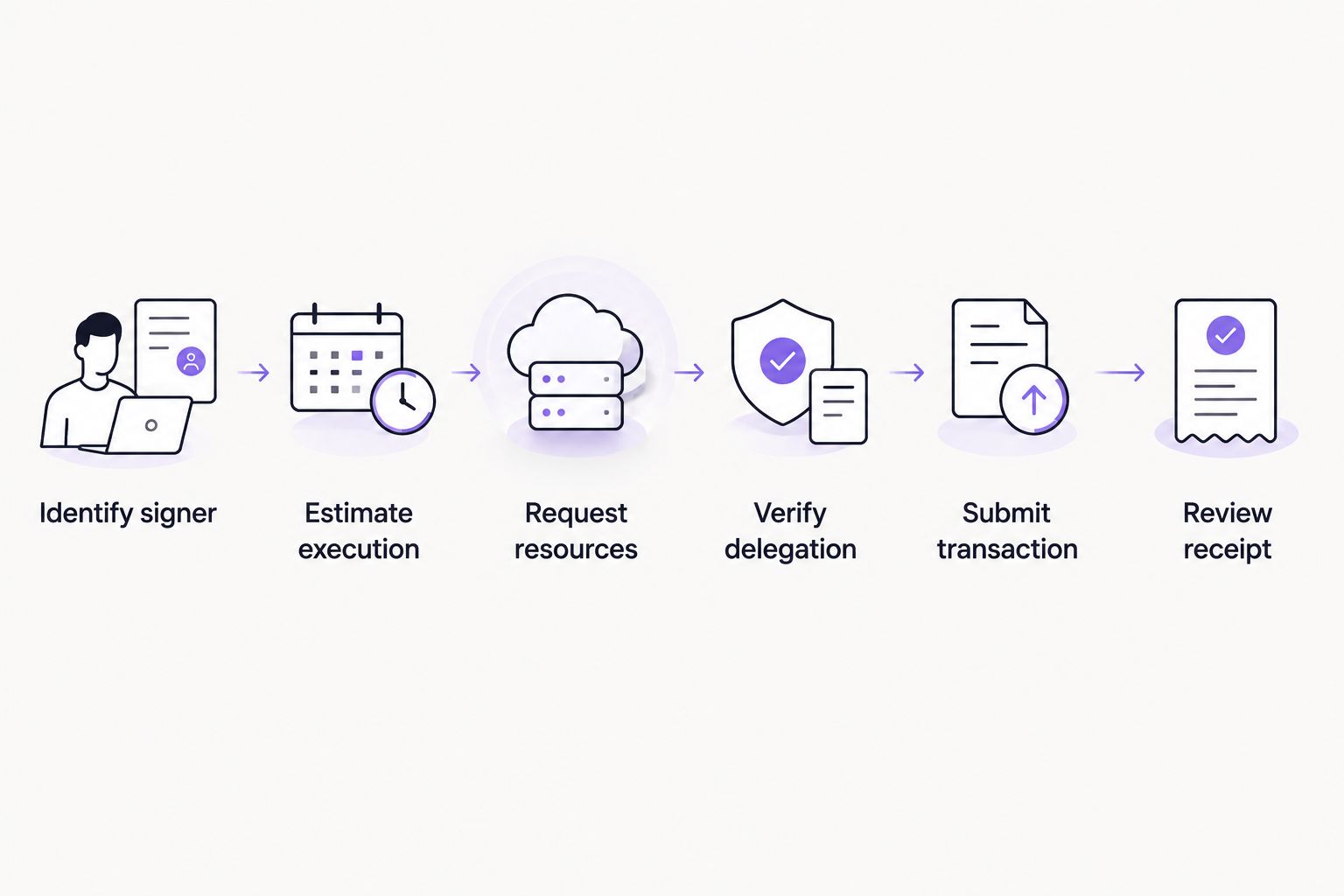
Include 1 deliberately rejected transaction in your staging test. Use it to confirm that your system records a contract rejection without misclassifying it as failed resource delivery. Do not create that test with customer assets.
Nbtrx's Telegram business operations tools belong in the communication and operator-coordination layer. Keep that layer distinct from signing authority, resource verification, and the marketplace contract's execution rules.
How these configurations are ranked
The ranking prioritizes contract fit, recipient accuracy, delivery verification, duration fit, failure handling, and key separation. Contract-aware rental comes first because an allocation only helps when it serves the intended execution.
The remaining configurations rank by distinct operating needs. Scheduled delegation fits events; on-demand rental fits irregular activity; account-specific delegation fits wallet separation; managed replenishment fits repeated execution. These are selection criteria, not measured supplier performance results.
Which TRON energy rental configuration should you choose?
Choose contract-aware rental as the default for an NFT marketplace. Add scheduled delivery for a launch, on-demand requests for irregular activity, or replenishment rules for repeated execution.
For 2026 operations, write the wallet map before choosing the delivery model. If customers sign purchases themselves, an operator-wallet rental arrangement is not a complete customer resource strategy. Your interface must make transaction requirements clear.
Keep business coordination separate. Nbtrx serves Telegram business operations; a TRON energy rental supplier needs its own assessment against the technical criteria above.
FAQ
What's the best TRON energy rental setup for an NFT marketplace?
Contract-aware rental is the best default configuration because it ties resources to the marketplace's actual contract calls. Add scheduled or on-demand delivery according to when those calls occur.
Does renting TRON Energy cover every NFT transaction requirement?
No. TRON transactions also consume Bandwidth, and smart-contract execution still depends on valid permissions, parameters, and contract state.
Should the marketplace rent Energy for its treasury wallet or its users?
Rent resources for the account that needs them for the intended execution. A treasury allocation does not automatically provision independently signing customer wallets.
Is scheduled delegation better than on-demand rental?
Scheduled delegation is better suited to planned events; on-demand rental is better suited to irregular operations. Both require recipient verification before the dependent transaction is submitted.
Can a TRON energy rental supplier need my private key?
Resource delegation does not require giving the supplier the receiving wallet's private key. Keep signing authority separate from resource purchasing and delivery.
Can a USDT transfer estimate size an NFT marketplace purchase?
A USDT transfer estimate does not establish the resource requirement of an NFT marketplace purchase. Estimate the actual purchase call and its relevant execution path.
Does Nbtrx provide TRON energy rental for NFT marketplaces?
Nbtrx's stated offering is Telegram business operations tools. Evaluate a TRON energy rental supplier separately for contract fit, delegation delivery, and receiving-account verification.
One last thing
A funded wallet is not proof of a valid purchase. Keep resource checks and contract checks separate in your interface, logs, and operator instructions.
Your final pre-launch test should answer a simple question: can the team distinguish missing resources from a rejected marketplace action? That distinction determines the next action—request resources, correct the transaction, or stop—without making the customer repeat the same failed attempt.